 How to resolve AdBlock issue?
News
SONOMA COUNTY – A Sonoma County family died and several others were injured when a local teenager allegedly ran a red light late Saturday, setting off a four-car collision.
The crash occurred at 9:21 p.m. Saturday on eastbound Highway 37 at Reclamation Road in Sonoma County, according to California Highway Patrol Officer Scott Cakebread.
The CHP would not release the names of the fatalities or the driver of the car that hit them to Lake County News, although Bay Area media reported receiving the names from the agency.
The family that died included 45-year-old John Maloney and his wife Susan, 42, of Sonoma and their children Aiden, 8, and Grace, 5.
The man who hit them was identified as Steven Culbertson, 19, of Lakeport.
Conflicting reports were being given about the status of Culbertson, who Cakebread said was transported by helicopter to Santa Rosa Memorial Hospital.
While some media were reporting Culbertson died Sunday, on Sunday evening Santa Rosa Memorial spokesperson Katy Hillenmeyer said Culbertson was in critical condition. Lake County News could not reach Culbertson's family late Sunday.
Culbertson allegedly was driving a silver Mini Cooper at speeds of more than 90 miles per hour when he ran a red light and hit a Honda CR-V driven by Thomas Graham, 61, of Petaluma, the CHP reported.
The Mini Cooper then hit the Nissan Quest mini van driven by the Maloney family, the CHP said. The Quest then hit a Mitsubishi Galant driven by Carrie Rodriguez, 52, of Novato.
All of the members of the Maloney family were pronounced dead at the scene, Cakebread said.
Rodriguez and her passengers – Liberty Rosario, 42, of Fairfield and Adelaida Nicholas, 53, of Novato – were transported to area hospitals with minor injuries, according to the CHP. Graham and his passenger, James Parker of Stockton, were uninjured.
The CHP said the eastbound lane of Highway 37 was shut down just after 10 p.m. Saturday. At 11:25 p.m. the both directions of Highway 101 to Highway 27 were closed, as were Atherton Avenue to Highway 37 and the stretch of Highway 37 between Highway 131 and Lakeville.
The roadways remained closed until 7:30 a.m. Sunday as the investigation took place. Lakeville Road was shut completely, with travelers urged to take an alternate route. The vehicles involved in the crash were cleared from the scene at around 7 a.m., according to the CHP.
The CHP reported that several vehicles had gone through the closure at high speeds early in the morning.
Caltrans and the Sonoma County Coroner were called to the scene, according to the CHP report. A Caltrans boom truck was requested to assist the CHP with taking aerial photos of the crash scene.
Cakebread said the CHP's Major Accident Investigation Team (MAIT) – which is called out to investigate collisions where two or more deaths are involved – was working on the crash Sunday.
The social networking site Facebook provided information about some of those involved in the crash.
Culbertson's Facebook page said he was a 2008 graduate of Clear Lake High School, with aspirations of being a professional driver and mechanic. It also featured pictures of him driving on race course.
John Maloney's page featured pictures of him, his wife and his young children. While his profile was open to the public, his wife's was not.
He was a 1986 graduate of the University of Georgia, where he received a bachelor's degree in journalist before going on to receive a master's degree in humanities from Dominican University in San Rafael.
Maloney worked at SolarCraft, a solar services company with offices in Novato and Sonoma. SolarCraft's Web site listed Maloney as the company's vice president of sales and marketing, and noted that he had three children.
He noted in an August message to a friend on Facebook that his older daughter, Molly, was heading off to the University of Wisconsin this fall.
Friends left messages on the Facebook page over the weekend in remembrance of the family.
“John and Susan, Aiden and Grace. We all love you and miss you terribly. No words can convey the sorrow we feel at your loss. RIP 11/28/1009,” wrote Ben Delaney.
“Dearest Maloney Family - My heart breaks at the loss your friends and family are feeling right now ... My best wishes go out to them, and perhaps some peace can come from them knowing that you are and always will be together. Much ♥,” Shannon Greene wrote hours after the fatal crash.
E-mail Elizabeth Larson at
THE US GEOLOGICAL SURVEY HAS DOWNGRADED THIS QUAKE FROM 3.0 TO 2.9 IN MAGNITUDE.
THE GEYSERS – The Geysers area experienced a moderate on Saturday evening.
The quake, first reported to be 3.0 in magnitude but later downgraded to 2.9, occurred at a depth of 1.4 miles at 9:08 p.m. Saturday, according to the US Geological Survey.
The agency reported that the earthquake's epicenter was located two miles northwest of The Geysers, six miles west of Cobb and eight miles west northwest of Anderson Springs.
Five shake reports were submitted to the US Geological Survey – three from Cloverdale, one from Kelseyville and one from The Dalles, Oregon – approximately 759 miles away.
The Geysers area experienced a 3.7-magnitude earthquake on Nov. 24, as Lake County News has reported.
E-mail Elizabeth Larson at
The Mendocino County Sheriff's Office reported that a 911 telephone call came into the sheriff's dispatch center just after 9 a.m. Sunday reporting that a shooting had occurred in the Chicken Ridge subdivision east of Covelo.
Sheriffs deputies were dispatched to the location where they met up with Covelo Fire Personnel and learned the victim had been shot during a possible home invasion robbery over marijuana, according to the report from Capt. Kurt Smallcomb.
Smallcomb said the victim received serious injuries from the gunshots and was subsequently airlifted to an out of town hospital for major gunshot wounds.
He said deputies learned that at least three suspects had fled the location in a vehicle. The deputies had communication officers radio broadcast a "be on the lookout bulletin" to neighboring law enforcement entities regarding the description of the suspect vehicle.
Just after 10 a.m. Willits Police officers observed the described suspect vehicle and conducted a traffic stop on the vehicle, at which point one of the suspects fled on foot, Smallcomb said.
The two other suspects were being detained and questioned by law enforcement at the time of Smallcomb's report, which was issued Sunday afternoon.
Sheriff's deputies, Willits Police officers and California Highway Patrol officers were continuing the search for the third suspect who fled the car stop on Sunday, Smallcomb said.
He said Mendocino County Sheriff's detectives were conducting an investigation and following up on leads in regards to the incident.
Anyone with information as to the suspects responsible in this case are encouraged to contact the Mendocino County Sheriff's investigative tip line at 707-467-9159.
Follow Lake County News on Twitter at http://twitter.com/LakeCoNews and on Facebook at http://www.facebook.com/pages/Lake-County-News/143156775604?ref=mf .
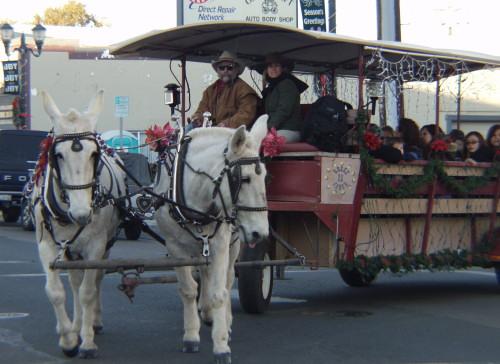
LAKEPORT – Visitors and residents alike came out on Saturday to enjoy the sights and sounds of an old-fashioned Christmas in downtown Lakeport.
The seventh annual Dickens' Christmas Market, cosponsored by the Lake County Chamber of Commerce and the Lakeport Main Street Association, lined several blocks of Main Street in the heart of town on Saturday.
The day saw clear skies overhead accompanied by a brisk wind. Melissa Fulton, the chamber's chief executive officer – outfitted in period costume – said the morning had started out perfectly still before the winds came up. The winds posed some challenges for vendors in tents.
Fulton said the day s good saw good attendance at the event.
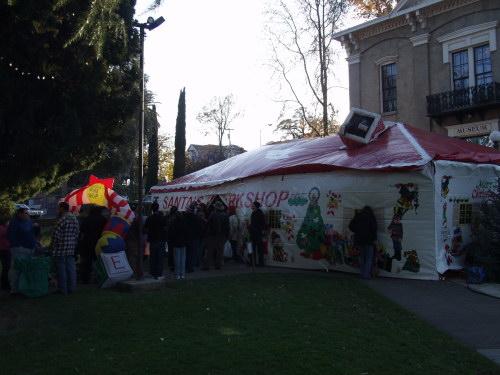
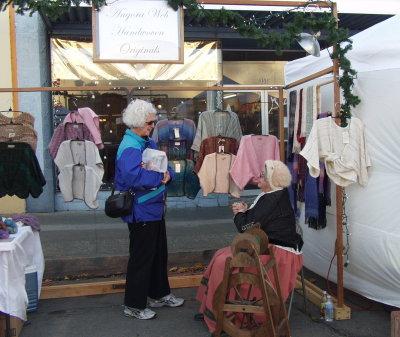
There was music, numerous vendors with interesting offerings, fun for children, a mule-drawn wagon that carried visitors along as it wound its way through town, and plenty of canine visitors, some wearing wreaths and Santa hats.
In addition, there was caroling and even a costume contest. Many folks strolled through the fair in authentic period costumes.
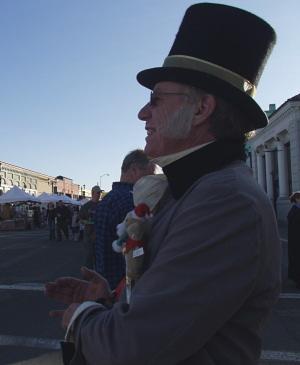
Bert Hutt, artistic director of the Soper-Reese Community Theatre, once again this year donned his best Victorian garb. With his top hat, cane and overcoat, Hutt looked like he just stepped out of the pages of “Great Expectations” or “A Christmas Carol.”
The annual event kicks off the Christmas season at the north end of the lake. As part of the celebration, the day ended with a lighted parade and lighting of the Christmas tree in the courthouse square.
E-mail Elizabeth Larson at

Randy: “Dawg! It was pitchy, off key at points … nawh.”
Paula: “You’re unique. You are special and unique.”
Simon: “Absolutely horrendous! Do you realize that you’re singing out of your nose?”
Kara: “Can I please talk?”
What’s the point I’m trying to make? It’s this: Shallots are the Bob Dylan of onions. They are special and unique, but they have been replaced by the pretty, perfect-bodied babes. (Growling and shaking my fists: “Lambert!”)
I love shallots and have been growing them in my garden for years. It’s a shame that the food television shows don’t know more about them. I think the networks also put too much into the practice of having excessively pretty people hosting their shows than people who actually know a lot about food, but that’s what our society has become.
One of the biggest problems in food television is that much of it is written by people who don’t know the actual produce and products they use. They’re often written and produced by big city people who are getting their information from the Internet, and one of the things I teach in almost every class I do is that the Internet can be your worst enemy.
Take shallots for instance: I was watching a pretty girl’s cooking program and she said that she liked to use shallots in the recipe since they are milder flavored than onions. I start screaming at the TV, “That’s not a shallot, you dingbat, that’s a potato onion, a false shallot! They’re harsh tasting and taste nothing like a shallot, so you obviously have never tasted a real shallot in your life!”
I’m not embarrassed to admit this, I really do yell at my TV in times like this. I had to stop watching Emeril the day my daughter said, “Daddy why do you watch him, you just end up yelling at the TV?”
The pretty TV chef goes on to talk about shallots’ superior flavor, and I realize that she’s just spouting information that one of her little interns or flying monkeys picked up off the Internet and shoved into the teleprompter. The pretty TV chef was only there because she is a pretty face and interacts well with a camera, not because she’s someone who actually knows what she was cooking with.
It is very common to find imposters being used as shallots. False shallots, potato onions and even using young red onions as shallots is pretty usual. Even the “shallots” you find at the local grocery stores are actually potato onions. Imposters are almost always larger than true shallots since true shallots are typically only a tablespoon to a quarter cup in size. Traditional gardening habits use the largest bulbs in the kitchen and then replant the smallest for next year. I do the exact opposite, and due to this “selective breeding” my shallots are larger than most, some of my shallots being a half of a cup in volume. Imposters are also easier to work with, having thin, easy to remove skins, while the skin on true shallots is like armor plating.
While false shallots must be used within a couple of months, true shallots, if stored in a cool dry place, can be stored up to a year.
In my opinion shallot imposters have become popular because they grow faster and larger than true shallot varieties. False shallots can take as little as three months from planting to harvest.
I planted my shallots a month ago and they are just now starting to sprout. Green tops looking like chives will start to grow and can be used sparingly like chives. The bulbs will start to look like a head of garlic, but then each bulb will separate from the mother and grow green tops.
The bunch of bulbs will start to spread out and look like they are pushing themselves out of the ground. Each bulb will grow larger. Then up to eight months from now the tops will die off and turn brown and that will let me know they are ready for harvest.
This long growing time is one of the reasons that, while imposters sell for dollars per pound, true shallots sell for dollars per ounce. It is often said of true shallots that their flavor is milder than onions but that isn’t really true.
The true shallot's flavor is strong and complex but it dissipates faster than onions and you don’t have that lingering onion taste in your mouth for hours. Its aroma contains hints of garlic, lemon, chives and earth. The texture of cooked true shallots is much softer than that of cooked onions. It is also best to avoid browning shallots since this turns them bitter.
If I were the head of a cooking school of my own, or were Emperor of the planet, I would require all chefs to spend two weeks per year working on a farm. Most of the truly great chefs either own a farm or have a close relationship with a farmer.
When I worked on an oyster farm there was a program that had restaurant workers spend a week working on the farm. Later there were fewer complaints from those restaurants because they knew their product better and didn’t jump to conclusions. Cooks who really know and understand their ingredients are the best of the best.
The shallot’s history is muddled at best. Their first mention is around 300 BCE when Theophrastus, “the father of botany,” wrote of the “askolonion.” Where this word originates is unknown, but we know both the words shallot and scallion originate from it.
Centuries later, Pliny the Elder concluded that they were named after the city of Ashkelon in southern Israel. Although the city of Ashkelon did exist in Theophrastus’ time, no evidence supports this correlation.
Some sources say shallots originated in China 2,000 years ago and still others claim Southeast Asia. Whatever its origin, they became very popular in French, Flemish, Mediterranean and Thai cuisines. The Crusaders brought the shallot to Europe in the 12th century from the Middle East.
I think the problem is that I’m being pedantic (I usually am), while the rest of the world is falling into the marketing ploy to merge all multiplier onions under the heading of shallots. Even the Web site named after the shallot has only has one picture of a true (grey) shallot on it. They market a variety of shallot grown from seeds even though shallots don’t make seeds.
There is an unwitting movement to have the word shallot include Allium oschaninii and Allium cepa var. aggegatum, which are the most common imposter shallots. I say unwittingly because it’s not a vast right wing conspiracy as much as it’s just that people have read the information online and repeated it not knowing that the information is incorrect.
Just like the word “forte” is correctly pronounced “fort,” but through years of people mispronouncing it as “for-TAY” the dictionary itself has now changed to reflect the incorrect pronunciation. You can actually compare an older dictionary to a newer one and see the change. Shallots are going through the same process. The Bob Dylan shallots are being overshadowed by the Adam Lambert shallots.
Shallots are high in flavanoids, a type of antioxidant that protects the body against cancer, diabetes and heart disease. Shallots are low in carbohydrates, cholesterol, saturated fat, and sodium. They are also high in folate, manganese, potassium, and vitamins A, B6 and C.
True shallots are available to grow in your garden but using false shallots in your cooking is acceptable as long as you understand that the flavor and texture will be different. I use the shallots from the grocery store any time I’m out of my own shallots.
In an amusing twist the recipe I’ve included goes fantastic with steaks. It’s a Bercy style sauce but not a true Bercy sauce. So I do get a giggle while making a false Bercy sauce with my false shallots. I know, I’m being pedantic again.
Just for the record, I love Adam Lambert’s music and wanted him to win American Idol. It was just funnier using him in this context than someone more obvious. And you have to admit, he sure is pretty.
Bercy sauce for steaks
2 to 3 shallots, finely diced
3 tablespoons unsalted butter, divided
1 cup dry white wine
3 cups beef stock
2 tablespoons demi-glace (optional)
1 tablespoon lemon juice
3 tablespoons chopped parsley
Salt
Pepper
After cooking your steak, set it aside to let it rest. Add 1 tablespoon butter to the pan the steak was cooked in and add shallots. Sauté until tender, just a couple of minutes, then add white wine. Scrape the fond from the steak off the bottom of the pan and simmer over medium heat until mixture is reduced to just a couple of tablespoons. Add stock, demi-glace and lemon juice.
Bring back to a simmer over medium heat and reduce again to one cup. Remove from heat, and finish the sauce by whisking in the remaining butter and the parsley. Salt and pepper to taste, but be sure to taste first since reducing the stock may have increased the saltiness.
Ross A. Christensen is an award-winning gardener and gourmet cook. He is the author of "Sushi A to Z, The Ultimate Guide" and is currently working on a new book. He has been a public speaker for many years and enjoys being involved in the community. Follow him on Twitter, http://twitter.com/Foodiefreak .
The crash occurred at around 11 a.m. Saturday at Crazy Creek Air Adventures in Middletown, according to Federal Aviation Administration spokesperson Laura Brown.
Brown said the crash involved a Schleicher ASW 27 glider and a Piper PA 25 tow plane.
“They were on approach to the same runway,” but coming from different directions when the glider and plane collided, said Brown.
Brown did not know if the aircraft hit head-on, a determination that she said is part of the investigation.
The glider pilot was killed, as was the plane's pilot, said Brown. There were no other passengers aboard the plane.
The identities of the pilots were not released late Saturday.
Jim Indrebo, who owns Crazy Creek Air Adventures, confirmed to Lake County News late Saturday that the crash had occurred.
“I can't say much about it,” he said, adding that he may be able to make a statement following the completion of the investigation.
Federal Aviation Administration and National Transportation Safety Board investigators were at the scene of the gliderport, located on Grange Road near Middletown, Saturday evening, Indrebo said.
Brown said the NTSB and FAA will issue a preliminary report on the crash within a few weeks.
The FAA investigates every aviation collision case, Brown said. However, it will be up to the NTSB to decide the incident's probable cause and decide if more investigation – leading to a final report in a few months' time – is warranted, she explained.
The NTSB could not be contacted late Saturday.
However, the agency's Web site explained that it deploys a safety board “go team” – led by a senior investigator – to respond to major incidents.
The NTSB reported that its go team can number from three to more than a dozen specialists ready to be deployed around the clock from the safety board's Washington, DC office.
On an annual basis, the NTSB investigates about 2,000 aviation collisions, according to its Web site.
Among the crashes it investigates annually, Brown said the FAA doesn't see many involving gliders, estimating they account for only “a handful a year.”
Schleichers are one-seat, high-performance gliders, designed with competitions pilots in mind, according to the company Web site. The gliders have a 49-foot wingspan.
Piper PA 25s, which have reportedly become widely popular among glider enthusiasts for use as tow planes, were manufactured for crop dusting from the 1950s through early 1980s. They are ones-seat planes, with a 36-foot wingspan, according to the Virtual Aircraft Museum.
E-mail Elizabeth Larson at