How to resolve AdBlock issue?
Refresh this page
How to resolve AdBlock issue?
Refresh this page
Lake County News,California
  • Home
    • Registration Form
  • News
    • Education
    • Veterans
    • Community
      • Obituaries
      • Letters
      • Commentary
    • Police Logs
    • Business
    • Recreation
    • Health
    • Religion
    • Legals
    • Arts & Life
    • Regional
  • Calendar
  • Contact us
    • FAQs
    • Phones, E-Mail
    • Subscribe
  • Advertise Here
  • Login

News

California seizes illegal cannabis products worth $61 million since start of 2024


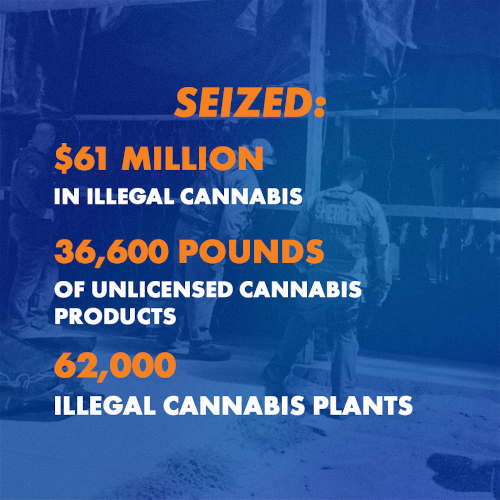
As California continues to support the legal and regulated cannabis market, on Tuesday Gov. Gavin Newsom announced state law enforcement operations that resulted in the seizure of over $61 million in illegal cannabis in the first four months of this calendar year — including 62,135 unlicensed cannabis plants and 36,619 pounds of unlicensed cannabis products.

“While we watch California’s legal cannabis market grow to become the largest worldwide, we are taking down those who operate outside the law,” Newsom said in a statement. “Putting a stop to illegal cannabis operations also means stopping organized crime, human trafficking, and the spread of illegal products that harm the health of Californians and our environment.”

Operations from Jan. 1 through April 30, 2024, through the Governor’s Unified Cannabis Enforcement Taskforce, were conducted in the counties of Alameda, Fresno, Humboldt, Kern, Los Angeles, Riverside, San Joaquin, Trinity, and Orange.

Enforcement highlights include:

• $61,467,088 million in illegal cannabis seized and destroyed.
• 36,619 pounds of unlicensed cannabis seized and destroyed.
• 62,135 unlicensed cannabis plants eradicated.
• 11 firearms seized.
• Five arrests.

Since its inception in 2022, the task force has seized $406,359,957 in unlicensed cannabis through 256 search warrants. The taskforce has also eradicated 409,656 plants and seized 139 firearms.

State agencies and departments participating in these taskforce operations include Department of Cannabis Control, Department of Fish and Wildlife, California National Guard, Department of Tax and Fee Administration, and State Water Resources Control Board Division of Water Rights. In addition, multiple federal and local partners assisted with enforcement operations.

The Unified Cannabis Enforcement Taskforce has been charged by the Governor to further align state efforts and increase cannabis enforcement coordination between state, local, and federal partners.

Newsom’s office said the enforcement actions protect consumer and public safety, safeguard the environment, and deprive illegal cannabis operators and transnational criminal organizations of illicit revenue that harms consumers and undercuts the regulated cannabis market in California.

Beyond the actions of the task force, Gov. Newsom has enacted policies and funding to support legal, regulated cannabis throughout the state.

The governor signed several pieces of legislation to erase past cannabis convictions, combat discrimination against off-the-job cannabis use, ensure statewide access to medicinal cannabis, and pave the way for California to join with other states to build legal interstate cannabis markets that work for everyone.

Previously, the administration enacted a budget that delivered historic tax relief for legal cannabis operators — particularly equity operators — while protecting other vital public investments that cannabis legalization has allowed us to fund.

To learn more about the legal California cannabis market, state licenses, and laws, visit https://cannabis.ca.gov/.

Clearlake City Council to consider surplus property sale, new community development job

CLEARLAKE, Calif. — The Clearlake City Council this week will consider selling a city-owned property and creating a new job in the Community Development Department.

The council will meet at 6 p.m. Thursday, May 16, in the council chambers at Clearlake City Hall, 14050 Olympic Drive.

The agenda can be found here.

The meeting will be broadcast live on the city's YouTube channel or the Lake County PEGTV YouTube Channel.

Community members also can participate via Zoom. The webinar ID is 821 8021 0243, the pass code is 273644. One tap mobile is available at +16694449171,,82180210243#, or join by phone at 669-444-9171 or 253-205-0468.

On the agenda is the presentation of adoptable dogs and a proclamation declaring May 18 to 24 as Safe Boating Week.

Under business, the council will discuss and consider approving the sale of a surplus city-owned property at 14709 Palmer Ave.

The city also will consider the classification and salary range for a community development specialist.

The staff report from Administrative Services Director/City Clerk Melissa Swanson said that the specialist “would be a vital support role within the Community Development Department, tasked with a variety of high level building and planning secretarial and clerical duties to assist the professional staff and the public.”

Swanson said key responsibilities of this new position will include clerical and technical support, public interaction, permit processing, record keeping, presentation preparation and financial management.

“This role not only enhances the operational efficiency of the Building and Planning Department but also fosters the city’s engagement with its citizens and its commitment to sustainable growth,” Swanson said.

On the meeting's consent agenda — items that are considered routine in nature and usually adopted on a single vote — are adoption of the fourth amendment to the fiscal year 2023-24 budget (Resolution 2023-27) adjusting appropriations; warrants, minutes of the April 17 Lake County Vector Control District Board meeting; and continuation of the recommended action: receive and file.

Following the open portion of the meeting, the council will go into closed session to discuss labor negotiations and a case of anticipated litigation.

Email Elizabeth Larson at This email address is being protected from spambots. You need JavaScript enabled to view it.. Follow her on Twitter, @ERLarson, or Lake County News, @LakeCoNews.

Mendocino and Lake counties proclaim May as Community Action Month

NORTH COAST, Calif. — On Tuesday, May 7, the Lake County Board of Supervisors of the Mendocino County Board of Supervisors each delivered proclamations in recognition of May as Community Action Month and honoring the 60th Anniversary of Community Action in America.

Staff and board members of North Coast Opportunities Inc., or NCO, Lake and Mendocino counties’ local community action agency, were on hand at both events to receive the proclamation.

Since its creation in 1964, Community Action has responded to local needs in every corner of America and helped make America a better place to live.

During this time, the nation’s Community Action Network has inspired a spirit of hope, helped people change their lives and improved communities.

When national, state, tribal, and local leaders partner with Community Action Agencies, workable solutions are created that connect more families to opportunity — and make America a better place to live for everyone.

“(Community Action) did begin with the war on poverty but more than that, I want to say that it is the belief that we can make a difference (in regards) to poverty,” NCO Board of Directors member Pastor Shannon Kimbell-Auth said. “It is the belief that we can make a difference in generational poverty. It is the belief that we, collectively, if we do this work, and we live this commitment, we will make lives better for all, not just some, but all the women and children and men of America. And when we do this work, we are the solution.”

NCO envisions healthy and safe communities with equitable opportunities for all and works to empower people to transform their lives by providing vital services and acting as a community leader to build economic justice and well-being.

The agency serves community members through over 25 programs that range from childcare to workforce development, food access to emergency preparedness and more.

“Thank you, to NCO … (for) the commitment that you have to our community and the impacts that you are making to our community,” County of Lake Board of Supervisors Chair Bruno Sabatier said. “You are involved in just about everything that I can think of, and I couldn’t appreciate it more, thank you for your … service.”

The Community Action vision remains clear — they believe in a nation that creates opportunities for all people to thrive, builds strong, resilient communities, and ensures a more equitable society.

“For 56 years, NCO has been committed to sustaining an equitable and just community by listening and responding to community needs,” said Patty Bruder, NCO’s CEO. “We are energized to continue our work into the future.”

And, there is still work to be done. Nearly 40 million Americans continue to live in poverty, and more are only one missed paycheck away from hardship.

However, Americans in poverty no longer face hardship alone. Today, 99% of counties in America have access to life changing services that create pathways to opportunity and prosperity because of a Community Action Agency.

To learn more about Community Action or NCO go online to www.ncoinc.org.

NCO is the Community Action Agency that serves Lake and Mendocino Counties, as well as parts of Humboldt, Sonoma, Del Norte and Solano counties. NCO reacts and adjusts to community needs, including disaster response and recovery.

For more information visit www.ncoinc.org or call 707-467-3200.

How the COVID-19 pandemic prompted more people to change jobs


An unprecedented number of U.S. workers quit their jobs in 2021 and 2022, the first full two years of the COVID-19 pandemic — a phenomenon dubbed the Great Resignation.

What followed was what’s come to be known as the Great Reshuffling: Some workers exited the labor market entirely, others quit and eventually rejoined the labor force and others changed employers with little or no break in employment.

New U.S. Census Bureau statistics from Longitudinal Employer-Household Dynamics, or LEHD, show to what extent U.S. workers changed jobs across industries during and after the pandemic emergency was declared over in 2023.

LEHD’s Job-to-Job Flows, or J2J, data product now includes an experimental research release of job flow counts across industries from the North American Industry Classification System, or NAICS, down to a more detailed subsector level (three-digit NAICS).

Analyzing industry subsectors rather than just industry sectors captures job shifts within and across industries, painting a richer picture of how frequently workers changed jobs during the pandemic.

For example, Food Service and Drinking Places is a subsector of an industry called Accommodation and Food Services.

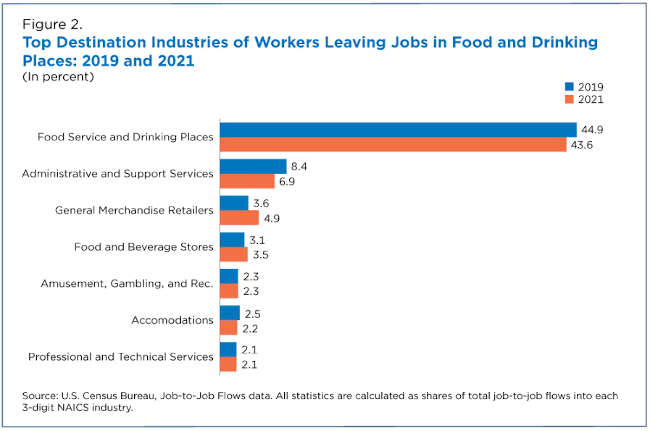
Our statistics show that in 2021, workers in this subsector were more likely than they were in 2019 to switch to jobs in another industry subsector like General Merchandise Retailers, part of the Retail Trade sector.

They were also less likely to transition into jobs in Administrative and Support Services, a subsector of yet another industry, during that same period.

These new origin-destination statistics also show that the Administrative and Support Services subsector was a top source and destination of jobs for workers changing employment.

The COVID-19 pandemic had a marked impact on the frequency of job changes between subsectors.


Job switching by industry

Where in the economy did all these job changes take place?

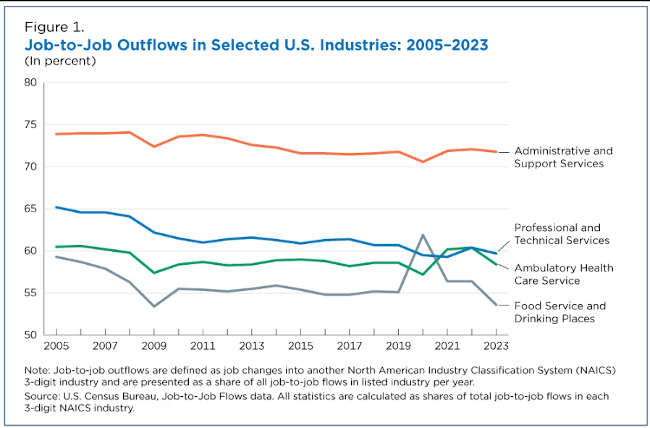
Four industries experienced the largest number of job-to-job transitions in 2021 (Figure 1): administrative and support services; food services and drinking places; professional, scientific, and technical services; and ambulatory health care services. A job transition for workers in these industries often involved a change in industry subsector.

For example, when the pandemic hit in March 2020, many bars and restaurants shuttered leading to a major outflow of workers from Food Services and Drinking Places. But outflows declined rapidly in 2021 and 2022 as establishments began to reopen. Other industries affected by the pandemic also experienced a brief drop in 2020 but recovered in 2021 as safety measures eased.

The new data provide a window into longer-term trends, too, showing for instance that workers in the Professional, Scientific and Technical Services industry were more likely to shift to jobs within their subsector than to one in another industry.

The share of people who switched jobs in that industry to go to a different one declined to less than 60% in 2022 from 65% in 2005.

Destination industries for job switchers

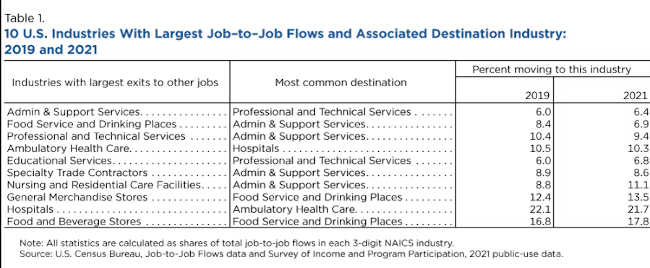
The new J2J Job Flows detailed industry tables tell us where workers who left one industry subsector went (Table 1).

For example, the Professional, Scientific, and Technical Services sector was the top destination of workers who left Administrative and Support Services jobs in 2021, accounting for 6.4% of all job-to-job flows, up slightly from 6.0% in 2019.

The Administrative and Support Services industry was the most common destination of workers who left Food and Drinking Places; Professional and Technical Services; Specialty Trade Contractors; and Nursing and Residential Care Facilities.

What the new data release offers

The new J2J data allows users to calculate the back-and-forth flow of jobs between industries.

For example, while job outflow rates in the Food and Drinking Places industry have now returned to pre-COVID rates, the recently released stats detail where exiting workers went and new ones came from.

The share of workers who switched from jobs in the Food Service and Drinking Places sector to ones in Administrative and Support Services, for instance, declined from 8.4% in 2019 to 6.9% in 2021 (Table 1).

Figure 2 illustrates that workers who left this industry in 2021 were more likely than they were in 2019 to accept jobs in the General Merchandise Retailers or Food and Beverage Stores.

Hubert Janicki is an economist in LEHD Research at the U.S. Census Bureau’s Center for Economic Studies.

Polarization may phase out of American politics as younger generations shift into power


Could the two political sides find common ground at last? JakeOlimb/DigitalVision Vectors via Getty Images

The sharp increase in political polarization in America over the past 50 years has been driven in part by how different generations think about politics. But the rise of younger generations to political power may actually erase the deep social divisions associated with polarization.

That’s one of the strong possibilities for the future suggested by the diverse array of findings of our research, including editing a collection of the most current work on how different generations of Americans participate in public life.

For the past 30 years, baby boomers (those born roughly between 1946 and 1964) and members of the Silent Generation (those born between 1925 and 1945) have driven and defined American politics. For the most part, the Silent Generation and the older baby boomers were the core of the Republican Party. And the younger baby boomers, along with many Gen Xers (born roughly between 1965 and 1981), formed the core of the Democratic Party.

Millennials (born between 1982 and 1995) and Gen Z (born between 1996 and 2013) lean liberal and are more likely to vote for Democrats. They were key contributors to Democratic election wins in 2018, 2020 and 2022, especially in swing states.

Based on our research, presented in “Generational Politics in the United States: From the Silents to Gen Z and Beyond,” earlier generations – the Silents, baby boomers and Gen X – are more divided than millennials and Gen Z.

We expect that in the future, highly partisan members of the Silent, boomer and Gen X generations will exit and no longer be part of American political life. They will be replaced by millennials and Gen Zers, who are less likely to define themselves as strong Republicans or Democrats. The greater consensus among young people today may lessen polarization.

A group of men in suits stand around a man in a suit sitting at a desk. All of them are smiling.
This 1989 photo of a bipartisan group of members of Congress alongside President George H.W. Bush shows a moment of collegiality despite party differences. Mark Reinstein/Corbis via Getty Images

5 decades of change

Back in the 1960s and 1970s, the vast majority of Americans had views roughly in the political center, with smaller numbers of people holding notably right-leaning or left-leaning opinions. In general, most voters had a broad consensus on policy issues. The Democratic and Republican parties were also broadly centrist. During this time period, Congress passed the Great Society programs, the Omnibus Crime Control and Safe Streets Act and the Clean Air Act with bipartisan support.

But over the past 50 years, fewer and fewer Americans have identified themselves as aligned with the political center, and more have described themselves as on the right or the left, either as liberals or conservatives. This has led to increasing differences between the political parties, with the Democrats to the left of center and the Republicans to the right.

Members of Congress now are more likely to stick with their political party when voting, rather than vote for legislation supported by the other party. Recent passage of legislation linking Ukraine aid with support of Israel has been described as “rare cooperation among the parties.”

This polarization has many causes, including the influence of special-interest money on lawmakers and parties and society’s increased economic inequality. But our research highlights the role that new and changing generations can play in future shifts in American politics.

American politics is the constant cycle of generations entering and exiting the political arena. Even more, variation in the social and political environment during each generation’s formative years notably affects the attitudes and behaviors each generation will subsequently adopt.

For instance, the youngest generation is used to a 24-hour online news cycle and has experience with contested elections. Changes in generational attitudes today hold the potential to lessen current levels of polarization.

Generations have different characteristics

When we look across the past century, our research finds profound differences in the demographics and political views of the generations today.

The millennials and Gen Zers are the most racially and demographically diverse generations in American history. They are the least religious, which means they are less likely than their elders to say they follow a religion, to believe in a biblical god and to pray.

Additionally, these younger generations are more likely to self-identify as liberal. As we and others explain in several chapters of our book, surveys show they are more liberal on a whole range of issues regarding social matters, the economy, immigration and climate change.

Millennials and Gen Zers also vote more Democratic than older generations. And there is some evidence to support the expectation that their governing style as elected officials emphasizes issues that millennial citizens care about. For example, a set of millennial mayors who held office at various times from 2004 to 2024 focused on traditional economic concerns but also added social justice perspectives to the mix.

Wooden blocks form two peninsulas, joined by a yellow wooden block across the gap between them.
There may be a way to bridge some of the nation’s political gaps – wait. Andrii Yalanskyi/iStock/Getty Images Plus

A new political center?

The consensus on political views among members of these younger generations means there is potential for decreasing polarization. This would be a key change in American politics, we believe for the better.

But there are other possible scenarios. As the old saying goes, demographics are not always destiny. There are thorny methodological questions involved in pinning down the impact of generations.

Politically, young Republican men can be conservative on social issues. And consensus among young Democrats could be challenged by events such as campus protests over the Israel-Hamas war in Gaza.

Overall, however, generational shifts portend the possibility of decreasing polarization.The Conversation

Sally Friedman, Associate Professor of Political Science, University at Albany, State University of New York and David Schultz, Professor of Political Science, Hamline University

This article is republished from The Conversation under a Creative Commons license. Read the original article.

Supervisors to hear from Health Services director, hold interviews for several department head jobs

LAKE COUNTY, Calif. — The Board of Supervisors this week will hear about the Health Services director’s plans for the coming fiscal year and hold confidential discussions regarding the recruitment for four department head jobs.

The‌ ‌board will meet beginning ‌at‌ ‌9‌ ‌a.m. Tuesday, May 14, in the board chambers on the first floor of the Lake County Courthouse, 255 N. Forbes St., Lakeport.

The‌ ‌meeting‌ ‌can‌ ‌be‌ ‌watched‌ ‌live‌ ‌on‌ ‌Channel‌ ‌8, ‌online‌ ‌at‌ https://countyoflake.legistar.com/Calendar.aspx‌‌ and‌ ‌on‌ ‌the‌ ‌county’s‌ ‌Facebook‌ ‌page. ‌Accompanying‌ ‌board‌ ‌documents, ‌the‌ ‌agenda‌ ‌and‌ ‌archived‌ ‌board‌ ‌meeting‌ ‌videos‌ ‌also‌ ‌are‌ ‌available‌ ‌at‌ ‌that‌ ‌link. ‌ ‌

To‌ ‌participate‌ ‌in‌ ‌real-time, ‌join‌ ‌the‌ ‌Zoom‌ ‌meeting‌ ‌by‌ ‌clicking‌ ‌this‌ ‌link‌. ‌ ‌

The‌ ‌meeting‌ ‌ID‌ ‌is‌ 865 3354 4962, ‌pass code 726865.‌ ‌The meeting also can be accessed via one tap mobile at +16694449171,,86533544962#,,,,*726865#. The meeting can also be accessed via phone at 669 900 6833.

In an item scheduled for 11 a.m., the board will receive a presentation on Health Services Director Anthony Arton's Workplan for fiscal year 2024-2025.

Some of the most important work in the supervisors’ day will take place in closed session as they hold interviews and consider making appointments to fill the director jobs in the Social Services, Water Resources and Public Works departments, as well as the administrator of Special Districts.

The full agenda follows.

CONSENT AGENDA

5.1: Adopt a proclamation designating the month of May 2023 as Military Appreciation Month.

5.2: Adopt proclamation designating May 4 to 11, 2024, as National Osteogenesis Imperfecta Awareness Week in Lake County.

5.3: Adopt a proclamation designating the week of May 18 to 24, 2024, as National Safe Boating Week in Lake County.

5.4: Adopt proclamation designating May 2024 as Maternal Mental Health Awareness Month in Lake County.

5.5: Approve travel to Orlando, Florida exceeding 1,500 miles for Deputy County Administrative Officer Casey Moreno to attend the Government Finance Officers Association annual conference from June 9 to 12, 2024 in an amount not to exceed $4,000.

5.6: Approve first amendment to agreement between county of Lake and 360 Junk Removal and Hauling, for nuisance abatement services, for an increase of $50,000, total amount not to exceed $100,000, for a term from Aug. 30, 2022 through June 30, 2024; and authorize the chair to sign.

5.7: Approve updates to Section 19.1 – “Acceptable Use Policy” of the “Board of Supervisors, County of Lake, CA, Policies and Procedures Manual.”

5.8: A) Approve the addition of a fixed asset titled ‘Palo Alto 1410 firewall HA Pair’ in 2023-2024 Capital Asset Listing in the amount of $93,186; and B) Approve budget transfer of $87,000 from account 001-1904-719.01-11, ‘Salaries and Wages, Permanent’ to account 001-1904-719.62-71; and C) Waive the formal bidding process due to cooperative purchasing and authorize the IT director to issue a purchase order in the amount of $93,185.88 to EPlus for a Palo Alto 1410 HA pair firewall and security services.

5.9: Adopt proclamation designating May 15, 2024 as California Peace Officers’ Memorial Day and May 12 to 18, 2024 as National Police Week in Lake County.

5.10: Adopt resolution revising the Fiscal Year 2023-2024 Adopted Budget of the county of Lake by canceling reserves in Fund 266 CSA #6 Finley Water System Capital Improvement Reserve Designation, in the amount of $40,000 to make appropriations in the Budget Unit 8466, Object Code 784.18-00 Maintenance – Buildings & Improvements, for the permanent repair of the Finley Water Mainline.

5.11: Approve late travel claims for August-December 2023 and January 2024 for Long-Term Care Ombudsman Volunteer, Heather Hurn Not available Not available

5.12: Adopt proclamation designating the month of May 2024 as National Foster Care Month in Lake County.

5.13: Approve Lake County’s System Improvement Plan for the term of November 2021 to November 2025 and authorize the chair to sign.

5.14: Approve Administrative Encroachment Permit #24-07 - Temporary closure of a portion of Clear Lake near Buckingham Homes Association office from May 17 to 19, 2024 for the 2024 Buckingham Test and Tune Boat and Car Show.

TIMED ITEMS

6.2, 9:03 a.m.: Pet of the Week.

6.3, 9:04 a.m.: Presentation of proclamation designating May 15, 2024 as California Peace Officers’ Memorial Day and May 12 to 18, 2024 as National Police Week in Lake County.

6.4, 9:06 a.m.: Presentation of Proclamation Designating May 2024 as Maternal Mental Health Awareness Month in Lake County.

6.5, 9:08 a.m.: Presentation of proclamation designating the month of May 2024 as National Foster Care Month in Lake County.

6.6, 9:10 a.m.: Presentation of proclamation designating May 4 to 11, 2024, as National Osteogenesis Imperfecta Awareness Week in Lake County.

6.7, 9:12 a.m.: Presentation of proclamation designating the week of May 18 to 24, 2024, as National Safe Boating Week in Lake County.

6.8, 9:14 a.m.: Presentation of proclamation designating the month of May 2023 as Military Appreciation Month.

6.9, 9:30 a.m.: Consideration of the March 31, 2024, report of Lake County pooled investments.

6.10, 11 a.m.: Presentation of Health Services Director Anthony Arton's Workplan for fiscal year 2024-2025.

UNTIMED ITEMS

7.2: Consideration of letter of support for Clearlake’s grant application for Lakeshore Drive Safety Enhancement Project.

7.3: Consideration of (a) letter of support to the Lake County Resource Conservation District for a request for proposal to the Governor's Office of Planning and Research for the Forest Sector Market Development Grant with the Lake County Community Risk Reduction Authority JPA as the Funded Partner; and (b) authorize county counsel to provide services and invoice the Lake County Community Risk Reduction Authority JPA for up to 25 hours of grant support.

7.4: Consideration of lease agreement between the county of Lake and Charlie Sawyer, Nancy Sawyer, Trustees of the Charles A. Sawyer and Nancy J. Sawyer Trust in the amount of $12,171 per month for five years.

7.5: Consideration of Amendment No. 1 between county of Lake and Ever Well Health Systems for adult residential support services and specialty mental health services in the amount of $125,000 for Fiscal Year 2023-24.

7.6: Consideration of resolution further amending resolution Number 2019-70 and 2019-162 to clarify the procedures used in the collection of taxes due pursuant to the Lake County Cannabis Cultivation Tax Ordinance.

ASSESSMENT HEARINGS

8.1: Consideration of withdrawal on the following assessment appeal applications: a) No. 07-2023 Charles Bellig; and b) No. 27-2022 Deborah Bakhtiari; and c) No. 28-2022 through 71-2022 Geysers; and d) No. 01-2023 through 04-2023 Ori Wheeler; and e) No. 21-2022 & 25-2022 Safeway; and f) No. 74-2022 Davita Inc.

8.2: Consideration of request by the appellant to continue the following assessment appeal applications: a) No. 06-2023 Blakely Hull; and b) 73-2022 Robert McMullen; and c) 24-2022 Tesla Energy; and d) 05-2023 Wendy Jameson.

8.3: Consideration of Stipulation for Assessment Appeal No. 22-2022 and 23-2022, Robert Coats.

CLOSED SESSION

9.1: Public employee appointment pursuant to Gov. Code Section 54957(b) (1): Interviews for Social Services director, appointment of Social Services director.

9.2: Public employee appointment pursuant to Gov. Code Section 54957(b) (1): Interviews for Water Resources director, appointment of Water Resources director.

9.3: Public employee appointment pursuant to Gov. Code Section 54957(b) (1): Interviews for Public Works director, appointment of Public Works director.

9.4: Public employee appointment pursuant to Gov. Code Section 54957(b) (1): Interviews for Special Districts administrator, appointment of Special Districts administrator.

9.5: Public employee evaluation: Information technology director.

9.6: Public employee evaluation: Child Support Services director.

9.7: Public employee evaluation: Animal Control director.

Email Elizabeth Larson at This email address is being protected from spambots. You need JavaScript enabled to view it.. Follow her on Twitter, @ERLarson, or Lake County News, @LakeCoNews.
  • 453
  • 454
  • 455
  • 456
  • 457
  • 458
  • 459
  • 460
  • 461
  • 462

Community

  • Lake County Wine Alliance offers sponsor update; beneficiary applications open 

  • Mendocino National Forest announces seasonal hiring for upcoming field season

Public Safety

  • Lakeport Police logs: Thursday, Jan. 15

  • Lakeport Police logs: Wednesday, Jan. 14

Education

  • Woodland Community College receives maximum eight-year reaffirmation of accreditation from ACCJC

  • SNHU announces Fall 2025 President's List

Health

  • California ranks 24th in America’s Health Rankings Annual Report from United Health Foundation

  • Healthy blood donors especially vital during active flu season

Business

  • Two Lake County Mediacom employees earn company’s top service awards

  • Redwood Credit Union launches holiday gift and porch-to-pantry food drives

Obituaries

  • Rufino ‘Ray’ Pato

  • Patty Lee Smith

Opinion & Letters

  • The benefits of music for students

  • How to ease the burden of high electric bills

Veterans

  • CalVet and CSU Long Beach team up to improve data collection related to veteran suicides

  • A ‘Big Step Forward’ for Gulf War Veterans

Recreation

  • Wet weather trail closure in effect on Upper Lake Ranger District

  • Mendocino National Forest seeking public input on OHV grant applications

  • State Parks announces 2026 Anderson Marsh nature walk schedule 

  • BLM lifts seasonal fire restrictions in central California

Religion

  • Kelseyville Presbyterian to host Ash Wednesday service and Lenten dinner Feb. 18

  • Kelseyville Presbyterian Church to hold ‘Longest Night’ service Dec. 21

Arts & Life

  • Auditions announced for original musical ‘Even In Shadow’ set for March 21 and 28

  • ‘The Rip’ action heist; ‘Steal’ grounded in a crime thriller

Government & Politics

  • Lake County Democrats issue endorsements in local races for the June California Primary

  • County negotiates money-saving power purchase agreement

Legals

  • March 3 hearing on ordinance amending code for commercial cannabis uses

  • Feb. 12 public hearing on resolution to establish standards for agricultural roads

How to resolve AdBlock issue?
Refresh this page