 How to resolve AdBlock issue?
News
On Wednesday, Rep. Mike Thompson (CA-04) and Rep. Greg Steube (FL-17) led a bipartisan group of 218 Members of Congress to successfully advance a discharge petition which will force House Speaker Mike Johnson to bring the Federal Disaster Tax Relief Act (H.R. 5863) to the House floor for a vote.
The bill would exempt thousands of qualified wildfire victims in California, including PG&E fire victims, from having to pay federal income tax on their settlement money or pay tax on attorney fees that are included in the settlement.
This relief would also apply retroactively to qualified victims.
“Fire survivors have been through enough in the wake of losing their homes and livelihoods to wildfires. It’s wrong to tax them on the settlement money meant to help them rebuild their lives,” said Thompson on Wednesday. “Today’s historic discharge petition reaffirms the House’s strong, bipartisan support for survivors and sends a clear message to Republicans who have stopped this bill in the Senate: It’s time to work with us to pass much-needed relief for disaster victims.”
The bill excludes from taxpayer gross income, for income tax purposes, any amount received by an individual taxpayer as compensation for expenses or losses incurred due to a qualified wildfire disaster (a disaster declared after 2014 as a result of a forest or range fire).
It also excludes relief payments for losses resulting from the East Palestine, Ohio, train derailment on Feb. 3, 2023 and designates Hurricane Ian, among other federally declared disasters, as a qualified disaster for the purposes of determining the tax treatment of certain disaster-related personal casualty losses.
The action marks only the third time a House discharge petition has succeeded in the last 22 years.
Next, the discharge motion will enter a waiting period for seven legislative days after which any signatory may call it up for a House vote.
Once called, it must be scheduled for a vote within two legislative days.
Thompson represents California’s Fourth Congressional District, which includes all or part of Lake, Napa, Solano, Sonoma and Yolo counties.
The bill would exempt thousands of qualified wildfire victims in California, including PG&E fire victims, from having to pay federal income tax on their settlement money or pay tax on attorney fees that are included in the settlement.
This relief would also apply retroactively to qualified victims.
“Fire survivors have been through enough in the wake of losing their homes and livelihoods to wildfires. It’s wrong to tax them on the settlement money meant to help them rebuild their lives,” said Thompson on Wednesday. “Today’s historic discharge petition reaffirms the House’s strong, bipartisan support for survivors and sends a clear message to Republicans who have stopped this bill in the Senate: It’s time to work with us to pass much-needed relief for disaster victims.”
The bill excludes from taxpayer gross income, for income tax purposes, any amount received by an individual taxpayer as compensation for expenses or losses incurred due to a qualified wildfire disaster (a disaster declared after 2014 as a result of a forest or range fire).
It also excludes relief payments for losses resulting from the East Palestine, Ohio, train derailment on Feb. 3, 2023 and designates Hurricane Ian, among other federally declared disasters, as a qualified disaster for the purposes of determining the tax treatment of certain disaster-related personal casualty losses.
The action marks only the third time a House discharge petition has succeeded in the last 22 years.
Next, the discharge motion will enter a waiting period for seven legislative days after which any signatory may call it up for a House vote.
Once called, it must be scheduled for a vote within two legislative days.
Thompson represents California’s Fourth Congressional District, which includes all or part of Lake, Napa, Solano, Sonoma and Yolo counties.
Two bills that proponents say would move the needle on California's electricity rate crisis by increasing oversight of utility spending on wildfire mitigation and other infrastructure investments emerged from the Senate suspense file on Thursday, a key hurdle.
SB 1003 (Dodd) would require utilities to demonstrate their wildfire mitigation plans prioritize affordable, timely solutions proven to effectively reduce risk.
AB 2054 (Bauer-Kahan) would prevent utilities from automatically passing excessive project costs on to ratepayers for projects like wildfire mitigation.
Wildfire mitigation is the biggest driver of skyrocketing electricity bills in recent years.
Instead of prioritizing cost-effective solutions, The Utility Report Network, or TURN, said utilities are incentivized to pursue the most expensive option — undergrounding power lines at a cost of up to $6.1 million per mile — because they can earn a lucrative rate of return.
TURN said the consequences have been severe rate shocks for Californians.
"SB 1003 and AB 2054 emerged from the suspense file today, an important step towards advancing oversight of utility spending in California,” Katy Morsony, legislative and assistant managing attorney at TURN, said Thursday.
“For too long, utilities have treated customers like a credit card — passing along budget overruns without regulator approval and choosing the most expensive option for wildfire mitigation to maximize profits. Enough is enough. It's time for lawmakers to prove they're working for utility customers, not executives,” Morsony said.
SB 1003 (Dodd) would require utilities to demonstrate their wildfire mitigation plans prioritize affordable, timely solutions proven to effectively reduce risk.
AB 2054 (Bauer-Kahan) would prevent utilities from automatically passing excessive project costs on to ratepayers for projects like wildfire mitigation.
Wildfire mitigation is the biggest driver of skyrocketing electricity bills in recent years.
Instead of prioritizing cost-effective solutions, The Utility Report Network, or TURN, said utilities are incentivized to pursue the most expensive option — undergrounding power lines at a cost of up to $6.1 million per mile — because they can earn a lucrative rate of return.
TURN said the consequences have been severe rate shocks for Californians.
"SB 1003 and AB 2054 emerged from the suspense file today, an important step towards advancing oversight of utility spending in California,” Katy Morsony, legislative and assistant managing attorney at TURN, said Thursday.
“For too long, utilities have treated customers like a credit card — passing along budget overruns without regulator approval and choosing the most expensive option for wildfire mitigation to maximize profits. Enough is enough. It's time for lawmakers to prove they're working for utility customers, not executives,” Morsony said.
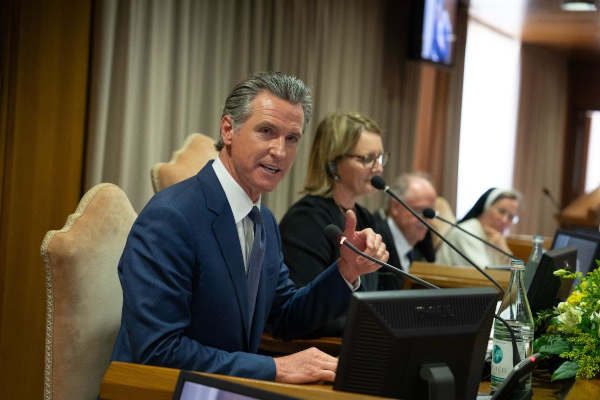
VATICAN CITY – At the Vatican Climate Summit, Gov. Gavin Newsom spoke before other governors, mayors and civic and faith leaders from around the globe, highlighting California’s nation-leading efforts on clean energy and calling out the propaganda and lies from Big Oil.
“Fossil fuel companies have been deceiving us. They've known the science. They've denied the science. They've delayed advancement. But we have the capacity to address this issue at a global level and we all must bring the moral authority that is needed and that this time demands,” said Newsom.
While in Vatican City, the governor and First Partner Jennifer Siebel Newsom had an audience with Pope Francis. His Holiness acknowledged California’s leadership on the climate crisis and the state’s moratorium on the death penalty while the governor thanked the Pope for his advocacy on climate.
The pope, Gov. Newsom, and other leaders signed a planetary compact aimed at accelerating global efforts to combat the climate crisis and build climate resilience.
“The refusal to act quickly to protect the most vulnerable who are exposed to climate change caused by human activity is a serious offense and a grave violation of human rights…. An orderly progress is being held back by the greedy pursuit of short-term gains by polluting industries and by the spread of disinformation, which generates confusion and obstructs collective efforts for a change in course,” said Pope Francis.
The governor’s address to the Vatican Climate Summit focused on climate resilience in the Golden State and made the case for taking urgent action on the climate crisis – just as California has in recent years. The governor also called for defending democracy as one of the essential tools for combating climate change.
While at the summit, the governor spoke with mayors, governors and indigenous leaders who are all committed to tackling the climate crisis. Following the Summit on Thursday, Gov. Newsom met with the president of Italy, Sergio Mattarella.
The governor and President Mattarella discussed the challenges states and countries face in addressing the climate crisis particularly during times of geopolitical instability. The president noted California’s global leadership and emphasized the importance of acting with urgency to combat the climate crisis.
With half the world's population poised to elect their leaders amid a backdrop of escalating political extremism, the stakes couldn't be higher for our climate future. The climate crisis transcends every border and boundary, and does not recognize partisan lines. Regardless of the world’s political future, extreme weather will continue to threaten lives. California is leading the charge to build bridges around the world to ensure decisive action against the climate crisis.
Below are the governor’s full remarks, as delivered at the Vatican Climate Summit. Watch the governor's remarks below.
My name is Gavin Newsom, I come from a state you may have heard of – California [in] the United States. The most diverse state in the most diverse democracy in the world.
California is a state of dreamers, of doers, of entrepreneurs, of innovators. At our best, we pride ourselves on being on the leading and cutting edge of new ideas.
We're a state where 27% of its population is foreign born. A majority minority state. A state that's proud to have been the home state of the founding papers of the United Nations. We're a pluralistic state that practices pluralism.
And we're a state that at our best — not always — but at our best, we believe the world, in many respects, looks to us to see that it’s possible to live together and advance together across many imaginable differences.
And that – that absolutely is the case when it comes to the issue of addressing the crisis of our time in climate change.
I'm here with humility and respect and appreciation to the work each and every one of you do in your respective jurisdictions. I'm grateful for the opportunity to share a little bit about the journey of California – its history, its proud past, its relationship to the moment and the work together we're doing to advance a brighter future.
I'm proud of California's leadership that dates back to the late 1960s. It was interesting, someone you may have heard of by the name of Ronald Reagan. Governor at the time, Ronald Reagan, that established the first environmental regulations in the United States of substance: regulating tailpipe emissions. Exactly for the reason the mayor was just advancing to address the issue of smog, air pollution in the city of Los Angeles.
1967 marks a moment of consciousness as it relates to affordification of sorts of the modern environmental movement in the United States of America.
Just three years later, interestingly, another Republican leader in the context of American politics, by the name of Richard Nixon – President Richard Nixon, through the Clean Air Act, codified California's authority and allowed California to maintain its leadership where it allowed us to punch above our weight in terms of advancing our low-carbon, green growth future.
That has carried over the course of generations. In the 70s, California led on energy efficiency in appliances. California led in the 70s on the first tax incentives around solar.
California continues to lead in a myriad of different areas. But we recognize, despite that leadership, the acuity of the crisis at hand. The hots are getting a lot hotter, the dries are getting a lot drier, the wets are getting a lot wetter.
The extremes – not just extremes in mother nature, as the Mayor was referencing — the extremes in our politics as well. And it marks the moment, in many respects, we’re in. How do we together address those extremes?
It's not lost on me, there’s a wonderful old African proverb, that says if you want to go fast, go alone. But if you want to go far, go together.
Our consciousness in the context of addressing this crisis is the framework of partnerships. Advancing partnerships. An open hand, not a closed fist.
And we are beginning anew to advance with vigor partnerships at the subnational level all around the globe. We’re part of an MOU – MOU under 2, many of you are associated with, now 270 jurisdictions around the world. Subnational jurisdictions representing 50% of the planet's GDP.
In the United States, we're part of an alliance of bipartisan governors – 24 – that represent over 50% of American population with the US Climate Alliance, that allows us to maintain our leadership regardless of what happens at the federal level.
And if there's anything I want to impress upon you, is the stability of California's relationship to the issue of changing the way we produce and consume energy and the issue of environmental stewardship. Regardless of what happens at the national level, we are a trusted and stable partner.
And I say that mindful that we are, from an economic output, the fifth largest economy in the world. Just behind Japan and Germany, slightly ahead of India.
I say that not to impress you, but to impress upon you, how proud I am to represent a state that is able to assert itself from an economic paradigm, but at the same time assert its values of not just growth, but the spirit of this conference, inclusion, of equity.
California has led in many areas — and one area in particular — our cap-and-trade program. $11 billion of completed programs since, sister, the 2014 convening – 76% of the investments have gone back into low-income communities. We write equity into the laws. We write equity and inclusion into the work we do each and every day.
But we're also writing in this moment a deeper level of consciousness, and that is calling this climate crisis what it is: the climate crisis is a fossil fuel crisis. The climate crisis is a fossil fuel crisis. It’s because the burning of coal, the burning of gas, and the burning of oil.
And with respect and, forgive me, if this comes off a little too harsh. It's been said and I'll repeat it: the polluted heart of the climate crisis are these fossil fuel companies that have been lying to us. They've been deceiving us. They've known the science. They've denied the science. They've delayed advancement.
We have the tools, we have the technology, we have the capacity to address this issue at a global level, a scaled level and they've been fighting every single advancement. And we have got to call that out.
And in peril of further alienating some, I have to call this out as well. I don't want to talk in the paradigm of a political conscience – I mentioned two Republicans, but let me mention one other.
Former President Donald Trump, who just last week, I never thought I'd see this. I've heard it, but I've never seen it. Donald Trump, just last week, had oil executives convening, talking about his election. And he openly asked them for $1 billion to roll back the environmental progress of the Biden Administration, the environmental progress that we've made over the course of the last half century. Open corruption.
A billion dollars to pollute our states, to pollute our country, and to pollute this planet and to rollback progress in the open.
This is the moment we're living in, and it calls for clarity. And it calls for understanding of what we're up against.
And so I'm very proud of living in a state that is pushing back against that agenda to roll back progress – frankly, to roll back a lot of the progress of the last century across a spectrum of issues, not just environmental stewardship, and to assert ourselves and stand tall. Again, in the principle of partnership.
And I'll close on this. I'm very proud as well, and I think this is important, that California is exceeding its audacious goal-setting. And I want this to be said because I think it's important to promote the progress, to also promote optimism as it relates to this issue, as we deal with so many of these challenges.
In every single instance, California has exceeded its nation-leading environmental goals.
I'm reminded there was someone very familiar to the Vatican by the name of Michelangelo, who once said the biggest risk in life is not that we aim too high and miss it – it's that we aim too low and reach it.
We have got to maintain our stretch goals. And California has done that across the spectrum. Goal-setting is no longer the issue in my state. It's about the great implementation. It's about the application.
We're in the “how” business, and it's about the power of emulation, proving that we can run the fifth largest economy, its economic engine, as we change the way we produce and consume energy.
And let me give you a proof point as I conclude my remarks. I come here today, day 32. 32 straight days – over one month — where California's economy is literally being run with 100% clean energy. 100%, 32 days straight.
Proving the paradigm that this can be done. In every case, exceeding our nation-leading goals.
So it's in that spirit again, with grace and humility – we're hardly perfect, I'm mindful of that, across a spectrum of issues that I look forward to working collaboratively with each and every one of you, being inspired by the work you're doing at a local level.
There's an old adage, if you don't like the way the world looks when you're standing up, stand on your head and go local. Because remarkable things are happening, as the Mayor said, at the local level. Localism is determinative.
And we think about climate, we think about greenhouse gas emissions. It’s the sum total of all those emissions that happen on a local basis, that is what we need to confront.
And so, again, with gratitude, with graciousness, with appreciation to His Holiness, to each and every one of you for your faith and devotion to this cause.
We look forward to maintaining our position of leadership. And we look forward to all of us bringing into our positions of formal authority, the moral authority that is needed and demands of this time.
Thank you very, very much.

LAKE COUNTY, Calif. — Federal officials will present a proposed conservation strategy for the Clear Lake hitch to the Board of Supervisors next week.
The hitch was listed as threatened under the California Endangered Species Act, or ESA, in 2014, and has been proposed for Federal Endangered Species Act listing multiple times since.
In February 2023, the Board of Supervisors declared an emergency regarding the fish in response to reports of critically low numbers in recent years.
The fish, a minnow native to Clear Lake, has been added to the United States Fish and Wildlife Service 2024 at-risk species list and is up for a federal ESA listing decision in early 2025.
The U.S. Fish and Wildlife-facilitated Conservation Strategy for the Clear Lake hitch will be used to identify activities, actions, efforts and management practices that will lead to conservation and recovery of the hitch.
Officials said this strategy will provide mutual support on agreed actions by tribal, local, state and federal partners.
U.S. Fish and Wildlife will present the conservation strategy to the Board of Supervisors for discussion and comment Tuesday, May 21.
There will be a 30-day public comment period following May 21.
All comments provided to Fish and Wildlife will be addressed and added to an appendix of the conservation strategy.
The latest draft of the 132-page conservation strategy is posted publicly on the Lake County Water Resources website.
If you have questions, please contact Water Resources at 707-263-2344 or email
Award will provide homebuyer assistance to 2018 and 2020 wildfire impacted households
A program set to launch this summer offers the promise of homebuyer assistance for Lake County residents as well as residents in other counties impacted by wildfires.
Golden State Finance Authority, or GSFA, has been awarded a $28 million grant from the California Department of Housing and Community Development to support individuals and families in California impacted by the devastating wildfires and other declared disasters in 2018 and 2020.
With the grant award, GSFA will administer the ReCoverCA Homebuyer Assistance Program to enable low- and moderate-income residents — homeowners or renters — of the Most Impacted and Distressed, or MID, California counties to relocate outside of high fire zone areas.
The program will provide homeownership assistance in the form of a forgivable loan, up to $350,000 per qualifying household.
The homebuyer assistance is designed to cover the funding gap between the first mortgage loan amount and the purchase price of a home.
“Rent increases and housing costs continue to be a challenge here, especially after the unprecedented fires of 2020. Financial assistance of this size can go a long way towards helping low-and-moderate income families secure long-term housing and re-establish roots in communities,” said Napa County Supervisor Anne Cottrell.
Low-to-moderate income homeowners and renters whose primary residence, at the time of the qualifying disasters in 2018 or 2020, was inside the mandatory evacuation zone or evacuation warning zones in an MID county will be eligible to apply for the ReCoverCA Homebuyer Assistance Program.
Eligible MID counties are: 2018 — Butte, Lake, Los Angeles and Shasta Counties; 2020 — Butte, Fresno, Los Angeles, Napa, Santa Cruz, Shasta, Siskiyou, Solano and Sonoma counties.
“It is difficult for many families that lost their homes to wildfire to simply rebuild in the same location due to construction costs, fire insurance requirements and other factors. In fact, many families had to relocate temporarily, even obtaining new jobs in a different location,” said Craig Ferguson, deputy director of GSFA. “ReCoverCA homebuyer assistance will be a big boost to help them start again with long-term housing and less fire risk going forward. We are excited to be a part of such a positive recovery effort.”
The creation and implementation of the ReCoverCA Homebuyer Assistance Program centers on the goal to increase the level of homeownership among impacted disaster survivors and contribute to the affordability and sustainability of communities across the state.
The grant provided by HCD is part of the State’s Disaster Recovery Action Plan for the 2018 and 2020 disasters and made possible through a Community Development Block Grant - Disaster Recovery grant from the United States Department of Housing and Urban Development.
The program is scheduled to launch in early June 2024, when eligible households will be able to officially apply for the ReCoverCA homebuyer assistance.
Complete program guidelines will also be made available in early June and published on the GSFA website www.gsfahome.org.
A program set to launch this summer offers the promise of homebuyer assistance for Lake County residents as well as residents in other counties impacted by wildfires.
Golden State Finance Authority, or GSFA, has been awarded a $28 million grant from the California Department of Housing and Community Development to support individuals and families in California impacted by the devastating wildfires and other declared disasters in 2018 and 2020.
With the grant award, GSFA will administer the ReCoverCA Homebuyer Assistance Program to enable low- and moderate-income residents — homeowners or renters — of the Most Impacted and Distressed, or MID, California counties to relocate outside of high fire zone areas.
The program will provide homeownership assistance in the form of a forgivable loan, up to $350,000 per qualifying household.
The homebuyer assistance is designed to cover the funding gap between the first mortgage loan amount and the purchase price of a home.
“Rent increases and housing costs continue to be a challenge here, especially after the unprecedented fires of 2020. Financial assistance of this size can go a long way towards helping low-and-moderate income families secure long-term housing and re-establish roots in communities,” said Napa County Supervisor Anne Cottrell.
Low-to-moderate income homeowners and renters whose primary residence, at the time of the qualifying disasters in 2018 or 2020, was inside the mandatory evacuation zone or evacuation warning zones in an MID county will be eligible to apply for the ReCoverCA Homebuyer Assistance Program.
Eligible MID counties are: 2018 — Butte, Lake, Los Angeles and Shasta Counties; 2020 — Butte, Fresno, Los Angeles, Napa, Santa Cruz, Shasta, Siskiyou, Solano and Sonoma counties.
“It is difficult for many families that lost their homes to wildfire to simply rebuild in the same location due to construction costs, fire insurance requirements and other factors. In fact, many families had to relocate temporarily, even obtaining new jobs in a different location,” said Craig Ferguson, deputy director of GSFA. “ReCoverCA homebuyer assistance will be a big boost to help them start again with long-term housing and less fire risk going forward. We are excited to be a part of such a positive recovery effort.”
The creation and implementation of the ReCoverCA Homebuyer Assistance Program centers on the goal to increase the level of homeownership among impacted disaster survivors and contribute to the affordability and sustainability of communities across the state.
The grant provided by HCD is part of the State’s Disaster Recovery Action Plan for the 2018 and 2020 disasters and made possible through a Community Development Block Grant - Disaster Recovery grant from the United States Department of Housing and Urban Development.
The program is scheduled to launch in early June 2024, when eligible households will be able to officially apply for the ReCoverCA homebuyer assistance.
Complete program guidelines will also be made available in early June and published on the GSFA website www.gsfahome.org.
LAKE COUNTY, Calif. — Kelseyville United Methodist Church has partnered with the Lake County Library Literacy Program to help address low literacy in Lake County.
Initiated by Pastor Isabel Budinger and with a desire to make a difference in the greater community, the church will offer its space for new tutor training, family literacy nights and one-on-one tutoring for learners in need.
On May 7, the church hosted its first literacy information session to share information about services with the community.
On Friday, May 17, the church will offer its first new tutor training, and on Wednesday, June 12, the church will host an all-ages Family Literacy Night with literacy activities, games, free books and more.
In addition to supporting learners in need, a priority for this partnership is to recruit more volunteer literacy tutors for the Adult, English as a Second Language and Lake County Jail literacy programs.
Pastor Budinger especially wants to help serve local migrant workers who are eager to become fluent in the English language. More Spanish bilingual tutors are needed for this purpose.
The Lake County Library Literacy Program provides free training, materials, and ongoing support for volunteer literacy tutors. No experience is necessary to become a literacy tutor. Volunteering is flexible for both the tutor and learner, with sessions typically held once per week for one hour.
According to World Population Review, only 76.9% of those 15 and older — considered the adult category — in California are able to read and write, making literacy an important cause.
If you are interested in becoming a literacy tutor or know someone who could benefit from services, please call 707-263-7633 or emailThis email address is being protected from spambots. You need JavaScript enabled to view it. . Your volunteerism could help change a life.
Visit the Literacy Program’s page on the Lake County Library website.
Georgina Marie Guardado is the Literacy Program coordinator.
Initiated by Pastor Isabel Budinger and with a desire to make a difference in the greater community, the church will offer its space for new tutor training, family literacy nights and one-on-one tutoring for learners in need.
On May 7, the church hosted its first literacy information session to share information about services with the community.
On Friday, May 17, the church will offer its first new tutor training, and on Wednesday, June 12, the church will host an all-ages Family Literacy Night with literacy activities, games, free books and more.
In addition to supporting learners in need, a priority for this partnership is to recruit more volunteer literacy tutors for the Adult, English as a Second Language and Lake County Jail literacy programs.
Pastor Budinger especially wants to help serve local migrant workers who are eager to become fluent in the English language. More Spanish bilingual tutors are needed for this purpose.
The Lake County Library Literacy Program provides free training, materials, and ongoing support for volunteer literacy tutors. No experience is necessary to become a literacy tutor. Volunteering is flexible for both the tutor and learner, with sessions typically held once per week for one hour.
According to World Population Review, only 76.9% of those 15 and older — considered the adult category — in California are able to read and write, making literacy an important cause.
If you are interested in becoming a literacy tutor or know someone who could benefit from services, please call 707-263-7633 or email
Visit the Literacy Program’s page on the Lake County Library website.
Georgina Marie Guardado is the Literacy Program coordinator.