How to resolve AdBlock issue?
Refresh this page
How to resolve AdBlock issue?

Refresh this page
Lake County News,California
  • Home
    • Registration Form
  • News
    • Education
    • Veterans
    • Community
      • Obituaries
      • Letters
      • Commentary
    • Police Logs
    • Business
    • Recreation
    • Health
    • Religion
    • Legals
    • Arts & Life
    • Regional
  • Calendar
  • Contact us
    • FAQs
    • Phones, E-Mail
    • Subscribe
  • Advertise Here
  • Login

News

Public comment invited on Lake County Parks, Recreation and Trails Master Plan

LAKE COUNTY, Calif. — County officials are asking for the community’s input on its parks, recreation and trails master plan, with the comment period set to close at the end of this week.

Lake County is renowned for its stunning landscapes, diverse ecosystems and abundance of recreational opportunities. It offers a wide range of recreational experiences for people of all ages and interests, be it on water, in the air or on land.

Over the last year and a half, the county of Lake worked to draft the first-ever parks, recreation, and trails master plan to inventory parks, facilities and trails, develop an understanding of community priorities and needs, and create actionable strategies to meet demands.

The plan was prepared with substantial public input to ensure alignment with community needs, and resulted in the following overarching vision: “From lakes to peaks — parks, programs, and trails that offer healthy and fun recreation experiences for all, while honoring cultural heritages and conserving natural resources for future generations.”

With the master plan draft now complete, the county invites and encourages you to provide comments.

You can do that online or in-person:

• On the web at www.lakecountyprt.com where the plan can be directly viewed and also includes the ability to provide comments or questions.
• In person at any of the three county libraries in Clearlake, Lakeport, and Middletown, as well as at the Lake County Public Services Department at 333 Second Street, Lakeport.

Comments will be accepted through May 31.

Police seek missing Clearlake teen

Antonio Lopez Padilla. Courtesy photo.

CLEARLAKE, Calif. — The Clearlake Police Department is asking for the community’s help in locating a missing teenager.

Antonio Lopez Padilla, 17, was last seen on Eighth Street in Clearlake late on Sunday night.

He has black hair and brown eyes, is 5 feet 6 inches tall and 140 pounds.

When he was last seen, he was wearing a white shirt black shorts and long white socks.

If you have any information regarding his whereabouts please contact Clearlake Police at 707-994-8251, Extension 1.

More people moved farther away from city centers since COVID-19


In a possible sign of the COVID-19 pandemic’s lasting impact, the country’s fastest-growing places are increasingly likely to be far-flung exurban communities on the outer margins of metro areas, according to new July 1, 2023, population estimates.

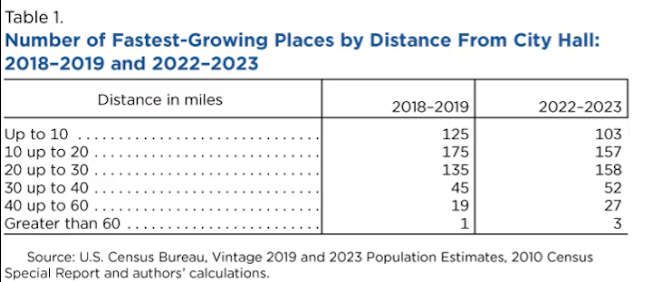
Fewer of the fastest-growing places between 2022 and 2023 were inner suburbs than in 2019 before the pandemic, and more were on the far outskirts of metro areas — 30, 40 and even more than 60 miles away from the largest city’s downtown.

“While the Census Bureau doesn’t define exurbs, we tend to think of them as far outer suburbs of metro areas, and they often have a mix of urban and rural character,” said Luke Rogers, a demographer in the Census Bureau’s Population Division. “Exurbs have sometimes been among the most rapidly growing communities, but this appears to be even more true now than before the pandemic.”

High housing costs and more remote work are possible reasons

Multiple factors are likely behind the increased growth of exurbs.

Among them: Rising housing costs after the start of the pandemic, which drove some people farther away from cities toward exurbs in search of cheaper homes.

Greater opportunities to work from home also likely contributed. Before the pandemic, telework and remote work options were much less common.

“With many more people in working ages now able to work from home at least some of the time, it’s likely that some people are more willing to live farther away from their place of employment than they would have in the past,” Rogers said.

Fastest-growing places before and after the pandemic

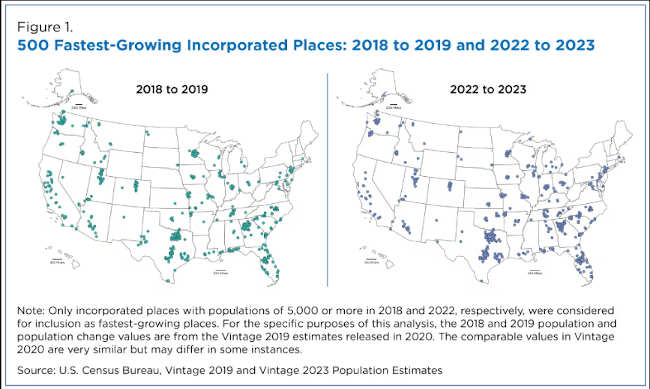
The 500 U.S. cities with the largest percentage increases in population in 2018-2019 and in 2022-2023 were in all four regions. But more than 4 out of 5 were in the South or West and nearly all were inside a metro or micro area (Figure 1).

One of the 500 fastest-growing cities from 2018 to 2019 and three from 2022 to 2023 were not in a metro or micro area.


Calculating distances from downtown

Using an approach outlined in a 2010 Census Special Report on Core Based Statistical Areas, we defined “downtown” as the location of city hall in the largest city in a metro or micro area. We then calculated the distance from the center of each of the 500 places to that point.

The distance bands used were:

• Up to 10 miles from city hall.
• 10 up to 20 miles away.
• 20 up to 30 miles away.
• 30 up to 40 miles away.
• 40 up to 60 miles away.
• Greater than 60 miles from city hall.

There were more exurbs — places as far as 60-plus miles outside a metro area’s largest city — among the nation’s fastest-growing places in 2023 than in 2019, the year before the pandemic hit. (Table 1).

At the same time, there were fewer (103 compared to 125) fast-growing places within a 10-mile radius and a 10-to-20-mile radius (157 compared to 175).

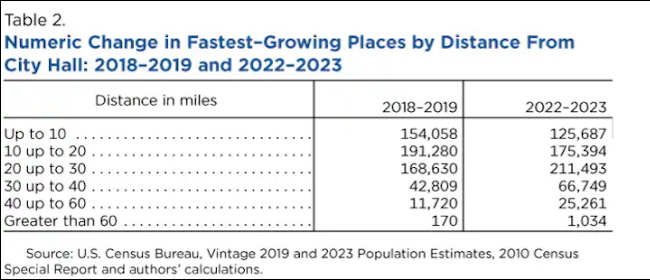
Numeric population change was similar: collectively, population gains increased in the areas farthest out and slowed within 20 miles of the city center.


Booming exurbs in Phoenix metro area

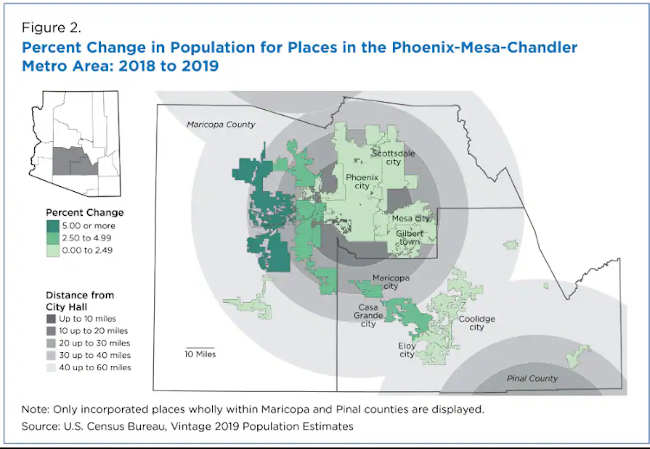
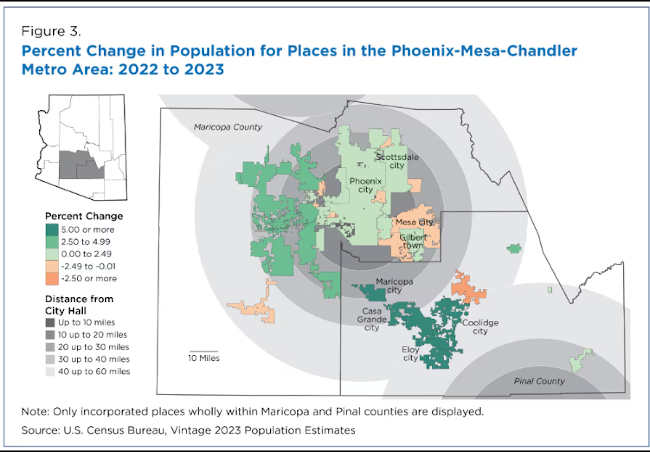
The Phoenix-Mesa-Chandler AZ metro area demonstrates the prominence of these new exurban boomtowns.

The metro area, which consists of Maricopa and Pinal counties, has grown steadily in recent decades reaching 5 million and becoming the nation’s 10th largest metro area. And while the metro area grew at a fast clip during both periods (2018-2019 and 2022-2023), exurbs increasingly contributed to that growth in the latter years.

Figures 3 and 4 show the percentage change in population for cities in the metro area. Growth in Phoenix itself dropped from 1.6% to 0.4% and similar slowdowns occurred in many of its closer-in suburbs such as Scottsdale (1.4% to 0.6%), Mesa (2.0% to -0.1%), and Gilbert (1.7% to 0.1%).

Yet growth rates in some of the more distant suburbs south of the city eclipsed already high rates of growth in 2018-19:

• Maricopa’s rapid 4.2% increase from 2018 to 2019 accelerated to a 7.1% increase last year.
• Casa Grande’s 2.8% increase swelled to 6.1%.
• Coolidge’s 1.6% increase surged to 9.4% growth last year.
• Eloy, more than 60 miles south of Phoenix city hall, was up 8.6% compared to a 1.5% increase in the year before the onset of the pandemic.

All told, these four exurbs contributed fully one-third of the entire metro area’s population growth last year, compared to just 4% from 2018 to 2019.


Temporary blip or enduring phenomenon?

Patterns of population growth and distribution regularly evolve, and it is too soon to tell whether the recent surge of exurban growth is a temporary blip or a more enduring phenomenon.

Demographers and geographers will continue to monitor the spatial dimensions of population growth and decline for the nation’s 19,000-plus cities and towns for insights.

Lindsay Spell is a geographer and Marc Perry is a senior demographer in the Census Bureau’s Population Division.

Wine and Beer Makers’ Festival supports Lake County Symphony

Doug and Kerry Moore display their winning wine from a previous Winefest. Courtesy photo.

LAKE COUNTY, Calif. — The 2024 Lake County Home Wine and Beer Makers’ Festival comes to Lakeport’s Library Park this year on Saturday, June 8, from noon to 5 p.m.

This family-friendly event has been going on for 22 years and is the largest fundraiser for the Lake County Symphony Association, which supports the Lake County Symphony, Community & Youth Orchestra, in-school music programs, and Allegro scholarship programs.

All home winemakers and brewers are eligible for the gold, silver and bronze ribbons awarded for a range of varietals and brews.

All amateur participants will have a chance to win the popular “Peoples’ Choice” awards voted on by attendees, with results announced during the festival.

As usual, tasters will also have a chance to sample wines from several Lake County commercial wineries, including Smiling Dogs, Rosa D’Oro, R Vineyards, Six Sigma and Brassfield Estate.

Don’t drink wine or beer? You can skip the entry fee and spend your time looking- and buying- original arts and crafts, clothing and agricultural products.

Non-tasters can support the symphony by purchasing “barrel of wine” raffle tickets or by participating in the popular silent auction, which features a variety of unique items donated by local businesses, along with original creations donated by artists.

Silent auction proceeds support the Lake County Symphony and music programs. Courtesy photo.

Congressman Mike Thompson is again donating products from his Lake County vineyard along with a nicely boxed U.S. flag flown at the Capitol.

As always, there will be plenty of delicious food choices, including Danae’s Desserts, Wholly Bowls & Rolls, La Catrina Mexican Food Truck, and Island Soul’s Caribbean specialties. 

And, of course, there will be music.

Twining Time features Anita Blu on keyboard and John Wagenot on guitar offering up their favorite R&B and folk tunes along with some of their originals.

Advance tickets are $30 and are available locally at Watershed Books, Wine in the Willows, Lake County Chamber of Commerce and Fore Family Vineyards. Tickets are also available online at Eventbrite.

For the latest Winefest information go to https://lakecountywinefest.com. Home winemakers, brewers and participating vendors can find registration forms and deadline dates at the same website. Visit Lake County Winefest on Facebook for more information.

Debra Fredrickson writes for the Lake County Winefest.

Garry Colson comes from Ukiah again with his collection of original artwork. Courtesy photo.

The origins of Memorial Day

Memorial Day, originally called Decoration Day, is a day of remembrance for those who died in service to their country.

The holiday was officially proclaimed in 1868 to honor Union and Confederate soldiers and was expanded after World War I to honor those who died in all wars.

It became an official federal holiday in 1971, known as Prayer for Peace, Memorial Day.

Today, Memorial Day honors over 1 million men and women who have died in military service since the Civil War began in 1861.

From The American Presidency Project, Proclamation 2889—Prayer for Peace, Memorial Day (1950): “Since war is the world's most terrible scourge, we should do all in our power to prevent its recurrence.

“It was the hope of mankind that with the cessation of hostilities of World War II the way would be open to founding a permanent peace. Instead, that war has left the world in a state of continued unrest. Accordingly, we feel the need of turning in humble suppliance to Almighty God for help and guidance.

“In recognition of this need, the Congress has fittingly provided, in a joint resolution which I approved on May 11, 1950, that Memorial Day, which has long been set aside for paying tribute to those who lost their lives in war, shall henceforth be dedicated also as a day for Nation-wide prayer for permanent peace. The Congress has also requested that the President issue a proclamation calling upon the people of the United States to observe Memorial Day in that manner.”

The infographic below compiles statistics from the U.S. Census Bureau and Department of Defense to honor our men and women who have served in the U.S. armed forces.

The Department of Defense, Defense Manpower Data Center provides statistics on the number of people who served and died in each of our nation’s wars.

Memorial Day Infographic by LakeCoNews on Scribd

Heat waves can be deadly for older adults: An aging global population and rising temperatures mean millions are at risk


Older adults face health risks from high heat for many reasons, including medications. AP Photo/Manu Fernandez

A deadly heat wave gripped large regions of Asia for weeks in April and May 2024. As temperatures climbed past 110 degrees Fahrenheit (43.3 Celsius) in India on May 7, campaigning politicians, local news announcers and voters waiting in long lines passed out from the oppressive heat.

From as far north as Japan to as far south as the Philippines, the relentless heat wreaked havoc on everyday life. Students and teachers in Cambodia were sent home from school, as their hand-held fans provided little protection against the stifling heat and humidity in their poorly ventilated classrooms. Farmers in Thailand saw their crops wither and mourned the loss of livestock that perished under the punishing sun. Hundreds of people died from the heat.

Most of the planet has suffered the dire effects of extreme heat in recent years.

A weekslong heat wave in the southwestern United States in 2023 was described as “hell on earth” in Phoenix, where temperatures hit 110 F (43.3 C) or higher for 31 straight days. At the same time, Europe saw unprecedented high temperatures that killed hundreds and contributed to devastating wildfires in Greece.

A man sits in chair closing his eyes next to a cooler on the back of a truck.
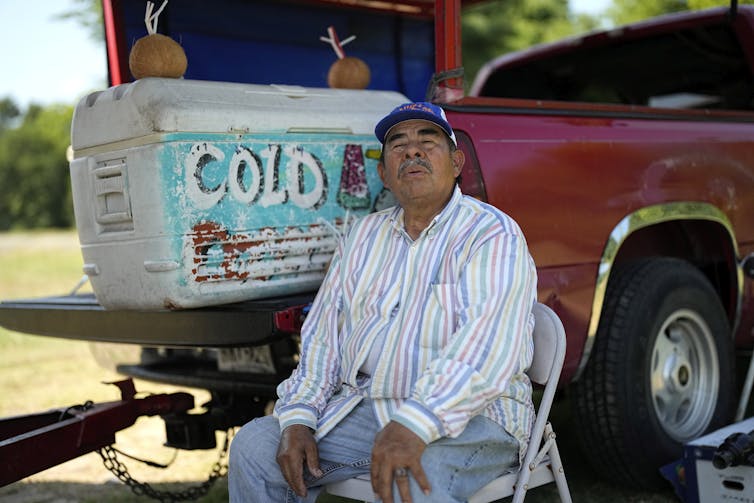
Summer 2023 was the hottest summer on record globally. For people working outside, like this fruit seller in Texas, shade was often the only respite from the heat. AP Photo/David J. Phillip

Regardless of where or when a heat wave strikes, one pattern is a constant: Older adults are the most likely to die from extreme heat, and this crisis will worsen in the coming years.

We study climate change and population aging. Our research documents two global trends that together portend a dire future.

More older adults will be at risk of heat stress

First, temperatures are hotter than ever. The nine-year period from 2015 and 2023 had the highest average temperatures since global records began in 1880.

Second, the population is aging worldwide. By 2050, the number of people ages 60 and older will double to nearly 2.1 billion, making up 21% of the global population. That proportion is 13% today.

These combined forces mean that ever-rising numbers of vulnerable older adults will be exposed to intensifying heat.

A older man driving an electric rickshaw with two passenger sits in direct sunlight in traffic on a hot day. He had a bandana over his head for shade.
Rickshaw drivers have little escape from the sun in New Delhi on May 3, 2024. Arun Sankar/AFP via Getty Images

To understand the risks ahead, we developed population projections for different age groups and combined them with climate change scenarios for the coming decades. Our analyses show that by 2050, more than 23% of the world population ages 69 and older will be living in regions where peak temperatures routinely surpass 99.5°F (37.5°C), compared with just 14% today.

That means that as many as 250 million additional older adults will be exposed to dangerously high temperatures.

Mapping the data shows that most of these older adults live in lower- and middle-income countries with insufficient services and limited access to electricity, cooling appliances and safe water.

Made with Flourish

In historically cooler regions in the Global North, including North America and Europe, rising temperatures will be the main force driving older adults’ heat exposure. In historically hotter regions in the Global South such as Asia, Africa and South America, population growth and increases in longevity mean that steeply rising numbers of older adults will be exposed to intensifying heat-related risks.

Policymakers, communities, families and older residents themselves need to understand these risks and be prepared because of older adults’ special vulnerabilities to heat.

Extreme heat is especially harmful to older adults

High temperatures are oppressive for everyone, but for older adults they can be deadly.

Extreme heat worsens common age-related health conditions such as heart, lung and kidney disease and can cause delirium. Older people don’t sweat as much as younger people, which makes it harder for their bodies to cool down when temperatures spike. These problems are intensified by common prescription medications, such as anticholinergics, which further reduce the capacity to sweat.

Spending time outdoors in hot humid weather can cause dehydration, a problem worsened by the side effects of prescription medications such as diuretics and beta-blockers. Dehydration can make older adults weak and dizzy, increasing their risk of falls and injury. These threats are even worse in regions lacking access to safe and affordable drinking water.

An older woman holds a glass of water next to a list of safety tips for older adults facing heat waves.
Tips for avoiding heat illness can save lives, but they can be difficult to follow, even in wealthy countries. Ohio Department of Aging

Poor air quality makes it difficult to breath, especially for those who already have lung problems such as chronic obstructive pulmonary disease, or COPD.

For older adults with physical health problems, temperatures as low as 80 F (26.7 C) can pose significant danger. And when humidity is as high as 90%, even 78 F (25.6 C) can be hazardous to older adults.

Nighttime heat is especially harmful for older adults whose homes lack air conditioning or who can’t afford to run their air conditioners for long periods. The ideal temperature for older adults’ restful sleep is between 68 and 77 F (20 and 25 C), and sleep quality diminishes as temperatures rise. A night of restless sleep can make an older adult more depressed and confused during their waking hours. Medications also can lose their effectiveness if stored in places much warmer than 77 F (25 C).

Older adults also may suffer emotionally during stifling heat waves

Being stuck indoors when temperatures are unbearable can make older adults bored, depressed and isolated. People with cognitive impairments may underestimate the dangers of extreme heat or may not understand the heat advisories.

Those who have physical mobility limitations or lack access to transportation can’t easily travel to public cooling centers – if there is one nearby – or find relief in nearby “green and blue areas,” such as parks and lakes.

Made with Flourish

These threats are especially dire in low- and middle-income nations, where older adults are more likely to live in substandard housing and lack access to high-quality health care or ways to cool down in the heat. We talk about this as “systemic cooling poverty.”

What can be done?

Policymakers can work to cut greenhouse gas emissions from fossil fuels in vehicles, power plants and factories, which drive global warming, and develop effective plans to protect older people from heat risk. Older adults and their caregivers also can take steps to adapt.

But efforts to help need to be tailored to each region and population.

Wealthy municipalities can increase public investments in early warning systems and ride services to cooling centers and hospitals. They can use geographic information systems to identify neighborhoods with high concentrations of older adults and expand power grids to manage increasing demand for air conditioning.

A woman and young girl sit in shade outside a small building with slats in the doors and a precarious looking roof.
In poorer countries, many homes and businesses lack ways for people to cool off in the heat. Sudipta Das/NurPhoto via Getty Images

In regions with substandard housing, limited access to clean water and few public supports such as cooling centers, much larger changes are necessary. Providing better health care, water and housing and reducing air pollution that can mitigate health problems during heat waves require significant changes and investments many countries struggle to afford.

The World Health Organization and Pan American Health Organization warn that this decade will be critical for preparing communities to handle rising heat and the risk to aging populations. Across all regions, researchers, practitioners and policymakers could save lives by heeding their call.The Conversation

Deborah Carr, A&S Distinguished Professor of Sociology and Director of the Center for Innovation in Social Science, Boston University; Enrica De Cian, Professor of Environmental Economics, Ca' Foscari University of Venice; Giacomo Falchetta, Research Scholar in Energy, Climate and Environment, Ca' Foscari University of Venice, and Ian Sue Wing, Professor of Earth and Environment, Boston University

This article is republished from The Conversation under a Creative Commons license. Read the original article.

  • 443
  • 444
  • 445
  • 446
  • 447
  • 448
  • 449
  • 450
  • 451
  • 452

Community

  • Lake County Wine Alliance offers sponsor update; beneficiary applications open 

  • Mendocino National Forest announces seasonal hiring for upcoming field season

Public Safety

  • Lakeport Police logs: Thursday, Jan. 15

  • Lakeport Police logs: Wednesday, Jan. 14

Education

  • Woodland Community College receives maximum eight-year reaffirmation of accreditation from ACCJC

  • SNHU announces Fall 2025 President's List

Health

  • California ranks 24th in America’s Health Rankings Annual Report from United Health Foundation

  • Healthy blood donors especially vital during active flu season

Business

  • Two Lake County Mediacom employees earn company’s top service awards

  • Redwood Credit Union launches holiday gift and porch-to-pantry food drives

Obituaries

  • Rufino ‘Ray’ Pato

  • Patty Lee Smith

Opinion & Letters

  • The benefits of music for students

  • How to ease the burden of high electric bills

Veterans

  • CalVet and CSU Long Beach team up to improve data collection related to veteran suicides

  • A ‘Big Step Forward’ for Gulf War Veterans

Recreation

  • Wet weather trail closure in effect on Upper Lake Ranger District

  • Mendocino National Forest seeking public input on OHV grant applications

  • State Parks announces 2026 Anderson Marsh nature walk schedule 

  • BLM lifts seasonal fire restrictions in central California

Religion

  • Kelseyville Presbyterian to host Ash Wednesday service and Lenten dinner Feb. 18

  • Kelseyville Presbyterian Church to hold ‘Longest Night’ service Dec. 21

Arts & Life

  • Auditions announced for original musical ‘Even In Shadow’ set for March 21 and 28

  • ‘The Rip’ action heist; ‘Steal’ grounded in a crime thriller

Government & Politics

  • Lake County Democrats issue endorsements in local races for the June California Primary

  • County negotiates money-saving power purchase agreement

Legals

  • March 3 hearing on ordinance amending code for commercial cannabis uses

  • Feb. 12 public hearing on resolution to establish standards for agricultural roads

How to resolve AdBlock issue?

Refresh this page