How to resolve AdBlock issue?
Refresh this page
How to resolve AdBlock issue?
Refresh this page
Lake County News,California
  • Home
    • Registration Form
  • News
    • Education
    • Veterans
    • Community
      • Obituaries
      • Letters
      • Commentary
    • Police Logs
    • Business
    • Recreation
    • Health
    • Religion
    • Legals
    • Arts & Life
    • Regional
  • Calendar
  • Contact us
    • FAQs
    • Phones, E-Mail
    • Subscribe
  • Advertise Here
  • Login

News

Who is displaced by tornadoes, wildfires and other disasters tells a story of vulnerability and recovery challenges in America


Age can make recovery harder after a disaster like the tornado that tore apart Greenfield, Iowa, in May 2024. AP Photo/Charlie Neibergall

People often think of disasters as great equalizers. After all, a tornado, wildfire or hurricane doesn’t discriminate against those in its path. But the consequences for those affected are not “one-size-fits-all.”

That’s evident in recent storms, including the widespread storms that brought deadly tornadoes to several states over the 2024 Memorial Day weekend, and in the U.S. Census Bureau’s national household surveys showing who was displaced by disasters in 2023.

Overall, the Census Bureau estimates that nearly 2.5 million Americans had to leave their homes because of disasters in 2023, whether for a short period or much longer. However, a closer look at demographics in the survey reveals much more about disaster risk in America and who is vulnerable.

It suggests, as researchers have also found, that people with the fewest resources, as well as those who have disabilities or have been marginalized, were more likely to be displaced from their homes by disasters than other people.
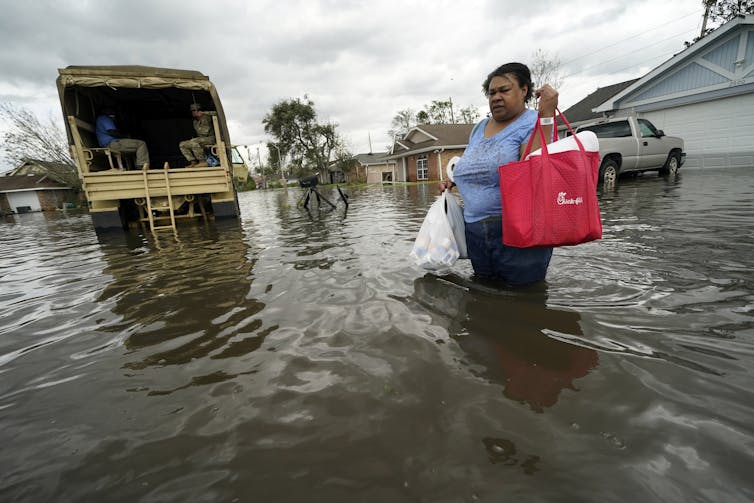
A woman walking in thigh-deep water crosses a road carrying a large bag. A National Guard truck brought her to the home to retrieve medications four days after the hurricane.
Disasters like hurricanes can cut electricity and running water to homes for weeks at a time, and can make access to retrieve medication and belongings for those displaced nearly impossible. AP Photo/Gerald Herbert

Decades of disaster research, including from our team at the University of Delaware’s Disaster Research Center, make at least two things crystal clear: First, people’s social circumstances – such as the resources available to them, how much they can rely on others for help, and challenges they face in their daily life – can lead them to experience disasters differently compared to others affected by the same event. And second, disasters exacerbate existing vulnerabilities.

This research also shows how disaster recovery is a social process. Recovery is not a “thing,” but rather it is linked to how we talk about recovery, make decisions about recovery and prioritize some activities over others.

Lessons from past disasters

Sixty years ago, the recovery period after the destructive 1964 Alaskan earthquake was driven by a range of economic and political interests, not simply technical factors or on need. That kind of influence continues in disaster recovery today. Even disaster buyout programs can be based on economic considerations that burden under-resourced communities.

This recovery process is made even more difficult because policymakers often underappreciate the immense difficulties residents face during recovery.

Following Hurricane Katrina, sociologist Alexis Merdjanoff found that property ownership status affected psychological distress and displacement, with displaced renters showing higher levels of emotional distress than homeowners. Lack of autonomy in decisions about how to repair or rebuild can play a role, further highlighting disparate experiences during disaster recovery.

What the census shows about vulnerability

The 2023 census data consistently showed that socially vulnerable groups reported being displaced from their homes at higher rates than other groups.

People over 65 had a higher rate of being displaced than younger people. So did Hispanic and Black Americans, people with less than a high school education and those with low household incomes or who were struggling with employment compared to other groups. While the Census Bureau describes the data as experimental and notes that some sample sizes are small, the differences stand out and are consistent with what researchers have found.

Low-income and marginalized communities are often in areas at higher risk of flooding from storms or may lack investment in storm protection measures.

The morass of bureaucracy and conflicting information can also be a barrier to a swift recovery.
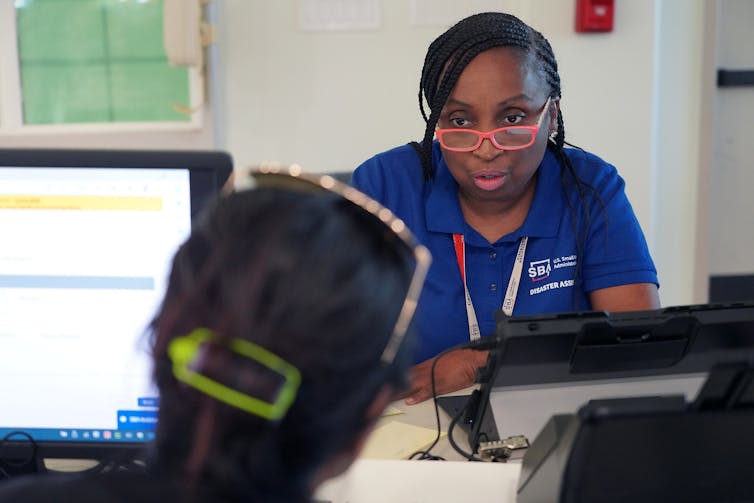
A woman in a polo shirt with a shirt reading
FEMA typically sets up recovery centers near disaster sites to help residents apply for federal aid. But getting to centers like this one near Lahaina, Hawaii, where a fire destroyed much of the town in 2023, can be difficult for people displaced by disasters. Department of Homeland Security

After Hurricane Sandy, people in New Jersey complained about complex paperwork and what felt to them like ever-changing rules. They bemoaned their housing recovery as, in researchers’ words, a “muddled, inconsistent experience that lacked discernible rationale”.

Residents who don’t know how to find information about disaster recovery assistance or can’t take time away from work to accumulate the necessary documents and meet with agency representatives can have a harder time getting quick help from federal and state agencies.

Disabilities also affect displacement. Of those people who were displaced for some length of time in 2023, those with significant difficulty hearing, seeing or walking reported being displaced at higher rates than those without disabilities.

Prolonged loss of electricity or water due to an ice storm, wildfire or grid overload during a heat emergency can force those with medical conditions to leave even if their neighbors are able to stay.

That can also create challenges for their recovery. Displacement can leave vulnerable disaster survivors isolated from their usual support systems and health care providers. It can also isolate those with limited mobility from disaster assistance.

Helping communities build resilience

Crucial research efforts are underway to better help people who may be struggling the most after disasters.

For example, our center was part of an interdisciplinary team that developed a framework to predict community resilience after disasters and help identify investments that could be made to bolster resilience. It outlines ways to identify gaps in community functioning, like health care and transportation, before disaster strikes. And it helps determine recovery strategies that would have the most impact.

Shifts in weather and climate and a mobile population mean that people’s exposure to hazards are constantly shifting and often increasing. The Coastal Hazard, Equity, Economic Prosperity, and Resilience Hub, which our center is also part of, is developing tools to help communities best ensure resilience and strong economic conditions for all residents without shortchanging the need to prioritize equity and well-being.

We believe that when communities experience disasters, they should not have to choose among thriving economically, ensuring all residents can recover and reducing risk of future threats. There must be a way to account for all three.

Understanding that disasters affect people in different ways is only a first step toward ensuring that the most vulnerable residents receive the support they need. Involving community members from disproportionately vulnerable groups to identify challenges is another. But those, alone, are not enough.

If we as a society care about those who contribute to our communities, we must find the political and organizational will to act to reduce the challenges reflected in the census and disaster research.

This article, originally published March 4, 2024, has been updated with latest severe storm systems.The Conversation

Tricia Wachtendorf, Professor of Sociology and Director, Disaster Research Center, University of Delaware and James Kendra, Director, Disaster Research Center and Professor, Public Policy & Administration, University of Delaware

This article is republished from The Conversation under a Creative Commons license. Read the original article.
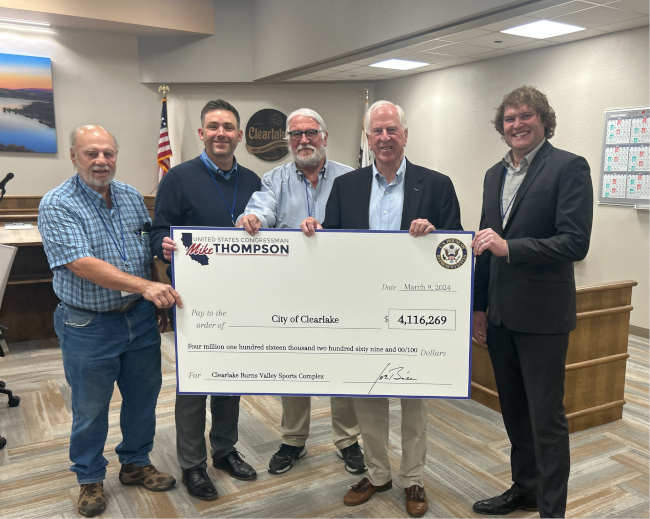
Congressman Thompson presents $4 million check for Clearlake’s Burns Valley sports complex

Congressman Mike Thompson presented a check for more than $4.1 million to the city of Clearlake for its Burns Valley Sports Complex and Recreation Center on Tuesday, May 28, 2024. From left to right, council members Russell Cremer, David Claffey and Dirk Slooten, Congressman Mike Thompson and City Manager Alan Flora. Courtesy photo.


CLEARLAKE, Calif. — The city of Clearlake’s effort to build a new sports complex took another step toward reality on Tuesday.

Congressman Mike Thompson came to town to present the city with a check for $4,116,279 for the construction of the Clearlake Burns Valley Sports Complex and Recreation Center.

Thompson helped secure the funding through the Consolidated Appropriations Act of 2024.

“Youth sports benefit everyone in Clearlake,” said Thompson. “The Burns Valley Sports Complex and Recreation Center will not only provide a venue for Clearlake's young athletes to train and compete, it is also expected to stimulate our economy by bringing in tens of thousands of new visitors to Clearlake each year. I was proud to work with city officials to identify the need for this funding and secure over $4 million for the project.”

The project will include a soccer field, baseball fields and a new 20,000-square-foot recreation center and a public works corporation yard behind the Burns Valley shopping center, on land the city purchased in December 2021.

The brand-new facility will expand the community’s access to sports and recreational amenities and help establish the city as a destination for sporting events and tournaments. At present, Lake County’s youth sports programs have no facilities to host tournaments.

A study conducted by Synergy Sports Global predicts the project will bring in over 40,000 additional annual visitors to Clearlake and result in 10,000 more annual hotel room stays.

The study also projects the new sports complex will generate an additional $8.6 million for the local economy each year.

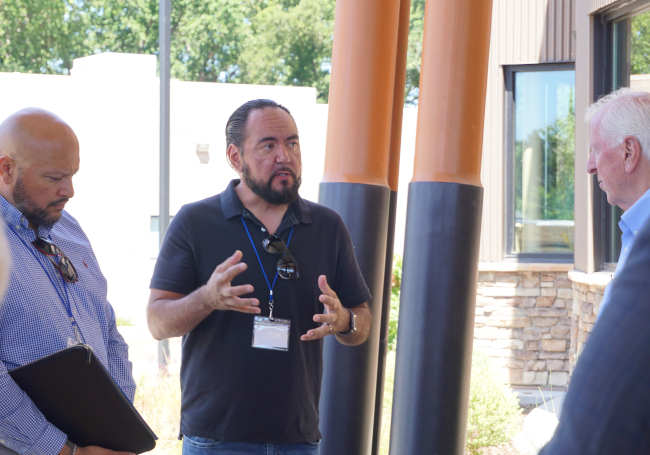
Elem Indian Colony Tribal Chairman Agustin Garcia speaks about development challenges to Congressman Mike Thompson at Lake County Tribal Health’s clinic in Clearlake, California, on Tuesday, May 28, 2024. Photo by Elizabeth Larson/Lake County News.

In addition to the recreation opportunities, the project has also created new housing.

The original parcel was 31 acres. The city sold a five-acre portion of the property to Danco Communities in May 2022 for $1.5 million.

The company built an 80-unit multi-family affordable housing complex, Oak Valley Villas, which celebrated its grand opening in April.

Rising costs challenge project

City Manager Alan Flora said when they started the sports complex project four years ago, he thought it would cost $8 million.

However, the project’s price tag is now at $20 million. Flora said the city now has $15 million for the project.

Thompson has so far provided more than $6 million to the effort. The check he presented on Tuesday is the second round of funding he has helped secure for the Burns Valley Sports Complex Project. In January of 2023, Thompson presented the city of Clearlake with a $2 million check to aid in the development of the complex.

Additionally, Flora said the Konocti Unified School District has pitched in $1 million and Lake County Tribal Health Consortium has provided $150,000. The rest of the funds for the project come from the city.

The city has figured out a phased approach for the project, which — like its 18th Avenue project — is being held up due to litigation filed against the city by the Koi Nation tribe. Flora said the trial in that case is due to take place in July.

He said he expects the city to break ground on the project in the spring.

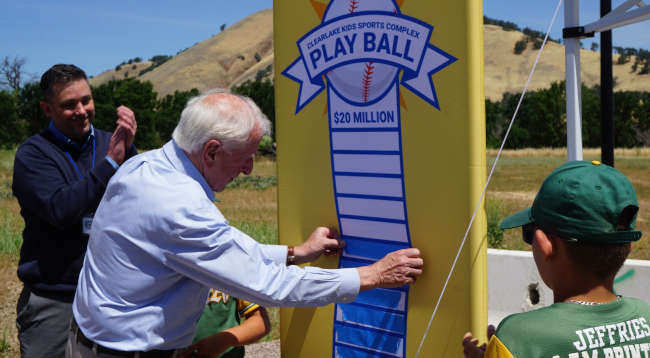
Congressman Mike Thompson helps update the fundraising sign for the Clearlake Burns Valley Sports Complex and Recreation Center on Tuesday, May 28, 2024, as Clearlake Mayor David Claffey looks on. Photo by Elizabeth Larson/Lake County News.


Thompson’s visit to the city to deliver the check included a tour around Clearlake with city, county and tribal officials.

The tour started with a brief meeting at City Hall, where Thompson presented the ceremonial check, before the group boarded a bus and headed out for stops at several key development sites.

The first stop was at the location where the Elem Indian Colony plans to build its new travel center site on an acre at 14825 and 14855 Lakeshore Drive, formerly the site of Mario’s Restaurant and Silk’s Bar and Grill, near Redbud Park.

From there, they went to the 40-acre Pearce Field, the city’s former airport and the site of the city’s major commercial development.

“This is a game changer for Clearlake,” said Flora, describing the concept for the high-end public market and commercial development that will include an Adventist Health medical office building and, potentially, a new hospital.

The group next traveled to the new Tribal Health clinic that opened last year, where CEO Ernesto Padilla explained how they stayed on budget during the pandemic by purchasing the materials and renting hangars to store them.

He said they are mirroring the services offered in Lakeport at the Clearlake clinic, and have purchased the dialysis building next door to offer more services, including pain management and behavioral health.

“There is a lot of need here,” Padilla said.

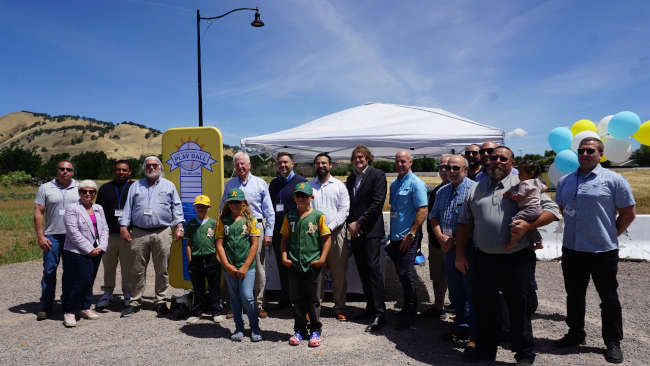
The tour’s final stop before returning to City Hall was at the recreation center site, where Thompson was joined by young ball players in placing blue tape on a sign used to track the fundraising for the project.

Email Elizabeth Larson at This email address is being protected from spambots. You need JavaScript enabled to view it.. Follow her on Twitter, @ERLarson, or Lake County News, @LakeCoNews.

Clearlake City Council members, city staff, Elem Indian Colony officials and community members joined Congressman Mike Thompson at the Clearlake Burns Valley Sports Complex and Recreation Center on Tuesday, May 28, 2024. Photo by Elizabeth Larson/Lake County News.

CHP investigates Sunday hit-and-run that killed pedestrian

LAKE COUNTY, Calif. — A Clearlake woman died early Sunday morning after being hit by a vehicle that fled the scene.

The California Highway Patrol’s Clear Lake Area office said the fatal crash occurred on Highway 53 north of Anderson Ranch Parkway near the city of Clearlake.

The victim’s name was not released pending the notification of next of kin.

At 1:53 a.m. that day, CHP Officer P. Leal Santana, and Officer W. Gregor were dispatched to a pedestrian down in the roadway.

When they arrived, officers found the pedestrian, a 23-year-old female from Clearlake, lying in the northbound lane of SR-53.

The CHP said the officers attempted to provide medical assistance; however, it was determined the pedestrian had already died of her injuries.

Evidence located at the scene indicated the pedestrian was struck by a vehicle traveling northbound in the No. 2 lane when the collision occurred, according to the CHP report.

The CHP said the driver fled the scene in a vehicle and did not report the incident.

Alcohol impairment is suspected to be a factor in this collision.

Any witnesses to this collision are asked to contact Officer Leal Santana of Clear Lake CHP at 707-279-0103.

Sheriff’s office seeks leads to identify woman found dead at Rodman Slough

LAKEPORT, Calif. — The Lake County Sheriff’s Office is asking for the community’s help in identifying a woman whose body was found on Monday.

The agency said the woman was found deceased in the Rodman Slough area of north Lakeport on Monday at around 9 a.m.

The sheriff’s office emphasized that the woman is not one of the persons currently missing in Lake County.

She is a white female, around 5 feet 2 inches to 5 feet 5 inches tall, and approximately 50 to 65 years old.

She was found wearing a black tank top-style shirt, purple leggings, burgundy socks and black shoes with green nail polish on her fingers.

The woman has short, pixie-cut blonde/brown hair.

She has identifiable tattoos: a butterfly on her left upper chest and a flower on the back right shoulder area.

If you may know who this person is, please call the Coroner’s Office at 707-262-4215.

More military veterans and active duty service members are dying by suicide than in battle – understanding why can help with prevention


Active duty service members and veterans experience unique stresses that can lead to suicide. MivPiv/iStock via Getty Images Plus

Although service members know they may lose their lives in combat in service of their country, they may not expect to lose their lives – or those they love – to suicide. A 2021 study estimated that four times as many active duty service members and veterans died by suicide as died in battle since 9/11.

Despite recent calls to action to improve suicide prevention within the military, suicide rates remain elevated among service members. In particular, active duty Army suicide rates were nearly two times higher than other active duty military services and more than two and a half times higher than the general population. Suicide rates are even more elevated in veterans, with an estimated 17 or more dying by suicide each day in 2021.

My research is aimed at identifying what drives high rates of suicide among certain groups. Better understanding what causes active duty service members and veterans to think about and plan suicide is imperative for efforts to prevent it.

Person with bowed head on one knee at a grave among a row of graves
Many soldiers are lost to suicide after the battle is over. AP Photo/Richard Vogel

Risk factors for suicide within the military

There are many reasons why service members and veterans may have elevated rates of thoughts of suicide and death. Notably, risk factors for active duty service members can be different from those of veterans.

Some factors linked to suicide in active duty service members include loneliness, relationship issues, workplace difficulties, trauma, disrupted schedules, increased stress, poor sleep, injury and chronic pain. On top of these same factors, veterans may also experience difficulties transitioning to civilian life.

Additionally, service members may have an elevated capability for suicide, meaning a decreased fear of death, high pain tolerance and familiarity with using highly lethal means like firearms.

Rethinking suicide research in the military

Increasing rates of suicide suggest that researchers need to study suicide differently in order to save more lives. Fortunately, several research advances are helping scientists rethink the way people study suicide within and outside the military.

Person in uniform with hand covering face while another person has a hand on their shoulder
Different approaches to studying suicide can help improve interventions. Prostock-Studio/iStock via Getty Images Plus

In my lab’s recent study, we harnessed some of these innovations to study what drives thoughts of suicide among service members. We asked 92 participants to download an app on their phones and take short surveys assessing suicide risk factors four times per day for one month. Using a newer type of statistical method called network analysis, we were able to pinpoint which symptoms related to suicide risk had the greatest influence on other symptoms at one moment in time as well as over time.

Overall, we found that feeling ineffective or like a burden to others, a sense of low belonging or feeling disconnected from others, and agitation are important drivers of moment-to-moment and longer-term risk for thoughts of suicide among service members and veterans.

Increasing effectiveness and belonging

Based on our study results, considering how the military both fosters and hinders a sense of belonging and effectiveness could help address suicide risk factors. This may become even more important as demands created by technology, such as drone pilots operating in siloed facilities, may lead active duty service members to be less connected to one another.

Additionally, some active duty service members report task saturation – feeling like they have too much to do without enough time, resources or tools to get tasks done. They also report working an unbalanced amount of hours that precludes rest and reflection. Allowing soldiers more time to do their work and reflect on it could renew their sense of effectiveness and improve their understanding of how they contribute to overall goals.

Close-up of two people holding hands, one of whom is wearing an army uniform
Fostering a culture of support in the military could help build connection among service members. AP Photo/Ted S. Warren

Additionally, military leadership could find ways to prioritize and reward group-level achievements over individual accomplishments. This could lead to both increased belonging and reduced feelings of ineffectiveness, in turn reducing thoughts of suicide.

Finally, relaxation techniques, including progressive muscle relaxation, massage and gentle movement, could be beneficial in reducing agitation.

There is still much work to do to turn the tides in the fight against suicide and help those who serve and protect us. If you or someone you love is thinking about suicide, know that you are not alone and there is help. For military-specific resources, you can call 988 and then press 1, or text 838255. You can also visit www.veteranscrisisline.net.The Conversation

April Smith, Associate Professor of Psychological Sciences, Auburn University

This article is republished from The Conversation under a Creative Commons license. Read the original article.
La Fiesta de Comida y Moda celebrates Latinx culture and heritage June 1

Folklorico dancers. Photo by Third Iris Photography.

MIDDLETOWN, Calif. — Get ready to immerse yourself in a vibrant celebration of Latinx heritage at the Food and Fashion Fiesta-Fiesta de Comida y Moda on June 1, from 5:30 to 8 p.m.

Hosted by the Middletown Art Center, or MAC, this event promises an evening brimming with cultural richness and community spirit.

Attendees are encouraged to don their traditional Latinx clothing to honor and celebrate Latinx heritage, with prizes awarded for the “best” traditional attire.

The event will feature an array of delectable treats, including free tacos, tamales, pupusas, and salad, beans and rice with additional food and beverages available for purchase.

Co-create a mural with Raìces Hermosas exhibit artist, Catalina Gonzalez or help Matin Zuniga build a sculpture from recycled water bottles.

Explore the Raìces Hermosas exhibit and offerings from local art vendors. Dance to the beats of DJ Chill-E, savor the captivating voice of Irma Lopez, and be enchanted by the grace of folklórico dancers from Middletown High School.

Family fun and children's activities will also be available.

“This event will honor the beauty and diversity of our culture in a night to remember,” said Samara Zepeda, project coordinator and cultural educator at MAC.

La Fiesta de Comida y Moda is the culminating event for the Raices Hermosas-Gorgeous Roots project which features a guest-curated exhibit of exceptional work from local and regional Latinx artists. It closes June 3.

MAC has been instrumental in nurturing educational experiences for Lake County students through free school field trips including inquiry-based exhibit tours and hands-on creative art activities.

Almost 3,000 Lake County students visited the Raices Hermosas exhibit, and explored artistic expressions of cultural roots, identity and element and principles of art and visual literacy.

By providing youth with a unique and enriching experience of California’s diverse cultural heritages, MAC continues to champion artistic expression and understanding across cultures.

“The Raices Hermosas exhibit and related field trips provided not only a moving visual experience but also a deep dive into the cultural and artistic heritages of Latinx people,” said Lisa Kaplan, executive and artistic director of MAC.

Join us at the Food and Fashion Fiesta-Fiesta de Comida y Moda for an unforgettable celebration of Latinx heritage and community spirit.

Funding for the Raíces Hermosas project is provided by Specified General Fund for the Museum Grant Program under the California Cultural and Historical Endowment.

The Food & Fashion Festival is sponsored by Lake County Tribal Health, Twin Pine Casino, North Coast Opportunities, MendoLake Food Hub and Hardester’s Markets.

Middletown Art Center is a nonprofit dedicated to engaging the public in art making, art education, and art appreciation and providing a platform for diverse voices and perspectives, striving to create an inclusive and accessible space for all.

To learn more and donate to support this or other MAC arts and cultural programs visit the center’s website.

For inquiries or further information, please contact the Middletown Art Center at 707-355-4465 or email This email address is being protected from spambots. You need JavaScript enabled to view it..

The Middletown Art Center is located at 21456 State Highway 175 in Middletown.
  • 442
  • 443
  • 444
  • 445
  • 446
  • 447
  • 448
  • 449
  • 450
  • 451

Community

  • Lake County Wine Alliance offers sponsor update; beneficiary applications open 

  • Mendocino National Forest announces seasonal hiring for upcoming field season

Public Safety

  • Lakeport Police logs: Thursday, Jan. 15

  • Lakeport Police logs: Wednesday, Jan. 14

Education

  • Woodland Community College receives maximum eight-year reaffirmation of accreditation from ACCJC

  • SNHU announces Fall 2025 President's List

Health

  • California ranks 24th in America’s Health Rankings Annual Report from United Health Foundation

  • Healthy blood donors especially vital during active flu season

Business

  • Two Lake County Mediacom employees earn company’s top service awards

  • Redwood Credit Union launches holiday gift and porch-to-pantry food drives

Obituaries

  • Rufino ‘Ray’ Pato

  • Patty Lee Smith

Opinion & Letters

  • The benefits of music for students

  • How to ease the burden of high electric bills

Veterans

  • CalVet and CSU Long Beach team up to improve data collection related to veteran suicides

  • A ‘Big Step Forward’ for Gulf War Veterans

Recreation

  • Wet weather trail closure in effect on Upper Lake Ranger District

  • Mendocino National Forest seeking public input on OHV grant applications

  • State Parks announces 2026 Anderson Marsh nature walk schedule 

  • BLM lifts seasonal fire restrictions in central California

Religion

  • Kelseyville Presbyterian to host Ash Wednesday service and Lenten dinner Feb. 18

  • Kelseyville Presbyterian Church to hold ‘Longest Night’ service Dec. 21

Arts & Life

  • Auditions announced for original musical ‘Even In Shadow’ set for March 21 and 28

  • ‘The Rip’ action heist; ‘Steal’ grounded in a crime thriller

Government & Politics

  • Lake County Democrats issue endorsements in local races for the June California Primary

  • County negotiates money-saving power purchase agreement

Legals

  • March 3 hearing on ordinance amending code for commercial cannabis uses

  • Feb. 12 public hearing on resolution to establish standards for agricultural roads

How to resolve AdBlock issue?
Refresh this page