 How to resolve AdBlock issue?
News
The same plan would protect current members from retirement changes but would form a powerful commission to modernize military retirement for future generations.
Like base closing commissions, final recommendations would have to be wholly rejected or accepted. The president and the Congress could not make select changes.
The White House debt cutting plan, delivered to the Joint Select Committee on Deficit Reduction, confirms what advocates for TRICARE beneficiaries had feared: that they are expected to share in the fiscal sacrifices to be asked of millions of Americans drawing federal entitlements.
Military associations sound equally alarmed by the rhetoric in the White House recommendations suggesting that key military benefits are just too generous and must be brought nearer to what civilians receive.
“Military service is unlike any other occupations, whether in government or the civilian sector,” said Joe Barnes, national executive director of the Fleet Reserve Association. Yet the White House now puts “a tremendous focus on trying to benchmark benefits associated with that service to what’s going on in the corporate world.”
“We were shocked at the tone of it,” said Steve Strobridge, director of government relations for Military Officers Association of America. “It talks about, basically, civilianizing the military benefits package. I mean it expresses that as a goal, which to us is absolutely anathema. The whole point of the benefit package is to provide an offset for unique conditions of military service. You can’t civilianize the package without civilianizing service conditions. If the last 10 years show us anything it’s that military conditions are getting worse than when these programs were designed.”
Two TRICARE features are targeted. Users of TRICARE for Life (TFL), the prized supplement to Medicare for beneficiaries 65 and older, would pay an annual fee, starting at $200 in 2013, with adjustments for inflation.
The White House notes that TFL users now pay only the Medicare Part B premium, $110 a month for most, and pharmacy co-pays. Otherwise they face no out of pocket health costs. By contrast, private sector elderly, in 2009, paid on average $2100 a year for their “Medigap” policy.
The annual TFL fee would save a $6.7 billion over 10 years.
Obama’s would save another $20 billion across a decade by raising pharmacy co-pays in the TRICARE retail network, sparing only active duty members. Current co-pays “have lagged” behind other plans, it says.
Family and retiree drug costs at retail outlets would move “closer to parity with the most popular federal employee health plan, BlueCross BlueShield Standard, and closer to the health plans that most Americans have from their employers,” the White House report explains.
Federal civilians now pay about $45 to get a brand name drug at retail. Military beneficiaries pay $9 and it rises next month to $12. Obama also wants military drug co-pays to rise automatically with costs to the government, thus shifting from a set dollar co-pay to a percentage formula. So co-pays for generic drugs at retail would be set at 10 percent of the Defense Department’s cost for the medicine.
Sometime after 2013 this would climb to 20 percent. Co-pays for brand names would start at 15 percent of cost and be raised to 30 percent over some yet unspecified period.
In proposing a commission to “reform” retirement, with authority similar to that of the 2005 Base Realignment and Closure Commission, the White House said the current system “is now out of line with most other government or private retirement plans.”
Even as associations like MOAA and FRA alerted members to details of Obama’s plan, and urged that e-mails and letters of protest flood Congress, the outcome of this fight to protect benefits appeared more uncertain than in battles past, with the real chance changes could become law by year’s end.
The unusual structure adopted in August to reach a debt deal – with the president and Congress conceding to the joint or “super” committee of 12 lawmakers responsibility to shape a take-it-or-leave-it legislative package by November 23 – almost certainly handcuffs the influence of lobbyists to derail whatever package of cost curbs the committee’s majority embraces.
“It changes the dynamic considerably,” said a key congressional staff member. “The changes get rolled into a package and all of a sudden it looks like just your fair share. And we shouldn’t take our fair share?”
The super committee’s power to cut a final deal leaves TRICARE advocates “automatically at a disadvantage” that they didn’t face defeating the Bush administration’s call for hefty TRICARE fee hikes starting in 2006. Those ideas had to clear familiar ground, the armed services committees.
“They can influence those committees very dramatically,” the staffer said.
Only two super committee members also serve on armed services, though all standing committees are invited to share views on cuts they favor and oppose. Sen. Jim Webb (D-Va.), who chairs the Senate military personnel panel, said he views lifetime health care as “part of a moral contract between our government and those who have stepped forward to serve. For this reason, I oppose the president’s proposals to impose new TRICARE fees on military retirees and other beneficiaries.”
But Arnold Punaro, a retired Marine major general, strongly supports initiatives to slow TRICARE cost growth as well as retirement reforms for new entrants. He applauds the planned retirement commission, urging that a prominent military leader, like retired Gen. Colin Powell, serve as chairman.
Punaro is an influential member on the Defense Business Board, which has recommended to the defense secretary broad changes in retirement and new initiatives to curb “out-of-control” health costs.
“The path advocated by the Praise-the-Lord-and-Pass-the-Benefits outfits are pushing this nation either to a hollow military or to a military way too small to deal with the threats we face,” Punaro said.
To comment, e-mail
Follow Lake County News on Twitter at http://twitter.com/LakeCoNews, on Tumblr at www.lakeconews.tumblr.com, on Facebook at http://www.facebook.com/pages/Lake-County-News/143156775604?ref=mf and on YouTube at http://www.youtube.com/user/LakeCoNews.
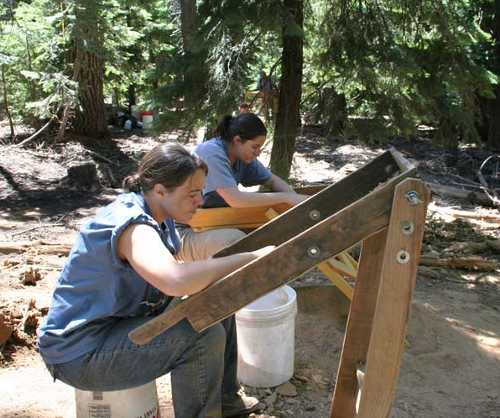
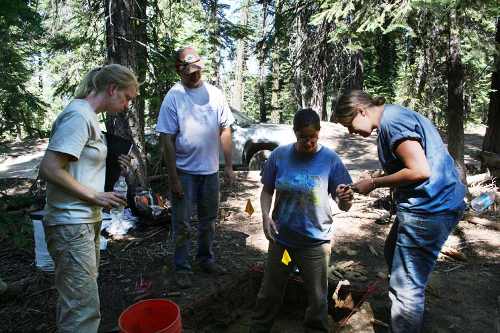
MENDOCINO NATIONAL FOREST, Calif. – For a week, 32 volunteers, 11 archaeologists and two tribal representatives from Round Valley lived on the Mendocino National Forest to work on a Passport in Time (PIT) archaeology project.
The work took place in the forest from Aug. 22 to Aug. 26.
The project participants were working on sample excavations across a site believed to be a prehistoric hunting base camp.
Findings included stone flakes from making and maintaining projectile points, partial and nearly whole projectile points, as well as other stone tools.
Projectile points are mostly large specimens used on spears, rather than associated with bow and arrow, a technology that came later in time.
“It’s kind of unusual at this elevation to find a lot of ground stone – we’re at 6,200 plus feet,” said Forest Archaeologist Mike Dugas. “There are quite a few pieces including a small pestle, an anvil stone and various milling stone fragments typically used for processing plant foods. These implements suggest families were at the site, as plant processing was typically done by women.”
Most projectile points found at the site appear to be 3,000 to 5,000 years old, according to the archaeologists.
“The early component is most likely representative of the Yuki tribal territory,” Dugas said. “The presence of artifacts which appear to be made from northeast obsidian sources suggest the Nomlaki were here at some point also. Obsidian analysis will tell us more about who and when the site was occupied. The bulk of tools we’re finding here are from the early period.”
PIT participants started 15 excavation units to sample across the site. Working in teams of three, they excavated square holes, digging across each layer a centimeter at a time and collecting the dirt in 5 gallon buckets which were poured through screens to filter out cultural artifacts. Each layer was carefully documented, including what items were found.
The unit concludes when sterile soil is reached, with no cultural evidence. On average, this was approximately 16 inches deep.
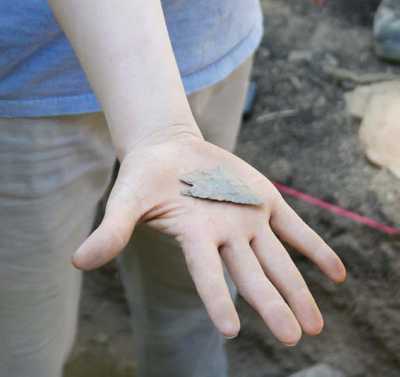
“I’ve gotten to do every job,” said PIT Volunteer Desiree Scott, who came to the project from San Rafael. “I can screen, I can dig, I can help out with paperwork.”
This is Scott’s second PIT project. Her first was a survey done on the Pike National Forest in Colorado, which was different from the hands-on experience she has had working on an excavation project.
Among her favorite experiences with this PIT project was learning new skills, as well as the diverse group of people working on the project and camping out all week.
“At night we talk about what everybody found,” Scott added.
Each morning, the group goes over safety and the plan for the day before travelling from the Masterson Group Campground to the project site, which Scott said was helpful.
Christa Westphal, an archaeologist from the Plumas National Forest Feather River Ranger District and Chico State University student, said her favorite part was “learning more about prehistoric archaeology.”
Wesley Thomas of Paradise came to the Mendocino National Forest for his first PIT project. He joined his son Lowell Thomas, an archaeologist from the Mendocino National Forest Grindstone Ranger District.
“I love it. It’s wonderful to be around all these intelligent, nice people who love what they’re doing with a lot of patience and a lot of knowledge that they share,” Wesley Thomas said. “If they had these going on for a month at a time I would do them all summer.”
This is Lowell Thomas’ third PIT Project working as an employee. He said his favorite part of the experience is, “seeing how much the volunteers enjoy the experience for the first time and seeing the cultural material that they didn’t know was on the Forest.”
The PIT project on the Mendocino National Forest was the fourth this season for Jim Blaes from Atascadero. He is scheduled to participate in another project next month in Markleeville, south of Lake Tahoe.
“I’ve enjoyed all of it … all I’ve been privileged to do,” Blaes said.
“I like working with these two guys, too,” Blaes laughed, nodding to Wesley and Lowell Thomas, who were working in the same unit.
The PIT Project site this year was first identified during the Keeran Timber Sale in 1976. Artifacts have been found at the site for decades and the site is in an area where there is a lot of disturbance that has brought items to the surface.
“We look around more (here) and find more and more each time,” Dugas said.
At the conclusion of the project, the units were filled in and forest archaeologists will process the information gathered.
The units loop down towards a watering hole, which Dugas speculated was the draw to the site as a base camp.
The diverse group of PIT volunteers included students, professors, retirees, and working professionals who wanted to learn more about archaeology and prehistoric cultures.
“We appreciate all the help from the PIT volunteers,” Dugas added. “It’s been a great week and we are glad we were able to share the experience and have a safe and successful project.”
PIT is a volunteer program with the Forest Service that provides an opportunity for the public to learn more about archaeology and historic preservation working side-by-side with Forest Service archaeologists and historians at sites across the United States.
For more information on the PIT program, or to apply to participate on a PIT project, please visit www.passportintime.com.
Follow Lake County News on Twitter at http://twitter.com/LakeCoNews, on Tumblr at www.lakeconews.tumblr.com, on Facebook at http://www.facebook.com/pages/Lake-County-News/143156775604?ref=mf and on YouTube at http://www.youtube.com/user/LakeCoNews.


Observations from NASA's Wide-field Infrared Survey Explorer (WISE) mission indicate the family of asteroids some believed was responsible for the demise of the dinosaurs is not likely the culprit, keeping open the case on one of Earth's greatest mysteries.
While scientists are confident a large asteroid crashed into Earth approximately 65 million years ago, leading to the extinction of dinosaurs and some other life forms on our planet, they do not know exactly where the asteroid came from or how it made its way to Earth.
A 2007 study using visible-light data from ground-based telescopes first suggested the remnant of a huge asteroid, known as Baptistina, as a possible suspect.
According to that theory, Baptistina crashed into another asteroid in the main belt between Mars and Jupiter about 160 million years ago. The collision sent shattered pieces as big as mountains flying. One of those pieces was believed to have impacted Earth, causing the dinosaurs' extinction.
Since this scenario was first proposed, evidence developed that the so-called Baptistina family of asteroids was not the responsible party. With the new infrared observations from WISE, astronomers say Baptistina may finally be ruled out.
“As a result of the WISE science team's investigation, the demise of the dinosaurs remains in the cold case files,” said Lindley Johnson, program executive for the Near Earth Object (NEO) Observation Program at NASA Headquarters in Washington.
“The original calculations with visible light estimated the size and reflectivity of the Baptistina family members, leading to estimates of their age, but we now know those estimates were off,” said Johnson. “With infrared light, WISE was able to get a more accurate estimate, which throws the timing of the Baptistina theory into question.”
WISE surveyed the entire celestial sky twice in infrared light from January 2010 to February 2011. The asteroid-hunting portion of the mission, called NEOWISE, used the data to catalog more than 157,000 asteroids in the main belt and discovered more than 33,000 new ones.
Visible light reflects off an asteroid. Without knowing how reflective the surface of the asteroid is, it's hard to accurately establish size. Infrared observations allow a more accurate size estimate. They detect infrared light coming from the asteroid itself, which is related to the body's temperature and size.
Once the size is known, the object's reflectivity can be re-calculated by combining infrared with visible-light data.
The NEOWISE team measured the reflectivity and the size of about 120,000 asteroids in the main belt, including 1,056 members of the Baptistina family.
The scientists calculated the original parent Baptistina asteroid actually broke up closer to 80 million years ago, half as long as originally proposed.
This calculation was possible because the size and reflectivity of the asteroid family members indicate how much time would have been required to reach their current locations – larger asteroids would not disperse in their orbits as fast as smaller ones.
The results revealed a chunk of the original Baptistina asteroid needed to hit Earth in less time than previously believed, in just about 15 million years, to cause the extinction of the dinosaurs.
“This doesn't give the remnants from the collision very much time to move into a resonance spot, and get flung down to Earth 65 million years ago,” said Amy Mainzer, a co-author of a new study appearing in the Astrophysical Journal and the principal investigator of NEOWISE at NASA's Jet Propulsion Laboratory (JPL) in Pasadena. Calif. “This process is thought to normally take many tens of millions of years.”
Resonances are areas in the main belt where gravity nudges from Jupiter and Saturn can act like a pinball machine to fling asteroids out of the main belt and into the region near Earth.
The asteroid family that produced the dinosaur-killing asteroid remains at large. Evidence that a 10-kilometer (about 6.2-mile) asteroid impacted Earth 65 million years ago includes a huge, crater-shaped structure in the Gulf of Mexico and rare minerals in the fossil record, which are common in meteorites but seldom found in Earth's crust.
In addition to the Baptistina results, the NEOWISE study shows various main belt asteroid families have similar reflective properties. The team hopes to use NEOWISE data to disentangle families that overlap and trace their histories.
“We are working on creating an asteroid family tree of sorts,” said Joseph Masiero, the lead author of the study. “We are starting to refine our picture of how the asteroids in the main belt smashed together and mixed up.”
JPL manages and operated WISE for NASA's Science Mission Directorate. The spacecraft was put into hibernation mode after it scanned the entire sky twice, completing its main objectives. The principal investigator, astronomer Edward Wright, is at UCLA.
The mission was selected competitively under NASA's Explorers Program managed by the agency's Goddard Space Flight Center in Greenbelt, Md. The science instrument was built by the Space Dynamics Laboratory in Logan.
The spacecraft was built by Ball Aerospace & Technologies Corp. in Boulder, Colo. Science operations and data processing take place at the Infrared Processing and Analysis Center at the California Institute of Technology in Pasadena. Caltech manages JPL for NASA.
Follow Lake County News on Twitter at http://twitter.com/LakeCoNews, on Tumblr at www.lakeconews.tumblr.com, on Facebook at http://www.facebook.com/pages/Lake-County-News/143156775604?ref=mf and on YouTube at http://www.youtube.com/user/LakeCoNews.
Scott De Leon, director of the County’s Public Works Department and Water Resources, reported that Water Resources staff has been on the lake throughout the summer performing regular water monitoring activities and the presence of a different species at this time is not surprising.
The species is identified as Microcystis, a species that tends to appear in spring and fall, whereas summer algal blooms in recent years have consisted mostly of a species called Lyngbya.
“Similar to other species of blue-green algae that we’ve seen, Microcystis also has the potential to release toxins, so it’s important for people to avoid areas with heavy algae accumulation or surface matting, regardless of the type,” De Leon said.
When viewed in the water, the Lyngbya species appears to be fibrous with hair-like filaments and creates floating mats that turn turquoise, purple, orange, and yellow.
In contrast, the Microcystis species appears to be more granular and its presence makes the affected water look like bright-green pea soup.
Both species can produce nuisance odors and may release toxins into the water, county officials reported.
Although the species are different, the advice remains the same, that is, common sense.
Lake County Health Officer Dr. Karen Tait agreed, recommending that it is best to avoid areas near dense patches of algae.
“If you see signs of algae accumulation, it’s best to keep away from that area,” Dr. Tait said.
Dr. Tait and officials from Lake County’s Environmental Health Division continue their recommendations that people and pets stay out of impacted areas, that untreated lake water never be used for drinking water, and that anyone experiencing symptoms after exposure should contact their physician.
“Clear Lake is one of many recreational water bodies around the world that are experiencing a similar increase in the presence of algae blooms,” De Leon said.
He noted that since algae mats move with the currents, the expanse of Clear Lake combined with changing winds can make mitigation efforts a challenge.
De Leon also said, “That also means that at any given time, there are generally many areas on Clear Lake that are not affected.”
The algae monitoring and mitigation efforts are part of the county’s focused approach to protect Clear Lake’s ecosystem and to enable residents and visitors to enjoy the lake to the fullest extent possible.
Lake County’s Water Resources staff has been trying a variety of techniques to mitigate the nuisance algae all summer, including harvesting, aeration and circulation, and chemical treatments.
It is expected the algae will subside significantly with the forecasted cooler temperatures.
For information on blue-green algae, visit the California Department of Public Health Web site at www.cdph.ca.gov/healthinfo/environhealth/water/pages/bluegreenalgae.aspx.
For information on the County’s algae mitigation efforts, contact the Lake County Water Resources office at 707-263-2344.
For health-related questions, contact the Lake County Health Services office at 707-263-1164.
Follow Lake County News on Twitter at http://twitter.com/LakeCoNews, on Tumblr at www.lakeconews.tumblr.com, on Facebook at http://www.facebook.com/pages/Lake-County-News/143156775604?ref=mf and on YouTube at http://www.youtube.com/user/LakeCoNews.
Four Caltrans workers have died in traffic-related incidents in the last year. Three of them were killed within 48 days, during May and June.
Those deaths reversed a steady trend of reduced fatalities, which is partially attributed to the Slow for the Cone Zone public awareness campaign established in 1999. A total of 178 Caltrans workers have died on the job since 1924.
“Motorists often automatically slow down when they see police or CHP officers,” said Caltrans Interim Director Malcolm Dougherty. “We also want them to slow down for Caltrans vehicles and equipment.”
The CHP officers will park their patrol vehicles within work zones.
Caltrans hopes that the presence of the officers will help to slow traffic or encourage vehicles to move over at least one lane from a highway work zone, as required by the Move Over law.
“Adhering to this law can mean the difference between life and death,” said CHP Commissioner Joe Farrow. “The only way to prevent tragedies from occurring on the side of the road is by giving emergency personnel, highway workers and the public some space.”
The CHP will also employ one or more additional enforcement vehicles at some work zones.
Officers will be on hand to ensure safety, and will ticket violators that are traveling too fast in work zones.
The need is significant. Caltrans currently has some 800 ongoing construction contracts valued at more than $10 billion.
The Move Over law, which took effect in 2007, requires drivers to move over a lane when emergency vehicles displaying flashing lights are present. It was amended in 2009 to add Caltrans vehicles with flashing amber lights.
Caltrans, the CHP, the California Office of Traffic Safety, and the Department of Motor Vehicles are working as partners to increase awareness of the law – through the Internet, public service announcements, billboards and the media.
Follow Lake County News on Twitter at http://twitter.com/LakeCoNews, on Tumblr at www.lakeconews.tumblr.com, on Facebook at http://www.facebook.com/pages/Lake-County-News/143156775604?ref=mf and on YouTube at http://www.youtube.com/user/LakeCoNews.
Education
Health
Business
Obituaries
Veterans
Recreation
Religion
Arts & Life
Government & Politics