 How to resolve AdBlock issue?
News
MENDOCINO COUNTY, Calif. – The Mendocino County Sheriff's Office said it believes a man being sought for two August homicides was involved with a burglary reported on Sept. 25 near Willits.
For more than a month the Mendocino County Sheriff's Office and a force of allied agencies have sought 35-year-old Aaron James Bassler of Fort Bragg.
Bassler is wanted for the August murders of Fort Bragg Councilman Jere Melo and Mendocino Land Trust employee Matthew Coleman.
Earlier this week. Mendocino County Sheriff Tom Allman said the search is taking place in a 400-square-mile area along the North Coast near Fort Bragg.
On Sunday, Sept. 25, Mendocino County Sheriff's deputies were dispatched to a discovered burglary of a vacation cabin located in the 16000 block of NorthSpur Road, approximately 14.2 miles east of Fort Bragg and approximately 10 miles northwest of Willits along the Noyo River watershed, according to a Wednesday report.
Upon arrival at the scene deputies discovered the person responsible for the burglary had forced entry into the cabin and appeared to have taken food items. Officials said investigators are still attempting to obtain an inventory of the cabin's items from the owner who was not present at the scene.
Deputies collected various items from inside the cabin that were believed to be touched by the person who had committed the burglary, according to the report. Those items were forwarded to the Mendocino County Sheriff's Office Evidence Bureau for processing of latent prints, which resulted in the recovery of a latent print.
The recovered latent print was forwarded to the California Department of Justice laboratory in Sacramento for identification purposes.
On Wednesday afternoon a Department of Justice latent print criminalist contacted investigators and confirmed the recovered latent print was Bassler, the Mendocino Sheriff's Office said.
The NorthSpur Road area was the location of additional burglaries that Mendocino County Sheriff's detectives were sent to investigate on Sept. 20, the report said.
One full-time residence and at two vacation cabins located in the 17000 block of NorthSpur Road had allegedly been burglarized. The agency said detectives learned the structures were not occupied at the time of the burglaries, forced entry was used and food items had been taken.
It also was learned that a .22 caliber rifle and a 12-gauge shotgun had been taken during one of the burglaries. Detectives at this time believe Bassler to be responsible for those burglaries.
As a result of the preceding information the Mendocino County Sheriff's Office activated the reverse 911 system on Wednesday afternoon to warn the residents of NorthSpur of Bassler's presence.
The Mendocino County Sheriff's Office said the effort to apprehend Bassler continues with support from several local, state and federal law enforcement agencies.
The public is encouraged to be vigilant of their surroundings and to report any possible sighting of Bassler by calling the Command Post at 707-961-2479 or 911 under emergency situations.
Follow Lake County News on Twitter at http://twitter.com/LakeCoNews, on Tumblr at www.lakeconews.tumblr.com, on Facebook at http://www.facebook.com/pages/Lake-County-News/143156775604?ref=mf and on YouTube at http://www.youtube.com/user/LakeCoNews .
The district's board of trustees unanimously ratified the agreement with the the California School Employees Association Chapter No. 638 at the board's Sept. 20 meeting, according to district Superintendent Dave McQueen.
The document, which also was ratified by the CSEA leadership, is for the period July 1, 2011, through June 30, 2014.
McQueen said the district was glad to have reached a conclusion on the negotiations.
Tiffany Kemp, the district's chief financial officer, said negotiations on the CSEA contract began in May 2010. Kemp added that all union contracts are for three-year terms.
CSEA Chapter President Holley Luia said the mediated agreement was reached when the district's unrepresented employees – including the superintendent, principals, confidential office employees, chief financial officer, counselors, classified management and the board of trustees – all agreed to cap themselves at the same benefit level as they asked the classified employees to take.
According to the document, benefits for full-time classified and unrepresented staff are capped at $16,000 per year.
Luia said that agreement most closely resembles a “fair share” and not the full share of the financial burden that she said classified workers had originally been asked to take.
Other points of the mediated agreement matters related to discipline, including putting a committee together to consider disciplinary issues, which McQueen called “pretty standard.”
Kelseyville Unified was put into “qualified” status by the state after concerns arose that it might not be able to meet its financial obligations, as Lake County News has previously reported.
That has led to hard financial decisions for the district, including layoffs and service cuts that the district board had to add to a financial recovery plan earlier this year. In all, the district identified nearly $2.3 million in cuts to keep fiscally sound.
Overall, classified staff workers have taken 21 layoffs, said Luia, although four and a half positions recently were restored thanks to additional, unanticipated state funding.
Even so, Luia – a secretary at Kelseyville High School who was among those who were hired back after layoff this summer – said the classified union remains concerned about the safety and well being of students on district campuses because of the cuts.
She said the cuts have resulted in inadequate custodial services, with three school campuses down to only one full-time secretary with a half-time secretary split between sites.
In addition, the district's transportation department has only four hours of clerical making it difficult for parents and school sites to get busing information, Luia said.
“CSEA is astutely aware of how the layoffs of such services hurt our kids and inconvenience our communities families and hope to make future restoration of laid off positions a priority for the district,” Luia said.
E-mail Elizabeth Larson at
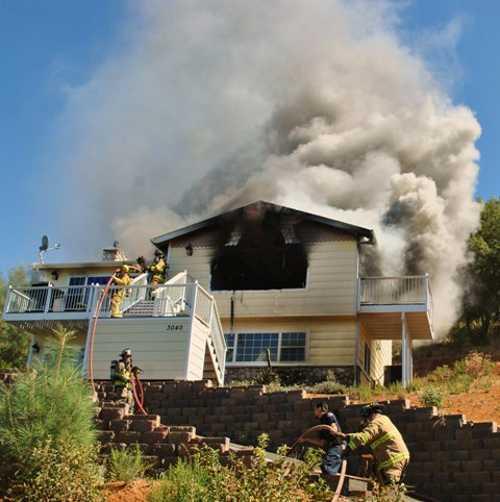
KELSEYVILLE, Calif. – A Monday afternoon fire damaged a home in the Kelseyville.
The fire was reported at about 1:45 p.m. at 3040 Edgewood Drive, according to reports from the scene.
Due to the steep terrain – the large two-story home is located on a hillside – and the fact that several others homes were close by, two local fire agencies and Cal Fire all converged at the scene with resources.
Kelseyville Fire sent two engines and one chief; Lakeport Fire sent an engine and a medic unit; and Cal Fire sent two battalion chiefs, three planes, one helicopter and one Konocti Conservation hand crew.
Reports from the scene indicated that most of the fire's damage was contained to the front portion of the home's upper story.
Units were being released from the scene shortly after 2:30 p.m., according to radio traffic.
Follow Lake County News on Twitter at http://twitter.com/LakeCoNews, on Tumblr at www.lakeconews.tumblr.com, on Facebook at http://www.facebook.com/pages/Lake-County-News/143156775604?ref=mf and on YouTube at http://www.youtube.com/user/LakeCoNews .

LAKEPORT, Calif. – The continued arraignment of a Northshore man accused of killing an Upper Lake woman earlier this month had to be delayed on Monday due to conflicts of interest concerns among local defense attorneys.
Daniel Ray Loyd, 50, of Nice, returned to Lake County Superior Court on Monday, but for a second time did not enter a plea.
He's charged with the Sept. 13 shooting death in Lucerne of 48-year-old Cindy Yvette Quiett.
Charges the District Attorney's Office has filed against Loyd include murder, a special allegation of using a gun and a second special allegation alleging that Quiett's homicide occurred during the commission of a robbery; robbery and a special allegation of use of a firearm; assault with a firearm, with a special allegation of personally using a firearm; allegations of being a felon in possession of a firearm and a felon carrying a loaded firearm in public; being a felon in possession of ammunition; a misdemeanor charge of brandishing a firearm; and special allegations that Loyd had two prior state prison terms, which attach to all of the main counts in the case.
Last week, defense attorney Doug Rhoades was appointed Loyd's attorney, and had asked for additional time before entering a plea, as Lake County News has reported.
However, on Monday, “I and every other public defender had to declare a conflict,” Rhoades told Lake County News.
He said those numerous conflicts for local attorneys arose from the number of people listed either as victims or witnesses in the case, with all of the attorneys having had some contact with some of those individuals.
In Rhoades' place, Ukiah attorney Robert Boyd was appointed Loyd's defense counsel, Rhoades said.
Deputy District Attorney John DeChaine said Loyd's entry of plea was put over to 10 a.m. Tuesday, Oct. 11, in Lake County Superior Court's Department Three.
E-mail Elizabeth Larson at
Last November, a case on behalf of Phyllis Wehlage, a resident of Evergreen Lakeport Healthcare, was filed against Evergreen California Healthcare and associated entities, including EmpRes Healthcare.
The case initially was filed in Sonoma County Superior Court – the corporation has a facility in Petaluma as well – and earlier this year the case was moved to the federal court's jurisdiction. A specific dollar amount in damages was not included in the filings.
Wehlage, who stayed at Evergreen Lakeport Healthcare in 2008, allegedly suffered “indignities and other harms” due to inadequate nurse staffing levels, the complaint stated.
In June federal court Judge Claudia Wilken ruled against EmpRes' and Evergreen's motion to have Wehlage's suit dismissed, clearing the way for the suit to become class action, according to court records.
However, earlier this month, following additional filings in the case, attorneys for EmpRes Healthcare filed a notice of mediation, which is supposed to commence in the case on Oct. 24.
Evergreen Lakeport Healthcare is a 99-bed skilled nursing facility for both long- and short-term needs, according to its Web site.
It's part of the larger, privately held Evergreen Healthcare Companies and EHC Management LLC, which are affiliates of EmpRes Healthcare, based in Vancouver, Wash. The corporation has skilled nursing and assisted living facilities across California, and in Idaho, Montana, Nevada, Oregon and Washington.
Messages left for Evergreen Healthcare's legal department and the lead attorney on the lawsuit were not returned.
Wehlage's attorneys, led by Michael Crowley, allege that the lawsuit is necessary because Evergreen Lakeport Healthcare is habitually understaffed.
The California Association of Health Facilities, a group representing an estimated 85 percent of California's nursing facilities, believes such litigation is damaging to the industry.
Mark Reagan, the association's attorney, called such lawsuits a “shakedown” of the industry.
Court documents explained that there was no response or long wait times for response to Wehlage's call light; she had lack of assistance for grooming and bathing; inadequate attention to toileting needs resulted in her sitting in a urine-soaked bed for hours; she suffered “rough and painful handling” by the facility's staff; and she was not assisted with eating or provided with the necessary fluids.
“All evils stem from understaffing, in my view,” Crowley told Lake County News.
Patricia McGinnis, executive director of California Advocates for Nursing Home Reform, agreed, arguing that most problems with health care quality in convalescent facilities are directly related to staffing.
“Understaffing is a chronic condition in California. There's no question about it,” said McGinnis, adding, “The problems that emanate from understaffing are huge.”
In addition, “We have a very, very poor enforcement system in California,” she said, noting that the system is “very provider oriented.”
McGinnis said there's an “easy answer” to these issues. “The state needs to go in and start doing enforcement and oversight.”
However, without that oversight, McGinnis believes that a lawsuit like that filed against Evergreen is the only remedy, as the state's complaint process is long and, in her view, often ineffective.
Reagan said the suits are in fact giving rise to problems for the industry. As one example, he said facilities looking for insurance are facing higher premiums because of the suits.
The association also argues that the state's licensed convalescent facilities are highly regulated and are meeting state and federal requirements for care.
In June Judge Wilken ruled there was a viable cause of action in Wehlage's case, and to address concerns the court had, Crowley and his team filed an amended complaint that named Evergreen's numerous other facilities as well as additional individual residents for the class action standing.
Crowley said the understaffing that is alleged in the case violates the Patients Bill of Rights, which includes the right to be in a facility that has sufficient staff to care for the needs of patients.
That bill of rights also lays out minimum state staffing requirements – including 3.2 nursing hours per day per patient – which the suit alleges Evergreen Lakeport violated.
McGinnis said convalescent facilities received an extra $1 billion in reimbursements between 2004 and 2008, but alleged that they still didn't meet state staffing requirements.
She said nursing home staff commonly are underpaid and have no health benefits, and as a consequence there is high turnover.
California Association of Health Facilities spokesperson Deborah Pacyna countered McGinnis' arguments on staffing levels, stating that the actual statewide staffing average is 3.6 hours per patient.
Pacyna said California convalescent facilities' hours of care surpass the the national average of 3.4 hours per day, and are beyond the statewide requirement of 3.2 hours per day per patient.
On June 29, Gov. Jerry Brown signed ABx1 19, which extended the Medi-Cal payment system for nursing homes until July 31, 2013, amounting to a Medi-Cal having to repay nursing homes about $400 million for a temporary rate cut, according to McGinnis.
McGinnis said her organization opposed the bill because it does not require facilities to use the money for staffing or care, and the system continues to lack meaningful accountability measures. She said those reimbursements should be used for patient care, not profits.
Reagan maintained that facilities are doing just what McGinnis said they should – providing greater care thanks to the government's reimbursement incentives.
According to the US government's Medicare site, www.medicare.gov, Evergreen Lakeport Healthcare is the lowest-ranked of three Lake County care facilities in Medicare's five star quality rating programs.
Evergreen's overall rating was one out of five stars, defined as “much below average.” It received one star for health inspections, two stars – “below average” – for staffing and three – “average” – for quality measures.
Inspectors found the facility had 13 health deficiencies – ranging from mistreatment, quality care, residents rights, nutrition and diet, pharmacy, environmental and administration – for the period of May 1, 2010, through July 31, 2011, two more than the average number of such deficiencies in California and eight more than the federal average.
A landmark case sets the stage
Crowley and law partner Tim Needham are “battle tested” in cases like Wehlage's. Crowley was lead trial counsel on a landmark class action case involving an estimated 32,000 plaintiffs versus Skilled Healthcare, a nursing home chain which owns 22 facilities, including all five of those located in Humboldt County.
In July 2010 a Humboldt County jury awarded the plaintiffs in the Skilled Healthcare case a $671 million verdict, the largest of its kind in the nation's history, following four and a half years of litigation and six and a half months at trial, Crowley said.
He called the Skilled Healthcare case a “perfect storm” in which he and his legal team were able to prove 1.3 million violations over a six-year period. The Humboldt County jury gave the plaintiffs in that case the maximum $500 penalty per violation.
The company later was allowed to settle for $50 million, which prevented it from going bankrupt, “which we were really not interested in doing,” Crowley said, adding they wanted the company “to function as a viable business that obeys the law.”
The court also issued an injunction in that case to ensure compliance, Crowley said.
“This is not unique to Skilled Healthcare,” said Crowley. “This is an industrywide practice,” and a practice that he said has become increasingly used despite laws like AB 1629, enacted to increase the size of medical reimbursements in order to increase staffing levels.
Rather than take that money and hire more staff, Crowley said such facilities are using it to increase profit margins – at the expense of patients.
The staff the facilities did have were paid “shockingly low” levels; in some cases, certified nursing assistants were not even paid minimum wage, he said.
The class action approach, Crowley said, is more effective, “because, quite frankly, we're dealing with corporations,” he said, adding, “They're not going to do the right thing because it's the right thing.”
A result of the verdict and injunction, said Crowley, was that every one of Skilled Healthcare's facilities began to aggressively hire certified nursing assistants, licensed vocational nurses and registered nurses.
“This hasn't been bad for business, this has been excellent for business,” he said, with more hires – and higher pay – set to result.
At first Skilled Healthcare's shares dropped, but they've since rebounded. “That company's in fine shape,” said Crowley, adding “We're not out to put anybody out of business,” but rather to change the industry's corporate culture.
In one way, the victory was hollow. “Most of our named clients died before trial,” said Crowley, with one woman surviving long enough to see the matter resolved.
Crowley argued that it was a victory for patients and a major wake up call for the industry.
However, the California Association of Health Facilities, has a markedly different view of such litigation.
Reagan said the group viewed the Skilled Healthcare award as “outlandish,” arguing that it was rendered by the jury without findings of patient suffering or harm.
“I think there was significant concern but certainly not panic under the circumstances,” Reagan said, in addressing the industry's reaction to the suit.
In the Skilled Healthcare suit, as in Evergreen Lakeport, Crowley alleged that the convalescent home industry has used understaffing as a business model.
In the Evergreen Healthcare suit, “there's very similar issues going on,” said Crowley.
“We think we can accomplish a social good with this,” Crowley said.
But Reagan and the California Association of Health Facilities don't share that opinion.
Reagan accused Crowley and his colleagues of being opportunists after having gotten “a very good result” in the Skilled Healthcare case.
There have been at least seven separate class actions brought by the same attorneys, said Reagan, trying to replicate an outcome that the association believes is not based on the facts.
In about half of those cases Reagan said the courts have dismissed the claims or limited them significantly.
Reagan believes that, ultimately, it will become “legally untenable” to carry out such awards against facilities.
E-mail Elizabeth Larson at
The Employment Development Department's latest report on California's employment numbers showed that Lake County had a 16.6 percent unemployment rate in August, down 0.9 percentage points over the month and 0.6 percentage points over the year.
California's unemployment rate in August was 12.1 percent, up from 12 percent in July but down from 12.4 percent in August 2010. The unemployment rate is derived from a federal survey of 5,500 California households.
The number of people unemployed in California was 2,175,000 – up by 8,000 over the month, but down by 83,000 compared with August of last year, the state reported.
The U.S. unemployment rate was unchanged in August at 9.1 percent, according to the US Bureau of Labor Statistics. The August 2010 national unemployment rate was 9.6 percent.
In August, Marin had a 7.8 percent unemployment rate, the state's lowest, and Imperial County had the highest statewide rate, 32.4 percent, according to the report.
Lake County's August rate ranked it No. 54 of the state's 58 counties, the Employment Development Department reported.
Lake's neighboring counties registered the following unemployment rates and statewide ranks: Glenn, 16.3 percent, No. 53; Colusa, 16 percent, No. 50; Yolo, 11.2 percent, No. 23; Mendocino, 10.7 percent, No. 16; Sonoma, 10 percent, No. 10; and Napa, 8.8 percent, No. 3.
Dennis Mullins of the Employment Development Department's North Coast Region Labor Market Information Division reported that Lake County industry employment increased 250 jobs between July and August.
Mullins said that increase is part of a usual trend as seasonal farm employment increased and schools begin rehiring for the new term.
He said that nine industry sectors gained jobs or were unchanged over the month, and two declined.
Job growth was noted in farm (+130); manufacturing (+10); trade, transportation and utilities (+10); private educational and health services (+10); and government (+100), according to Mullins.
He said industries with no change over the month included mining, logging and construction; information; financial activities; professional and business services.
Leisure and hospitality was down 20 jobs for August, and the “other services” category was down by 10 jobs, according to Mullins' report.
Mullins said government (-70), construction (-50) and financial activities (-20 and includes real estate) continue to lag over the year, accounting for over three-fourths of the county’s year-over job decline (-180).
Amongst Lake County's cities and Census designated places, in August Clearlake Oaks once again had the highest unemployment, 24.6 percent, followed by Nice, 24 percent; the city of Clearlake, 23.7 percent; Lucerne, 17.5 percent; Kelseyville, 16.9 percent; Middletown, 16.9 percent; city of Lakeport, 16 percent; Cobb, 14.8 percent; Lower Lake, 13.9 percent; Hidden Valley Lake, 13.7 percent; north Lakeport, 13.1 percent; and Upper Lake, 8.6 percent.
Lake County had a labor force of 25,120 people in August, with 4,170 of them jobless, based on the most recent state report. In July, records showed there were 24,980 people in the work force, with 4,360 of them out of work.
The Employment Development Department reported that there were 543,089 people in California receiving regular unemployment insurance benefits during the August survey week, compared with 566,380 last month and 620,844 last year.
New claims for unemployment insurance were 54,463 in August 2011, compared with 57,897 in July
and 65,261 in August of last year, the state reported.
State shows slight decrease in job numbers
Nonfarm jobs in California totaled 14,057,200 in August, a decrease of 8,400 jobs over the month, according to a survey of businesses that is larger and less variable statistically.
The Employment Development Department said the survey of 42,000 California businesses measures jobs in the economy. The year-over-year change – August 2010 to August 2011 – showed an increase of 171,100 jobs, up 1.2 percent.
The federal survey of households, done with a smaller sample than the survey of employers, showed a decrease in the number of employed people.
The state said that survey estimated the number of Californians holding jobs in August was 15,830,000, a decrease of 18,000 from July, and down 58,000 from the employment total in August of last year.
Five categories – mining and logging; manufacturing; trade, transportation and utilities; professional and business services; and leisure and hospitality – added jobs over the month, gaining 9,100 jobs, according to the Employment Development Department. Trade, transportation and utilities posted the largest increase over the month, adding 5,700 jobs.
Six categories – construction; information; financial activities; educational and health services; other services; and government – reported job declines over the month, down 17,500 jobs, the state said. Construction posted the largest decrease over the month, down 7,200 jobs.
In a year-over-year comparison, from August 2010 to August 2011, nonfarm payroll employment in California increased by 171,100 jobs, up 1.2 percent, according to the report.
The August report said that eight categories – mining and logging; construction; manufacturing; trade, transportation and utilities; information; professional and business services; educational and health services; and leisure and hospitality – posted job gains over the year, adding 209,200 jobs. Professional and business services posted the largest gain on a numerical basis, adding 57,700 jobs, up 2.8 percent.
Information posted the largest gain on a percentage basis, up by 5.6 percent, an increase of 24,100 jobs, according to the report.
Three categories – financial activities; other services; and government – posted job declines over the year, down 38,100 jobs, the state said.
The report showed that government posted the largest decline on both a numerical and percentage basis, down by 27,400 jobs, a decrease of 1.1 percent.
E-mail Elizabeth Larson at