 How to resolve AdBlock issue?
News
April 15, 2012, marks the 100th anniversary of the sinking of the RMS Titanic, and a century later the world remains fascinated by the ill-fated ocean liner.
The ship, carrying more than 2,200 passengers and crew, set sail on April 10, 1912, on her maiden voyage from Southampton, England, to New York City.
At the time the Titanic, built in Belfast, Ireland, was the largest passenger ship on the ocean, and the White Star Line billed the ship “unsinkable.”
Shortly after 11:30 p.m. April 14 Titanic struck an iceberg, and early the next morning the ship split and sank.
More than 1,500 people died. The RMS Carpathia picked up the the survivors in the lifeboats hours later.
The ship's sinking had worldwide repercussions, and for decades the wreck went undiscovered.
In 1985 the ship was discovered in 12,400 feet in the North Atlantic. The following year, the U.S. Congress passed the RMS Titanic Memorial Act to recognize the wreck site's discovery and its historical and cultural significance.
Answering the lingering questions
One hundred years after the sinking of the Titanic, a mystery still surrounds the cause of the events on that tragic night in April 1912.
On a clear night, under a sky of bright stars, how could two expertly trained lookouts miss an enormous iceberg lying directly in the ship's path? Furthermore, why did it take so long for help to arrive?
The National Oceanic and Atmospheric Administration's National Climatic Data Center (NCDC) may finally have given researchers the information needed to conclusively answer these questions.
Researchers used NCDC's data archive, which contains hundreds of millions of records stretching back as far as the mid-1700s, as their most significant source to uncover the real reason the Titanic sank.
NCDC archivists provided researchers with 75 Greenwich Mean Noon (GMN) ship observation forms from April 1912 containing air and sea surface temperatures in the vicinity of the wreck site.
These documents also contained observer comments and sketches of sea ice that proved to be just as valuable as the data. Some of these comments included ominous phrases such as “much refraction on the horizon.”
These comments and data would establish the framework for British Titanic historian Tim Matlin's new theory that a mirage actually played a major role in causing the Titanic to sink.
Observations recorded in the logbooks provided evidence of the recent arrival of the cold water Labrador Current in the area.
This current cooled the warm air above the Gulf Stream from the bottom up resulting in a strong thermal inversion, which causes light to bend.
This refraction would have made the horizon appear higher than normal, camouflaging the iceberg from view until it was too late.
The temperature inversion, with the warmer air aloft, would also have scrambled the Titanic's Morse code signal and caused the distress rockets to appear lower in the sky to nearby ships, making the rescue effort exceedingly difficult.
These data records, never before used in such a capacity, also assisted Matlin and his team in the production of “Titanic: Case Closed,” a 96-minute documentary that explains his theory in detail with vivid effects and dramatic first-hand accounts.
However, these records might not have even been available without the preservation work of the Climate Database Modernization Program (CDMP) at NCDC.
The CDMP team imaged the century-old forms to permanently preserve them and make them digitally available to others.
A critical telegram
Historians also have discovered that a telegram from another ship could have saved Titanic.
On April 14, 1912, the German-flagged S.S. Amerika also was steaming for the United States, just ahead of Titanic.
When the Amerika encountered several large icebergs near 41°27'N, 50°8'W – in the middle of the Atlantic – she passed the message on to the hydrographic office – a precursor to the Defense Mapping Agency Hydrographic Center – in Washington, D.C., via the Titanic's radio relay.
The Amerika's radio antennae were not large enough to get messages to the ground relay station at Cape Race, Newfoundland, Canada from her distance, and it was common practice for other larger ships to relay messages.
As a result of this radio relay, the Titanic actually had the location of the icebergs that they struck one day later.
The resultant fallout from this maritime disaster put into motion the Safety of Life at Sea (SOLAS) Convention in 1914, which, after subsequent meetings, includes a global requirement for baseline weather forecasts to ensure safer ocean voyages worldwide. The United States was one of the original signatories of this convention.
Today, the National Weather Service, through the Ocean Prediction Center, National Hurricane Center, and Honolulu, Hawaii Weather Forecast Office, assumed the obligation to issue warnings and forecasts for the North Atlantic and North Pacific Oceans.
For more visit www.noaa.gov/titanic .
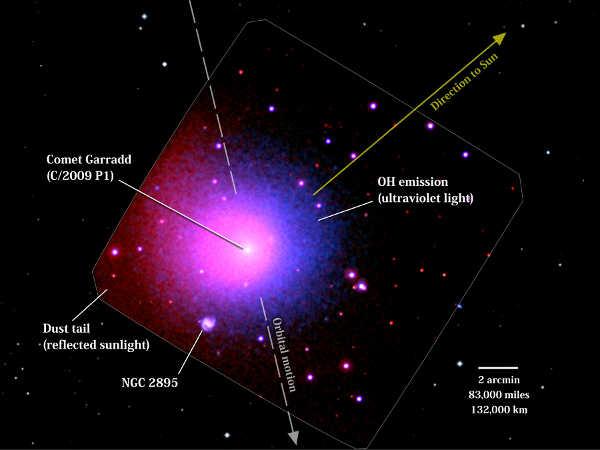
An outbound comet that provided a nice show for skywatchers late last year is the target of an ongoing investigation by NASA's Swift satellite.
Formally designated C/2009 P1 (Garradd), the unusually dust-rich comet provides a novel opportunity to characterize how cometary activity changes at ever greater distance from the sun.
A comet is a clump of frozen gases mixed with dust. These "dirty snowballs" cast off gas and dust whenever they venture near the sun. What powers this activity is frozen water transforming from solid ice to gas, a process called sublimation. Jets powered by ice sublimation release dust, which reflects sunlight and brightens the comet.
Typically, a comet's water content remains frozen until it comes within about three times Earth's distance to the sun, or 3 astronomical units (AU), so astronomers regard this as the solar system's "snow line."
"Comet Garradd was producing lots of dust and gas well before it reached the snow line, which tells us that the activity was powered by something other than water ice," said Dennis Bodewits, an assistant research scientist at the University of Maryland, College Park, and the study's lead investigator. "We plan to use Swift's unique capabilities to monitor Garradd as it moves beyond the snow line, where few comets are studied."
Comets are known to contain other frozen gases, such as carbon monoxide and dioxide (CO and CO2), which sublimate at colder temperatures and much farther from the sun.
These are two of the leading candidates for driving cometary activity beyond the snow line, but phase transitions between different forms of water ice also may come into play.
C/2009 P1 was discovered by Gordon J. Garradd at Siding Spring Observatory, Australia, in August 2009. Astronomers say that the comet is "dynamically new," meaning that this is likely its first trip through the inner solar system since it arrived in the Oort cloud, the cometary cold-storage zone located thousands of AU beyond the sun.
Comet Garradd was closest to the sun on Dec. 23, 2011, and passed within 118 million miles (1.27 AU) of Earth on March 5, 2012. The comet remains observable in small telescopes this month as it moves south though the constellations Ursa Major and Lynx.
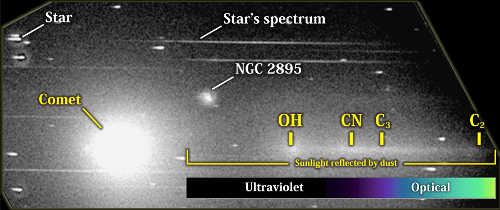
Although Swift's prime task is to detect and rapidly locate gamma-ray bursts in the distant universe, novel targets of opportunity allow the mission to show off its versatility. One of Swift's instruments, the Ultraviolet/Optical Telescope (UVOT) is ideally suited for studying comets.
The instrument includes a prism-like device called a grism, which separates incoming light by its wavelength.
While Swift's UVOT cannot detect water directly, the molecule quickly breaks up into hydrogen atoms and hydroxyl (OH) molecules when exposed to ultraviolet sunlight.
The UVOT detects light emitted by hydroxyl and other important molecular fragments – such as cyanide (CN), carbon monosulfide (CS) and diatomic and triatomic carbon (C2 and C3, respectively) – as well as the sunlight reflected off of cometary dust.
"Tracking the comet's water and dust production and watching its chemistry change as it moves deeper into the solar system will help us better understand how comets work and where they formed," said Stefan Immler, a researcher and Swift team member at NASA's Goddard Space Flight Center in Greenbelt, Md.
Swift last observed the comet on April 1, when it was 1.53 AU away and just past the orbit of Mars. Although detailed results are not yet available, Bodewits estimates that Comet Garradd was shedding about 400 gallons of water each second -- enough to fill an Olympic-size swimming pool in under 30 minutes.
But the water given off by the comet was only about half of the dust mass it produced. Bodewits estimates that each second, Garradd was losing about 7,500 pounds (3.5 metric tons, or about twice the typical mass of a small car) in the form of dust and icy grains.
Thanks to Garradd's brightness and the UVOT's sensitivity and resolution, researchers can monitor the comet when it is beyond the grasp of most ground-based observatories. Plans call for observations at eight different distances from the sun out to about 5.5 AU, which the comet will reach in April 2013.
LAKEPORT, Calif. – Kitten season is arriving early in Lake County this year, and these three little kittens are among the first of the season to be put up for adoption at Lake County Animal Care and Control.
They're about 6 weeks old and come in a variety of colors – calico, orange tabby and black.
Lake County Animal Care and Control is located at 4949 Helbush in Lakeport, next to the Hill Road Correctional Facility.
Office hours are Monday through Friday, 8 a.m. to 5 p.m., and 1 p.m. to 3 p.m., Saturday. The shelter is open from 10:30 a.m. to 4:30 p.m. Monday through Friday and on Saturday from 1 p.m. to 3 p.m.
Visit the shelter online at http://www.co.lake.ca.us/Government/Directory/Animal_Care_And_Control.htm .
To fill out an adoption application online visit http://www.co.lake.ca.us/Government/Directory/Animal_Care_And_Control/Adopt/Dog___Cat_Adoption_Application.htm .
For more information call Lake County Animal Care and Control at 707-263-0278.
In the midst of an emergency, a member of the public may have to call 911.
It is the calm voice and gentle demeanor at the other end of the phone that can help soothe rattled nerves and calm a stressful situation.
The U.S. Congress has designated the second full week of April of each year as National Public Safety Telecommunicators Week.
The California Highway Patrol (CHP) this week is taking the opportunity to thank communication workers who are on the front line of emergency response.
“The dedicated public safety dispatchers you speak with at our communications centers throughout the state are highly trained professionals. In an emergency, they may be the first person within our agency that you may come in contact with,” said CHP Commissioner Joe Farrow. “We are proud of the vital and often life-saving services they provide on a daily basis.”
CHP dispatchers often have challenging and stressful jobs since they take the majority of California’s wireless 911 emergency and non-emergency calls.
Dispatchers ensure the appropriate assistance is provided, whether it is sending an officer to respond to a call, or contacting fire, ambulance, or other emergency services.
In addition, they are in constant radio communication with the patrol officers, often assisting them by looking up vehicle identification, license plate and driver license numbers, or by running checks for wanted subjects.
The CHP has 25 communications/dispatch centers statewide that employ nearly 900 public safety dispatchers.
Last year, these individuals were responsible for handling approximately 9.3 million calls for service (911 and other calls).
Calling 911 during a stressful incident can be intimidating.
The following tips are designed to help callers through an emergency:
- No matter what happens – stay calm.
- Be prepared to provide your name, phone number, address or location, and a detailed description of the incident being reported.
- Let the dispatcher guide the conversation.
- Wait for the dispatcher to ask questions, then answer clearly and calmly.
- Listen carefully and follow all directions provided by the dispatcher.
- Be prepared to provide a physical description if an emergency involves a criminal suspect.
- Cellular telephones may not tell the call-taker where you are. Use a landline to report an emergency whenever possible.
- Remember, 911 is for life-threatening emergencies. Misuse of the emergency 911 system will result in a delay for callers with real emergencies and is punishable by a fine of not more than $1,000.
“We commend the employees who provide radio, telephone, and computer services to the public and CHP officers in the field, and we appreciate their continued dedication and professionalism,” Farrow added.
In the opening lines to The Waste Land, T.S. Eliot wrote, “April is the Cruelest Month.”
You might agree if you live in the southeastern United States. Last April, a historic outburst of 202 tornadoes turned broad swaths of that part of the country into a disaster zone.
“The event of April 27 and 28, 2011, was the costliest convective storm in U.S. History,” said Kevin Knupp, professor of atmospheric sciences at the University of Alabama-Huntsville.
And he doesn't just mean costly in terms of property damage – 316 people lost their lives.
Of the 202 twisters that day, 62 tore through Alabama, where Knupp works. Ten of them were ranked EF 4 and 5 on the Enhanced Fujita Scale.
Three tornadoes churned paths more than 120 miles long, and a large number of the twisters cut swaths more than a half mile wide.
Knupp saw the results firsthand, and he’s been studying them ever since.
Aided by a team of graduate students and colleagues, he’s sifted through gigabytes of data1 collected by NASA and NOAA satellites and local ground sensors.
A year later, they have drawn some interesting conclusions.
One discovery was how rapidly an EF-5 spun up near the small town of Hackleburg, Alabama.
“The Hackleburg storm got its act together really quickly,” said Knupp.
This particular twister formed only 50 minutes after the underlying thunderstorm appeared. For comparison, the average time for tornado formation is 2 hours.
The twister blasted through north Alabama with winds over 200 miles per hour, killing 72 people.
Knupp’s team believes that something called a “thermal boundary” set the stage for the birth of the killer. Cool, moist air on one side of the boundary formed a low cloud base – “kind of like a wall,” he explained.
Warm air from the storm ran into the wall and swept upward. Updrafts are a key ingredient of tornadoes. In this case, updrafts as swift as 75 feet per second were recorded.
They also noticed that many of the tornadoes seemed to cluster in space and time. Knupp offers the example of Arab and Guntersville, neighboring communities not far from NASA’s Marshall Space Flight Center: “Sixteen tornadoes touched down in the area – 13 of them in a half hour period.”
Could local topography have attracted the twisters?
There does appear to be a link between the shape of the landscape and the path of these tornadoes.
“Arab-Guntersville is in a valley between two mountain ridges, and valleys can channel the flow of air, like in a breezeway,” noted UA-Huntsville atmospheric scientist Tim Coleman, a member of the research team.
Coleman also noticed a correlation between the slope of the terrain and the onset of damage tracks. “Winds intensified on the downward slopes of mountains in the area—and that is sometimes where the damage path starts,” he said.
He has observed this phenomenon in past tornadoes in east Tennessee and southern Virginia.
This tornado-topography hypothesis might seem obvious, but researchers have not always had enough data to test it – that is, not until April 2011.
Prompted in part by the outbreak, Coleman has studied tornado paths all over the southeast and found some interesting repeats.
For example, just north of Birmingham, several violent tornadoes have tracked within a 10-mile wide band since 1977. A similar track appears to the north and west of Huntsville.
“More research is needed to see if topography really plays a role,” cautioned Coleman. “The more we can learn, the more accurate we can make tornado warnings.”
They’re likely to get more data in the near future. It is April, after all.
Dauna Coulter works for the National Aeronautics and Space Administration.
LAKEPORT, Calif. – The trial of two young Clearlake Oaks men accused of killing a small boy and wounding five others in Clearlake last June will continue after the defense and prosecution reached an agreement that resulted in the disposition of a mistrial motion.
Paul William Braden, 22, and Orlando Joseph Lopez, 24, are being tried on 15 counts each for the shooting death on June 18, 2011, of 4-year-old Skyler Rapp and the wounding of his mother, Desiree Kirby; her boyfriend, Ross Sparks and his brother, Andrew Sparks; and friends Ian Griffith and Joseph Armijo.
Last Thursday, April 5, Lopez's defense attorney, Stephen Carter, moved for mistrial, alleging that District Attorney Don Anderson had committed prosecutorial misconduct by abusing Carter in front of the jury.
Specifically, Anderson had said Carter was being “artful” in trying to get around a hearsay objection.
Carter said that was a slur against his integrity, and at a subsequent hearing that day outside of the presence of the jury he moved for mistrial.
The hearing on Carter's mistrial motion was set to begin at 1:30 p.m. Thursday, but it was just under an hour late in getting under way, with Carter, Anderson, Braden's attorney Doug Rhoades and visiting Judge Doris Shockley in chambers discussing a resolution.
When they emerged, Carter told the court. “We have all of us met in chambers and we've produced a stipulated admonition that all parties agree can be read to the jury.”
That admonition, he said, is a lesser sanction than mistrial.
The admonition to be read to the jury states, “It is always inappropriate for attorneys to address each other in the courtroom during objections and testimony. Please disregard any extraneous comments made by an attorney while objecting to another attorney's questioning.”
Carter added, “That will dispose of the motion properly.”
In response, Anderson said the wording Carter had read was different than what he remembered being stated in chambers. Carter insisted it was the same wording.
Anderson wanted the second portion of the admonition reworded. Carter replied, “I'm a little surprised now we're on the record that Mr. Anderson balks,” he said.
Anderson repeated that the language wasn't the same as what he had agreed to in the chambers discussion. Carter insisted it was.
Shockley, who said she thought the matter had been settled in chambers, said there was a separate issue which she was putting on the record, and which echoed comments she had made to the attorneys last week.
“Attorneys address all objections to the court,” she said. “They do not discuss with each other anything on the record.”
When questioning witnesses, the attorneys are not to comment on the testimony, summarize it or do anything to draw attention to themselves, she said. “The only evidence before the jury is the witness' answer.”
Shockley said the attorneys in the case had been “lax” in how they conducted cross-examination. She said she had not had objections, and doesn't take action to address such issues unless she feels it necessary.
“Because of the way things are going here, it's necessary,” she said.
She said the attorneys know the rules of evidence and they need to follow them, adding she would no longer allow the comments to continue.
“I don't know how to be any more direct, but, I can be if called upon to do so,” she said.
The judge said they needed to “back up and realize what our function is here.”
She added, “Don't mistake kindness for weakness.”
As they returned to the issue of the stipulation, Anderson ultimately agreed to the wording Carter had offered the court.
Shockley said it will be read to the jurors when they return to court next Wednesday, April 18. Testimony this week has been delayed due to a juror's illness.
Witness arrested for failing to appear for testimony
In other case business Thursday, the court dealt with the failure by 20-year-old Leonardo Lopez, Orlando Lopez's younger brother, to appear for testimony last month.
Leonardo Lopez had been subpoenaed to appear on March 20. He failed to appear that day but showed up the next, with Shockley ordering him to return on March 23. He didn't.
He appeared in court on Thursday afternoon, wearing a jail jumpsuit and handcuffs. He was arrested on a bench warrant for failure to appear on April 2.
Lopez also had failed to appear for testimony during the case's preliminary hearing last fall.
Defense attorney Steven Brown, appointed to represent the younger Lopez, wanted the court to give his client an opportunity to explain his failure to comply.
Called to take the witness stand, Lopez admitted his failure to appear, saying he could not get a ride. He also admitted he did not attempt to call the court, the District Attorney's Office or Victim-Witness to rectify the situation. When asked why he didn't take such actions, he responded, “I don't know.”
Under questioning from Shockley, Lopez said he understood his obligation to appear, but in response to further questions from Brown, said he didn't know there was anything he could do.
Brown told the court that since the failure to appear he had become Lopez's attorney, and he would help Lopez resolve his transportation issues.
He added that there is now an immunity agreement for Lopez in effect with the District Attorney's Office, which can't be enforced unless he testifies.
“He has certainly learned his lesson and he will be here when the court orders him to be here,” Brown said.
While Anderson said he had a lot of faith in Brown, he was concerned that Lopez “has thumbed his nose at us” after the warrant was issued.
Shockley said she didn't like keeping witnesses in custody. However, she initially was going to deny the request to release Lopez due to concerns that he hadn't spoken with his mother, who lives in Lakeport, about staying with her in order to make his court appearance, which was an option Brown had offered the court.
After a break, an agreement was reached to have Lopez stay with his mother. By that time Lopez had been returned to the jail, but Shockley ordered him released.
The hearing on another matter, relating to the admissibility of evidence found on a cell phone given to police by Ross Sparks, began on Thursday afternoon but Anderson asked that it be continued.
Shockley ordered the hearing to take place at 8:15 a.m. Wednesday, April 18, out of the jury's presence. Jurors will return that day by 10 a.m.
Email Elizabeth Larson at