 How to resolve AdBlock issue?
News
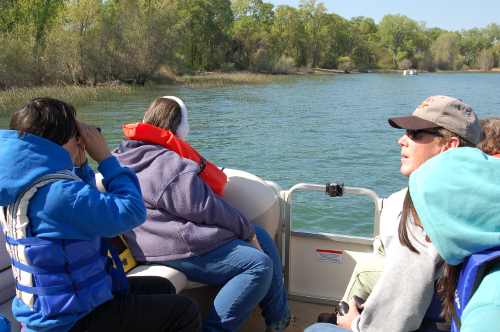
CLEARLAKE, Calif. – The upcoming Heron Festival slated for Saturday, May 5, at Redbud Park in Clearlake, offers a unique opportunity for visitors to travel in to Anderson Marsh on pontoon boats and enjoy excellent speakers and presentations, including one by renowned wildlife photographer Phillip Greene.
The annual Heron Festival, presented by the Redbud Audubon Society, is returning to the south part of Clear Lake this year, where it was born 18 years ago.
Pontoon Boat passengers will enjoy a wonderful trip on Cache Creek, through Anderson Marsh, to view great-blue herons, egrets, and much more including double-crested cormorant and osprey, Western and Clark’s grebes and a variety of other ducks.
Each boat carries about 10 people and is accompanied by an experienced Redbud Audubon birding guide who shares expertise on birds and wildlife observed on the trip.
The boat rides last about 90 minutes and cost $20 per person.
Given the popularity of the rides, advance reservations are advised and may be made by going to www.heronfestival.org or by calling 707-263-8030.
The festival is only one day this year, and one of the featured speakers will be Philip Green, internationally known photographer of herons and egrets.
His spectacular photos and lecture focus on the nesting cycle of herons, with special emphasis on mating behaviors, nest building, and fledging. His presentation will be at 11 a.m. at the festival event tent at Redbud Park.
Many other activities are planned for the Heron Festival, including a nature fair, children’s activities, and “Raptor Speak – a live owls and hawks presentation by Native Bird Connections,” that will give visitors a rare opportunity to see raptor behavior up close.
For a complete schedule of activities or to reserve your space for a boat ride go to www.heronfestival.org or call 707-263-8030.
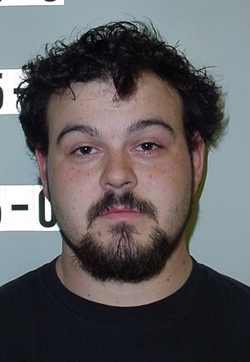
LAKEPORT, Calif. – A Kelseyville man who earlier this week was alleged to have been attempting to illegally sell firearms at a Lakeport grocery story was arrested Thursday not just on weapons charges but also for allegedly molesting children in foster care.
Benjamin Asher Rose, 22, was arrested in the case, according to a report from Sgt. John Gregore of the Lake County Sheriff's Office.
On Tuesday, April 3, sheriff’s detectives received information that Rose allegedly was carrying a firearm and attempting to sell firearms unlawfully at the Grocery Outlet in Lakeport, Gregore said. Detectives worked on obtaining additional information and a search warrant for Rose’s home.
While detectives were conducting the investigation, they also received a report alleging that Rose sexually molested two young girls while they were in foster care in 2008 and 2009, according to Gregore.
Detectives then set up surveillance on Rose to place him under arrest on the molestation charges and serve the search warrant, Gregore said.
On Thursday, April 5, at approximately 4:30 p.m., detectives spotted Rose as he left his home in a black Lexus sedan, Gregore said.
Because of the possibility that the suspect was in possession of firearms, Gregore said sheriff’s deputies and detectives conducted a high risk traffic stop on Rose on Soda Bay Road, near Steelhead Drive, in Kelseyville.
Rose had a loaded 9 millimeter handgun in a holster on his right hip, Gregore said.
Gregore said detectives searched Rose’s home and found five loaded rifles, three loaded handguns and a loaded shotgun in his room.
Rose was arrested for lewd and lascivious acts with a child under 14 and continuous sexual abuse of a child, Gregore said.
In addition, Rose was charged with carrying a concealed weapon in a vehicle and carrying a loaded firearm in a public place, Gregore said.
On Saturday Rose remained in custody at the Lake County Correctional facility on $500,000 bail.
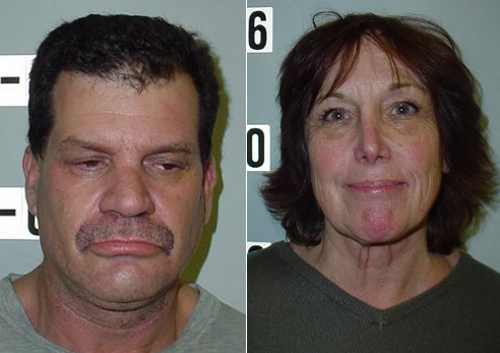
CLEARLAKE, Calif. – Lake County Sheriff’s Office Narcotics Task Force detectives arrested two Clearlake residents this week after findings drugs, paraphernalia and weapons at the home they shared.
Ricky Lawrence Bryan, 52, a truck driver, and 67-year-old Janie Lou Easterbrook, a rancher, both from Clearlake, were arrested following a warrant search on Wednesday, April 4, according to Sgt. John Gregore of the Lake County Sheriff's Office.
Gregore said Lake County Sheriff’s Office Narcotics Task Force detectives secured a search warrant for the home and person of Bryan this past Tuesday. They served it at 6:30 p.m. Wednesday and contacted Bryan as he was driving to his home.
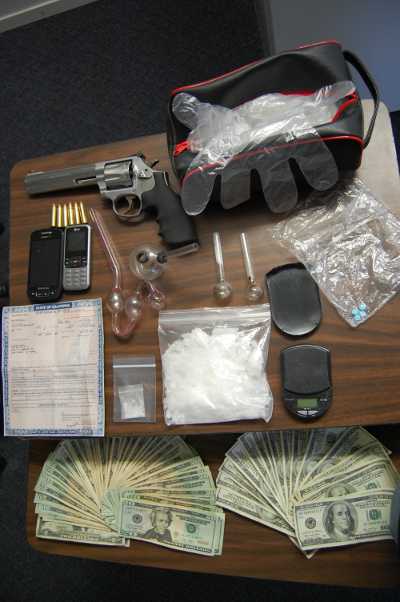
Bryan had $3,360 in currency in his wallet and pockets. Gregore said narcotics detectives also found evidence related to drug sales in text messages on Bryan’s phone.
Narcotics detectives located glass pipes used to smoke methamphetamine, a small bag with suspected Oxycontin pills and a digital scale with suspected methamphetamine residue in Bryan’s bedroom, Gregore said.
The detectives also located a loaded stainless steel Smith and Wesson .357 revolver under the cushion of a chair in the room, according to Gregore.
He said the detectives found a small amount of suspected methamphetamine in a room belonging to Easterbrook.
In addition, approximately 5 ounces of suspected methamphetamine were found in the garage of the residence, Gregore said.
Gregore said Bryan’s currency and his burgundy Corvette were seized by narcotics detectives at the scene for possible asset forfeiture proceedings.
Bryan was arrested for possession of a controlled substance for sales, felon in possession of a firearm, possession of a narcotic controlled substance and felon in possession of ammunition. Gregore said the sheriff's Web site lists an incorrect subsection stating ammunition sales to a minor on Bryan's booking sheet.
Jail records showed Bryan remained in custody on Saturday on a no-bail hold.
Easterbrook was arrested for possession of a controlled substance for sale, with bail set at $25,000. She later posted bail and was released, according to jail records.
Bryan also was arrested by narcotics detectives at his home in February, as Lake County News has reported.
At the time of his February arrest, detectives found drugs, currency, a loaded .22 caliber pistol and paraphernalia, officials reported.
LAKEPORT, Calif. – It's nonstop action for these two little female pups.
The girls, now about 12 weeks old, are border collie mixes.
They came to the shelter with their mom, Delilah.
Both of the girls have short coats; one is chocolate colored, the other is black. They are expected to be medium-sized dogs like their mom.
The puppies also have been spayed.
They are in kennel No. 25, ID No. 32045.
Lake County Animal Care and Control is located at 4949 Helbush in Lakeport, next to the Hill Road Correctional Facility.
Office hours are Monday through Friday, 8 a.m. to 5 p.m., and 1 p.m. to 3 p.m., Saturday. The shelter is open from 10:30 a.m. to 4:30 p.m. Monday through Friday and on Saturday from 1 p.m. to 3 p.m.
Visit the shelter online at http://www.co.lake.ca.us/Government/Directory/Animal_Care_And_Control.htm .
To fill out an adoption application online visit http://www.co.lake.ca.us/Government/Directory/Animal_Care_And_Control/Adopt/Dog___Cat_Adoption_Application.htm .
For more information call Lake County Animal Care and Control at 707-263-0278.
Nature’s Notebook needs you to get outside this spring, join many other observers across the nation, and help it reach its millionth observation of plant and animal life events.
People like you – gardeners, farmers, birders, hikers, anglers, joggers, or all-around nature enthusiasts – are already recording the recurring events they see in the lives of the plants and animals around them – such as when cherry trees or lilacs blossom, when robins build their nests, when salmon swim upstream to spawn, or when leaves turn colors in the fall.
And the millionth observation is imminent – as of the week of April 1-7, citizen-scientists around the country have already clocked in with the 900,000th observation of 16,000 individual plants and animals at 5,000 sites. Each entry represents important scientific information about an actual event in a specific plant or animal’s life.
“Hitting the one millionth observation will be quite exciting, because large sets of data ultimately result in better, more informed policy and management decisions about our environment,” said Jake Weltzin, executive director of the USA-National Phenology Network, which manages Nature’s Notebook. “Clean water and healthy wildlife are everyone’s goal, but scientists and land managers need your help to gather observations that we can’t do alone.”
Knowledge of when recurring life stages occur is referred to as phenology, and people have tracked phenology for centuries for the most practical of reasons: when to hunt and fish, when to plant and harvest crops, and when to navigate waterways.
Tracking phenology is just as critical today for the same reasons and for new ones too.
The data in Nature’s Notebook are helping researchers understand how plants and animals are responding to climate change and, in turn, how those responses are affecting people and ecological systems.
This information is already being used or will be used in ways that benefit society, including developing more accurate indicators of spring, forecasting the onset of allergy season or the chances of western wildfires, managing wildlife and invasive plants, and setting baselines for performance when restoring habitats.
Phenology and climate change
Changes in phenology are among the most sensitive biological indicators of global change.
Across the world, many springtime events are occurring earlier – and fall events happening later – than in the past. These changes are happening quickly for some species and more slowly, or not at all, for others, altering relationships and processes that have been stable for thousands of years.
Some wildlife – like caribou and butterflies – are becoming mismatched from their plant food resources, which are responding differently.
Migrations for some birds are changing too, as they can now overwinter instead of moving south for the winter, or as they fly north more quickly to keep pace with an advancing front of spring flowering.
Working farms and ranches need phenology information too: pollination by native insects contributes more than $3 billion in agricultural crops each year.
Climate-driven changes in the phenology of crops and native insects could change the effectiveness of insect pollination for the better or for the worse, and certainly complicates management decisions.
However, we know very little about how pollinator phenology is changing, which makes it difficult to predict how crops will be affected and how farmers might best adapt their management practices.
By collecting observations of insect phenology and crop phenology together, the USA-NPN is contributing to our understanding of the changes taking place and helping to ensure the viability of crops across the country.
In short, scientists need more and better information about the pace and pattern of nature – locally to nationally – to answer important scientific and societal questions, and to build the tools and models needed to help people understand and adapt to the changes.
Nature’s Notebook, by providing a place for people to enter, store, and share their observations, makes it possible for the general public to help researchers improve the understanding about how changes in phenology relate to changes in climate our environments.
And this is where you come in
“The more data the better,” said Weltzin who, as an ecologist, has contributed his share of observations to Nature’s Notebook by tracking flowering and fruiting of cactus near his Tucson home.
“By compiling observations from our participants, we’re starting to be able to piece together large-scale changes, like the early spring in 2010, which stretched from Missouri to Maine,” Weltzin said. “And, as you probably already know, 2012 is shaping up to be just as unusual … in most places, winter was weak, and spring is soon upon us, bringing not only early birds and beautiful flowers and a new batch of maple syrup, but also allergies and invasive plants and insect pests like mosquitoes.”
So if you are interested in becoming a citizen-scientist, there are four simple steps: learn about the plants and animals you can observe in your area, learn how to observe, sign up, and log in to Nature’s Notebook and record your observations. And maybe, just maybe, you will record the one millionth observation.
More importantly, Nature’s Notebook is an exciting way for you to experience plants or animals you see all the time in a brand new way.
Participating can help you:
- Advance your knowledge and more intimately connect with plants and animals in your area.
- Experience nature up close in a way few people have the opportunity to do.
- Organize and interpret your own observations of seasonal change using cutting-edge mapping tools.
- Contribute to a historic effort that benefits future generations.
By joining the program, you ultimately empower your hobby to benefit scientific discovery. To get started, check out the Nature’s Notebook Web site, http://www.usanpn.org/participate/observe .
The USA National Phenology Network is a partnership among governmental and nongovernmental science and resource management agencies and organizations, the academic community, and the public.
There are more ways to get involved – partner your organization with us, let us know about legacy phenology data sets, or even share a dataset you may have already collected.
For more information visit http://www.usanpn.org/ or contact Jake Weltzin at
Other USGS Citizen-Science programs
USGS citizen-science programs want you to be the scientist. The public helps collect data used by emergency responders, scientists, and resource managers.
Here are some other USGS citizen-science programs:
– Did You Feel It? After earthquakes or shaking events, “Did you Feel It?” (http://earthquake.usgs.gov/research/dyfi/ ) collects Web-based citizen responses to help provide rapid intensity assessments for earthquake science and response. The involvement of citizens is key because decisions made during and immediately after an earthquake can save lives and protect property. If you are a tweeter, consider using “Did You Tweet It?” to record what you are experiencing in real time. The USGS Twitter Earthquake Dispatch (@USGSted) application helps the USGS discern how severe an earthquake might be.
– Breeding Bird Survey: Since 1966, thousands of volunteers have contributed data used by the USGS’s North American Breeding Bird Survey, http://137.227.245.162/BBS/learning/ , to monitor populations of more than 400 bird species. This citizen-science program helps identify conservation priorities and inform sound management practices.
– North American Bird Phenology Program: Between 1880 and 1970, volunteers collected information about migratory birds across North America. Now, citizens worldwide are helping the North American Bird Phenology Program rescue and curate the data from this historical collection of six million bird migration card observations, illuminating migration patterns and population status of birds across the continent.
– Wildlife Health Event Reporter: The Wildlife Health Event Reporter (WHER), http://www.whmn.org/wher/ , enables anyone with an Internet connection to report sightings of sick or dead wildlife. The site www.healthmap.org has enhanced its mobile phone application “Outbreaks Near Me,” http://www.healthmap.org/outbreaksnearme/ . to accept and relay wildlife health reports to the WHER site. These tools can lead to the detection and containment of wildlife disease outbreaks that may pose a health risk to wildlife, domestic animals, or people.
California law grants a surviving spouse special rights and obligations concerning the probate estate and personal debts of a deceased spouse.
These are governed by community property laws. The same rules apply to California registered domestic partners.
Community and quasi community property is divided equally at death, and separate property belongs to the owning spouse.
Assets acquired while married and living together are either community or quasi community property.
Any property acquired before marriage, or by gift or inheritance while married, is the separate property of that spouse.
Accordingly, a surviving spouse owns one-half of all the couple's community property and quasi community property. The decedent may thus bequeath his or her one-half of the community property, and all his or her separate property, as he or she pleases.
If the deceased spouse attempts to give all of a community property asset to someone other than the surviving spouse, the surviving spouse must elect between inheriting under the deceased spouse's will or trust and receive those gifts, or else enforce her community property rights.
When a deceased spouse dies intestate (i.e., without a will) owning an interest in community property assets not held in joint tenancy or trust, the surviving spouse owns the entire community property estate.
After 40 days, the surviving spouse has complete control, unless, in the case of real property, someone has filed a notice claiming an inheritance under the deceased spouse's will.
Probate is never required to transfer property from the deceased to the surviving spouse. The surviving spouse can use either the affidavit procedure for small estates or file a spousal property petition. Small estates are those appraised at under $150,000.
Affidavits may not be used for real property appraised over $50,000, even in small estates.
Sometimes, however, a surviving spouse will probate the entire community property and the decedent's separate property. This is because, generally, the surviving spouse is personally liable for all the debts of the deceased spouse, up the value of any community and separate property received without probate.
Through probate the surviving spouse can avoid personal liability and have the debts allocated. If any such assets are held in a trust, the trustee can transfer them to the executor. Community property in joint tenancy would presumably need to be transferred too.
In a probate, the surviving spouse can petition to have debts allocated between the spouses. They are typically allocated as if a divorce had occurred at date of death.
Generally, the community property answers for all the debts incurred during marriage. There are exceptions.
The deceased spouse's funeral expenses and expenses of last illness are allocated to the decedent's estate only, and not to the surviving spouse's one-half interest in the community property or separate property.
Debts from before marriage are allocable to the debtor spouse's separate property, and, any excess is allocated to the debtor spouse's one-half interest in the community property estate.
Upon petition in a probate the surviving spouse may receive a family maintenance allowance as necessary to maintain the surviving spouse and dependent children in their accustomed manner of living.
Upon petition, the court, at its discretion, may also grant a family homestead. A family homestead allows the surviving spouse, and any minor children, to live in a residence for a period of time as the court finds proper; sometimes the surviving spouse's remaining lifetime.
Interestingly, the foregoing spousal protections apply even if the deceased spouse's probate estate is all separate property, and even if it is all bequeathed to someone other than the surviving spouse.
Naturally in that case the court would unlikely grant the surviving spouse a lifetime homestead as the court considers the competing interests of the decedent's heirs and beneficiaries and the decedent's own testamentary bequests.
How the surviving spouse should best proceed is something to discuss with a qualified attorney based on the facts and circumstances.
Dennis A. Fordham, attorney (LL.M. tax studies), is a State Bar Certified Specialist in Estate Planning, Probate and Trust Law. His office is at 55 First St., Lakeport, California. Dennis can be reached by e-mail at