 How to resolve AdBlock issue?
News
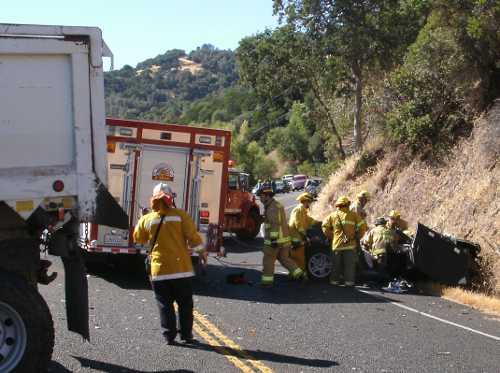
CLEARLAKE OAKS, Calif. – A Eureka man suffered major injuries in a crash on Friday near Clearlake Oaks.
Terrance M. L. Reeves, 29, suffered lower extremity trauma as a result of the crash, which occurred on Highway 20 half a mile west of Olson Road at 4:10 p.m. Friday, according to a Saturday report from the California Highway Patrol.
Reeves was driving a 2012 Ford Mustang with 35-year-old Eureka resident Jessica Hennings as riding as his passenger, the CHP reported.
The CHP said Reeves was headed westbound on Highway 20 and was traveling through a curve at a reported speed of 45 miles per hour, followed by 37-year-old Brian M. Airehart of Durham, who was driving a 2003 Toyota 4Runner.
Richard D. Cepuch 52, of Hidden Valley Lake, was driving a 2000 Mack dump truck eastbound at a stated speed of 42 miles per hour, slowing for the same curve through which Reeves was traveling, the CHP said.
For reasons still under investigation, the Mustang drifted into the opposing lane and into the path of the dump truck, the report explained.
Cepuch, according to the CHP, attempted to avoid the collision but could not, and the left front of the dump truck struck the left front of the Mustang.
The Mustang came to rest against the north hillside, partially within the westbound traffic lane, while the Mack dump truck came to rest facing a southerly direction, partially within the eastbound traffic lane and on the shoulder, the CHP said. Airehart moved his vehicle to the shoulder west of the collision.
Emergency crews soon arrived on scene and extricated Reeves with special equipment, the CHP said. Hennings was able to get out of the car after the collision, having sustained minor injuries, including a seat belt abrasion.
Paramedics stabilized Reeves before he was transported to Santa Rosa Memorial Hospital via REACH air ambulance, the CHP said.
Neither Cepuch nor Airehart were injured, with Cepuch working to contain a diesel spill from a ruptured fuel tank as a result of the collision, the CHP said. Radio reports indicated Lake County Environmental Health responded to assist with handling the 40-gallon spill.
The CHP said the debris from the collision struck Airehart’s vehicle, causing minor scratches to the bumper and a possible chip in the windshield.
All four people involved in the crash were wearing their seat belts, according to the report.
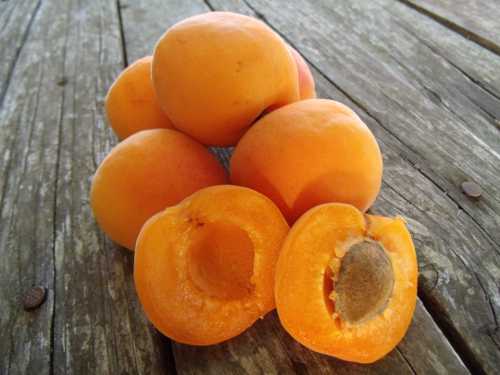
It wouldn’t be fair to write about the delicately sweet apricot without indulging in – er, researching – their flavor a bit. I have a bowl of five fully ripe examples at my side, picked fresh at the height of ripeness.
It’s an all-too-scarce privilege to access fully ripe apricots, as the season is short and most commercial operations pick them on the green side for better shelf worthiness.
While you can hasten the ripening process by placing them in a paper bag and leaving them at room temperature, their flavor and sweetness remains the same as the day of harvest. Only their texture, color and juiciness will improve off tree.
An apricot picked ripe is a rare thing of beauty, and I’m especially thankful that local farmers bring them to market ripe from the tree.
Apricots are an early summer fruit. Depending on where they’re grown, their season begins anywhere from mid-May to mid-June and generally runs a couple of months. They’re at farmers’ markets now, but may not be for long.
My mind rushes to “The Arabian Nights,” a favorite book of childhood, when a gently fragrant apricot is at hand. I think of Persian kings and warm nights in Morocco. This softly velvet, light orange fruit has been a favorite in the Middle East since ancient times.
While there is argument as to where the apricot was first cultivated (some say China, others India), its origins are most often associated with Armenia. Its scientific name, Prunus armeniaca, means Armenian plum, and it has been cultivated in that country since ancient, even prehistoric, times.
Apricots were introduced to Greece by Alexander the Great, and then to Europe by a Roman general named Lucullus.
Speaking of ancient Greece, experts in its mythology believe apricots were the “golden apples of Hesperides,” the fruit that Hercules was ordered to pick in the 11th of his 12 labors.
They were popular in ancient Persia (dried ones were valuable commodities on Persian trade routes), and they remain an important fruit in Persia’s modern day counterpart, Iran.
Not surprisingly, the main producers of apricots worldwide are all in the Middle Eastern and Mediterranean regions, with one lone exception, Japan.
In the U.S., California is the king of apricot production, fully 95 percent of it. Most of modern American production of apricots comes from the seedlings carried to the west coast by Spanish missionaries. (Which, in turn, were from the seeds of trees that were introduced to the New World by the English.)
The previously mentioned five apricots at my side (long since eaten) provided me with my entire daily requirement of vitamin A. They’re also high in vitamin C and fiber.
Apricots are full of the important antioxidant beta carotene, which is converted to vitamin A in our bodies, protecting our eyes, hair, skin, gums, and various glands.
Right now I’m thinking of warm, spicy apricot chutney that’s flavored with ginger, coriander, and a bit of garlic. It’s a wonderful way to preserve fresh apricots, and a recipe is below. It’s fantastic on grilled chicken or pork, or eaten directly on a cracker, with or without cream cheese. Be sure to try it with goat cheese, too, especially since Lake County is home to an amazing goat dairy.
In addition to being delicious, there is a health benefit to consuming apricots in chutney. The cooking process breaks down their cell walls, thus releasing more beta carotene to nourish our bodies.
Apricots added to chicken give it an Asian or Middle Eastern feel, depending on the spices and flavors used.
Tossing halved apricots on the grill brings out their natural sweetness. Balsamic vinegar (mixed with honey or plain) can be brushed on before grilling to add an interesting layer of flavor. Grilled apricots are a wonderful accompaniment to pork and are delicious when served with vanilla ice cream.
A simple, tasty and colorful hors d’oeuvre can be made when halved, pitted apricots are filled with cream cheese and sprinkled with crushed pistachios.
If you were overly ambitious in buying fresh apricots and have a large quantity that are getting near the over ripe stage, you can puree them (sans pits) to make a delicious nectar. Add enough water to make a thick juice-like consistency. If apricots are very ripe, it’s unlikely you’ll need to sweeten the puree, but a bit of honey, agave nectar or simple syrup may be added to your liking.
What about those apricots I just enjoyed? They were ripe, sweet and oh-so-delicious! I hope you’ll have a chance to enjoy many while the season lasts. Bon appétit!
Apricot chutney
5 cups of fresh apricots (about 2 pounds), rinsed, halved and pitted
1-1/2 cups brown sugar
1 medium onion, peeled and thinly sliced
Just under 1 cup raisins (about 4 oz.), dark or light
1 tsp grated fresh ginger root
1 cup cider vinegar
1 tsp coriander seeds
3 cloves garlic, peeled and thinly sliced
Salt to taste
Put all the ingredients into a large pan and boil until the apricots are very soft.
Remove the apricots from the pan with a slotted spoon and put them into clean, dry jars.
Boil the remaining liquid until it becomes a thick syrup.
Pour the syrup into the jars, cover them, and allow them to cool before storing.
If not using sterile canning procedure, store the chutney in the fridge.
Esther Oertel, a freelance writer, cooking teacher, and speaker, is passionate about local produce and all foods in the vegetable kingdom. She welcomes your questions and comments and may be reached at
LAKEPORT, Calif. – You never know what kind of dog breed you can find at Lake County Animal Care and Control.
This week, alongside mixes of mastiff, Chihuahua and terriers, there are French bulldog and Schipperke mixes looking for loving new homes.
Thanks to Lake County Animal Care and Control’s new veterinary clinic, many of the animals offered for adoption already are spayed or neutered and ready to go home with their new families.
Dogs that are adopted from Lake County Animal Care and Control are either neutered or spayed, microchipped and, if old enough, given a rabies shot and county license before being released to their new owner. License fees do not apply to residents of the cities of Lakeport or Clearlake.
If you're looking for a new companion, visit the shelter. There are many great pets hoping you'll choose them.
The following dogs at the Lake County Animal Care and Control shelter have been cleared for adoption (additional dogs on the animal control Web site not listed are still “on hold”).

Schipperke mix
This female Schipperke mix is 7 months old.
She has a medium-length tan coat and has not been altered.
Find her in kennel No. 6, ID No. 33603.

French bulldog-terrier mix
The French bulldog-terrier mix is a male. Shelter staff haven’t given an age estimate.
He has a short white coat and has not yet been neutered.
He’s in kennel No. 8, ID No. 33641.

‘Carlos’
“Carlos” is a 7-month-old male dachshund-terrier mix.
He has a short tan coat, floppy ears and big brown eyes, weighs just over 11 pounds and has not yet been altered.
He’s in kennel No. 7, ID No. 33433.

‘Brandon’
“Brandon,” like his kennel mate Carlos, is a 7-month-old male dachshund-terrier mix.
He weighs 9 pounds, has a short tan coat, floppy ears and brown eyes, and has not yet been neutered.
Find him in kennel No. 7, ID No. 33432.

‘Cali’
“Cali” is a female Chihuahua mix is 8 years old.
She has a short black and brown coat, and has been spayed.
She’s in kennel No. 13, ID No. 33343.

‘Taco’
“Taco” is a 3-year-old male Chihuahua mix.
He has a short white coat, and is not yet neutered.
He’s in kennel No. 16, ID No. 33342.

Chihuahua-terrier mix
This female Chihuahua-terrier mix is 4 years old.
She weighs 9 pounds and has a short tan coat.
Find her in kennel No. 18, ID No. 33273.

‘Boda’
“Boda” is 6-month-old female springer spaniel-border collie mix.
She has a short black and white coat, and is not yet spayed.
She is in kennel No. 19, ID No. 33494.
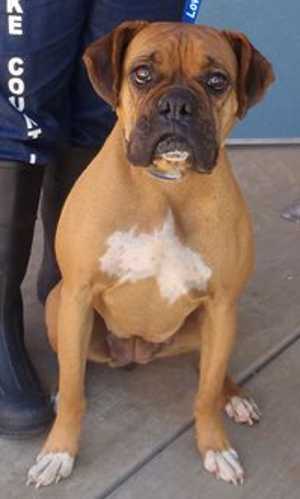
Boxer mix
This female boxer mix is 4 years old.
She has red and white coloring, a docked tale and weighs 50 pounds.
She’s in kennel No. 20, ID No. 33284.

‘Slick’
“Slick” is a 3-year-old male Australian Kelpie mix.
He has a short tricolor coat and weighs just over 42 pounds.
Find him in kennel No. 22, ID No. 33397.
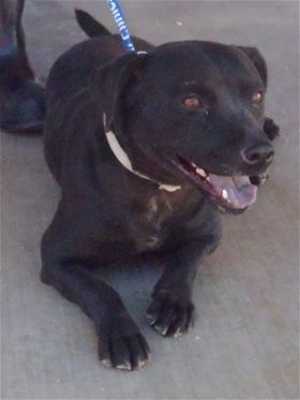
Female dachshund mix
This female dachshund mix is 1 year old.
She has a short black coat, weighs 32 pounds and has not yet been spayed.
She’s in kennel No. 24, ID No. 33221.
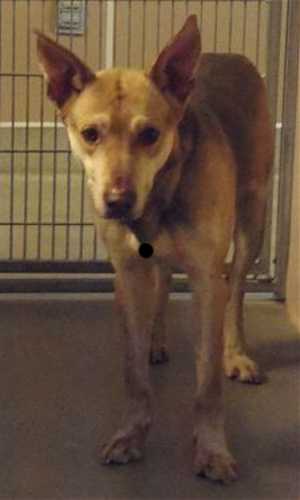
Male husky mix
This male husky mix is just over 4 years old.
He has a long red and tan coat, gold eyes and erect ears, weighs just over 56 pounds and has been neutered.
Find him in kennel No. 30, ID No. 32738.

Pit bull terrier mix
This male pit bull terrier mix is 8 months old.
He weighs nearly 39 pounds, and has a short brown and brindle coat.
He’s in kennel No. 31, ID No. 33400.
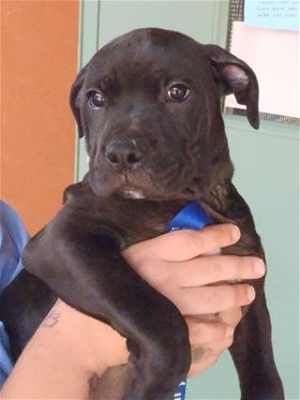
Male mastiff mix pup
This male mastiff mix pup is 16 weeks old.
He has a short black coat with white markings, and has not yet been altered.
Find him in kennel No. 32a, ID No. 33551.

Male mastiff mix pup
This male mastiff mix pup is 16 weeks old.
He has a short black coat with white markings, and has not yet been altered.
Find him in kennel No. 32b, ID No. 33552.

Female mastiff mix pup
This female mastiff mix pup is 16 weeks old.
She has a short black coat with white markings, and has not yet been altered.
Find her in kennel No. 32c, ID No. 33551.

Female mastiff mix pup
This female mastiff mix pup is 16 weeks old.
She has a short black coat with white markings, and has not yet been altered.
Find her in kennel No. 33b, ID No. 33555.

Female mastiff mix pup
This male mastiff mix pup is 16 weeks old.
He has a short black coat with white markings, and has not yet been altered.
Find him in kennel No. 33c, ID No. 33556.
Adoptable dogs also can be seen at http://www.co.lake.ca.us/Government/Directory/Animal_Care_And_Control/Adopt/Dogs_and_Puppies.htm or at www.petfinder.com .
Please note: Dogs listed at the shelter's Web page that are said to be “on hold” are not yet cleared for adoption.
To fill out an adoption application online visit http://www.co.lake.ca.us/Government/Directory/Animal_Care_And_Control/Adopt/Dog___Cat_Adoption_Application.htm .
Lake County Animal Care and Control is located at 4949 Helbush in Lakeport, next to the Hill Road Correctional Facility.
Office hours are Monday through Friday, 8 a.m. to 5 p.m., and 1 p.m. to 3 p.m., Saturday. The shelter is open from 10:30 a.m. to 4:30 p.m. Monday through Friday and on Saturday from 1 p.m. to 3 p.m.
Visit the shelter online at http://www.co.lake.ca.us/Government/Directory/Animal_Care_And_Control.htm .
For more information call Lake County Animal Care and Control at 707-263-0278.
Email Elizabeth Larson at

With all the fanfare about Mars rover Curiosity landing on the Red Planet in August 2012, it’s easy to forget that there’s already a rover on Mars – an older, smaller cousin set to accomplish a feat unprecedented in the history of Solar System exploration.
Mars rover Opportunity is on track to complete the first extraterrestrial marathon.
A marathon is 26.2 miles. When Opportunity landed on Mars in 2004, NASA’s goal was to have the rover travel a meager 600 meters.
However, no one knew what kind of “runner” Opportunity would turn out to be. As of July 2012, Opportunity has traveled almost 22 miles – only 4.2 miles short of a full marathon.
Runner-author Hal Higdon once said, “The marathon never ceases to be a race of joy, a race of wonder.” That goes double for a marathon on another world where every mile promises a new discovery.
Opportunity’s prime mission is to search for signs of ancient water.
Today the Red Planet is a bone-dry desert with a breathtakingly thin atmosphere, conditions deadly to almost every known form of life on Earth.
Billions of years ago, however, things might have been different. Many researchers believe that Mars was warmer, wetter, and friendlier to Martian life. Opportunity’s job is to search for clues to that ancient time.
Just getting to the starting line was epic. “This particular marathoner had to fly about 283 million miles across space before being unceremoniously drop-bounced on the Martian surface,” said Ray Arvidson, Mars Exploration Rover Mission deputy principal investigator.
Like many long-distance runners, Opportunity likes to “take it slow.” On a typical drive day, the rover travels only 50 to 100 meters. This gives the rover time to pause and look for the unknown.
It also allows Opportunity to take plenty of photos along the way. Recently the rover sent home its 100,000th image, a stunning panorama.
Opportunity first uncovered signs of water in deposits near the landing site in Eagle Crater. There were rocks that seemed to have formed in an ancient shallow lake.
Over the next four years, Opportunity scavenged ever larger and deeper craters, finding more evidence of wet periods. Indications were, however, that the ancient lake water might have been too acidic for life.
The metallic marathoner soon set its sights on Endeavour Crater – an enormous pit 14 miles wide and hundreds of meters deep.
Endeavour’s depth would offer a look farther back into the history of Mars, to a time when the water was possibly less acidic.
The marathon route crossing Mars’ Meridiani plain to Endeavor was a daring trek —with no aid stations anywhere.
Raging dust storms reduced the rover’s solar power so much that Opportunity almost entered the “sleep of death”; soft, sandy, wind-blown ripples trapped the rover’s wheels, and there was an injury: A failure in Opportunity’s right front steering actuator made running forward tricky. Ever resourceful, the rover ran part of its race backwards.
“The course took Opportunity over sedimentary bedrock made of magnesium, iron, and calcium sulfate minerals – further indications of water billions of years ago,” says Arvidson.
When the marathoner reached Endeavour Crater in August 2011, things got interesting.
“Endeavor is surrounded by fractured sedimentary rock, and the cracks are filled with gypsum. Gypsum forms when ground water comes up and fills cracks in the ground, depositing hydrated calcium sulfate. This is the best evidence we’ve ever found for liquid water on Mars.”
The gypsum veins were likely formed in conditions more pH-neutral and possibly more hospitable to life: Jackpot!
But this marathoner isn’t done. Opportunity is doing so well that 26.2 miles might not be the finish line after all.
“We have no plans to stop running,” says Arvidson.
Extraterrestrial ultra-marathon anyone?
Dauna Coulter works for the National Aeronautics and Space Administration.
NORTHERN CALIFORNIA – A fire that began burning in Yolo County Saturday morning was reported to be threatening several homes by nightfall.
Cal Fire’s Sonoma-Lake-Napa Unit reported that the Forrest Fire – located off Forrest Avenue and Highway 16 at Guinda, south of Rumsey Canyon – began shortly after 10 a.m. Saturday.
The latest report on the fire, released after 9 p.m., said that it had burned 550 acres and was 15 percent contained. Those numbers were rolled back slightly from higher estimates of containment and acreage Cal Fire issued previously.
Helicopters, air tankers and firefighters on the ground had fought the fire throughout the day, according to radio reports.
More than 400 personnel were assigned to the incident, along with 22 engines, 16 fire crews, six air tankers, five helicopters and 10 bulldozers.
Cal Fire said the fire burned up the Blue Ridge outside the community of Guinda during the afternoon.
By Saturday evening, the winds in the area had shifted and several homes were threatened, the agency reported.
During the course of Saturday four injuries were reported and several commercial vehicles were destroyed, according to Cal Fire.
A cause has so far not been reported.
Email Elizabeth Larson at
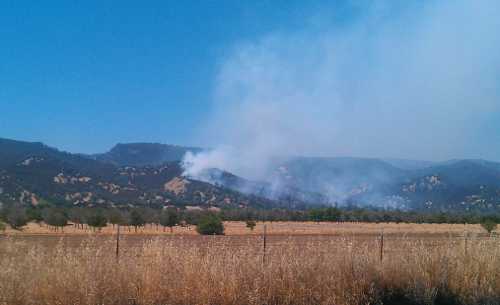
NORTHERN CALIFORNIA – Firefighters are at work on another wildland fire in the region, this time in Yolo County.
Cal Fire reported that the “Forrest Fire” began late Saturday morning off for Forrest Avenue and Highway 16 in Guinda, south of Rumsey Canyon in neighboring Yolo County.
The incident has grown rapidly in size. At about 5:15 p.m., Cal Fire reported that the fire had scorched 600 acres and was 25 percent contained.
Radio traffic indicated additional helicopters were heading into the area to assist with fighting the fire, with an air tanker being sent from Santa Rosa.
No cause has been given yet, although initial reports indicated multiple vehicles were involved and power lines were down.
Several Lake County residents have reported seeing smoke from the fire in the direction of the Morgan Valley area.
Email Elizabeth Larson at