 How to resolve AdBlock issue?
News
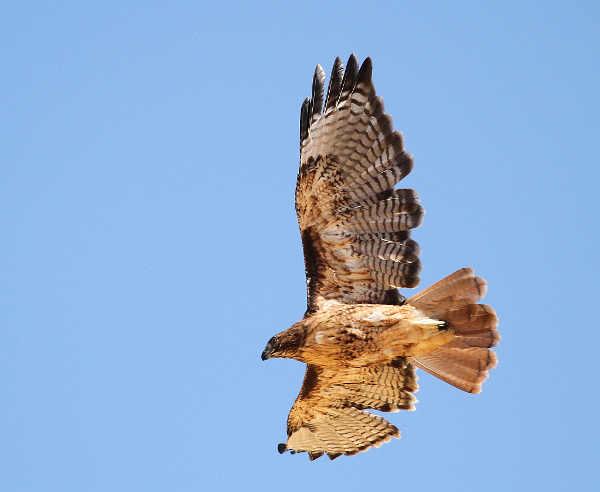
KELSEYVILLE, Calif. – Last week, not far from where she fell from the sky, injured and burned, a year and a half ago, a young red-tailed hawk returned to her wild home, her wholeness credited to the efforts of a devoted group of raptor rehabilitation specialists.
“Sparkie,” as she became known to those who nursed her back to health, was ready to go by the time she was carried out into a field near Steele Wines in Kelseyville last Thursday afternoon.
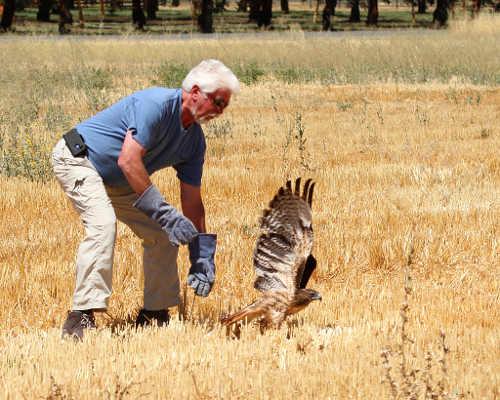
Wearing long thick leather gloves, Brad Marsh – raptor rehabilitation and release coordinator for The Bird Rescue Center, based in Santa Rosa – gently held Sparkie against his chest as he prepared to release her back to her wild life.
Sparkie, as the volunteers would point out, would never lose her spirit or essential wildness – which she’ll need to survive and thrive – and that was evident as she struggled in Marsh’s arms.
“She’s as ready as she’s ever going to be,” Marsh said.
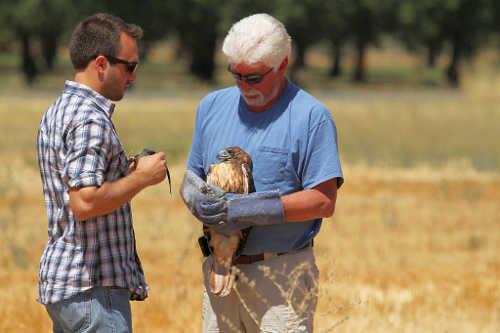
Then it was time to remove the hood and let her set out on her way.
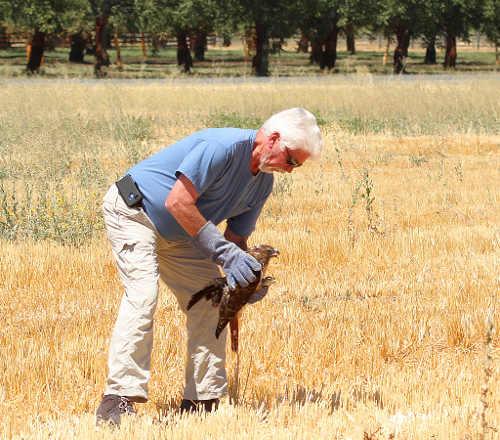
Marsh set her down and let her take off. She headed for some nearby pine trees, where she perched for a time.
Then she left the tree and flew in a wide circle over the little group that watched her from the ground before she settled into a tree once more.
Marsh and fellow volunteers Eric Ballinger and Amy McLintock made sure she was settled before it was time to go back to Santa Rosa.
Marsh said Sparkie was the longest rehabilitation case the center has had, at 17 months. He called the work “a labor of love” and Sparkie herself “truly a miracle bird.”
Torn from the sky
In March 2011, Sparkie was found injured after hitting an electrical pole near Kelseyville.
She was taken to The Bird Rescue Center, where injured raptors and larger birds from Lake County and other parts of the North Coast go for care.
The group, which Marsh said has been in existence for more than 30 years, specializes in rehabilitating and releasing native wild birds like Sparkie, and also works to educate the public about the birds.
Marsh said the center takes in between 2,500 and 3,000 wild birds annually. The center reported that it sees an estimated 125 different species each year.
Marsh said Sparkie was in bad shape when she arrived.
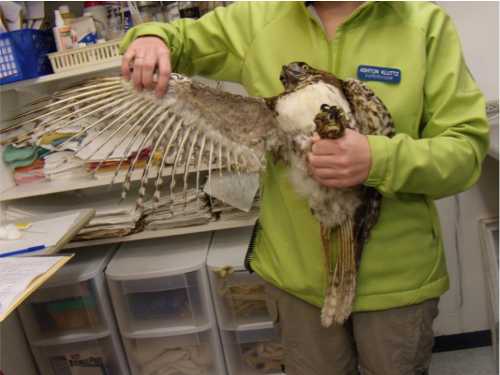
“There was no feathering left on the entire right wing,” he said.
Sparkie, then just 1 year old, didn’t yet have the notable red tail of her species. However, the tail she did have was left looking like straw stubble, Marsh said.
The volunteers at The Bird Rescue Center got down to the business of getting Sparkie back on the wing.
It was a long journey from the early stages of acute care to working out Sparkie’s muscles in preparation for being released.
The electrocution left her with extensive tissue damage to her right wing, right inner thigh and right leg.
Sparkie would lose some of that tissue – in the case of her right leg, at one point her bone was exposed – and required surgeries and daily treatment to keep the wounds from becoming infected.
Her burned leg eventually healed, although she now lacks the characteristic hawk leg scales, Marsh said.
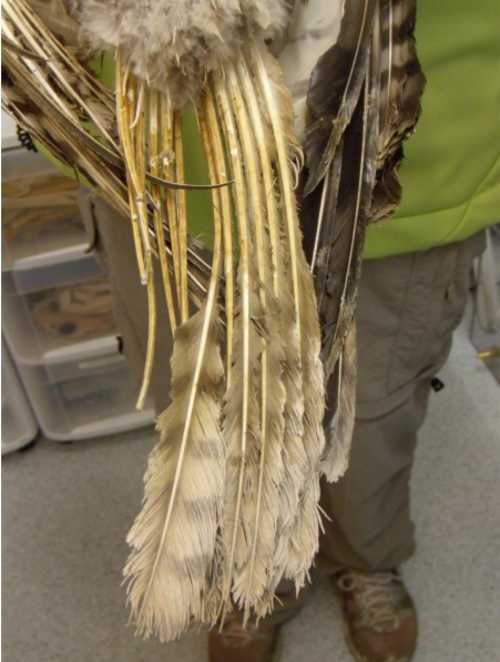
In July and August 2011 Sparkie had her first molt since being electrocuted. Her feathers began to come in, and the rich red tail feathers appeared.
But she was still missing feathers, and when she molted again last November it was clear she had suffered follicle damage from the electrocution, with her right wing showing gaps between the feathers.
By this past July, her right wing looked almost complete – except for a small cap in her secondary feathers. While center staff reported she would always have problems with those feathers, Sparkie had enough wing feathers to successfully return to the wild.
Then it was time to focus on rehabilitation.
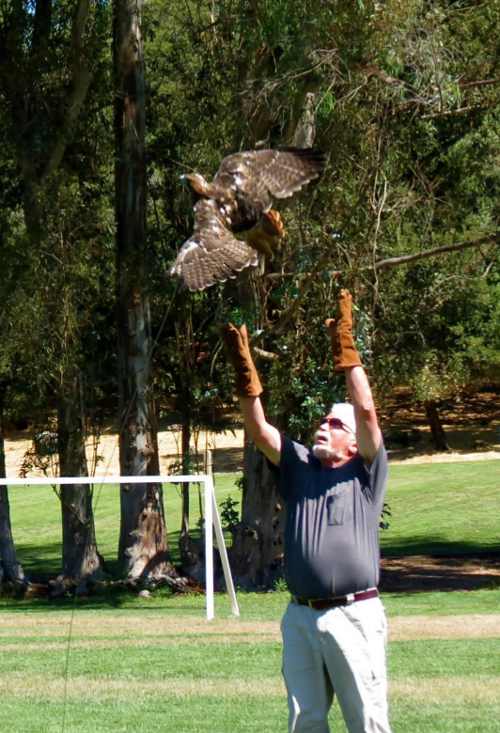
In order to give her the workouts needed to return her to full health, Marsh said they put her on a 130-foot line and took her for short practice flights.
She took her first flight since being electrocuted on Monday, Aug. 6, when she flew more than 100 feet.
At one point she was doing up to 30 of the short flights daily. Marsh likened it to circuit training for a bird.
New birds, new challenges
Sparky is the 112th bird the center has released or transferred to further care this year, Marsh said.
Not all of the birds the center tries to help have Sparkie’s good result.
Marsh said the center has received three electrocuted birds from Lake County this year – a great horned owl, red-shouldered hawk and red-tailed hawk. All of them died.
He said they’re already tending to a new raptor that was brought to the center the day before Sparkie’s release.
That new rescue is a bald eagle, he said. The eagle, which appears to be suffering from neurological issues, was found near Walker Ridge, the scene of a large wildland fire that burned earlier this month.
It’s not yet clear what happened to the eagle, but it was found in an area bounded on both sides by the fire’s burn area.
To learn more about The Bird Rescue Center, its work and mission, or to donate, visit www.thebirdrescuecenter.org .
Email Elizabeth Larson at
LAKEPORT, Calif. – The Lake County Fair – which begins Aug. 30 – is partnering with Lake County CAN to feed the county’s hungry.
As part of an inaugural food drive, the fair will offer community members free entrance to the fair on Friday, Aug. 31, in exchange for four cans or four items of nonperishable food brought the fair between 4 p.m. and 7 p.m. that day.
Suggested donations are tuna, beef stew, fruit, soup, spaghetti sauce, macaroni and cheese, dried beans and rice mix.
Lake County CAN distributes donations to seven food pantries throughout Lake County at Methodist Churches in Clearlake, Clearlake Oaks, Kelseyville, Lakeport, Lower Lake, Middletown and Upper Lake.
These food pantries are available to anyone in need, regardless of their beliefs.
For more information phone 707-987-3379 or 707-263-6181.
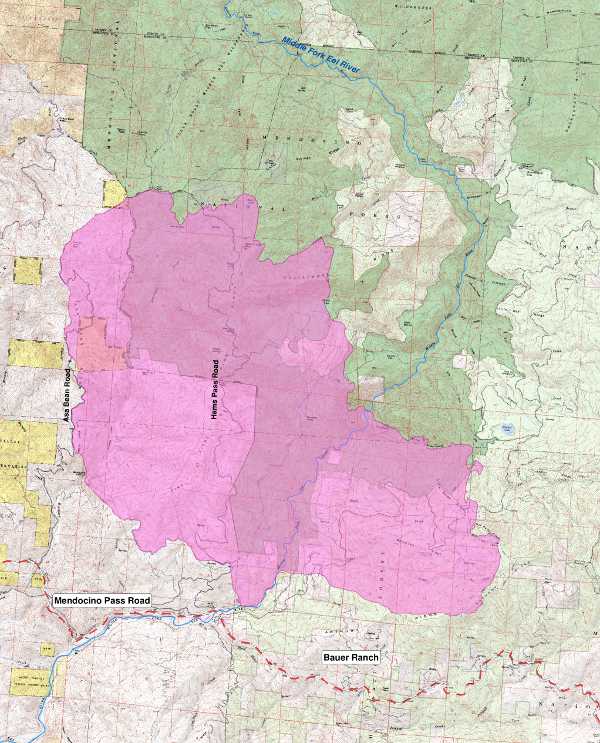
NORTH COAST, Calif. – The wildland fire complex burning 10 miles northeast of Covelo continued to grow on Sunday.
The North Pass Fires reached 27,153 acres by Sunday night, with 34 percent containment, according to the unified command of Cal Fire and the US Forest Service.
The lightning-caused fires have been burning since Saturday, Aug. 18.
The fires have burned six structures to date, and destroyed a fire truck on Saturday. The crew was not injured, according to Mendocino National Forest spokesperson Tamara Schmidt.
Evacuations east of Covelo remain in place, officials reported.
There were 1,678 fire personnel on scene Sunday, with 121 engines, 26 fire crews, two airtankers, 15 helicopters, 33 bulldozers and 25 water tenders, according to the unified command’s report.
The Sunday evening report said the fires are continuing to spread to the east toward Forest Road M2, south towards Anthony’s Ridge, north to Cedar Springs Ridge and northeast towards Pothole Creek and Steel Bench.
Email Elizabeth Larson at

LAKE COUNTY, Calif. – The body of a young local soldier killed earlier this month in Afghanistan will return home this week, with a procession planned through the streets of Kelseyville and Lakeport on Tuesday and a separate public memorial service to take place next weekend.
Sgt. Richard Allen Essex, 23, of Kelseyville died on Thursday, Aug. 16, in a Black Hawk helicopter crash in Afghanistan's Kandahar province, as Lake County News has reported.
Essex's body will be returned to Lake County on Tuesday, according to a statement issued by Operation Tango Mike on behalf of Essex's family.
Essex, a door gunner on the helicopter, was serving in the U.S. Army, and was assigned to A Company, 2nd Battalion, 25th Combat Aviation Brigade, 25th Infantry Division, based at Schofield Barracks, Hawaii.
Along with Essex, the crash killed 10 others, including six other members of the US military. Officials have said the cause of the crash is still under investigation.
Essex was a 2008 graduate of Kelseyville High School, a poet, musician, artist and athlete.
Based on Essex's wishes, a procession will travel through Kelseyville, past Kelseyville High School, and then through Lakeport.
Community members are asked to pay their respects and honor Essex by lining Main Street in Kelseyville at 12 p.m. and Main Street in Lakeport at 12:15 p.m. Tuesday.
On Saturday, a special public memorial service for Essex will be held at Kelseyville High School, 5480 Main St.
Essex's family invites the community to honor and celebrate his life at the service, which will begin at 11 a.m. on the school's football field.
The gates will open at 8 a.m. to fire, law enforcement and military personnel for vehicle staging. At 10 a.m. the gates open to the public.
Additional details of the procession and services will be posted as they become available.
Email Elizabeth Larson at
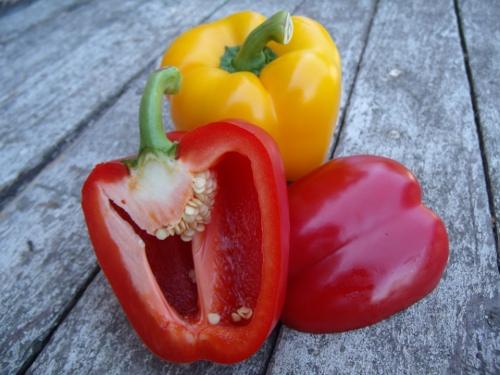
I’m not sure what I like most about bell peppers; there’s so much about them to love.
Their immensely satisfying crunch is definitely a contender, the sound of which (and feel on my teeth) can be considered one of life’s simple pleasures.
Related to this – the cause of the crunch, so to speak – is the crisp texture and water content that makes them such a refreshing treat.
Their mild taste – with its bit of subtle sweetness – makes them a companionable component for many a recipe, whether raw or cooked.
And – oh! – last, but definitely not least, their vivid rainbow colors are a delight to behold! Feasting my eyes on heaps of peppers in bright hues of red, orange, yellow, green and purple is such a treat, one that may tip the scales in favor of this quality.
If you’re wondering, other less available colors include ivory, maroon, chocolate brown and even black.
Add to that some solid nutritional content and you’ve got yourself a pretty lovable vegetable! (Or fruit, if speaking botanically.)
These members of the capsicum family are native to the Americas – Mexico and points south – and have been cultivated for more than 9,000 years.
The term “pepper” is a misnomer, one given by Christopher Columbus upon bringing the plant back to Europe.
At that time, unrelated peppercorns imported from India were an immensely popular spice, and Europeans extended the word “pepper” to mean any piquant food.
However, as we know, our topic today is far from spicy, being one of the few plants in the capsicum genus void of capsaicin, the chemical in hot peppers that produces a burning sensation on mucous membranes.
This is due to a recessive gene that eliminates capsaicin and its resulting hot taste.
Bells are part of a group of mild peppers known collectively as “sweet peppers” and include such cousins as pimentos and banana peppers.
The name “bell” refers to its somewhat square, bell-like shape.
There are those who don’t like bell peppers, and this may be due to the peppers bred to be picked green and immature. These peppers can have – in the words of organic foods enthusiast and writer Jeff Cox - a “bitter, vegetative, almost metallic edge” to their taste.
In contrast, colorful peppers (red, yellow, orange, and the like) are sweetly flavored.
Peppers of every color are used in a variety of recipes.
Green peppers are favored in the cooking of the American south, particularly in such Cajun and Louisiana Creole dishes as etouffe, gumbo and jambalaya.
They’re one of the three components of the “holy trinity” of this style of cooking, a variant on French mirepoix, with the other two being onions and celery. (Mirepoix includes carrots in place of bell peppers.)
The French county dish ratatouille includes red bell peppers along with eggplant and other summer vegetables.
In Spain, bell peppers are featured in gazpacho, a refreshing cold summer soup, and some versions of paella, a dish featuring rice and meats or seafood.
In the Basque region of Spain, rice and pepper soup is popular.
Peppers are wonderful as a component of marinara sauce and other tomato-based dishes, and go especially well with sausages, either as a sauté or in a soup (such as an especially delicious-sounding one with white beans).
You can skewer them for the grill, stuff and bake them, roast and puree them for a soup, sauté all colors together (to use in fajitas, for example), or add them to pasta or bean salads.
Velvety textured roasted red peppers have a rich, soft, but intense flavor, and are a tasty addition to sandwiches or pasta salads. Thankfully, they’re easily made at home in the oven or outdoors on the grill.
One method is to place them on a broiler rack or pan and broil 2 to 3 inches from the heat. Rotate them until the skins are evenly blackened.
Using tongs, transfer the peppers to a brown paper bag (or to a covered bowl or enclose them in aluminum foil) and let them sweat for 15 to 20 minutes.
This makes the skins easy to peel away, and the peppers will be soft and yielding.
Peel, stem, and seed them, and place them in an airtight container until ready to use. They’ll keep, refrigerated, for a week.
Paprika is made from dried and ground sweet red peppers, often of the bell variety, though other members of the capsicum family are also used.
It’s available in sweet, smoked, moderately hot, and hot. It was popularized by Hungarians (who make the best, by the way) and is a main flavor component of many of their dishes, including goulash, a Hungarian stew.
To make a delicious red pepper paste, cook them along with onions and garlic on low heat for a few hours until ultra soft and caramelized. The resulting product may be spread on toasted baguette slices or to add intense flavor to soups, sauces, or other dishes.
When purchasing bell peppers, choose those with glossy, tight skins. They should be firm to the touch, with no soft spots.
If you’re buying peppers to roast and peel, look for those with the smoothest sides.
To store, refrigerate whole, unwashed peppers in the crisper drawer of your fridge for up to a week. Wrap any cut pieces in plastic and use them as soon as possible.
Since peppers colored other than green are riper, they won’t keep as long as the green ones.
A quick and easy way to clean bell peppers is to slice off the top and bottom and cut it lengthwise along one side.
Open the pepper flat and run a knife sideways along the inside of the pepper to remove ribs and seeds.
At this point rinse the pepper and proceed with your recipe or cut for eating raw. The flat oblong shape is wonderful for roasting on the grill.
Peppers become more nutritious as they ripen, and beta-carotene is responsible for their bright hues. Red peppers provide more than 1½ times our daily need for vitamin C in just a half cup.
Peppers have a significant amount of vitamin A, and also contain folate and vitamin B6.
Today’s recipe is wonderful as a bright spread on little toasts for an hors d’oeuvre or as a filling for quiches or small little tarts. It’s nice, too, as a vegetable side dish, served either warm or at room temperature.
Enjoy!
Peppers Provencal
¼ cup extra virgin olive oil
2 tablespoons unsalted butter
2 cups thinly sliced yellow onions
2 red bell peppers, stemmed, seeded, and cut into very thin strips
½ teaspoon herbs de Provence
Salt and freshly ground black pepper, to taste
2 garlic cloves, finely minced
½ cup finely shredded fresh basil leaves
Heat the oil and butter in a heavy skillet or saucepan over medium heat under the butter is melted.
Add the onions and peppers; season with herbs de Provence and salt and pepper.
Simmer, stirring frequently, until the vegetables are limp, tender, and slightly brown, about 45 minutes. The peppers should have a marmalade-like appearance.
Add the garlic and basil and cook for another five minutes.
Remove the vegetables from the skillet and let cool to room temperature. Drain any excess oil. The peppers are now ready to use.
This recipe makes about two cups and is courtesy of “The Silver Palate Cookbook” by Julee Rosso and Sheila Lukins.
Note: Herbs de Provence is an herb blend that is sold under a variety of brand labels and is available in most supermarkets. The blend is reminiscent of the herbs used in the Provence region of France, typically including such herbs as savory, thyme, marjoram, and lavender. Blends from different companies vary in their combination of herbs.
Esther Oertel, a freelance writer, cooking teacher, and speaker, is passionate about local produce and all foods in the vegetable kingdom. She welcomes your questions and comments and may be reached at
It’s summer, 2012. The slap, slap, slap of Cache Creek drums on the bottom of my boat as I paddle down the North Fork.
Bobbing, weaving, head down. Branches have grown since last summer. The North Fork is the first couple miles of the Wilderness run and the vegetation makes for more difficult obstacles than further down on the main stem of the creek.
Flows are high this year, despite the drought. It’s an artifact of human water management. With less water in Clear Lake this year after a meager winter, Indian Valley reservoir is releasing more to make up the difference for the thirsty farms in Yolo County.
I have to thank the farms for this experience. If people hadn’t changed the water regime, this creek would be mostly dry in the summer. Makes me reflect on what it means for things to be truly “wild.” But, that thought is cut short by my scanning an Arundo on the shoreline.
A quick turn, paddle in deep, pulling off on the left bank. Arundo, giant reed, false bamboo, cutter of hands and eroder of streambanks. Another human artifact.
Planted as an ornamental and for erosion control, escaped to the “wild” and invades ecosystems. Our hubris about “fixing” nature has broken it.
Ironically, I’m here doing the same thing. Tuleyome’s been battling this weed within the Cache Creek wilderness for the last seven years, and have the infestation down to less than a handful of plants.
This one escaped my detection until now. A quick herbicide spray, and we’re back on the river.
Where there used to be almost 100 of these giant weeds here in the wilderness, we’ve reduced to a handful. Soon there will be none.
The system is broken, though, and hidden upstream sources will continue to fertilize our shores with little plants. We’re in this for the long haul.
The native willows and cottonwoods sway in the slight breeze. Rushes and sedges line the banks, forming a ribbon of green contrasting the bright yellow of my kayak.
There’s a rumble up ahead, warning of a rapid. I’ve run this so many times in the last dozen years, my reaction is automatic. Back paddle, pick my line, hit it straight, dig hard and avoid the tree branch.
A great blue heron unfolds his wings and heads downstream. He’ll be our traveling companion for the rest of the trip, always staying ahead of the interlopers.
Turtles on streamside rocks give us a sideways glance. Some are stacked on each other. King of the mountain gets the sunlight. Some slip into the water as we get closer. They’ll emerge downstream on the next rock that is to their liking.
We pull off at Trout Creek. Even though it’s summer, there’s a steady flow coming out of the side canyon. We know the spring-fed creek will be flowing late into the summer.
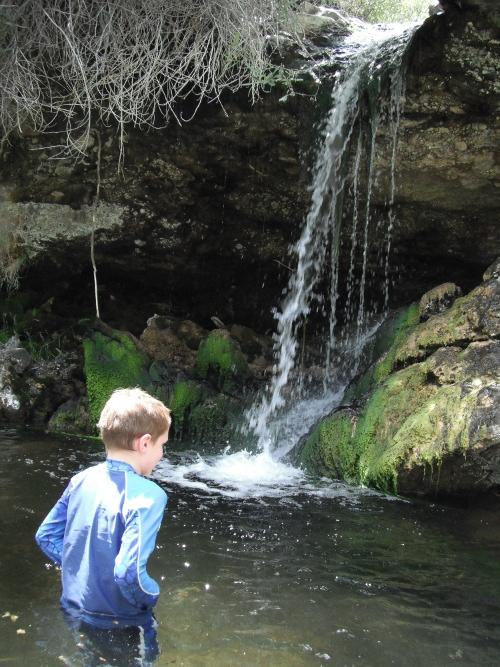
We also know what’s up the canyon. Scrambling up the rocks and ducking under the willows, we pick our way toward the sound of falling water. I’ve been here before, and many times.
A large stream of water shoots off a rock ledge, falling vertically into a perfectly round pool. Behind the pool is a grotto. Water droplets drip from rocks onto ferns. This oasis is largely unknown, save for a few boaters that follow the bear path up the canyon. No roads, no trails. Wild.
Back on the water, the breeze picks up. We’re floating downstream, but getting pushed backwards.
Time for the arms to start working again. The drumming of the water gets an accompaniment with the swoosh of paddle strokes.
The rhythm is broken by the crunch of branches. Mother bear and her cub run up the hillside, their bronze fur rippling with each stride.
The exhilaration of seeing such a creature is replaced by the analytical mind. Bear, check. Turtles, river otter, bald eagle, osprey, green heron, blue heron, garter snake, deer … all, check.
Later, as we drag the boats up to the car, I reflect on the human infrastructure that was required to allow me to enjoy this wilderness. Cars, gas, rubbers, plastics, and a sinuous serpentine asphalt ribbon. It’s paradoxical, and uniquely human.
The artificial gets me closer to the natural. It’s a paradox, but also a balance. Preserving wild areas provides that balance.
Andrew Fulks is the president of Tuleyome, a regional conservation nonprofit, and is presently the Putah Creek Riparian Reserve Manager for UC Davis, managing six miles of stream and several hundred acres. His interest is in open space preservation and public access.