 How to resolve AdBlock issue?
News

KELSEYVILLE, Calif. – The community is preparing to welcome home a fallen soldier on Tuesday.
The body of Sgt. Richard Essex, 23, of Kelseyville, is being flown to California on Tuesday, with a procession planned through the county early in the afternoon.
Essex was serving in the U.S. Army, and was assigned to A Company, 2nd Battalion, 25th Combat Aviation Brigade, 25th Infantry Division, based at Schofield Barracks, Hawaii.
He was the door gunner on a Black Hawk helicopter that crashed in Afghanistan's Kandahar province on Thursday, Aug. 16, as Lake County News has reported.
The cause of the crash – which claimed a total of 11 victims – remains under investigation.
The body of Essex and several of his fellow soldiers was returned to the United States on Sunday, Aug. 19, according to the Air Force Mortuary Affairs Operations Office.
The “dignified transfer” on Aug. 19 occurred at Dover Air Force Base in Delaware.
His body will be flown from the East Coast on Tuesday morning and then will be driven to Lake County.
Essex’s procession will move down Highway 29 and then to Merritt Road before turning onto Main Street in Kelseyville, where it’s expected to pass through at about noon.
It will pass Kelseyville High School – where Essex graduated in 2008 – before moving back onto Highway 29 and then to Lakeport, where it’s expected at about 12:15 p.m.
The procession will turn onto S. Main Street at the Highway 175 intersection before winding its way through Lakeport.
The California Highway Patrol will be on hand to help control traffic to allow the procession to move on and off the highway.
Community members are welcome to line Main Street in both Kelseyville and Lakeport for the procession.
A public memorial service for Essex will take place beginning at 11 a.m. Saturday, Sept. 1, on the football field at Kelseyville High School, 5480 Main St.
A map of the anticipated procession route is shown below. It will be updated as more details become available.
Email Elizabeth Larson at
View Larger Map

KELSEYVILLE, Calif. – The Ely Stage Stop and Country Museum is expanding.
Over the past two weekends, volunteers have met at the museum-in-progress, located at 9921 State Hwy 281 (Soda Bay Road), to begin building the new display barn.
Greg Dills, who is overseeing the work, reported that on Saturday, Aug. 18, six volunteers began construction of the 2,000-square-foot barn that will house many of the society’s artifacts.
Anyone interested in becoming involved with the project is invited to call Dills at 707-263-4180, Extension 102, for more information.

California Attorney General Kamala Harris on Monday announced a bill to combat blight was signed into law by Governor Edmund G. Brown Jr.
Assembly Bill 2314 by Assemblymember Wilmer Carter, D-Rialto, provides additional tools to local governments and receivers to fight neighborhood blight caused by vacant homes.
“The foreclosure crisis has had a devastating impact on many families and communities,” said Attorney General Harris. “This legislation will help victims of the crisis who remain in their homes, but have been forced to endure the negative economic, health and safety consequences of blight in their neighborhoods.”
“We need solutions to the problem of blight which threatens the health and safety of California communities hit hardest by the mortgage crisis,” said Assemblymember Wilmer Amina Carter, D-Rialto. “AB 2314 will ensure that local jurisdictions continue to have the tools to prevent and fight neighborhood blight due to foreclosures.”
The new law is part of the California Homeowner Bill of Rights sponsored by Attorney General Harris.
The Homeowner Bill of Rights builds upon and extends reforms first negotiated in the recent national mortgage settlement between 49 states and leading lenders.
Attorney General Harris secured up to $18 billion for California homeowners in that agreement, and has also built a Mortgage Fraud Strike Force to investigate crime and fraud associated with mortgages and foreclosures.
Empty homes as a result of foreclosure invite squatters, bug infestation, and crime in communities, which hurts the market value of neighboring homes.
AB 2314 will give new homeowners additional time to remedy code violations and would help compel the owners of foreclosed property to pay for upkeep.
In July, two key parts of the Homeowner Bill of Rights were signed into law.
Those bills, which came out of a two-house conference committee, provide protections for borrowers and struggling homeowners, including a restriction on dual-track foreclosures, where a lender forecloses on a borrower despite being in discussions over a loan modification to save the home.
The bills also guarantee struggling homeowners a single point of contact at their lender with knowledge of their loan and direct access to decision makers.
Other components of the Homeowners Bill of Rights are pending in the state legislature. These will enhance law enforcement responses to mortgage and foreclosure-related crime, in part by empowering the attorney general to call a grand jury in response to financial crimes spanning multiple jurisdictions. A bill to provide enhanced protections for tenants in foreclosed homes has passed both houses and is awaiting action by Governor.
For more information on the California Homeowner Bill of Rights, go to www.oag.ca.gov .
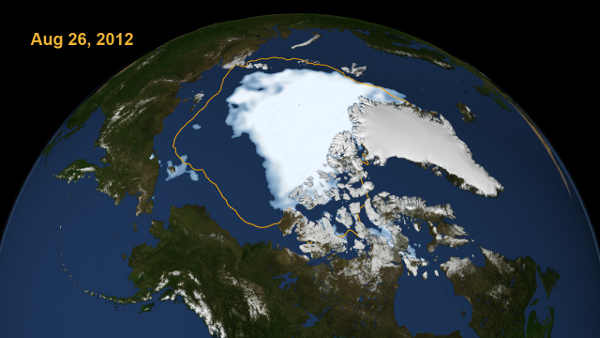
The blanket of sea ice floating on the Arctic Ocean melted to its lowest extent ever recorded since satellites began measuring it in 1979, according to NASA and the NASA-supported National Snow and Ice Data Center (NSIDC) in Boulder, Colo.
The extent of Arctic sea ice on Aug. 26, as measured by the Special Sensor Microwave/Imager on the U.S. Defense Meteorological Satellite Program spacecraft and analyzed by NASA and NSIDC scientists, was 1.58 million square miles, or 27,000 square miles below the Sept. 18, 2007, daily extent of 1.61 million square miles.
Since the summer Arctic sea ice minimum normally does not occur until the melt season ends in mid- to-late September, the CU-Boulder research team expects the sea ice extent to continue to dwindle for the next two or three weeks, said Walt Meier, an NSID scientist.
“It’s a little surprising to see the 2012 Arctic sea ice extent in August dip below the record low 2007 sea ice extent in September,” he said. “It’s likely we are going to surpass the record decline by a fair amount this year by the time all is said and done.”
Over the last three decades, satellites have observed a 13 percent decline per decade in the minimum summertime extent of the sea ice. The thickness of the sea ice cover also continues to decline.
“The persistent loss of perennial ice cover – ice that survives the melt season – led to this year’s record summertime retreat,” said Joey Comiso, senior research scientist at NASA’s Goddard Space Flight Center in Greenbelt, Md. “Unlike 2007, temperatures were not unusually warm in the Arctic this summer.”
Comiso said 2007 it was much warmer. “We are losing the thick component of the ice cover. And if you lose the thick component of the ice cover, the ice in the summer becomes very vulnerable.”
“By itself it’s just a number, and occasionally records are going to get set,” Meier said about the new record. “But in the context of what’s happened in the last several years and throughout the satellite record, it’s an indication that the Arctic sea ice cover is fundamentally changing.”
On Sept. 18, 2007, the September minimum extent of Arctic sea ice shattered all satellite records, reaching a five-day running average of 1.61 million square miles, or 4.17 million square kilometers.
Compared to the long-term minimum average from 1979 to 2000, the 2007 minimum extent was lower by about a million square miles – an area about the same as Alaska and Texas combined, or 10 United Kingdoms.
While a large Arctic storm in early August appears to have helped to break up some of the 2012 sea ice and helped it to melt more quickly, the decline seen in in recent years is well outside the range of natural climate variability, said Meier.
Most scientists believe the shrinking Arctic sea ice is tied to warming temperatures caused by an increase in human-produced greenhouse gases pumped into Earth’s atmosphere.
CU-Boulder researchers say the old, thick multi-year ice that used to dominate the Arctic region has been replaced by young, thin ice that has survived only one or two melt seasons – ice which now makes up about 80 percent of the ice cover.
The record-breaking Arctic sea ice extent in 2012 moves the 2011 sea ice extent minimum from the second to the third lowest spot on record, behind 2007. Meier and his CU-Boulder colleagues say they believe the Arctic may be ice-free in the summers within the next several decades.
“The years from 2007 to 2012 are the six lowest years in terms of Arctic sea ice extent in the satellite record,” said Meier. “In the big picture, 2012 is just another year in the sequence of declining sea ice. We have been seeing a trend toward decreasing minimum Arctic sea ice extents for the past 34 years, and there’s no reason to believe this trend will change.”
The Arctic sea ice extent as measured by scientists is the total area of all Arctic regions where ice covers at least 15 percent of the ocean surface, said Meier.
Scientists say Arctic sea ice is important because it keeps the polar region cold and helps moderate global climate – some have dubbed it “Earth’s air conditioner.”
While the bright surface of Arctic sea ice reflects up to 80 percent of the sunlight back to space, the increasing amounts of open ocean there – which absorb about 90 percent of the sunlight striking the Arctic – have created a positive feedback effect, causing the ocean to heat up and contribute to increased sea ice melt.
Earlier this year, a national research team led by CU embarked on a two-year effort to better understand the impacts of environmental factors associated with the continuing decline of sea ice in the Arctic Ocean.
The $3 million, NASA-funded project led by Research Professor James Maslanik of aerospace engineering sciences includes tools ranging from unmanned aircraft and satellites to ocean buoys in order to understand the characteristics and changes in Arctic sea ice, including the Beaufort Sea and Canada Basin that are experiencing record warming and decreased sea ice extent.
NORTH COAST, Calif. – Thousands more acres of wildland burned over the course of Monday in northern Mendocino County due to a lightning fire complex that began more than a week ago.
The North Pass Fires, burning 10 miles northeast of Covelo, burned about 4,500 acres over the course of late Sunday night and Monday, according to acreage totals offered by the unified command of Cal Fire and the US Forest Service.
By nightfall Monday, the two lightning-caused fires that were sparked on Saturday, Aug. 18, had reached approximately 31,656 acres with 34 percent containment, officials reported.
The number of firefighters at the incident totaled 1,666 on Monday; resources included 116 engines, 26 fire crews, two airtankers, 12 helicopters, 33 bulldozers and 25 water tenders, according to the Cal fire and US Forest Service report.
Evacuations remained in effect on Monday for dozens of homes and businesses east of Covelo, with a US Forest Service closure order in effect for the northern two-thirds of the Covelo Ranger District.
Fire officials reported that the fires continued to spread north toward the Middle Fork of the Eel River, Hammerhorn Lake, Foster Glade and Asa Bean Ridge within the Yolla Bolly Middle Eel Wilderness.
Officials also anticipate an eastward progression toward Forest Road M2 and Anthony Peak and southward toward Forest Highway 7, north towards Georges Valley and Soldier Ridge, and northeast toward Uhl Peak, Buck Rock and Little Buck Rock.
Fire crews have begun mopping up on the western flank of the fire along Asa Bean Ridge, while indirect line construction along Anthony Ridge and Forest Road M2 to prepare for future firing operations is planned for the next shift, the report said.
Email Elizabeth Larson at

COBB, Calif. – A Middletown man has been taken into custody for allegedly shooting a Kelseyville resident during an attempted robbery Saturday night.
John Chester Cook, 33, was arrested in the case, according to Sgt. Steve Brooks of the Lake County Sheriff’s Office.
At 8:05 p.m. Saturday sheriff’s deputies responded to a residence, located in the 9000 block of Highway 175 in Kelseyville, for a reported gunshot victim, Brooks said.
When deputies arrived at the residence, they were told by witnesses that their roommate stumbled into the residence and said he had been shot in the abdomen. Brooks said they also told deputies that they had already transported the victim to Sutter Lakeside Hospital for treatment. They were unable to provide any information as to who shot their roommate.
Deputies responded to Sutter Lakeside Hospital and contacted the victim, who said he was hitchhiking on Highway 175 near Wildcat Road when he received a ride from three unknown male subjects, Brooks said. The subjects drove the victim to an area on Diamond Dust Trail off of Highway 175.
Brooks said the suspect sitting next to the victim said that he wanted his marijuana and everything else he had. The victim attempted to get out of the vehicle and started to struggle with the suspect sitting next to him.
During the altercation the suspect fell out of the vehicle onto the ground where he continued to fight with the victim, Brooks said. The victim said he was standing over the suspect who was on his back, when the suspect drew a handgun and shot him once in the abdomen.
The victim told deputies that he retreated to his residence and contacted his roommate, who drove him to the hospital, Brooks said.
During the course of the investigation, deputies were able to identify Cook as the person allegedly responsible for shooting the victim. Brooks said deputies later located Cook and the firearm believed to have been used in the shooting in the area of Loch Lomond. A check of the firearm revealed it had been reported stolen out of Clearlake.
Cook was arrested for attempted robbery, assault with a deadly weapon, use of a firearm in the commission of a felony, possession of stolen property, felon in possession of a firearm and carrying a loaded firearm in public, Brooks said.
Cook was transported to the Lake County Hill Road Correctional Facility and booked, with a no bail hold set due to a misdemeanor bench warrant, according to jail records.