 How to resolve AdBlock issue?
News
NORTHERN CALIFORNIA – Some racial groups are more likely to bear the brunt of extreme heat waves because of where they live, according to a new study by researchers at the University of California, Berkeley.
The findings, published in the journal Environmental Health Perspectives, highlight racial disparities at a time when the frequency and intensity of extreme heat waves is expected to increase with climate change.
Researchers used satellite imagery data to identify areas where there is no tree canopy to provide shade, and where half or more of the land is covered by heat-absorbing hard surfaces, such as pavement, concrete or roofing materials.
Such land characteristics put residents at greater risk when the mercury rises because they exacerbate the heat, the study authors said.
The authors used U.S. Census data to reveal that the heat-prone neighborhoods were disproportionately populated by African Americans, Asians and Hispanics.
Compared with their white counterparts, African Americans were about 50 percent more likely to live in these communities, while Hispanics were 37 percent and Asians a third more likely to do so.
“This study highlights a mechanism by which racial and ethnic minorities will likely suffer more from the effects of climate change,” said study lead author Bill Jesdale, research associate in UC Berkeley’s Department of Environmental Science, Policy and Management. “It may not be surprising that minorities live in inner cities, but this is the first paper to assess what that means in terms of heat vulnerability at a national level.”
Rachel Morello-Frosch, a professor with joint appointments at the College of Natural Resources and the School of Public Health and the study principal investigator, noted that regional studies have identified similar trends, but seeing this residential segregation on a national scale was surprising.
“Segregation tends to concentrate racial and ethnic minorities into more densely populated urban areas,” she said. “While some of this residential choice is based upon preference, a lot is based upon where people can afford to live.”
Some steps that city planners can take to ameliorate the impact of climate change include planting more trees and lightening the coloring of roofs and pavements.
When possible, replacing harder surfaces with more permeable materials can also help, the authors said.
“Planting trees and changing the heat-absorbing characteristics of our built environment may be crucial to protecting our public’s health by mitigating heat risks, particularly in densely populated central areas of cities,” said Jesdale.
The Hewlett Foundation and the California Environmental Protection Agency helped support this research.
Sarah Yang writes for the UC Berkeley News Center.
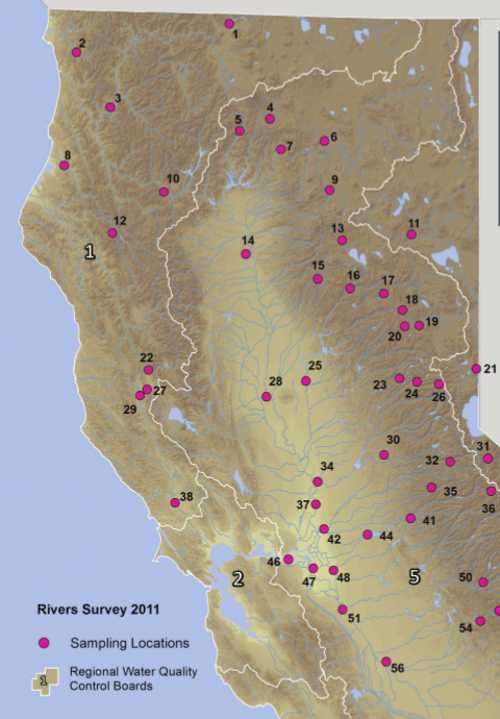
Concentrations of contaminants such as methylmercury and pesticides in sport fish were found to be low at the majority of locations sampled in the first-ever systematic statewide survey of California rivers and streams.
The fish survey, conducted by the State Water Resources Control Board’s Surface Water Ambient Monitoring Program (SWAMP), surveyed sport fish from 63 locations in 2011.
The survey analyzed sport fish because they provide information on potential human exposure to contaminants, and on the condition of the aquatic food web.
Other pollutants, including dieldrin, PCBs, DDT, chlordanes and selenium were also analyzed, but were not found at high enough concentrations to be a problem.
While a majority of areas sampled had low concentrations of methylmercury and pesticides, fish high in the food chain in the Sacramento-San Joaquin Delta region – such as largemouth, smallmouth and striped bass, and Sacramento pikeminnow – showed a high accumulation of methylmercury, the report showed.
Water from Clear Lake reaches the delta through Cache Creek and the Yolo Bypass. Locations within Lake County specifically were not tested in this initial study.
Nearby locations that were tested included the Van Arsdale fishing counting station on the Eel River, Cold Creek at Pottery Valley and the Coyote Valley Dam egg collection area on the Russian River, according to the report.
Methylmercury can affect the developing nervous system of children and adolescents, potentially leading to learning disabilities.
Methylmercury contamination of California rivers and streams likely originates from multiple sources, including historic mercury, gold and silver mining; global emissions to the atmosphere; and urban and industrial wastewater and storm water.
Methylmercury is generally a low concern in high elevation locations where trout species predominate and where most of the fishing spots sampled were located.
The initial screening study is a first step in an effort to identify and quantify contaminants in California’s rivers and streams to provide a detailed evaluation of human and wildlife exposure, and to establish priorities for cleanup actions.
In this survey, 568 fish representing 16 species were collected from 63 popular river and stream fishing locations throughout California. Where possible, multiple species were analyzed at each location.
Trout species and salmon had low concentrations of methylmercury and other contaminants. Cleaner species were frequently present alongside the species with high concentrations at the contaminated locations.
The River and Stream Survey was funded by the State Water Resources Control Board’s Surface Water Ambient Monitoring Program and the United States Environmental Protection Agency.
The survey is one component of a new program to track sport fish contamination in all California water bodies. Results from a survey of the state’s lakes were reported three years ago, and results for the coast were published last year.
The public can access results for individual fishing locations including the Coast Survey and the Lakes Survey through the California Water Quality Monitoring Council’s “My Water Quality” Web portal at www.CaWaterQuality.net . Information on sport fish contamination can be accessed by clicking on “Is It Safe to Eat Fish and Shellfish from Our Waters?”
The River and Stream Survey Report is available on the SWAMP Web site at http://www.waterboards.ca.gov/water_issues/programs/swamp/rivers_study.shtml .

LAKE COUNTY, Calif. – Wood frame buildings, wooden stairs, and wooden awnings were ingredients in a recipe for disaster when “the dread demon of fire” visited Lakeport three times between July 1924 and April 1926.
Some of Lakeport’s buildings stood three stories tall, but available ladders only reached two stories, forcing people to escape down ropes from the Monroe Apartments. News accounts do not mention fire escapes.
Despite a lack of fully functional equipment, Lakeport’s fire department, with help from other towns, fought valiantly to save the downtown area. No one died in the fires and no one sustained major injuries, but some people barely escaped in time.
Businesses, offices, apartment buildings and homes all went up in flames with damages totaling about $183,000. Some business owners who lived adjacent to their businesses lost both their homes and their businesses.
H.P. McQueen’s Blue Goose Grill and A.W. Chapman’s grocery store were among those businesses burned out in more than one of these fires.
On July 21, 1924, around 5:30 p.m. a fire started near First and Main streets. By the time firefighters controlled the blaze an hour later, five businesses, housed in three buildings were gone, and others had sustained damage. A.M. Akins’ hardware store, Mrs. A. Marsh’s hotel building, John Behr’s building, W. A. Chapman’s grocery store, Leflor and Saunders’ restaurant and hotel business, Piner’s auto top business and Fred Michaels’ cabinet and machine shop all burned in the fire. Damages totaled about $38,100.
Firefighters remained at the scene through the night, alert for flare-ups. Volunteers from Kelseyville and Upper Lake came to support Lakeport, just as Lakeport volunteers had assisted at Upper Lake’s devastating fire only three months earlier.

A vaudeville troupe, in town to perform, assisted in saving the Orpheum Theatre.
Two men fighting the fire on the roof of Akins’ hardware store were stranded on top of a brick wall when the roof collapsed. They managed to escape onto the roof of the adjacent Whitton Building and make their way to safety.
Following the 1924 fire, the town board set up a fire district, bounded by Clear Lake, Armstrong, Forbes and Sixth streets, within in which no more frame buildings would be permitted.
The requirements did not remove existing frame buildings within the boundaries, leaving Lakeport still vulnerable to fire.
The town didn’t have long to wait for the next conflagration.
A midday fire roared through buildings between Third and Fourth streets along Main Street’s east side on June 26, 1925. Faulty wiring was suspected as the cause of the fire that broke out shortly before noon in the Lakeman building.
The fire destroyed the three-story Piner Apartment building (formerly the May building) which also housed three stores; Jacob Lakeman’s building and his residence behind and Dr. Stipp’s home. Damage to these wood-frame buildings totaled about $45,300.
Volunteers helped to move most of Dr. Stipp’s possessions to safety from his doomed residence, but were unable to save his Oldsmobile.
Firefighters abandoned Stipp’s house when they realized that they could not save it and that the fire was threatening the west side of the street. They held the fire to the east side of Main Street, but the heat broke windows in buildings on the west side as far north as Anderson & Relfe’s Chevrolet dealership between Fourth and Fifth.

Main Street’s west side had been spared, temporarily. Employees at the Lake County Bee discovered a breaking news story on their doorstep about 11 p.m. on April 20, 1926, when they noticed a fire in the rear of the nearby Monroe Apartments.
By the time firefighters had controlled the blaze a few hours later five buildings had burned and damages had reached about $100,000.
The three-story Monroe Building, formerly the Lakeview Hotel, housed four businesses on the first floor, with apartments on the second and third floors.
Flames pouring up the stairs of the Monroe Building, which apparently had no fire escapes, nearly trapped several residents and guests.
Pendy Burriss barely escaped and then returned to rescue Mrs. Monroe who was unable to get out of the building on her own
Members of the Dixie Jubilee Quartet, settling in for the night at the Monroe Apartments after a performance, were roused by the alarms. With little time to spare, they threw their suitcases out the windows to safety, and then waited while firefighters tried to get a ladder to them. Some of the troupe escaped down ropes when ladders proved to be too short to reach them on the third floor.
The fire burned north along Main Street to the south wall of the Masonic hall and west along Third Street, where it damaged the Lake County Bee office.

Both the Lake County Bee and the Clear Lake Press suffered damage but were able to publish their papers. Volunteers had moved paper and equipment out of the Bee plant to safety and brought it back when the danger had passed. By 4 a.m. the Bee was back in operation and published the issue that the fire had interrupted.
With the Press office destroyed, the employees published it with help from the Lake County Record in Upper Lake and the Bee in Lakeport.
Two bodies awaiting funerals at Russell’s undertaking establishment were taken to a safer location before flames destroyed the business.
Other businesses lost in the 1926 fire were The Toggery, Embree & Charlton’s barber shop, Winstead’s Café, Curry’s Furniture, Dr. F. H. Forshee’s optometry office, California Telephone & Light and the Blue Goose Grill.
Within a week of the fire, business owners had found new locations and the property owners were making plans to replace the destroyed buildings.
The Clear Lake Press linotype had been hauled to San Francisco for repairs, but the Lakeport Women’s Civic Club, which owned the building, decided not to rebuild. The Clear Lake Press went out of business in July 1926.
After the 1926 fire the Lakeport Fire Department declared wooden awnings to be a menace and requested that property owners remove them. The awnings were a fire hazard and many were rickety, not strong enough to support people who might be up there during fires.

Construction on new concrete buildings began in June. J. D. Monroe’s building had four store fronts facing Main Street and two on Third Street. This building now houses Watershed Books, The Video Game Shop, Your One Stop Party Shop, The Goldsmith jewelry shop and the Lake County Arts Council.
J. W. Curry, Sarah Monroe and Judge Morton Sayre also replaced their burned-out buildings with concrete structures that still stand along Main Street. Curry’s Furniture has remained in the same location since rebuilding.
Better firefighting equipment and improved building codes have done much to reduce the number of disastrous fires in Lakeport.
A grocery store on Third Street between Main and Park streets burned about 1990 and in 2012 the Lunas building at Main and Third Streets suffered major damage, but those fires did not spread to other buildings.
Note: Articles in the Lake County Bee and the Lake County Record are on microfilm in the collection of the Lake County Library.
Jan Cook has lived in Lake County for about 40 years. She works for the Lake County Library, is the editor of the Lake County Historical Society’s Pomo Bulletin and is a history correspondent for Lake County News. If you have questions or comments please contact Jan at

LAKE COUNTY, Calif. – The flags of fallen veterans will fly in display at cemeteries throughout Lake County on Monday, Memorial Day.
Lake County Veterans Memorial-Avenue of Flags Association, with the help of local volunteers, will install the flagpoles and mount the large flags along the avenues of county cemeteries.
These flags once draped the casket of a fallen veteran. Upon the completion of the internment ceremony, the family is presented the flag.
The family has the option of donating the use of the veterans’ burial flag to the Lake County Veterans Memorial- Avenue of Flags Association.
On Memorial Day and Veterans Day the flags are flown to commemorate the memory of veterans who defended our country.
Avenue of Flags will be presented at the following cemeteries: Hartley Cemetery in Lakeport, Upper Lake Cemetery, Kelseyville Cemetery and Lower Lake Cemetery.
Installation of flagpoles and flags will begin at 7 a.m., weather permitting. Takedown of flags and flagpoles will occur at 4 p.m.
Volunteers would be appreciated at all locations.
For more information call the following representatives: Upper Lake (Byron Green, 707-275-9515), Lower Lake (Dave Schober, 707-533-5843), Kelseyville (Paul Harris, 707-279-1115) and Hartley Cemetery, Lakeport (Dean Gotham, 707-350-1159).
Express your respect for fallen veterans and experience the pride of the magnificent display of the veterans’ flags. Never forget.
Among the hundreds of new planets discovered by NASA’s Kepler spacecraft are a class of exotic worlds known as “hot Jupiters.”
Unlike the giant planets of our own solar system, which remain at a safe distance from the sun, these worlds are reckless visitors to their parent stars.
They speed around in orbits a fraction the size of Mercury’s, blasted on just one-side by starlight hundreds of times more intense than the gentle heating experienced by Jupiter here at home.
Meteorologists watching this video are probably wondering what kind of weather a world like that might have. The short answer is “big.”
Heather Knutson of Caltech made the first weather map of a hot Jupiter in 2007.
“It’s not as simple as taking a picture and – voila! – we see the weather,” said Knutson.
These planets are hundreds of light years from Earth and they are nearly overwhelmed by the glare of their parent stars. “Even to see the planet as a single pixel next to the star would be a huge accomplishment,” she added.
Instead, Knutson and colleagues use a trick dreamed up by Nick Cowan of Northwestern University.
The key, she explained, is that “most hot Jupiters are tidally locked to their stars. This means they have a permanent dayside and a permanent night side.
As we watch them orbit from our vantage point on Earth, the planets exhibit phases – e.g., crescent, gibbous and full. By measuring the infrared brightness of the planet as a function of its phase, we can make a rudimentary map of temperature vs. longitude.”
NASA’s Spitzer Space Telescope is the only infrared observatory with the sensitivity to do this work. Since Knutson kick-started the research in 2007, nearly a dozen hot Jupiters have been mapped by astronomers using Spitzer.
The most recent study, led by Nikole Lewis, a NASA Sagan Exoplanet Fellow working at MIT, shows a gas giant named HAT-P-2b.
“We can see daytime temperatures as high as 2400 K,” said Lewis, “while the nightside drops below 1200K.
Even at night,” she marveled, “this planet is ten times hotter than Jupiter.”
These exoplanet maps may seem crude compared to what we’re accustomed to on Earth, but they are a fantastic accomplishment considering that the planets are trillions of miles away.
The maps show huge day-night temperature differences typically exceeding 1000 degrees. Researchers believe these thermal gradients drive ferocious winds blowing thousands of miles per hour.
Without regular pictures, researchers can’t say what this kind of windy weather looks like. Nevertheless, Knutson is willing to speculate using climate models of Jupiter as a guide.
“Weather on hot Jupiters,” she predicts, “is really big.”
Over the years, planetary scientists have developed computer models to reproduce the storms and cloud belts in Jupiter’s atmosphere.
If you take those models and turn up the heat, and slow down the rotation to match the tidally-locked spin of a hot Jupiter, weather patterns become super-sized.
For instance, on a hot Jupiter the Great Red Spot might grow as large as a quarter the size of the planet and manifest itself in both the northern and southern hemispheres.
“Just imagine what that would look like – a pair of giant eyes staring out into space!” said Lewis.
Meanwhile, Jupiter’s famous belts would widen so much that only two or three would fit across the planet’s girth.
Ordinary clouds of water and methane couldn’t form in such a hot environment. Instead, Knutson speculated that hot Jupiters might have clouds made of silicate – that is, “rock clouds.”
“Silicates are predicted to condense in such an environment,” she said. “We’re already getting some hints that clouds might be common on these planets, but we don’t yet know if they’re made of rock.”
For now just one thing is certain: The meteorology of hot Jupiters is out of this world.
Dr. Tony Phillips works for the National Aeronautics and Space Administration.
LAKE COUNTY, Calif. – Dogs of all ages and breeds are available for adoption this week through the county and rescue groups.
Adoptable dogs from Lake County Animal Care and Control and the SPCA of Clear Lake are featured this week.
In addition to the animals featured here, all adoptable animals in Lake County can be seen here: http://bit.ly/Z6xHMb .
SPCA OF CLEAR LAKE
All dogs have been spayed or neutered, are microchipped and current on all their vaccinations and started on heartworm preventative. For more information on the dogs listed below, contact the SPCA of Clear Lake, 707-279-1400.

‘Bo’
‘Bo’ is an adorable kelpie mix pup, approximately 3 months old.
He is very friendly and loves giving kisses.

‘Riley’
‘Riley’ is a sweet and energetic 4-month-old Rottweiler mix.
She has been started on her basic obedience and is eager to please.

Brindle pups
Seven puppies are needing homes.
They are 10 weeks old, with six brindles and one all-black pup.
LAKE COUNTY ANIMAL CARE AND CONTROL
Dogs that are adopted from Lake County Animal Care and Control are either neutered or spayed, microchipped and, if old enough, given a rabies shot and county license before being released to their new owner. License fees do not apply to residents of the cities of Lakeport or Clearlake.
If you're looking for a new companion, visit the shelter. There are many great pets hoping you'll choose them.
The following dogs at the Lake County Animal Care and Control shelter have been cleared for adoption (additional dogs on the animal control Web site not listed are still “on hold”).

Female pit bull terrier mix
This female pit bull terrier mix is 7 months old.
She weighs nearly 26 pounds, has been spayed, and has a short brown and white coat.
She is currently in foster, ID No. 35880.

Chihuahua-wirehaired terrier
This male Chihuahua-wirehaired terrier is 8 months old.
He weighs nearly 10 pounds, has a long tan coat and has been altered.
He’s currently in foster, ID No. 36211.

Male Chihuahua mix
This male Chihuahua mix is 9 months old.
He has a short tan coat, weighs 4 pounds and has not yet been neutered.
He’s in kennel No. 3, ID No. 36498.

Female Chihuahua mix
This female Chihuahua mix is 3 years old.
She has a short black and tan coat and weighs nearly 8 pounds. It was not reported if she had been altered.
Find her in kennel No. 4, ID No. 36406.

Australian Shepherd mix pup
This Australian Shepherd mix pup is 7 months old.
He has a short tricolor coat and weighs 27 pounds. It was not reported if he had been altered.
He’s in kennel No. 6, ID No. 36511.

Mastiff-hound mix
This mastiff-hound mix is 8 months old.
He has a short brown brindle coat and weighs 54 pounds. Shelter staff did not say if he had been altered.
Find him in kennel No. 8, ID No. 36410.

Male boxer mix
This male boxer mix is 2 years old.
He has a short brown brindle and white coat, weighs 47 pounds and has not yet been neutered.
He’s in kennel No. 9, ID No. 36409.

Labrador Retriever mix
This male Labrador Retriever mix is 2 years old.
He has a short brown coat and weighs 112 pounds. Shelter staff did not report if he had been altered.
Find him in kennel No. 10, ID No. 36407.

Mastiff-hound mix
This mastiff-hound mix is 8 months old.
She has a short brown brindle and black coat and weighs 60 pounds. It was not reported whether or not she had been altered.
She’s in kennel No. 11, ID No. 36411.

Labrador Retriever-Chesapeake Bay Retriever mix
This Labrador Retriever-Chesapeake Bay Retriever mix is 7 years old.
He has a short brown coat and has been neutered.
Find him in kennel No. 12, ID No. 36370.

Chihuahua mix
This female Chihuahua mix is 9 months old.
She has a short tan coat, weighs 7 pounds and has been spayed.
She’s in kennel No. 18a, ID No. 36421.

Chihuahua mix
This male Chihuahua mix is 9 months old.
He has a short tan coat, weighs 7 pounds and has been neutered.
Find him in kennel No. 18b, ID No. 36420.

Pit bull terrier-hound mix
This male pit bull terrier-hound mix is 4 months old.
He weighs 18 pounds, has a short tan and white coat, and has been spayed.
He’s in kennel No. 22c, ID No. 36139.

Male terrier mix
This male terrier mix is 16 weeks old.
He has a short tan coat, weighs 15 pounds and has been neutered.
Find him in kennel No. 26, ID No. 36303.

‘Baby’
“Baby” is a 9-month-old red heeler mix.
She has a short tricolor coat, weighs 24 pounds and has been spayed.
She’s in kennel No. 29, ID No. 36374.
Please note: Dogs listed at the county shelter's Web page that are said to be “on hold” are not yet cleared for adoption.
To fill out an adoption application online visit http://www.co.lake.ca.us/Government/Directory/Animal_Care_And_Control/Adopt/Dog___Cat_Adoption_Application.htm .
Lake County Animal Care and Control is located at 4949 Helbush in Lakeport, next to the Hill Road Correctional Facility.
Office hours are Monday through Friday, 8 a.m. to 5 p.m., and 1 p.m. to 3 p.m., Saturday. The shelter is open from 10:30 a.m. to 4:30 p.m. Monday through Friday and on Saturday from 1 p.m. to 3 p.m.
Visit the shelter online at http://www.co.lake.ca.us/Government/Directory/Animal_Care_And_Control.htm .
For more information call Lake County Animal Care and Control at 707-263-0278.
Email Elizabeth Larson at