 How to resolve AdBlock issue?
News
CLEARLAKE OAKS, Calif. – Two visitors to Lake County died Saturday evening when the motorcycle on which they were traveling hit a guard rail on Highway 20.
The wreck occurred at 6:25 p.m. on Highway 20 west of New Long Valley Road, the California Highway Patrol said in a Saturday night report.
The CHP did not release the names of the 62-year-old man and the 60-year-old woman, both from Rio Linda, who were killed in the crash, pending notification of kin.
The CHP’s preliminary report said the male driver was traveling at an unsafe speed west on Highway 20 when he allowed his 1998 Harley-Davidson motorcycle to veer across the eastbound lane, hitting a steel guard rail.
Both the driver and his passenger were thrown from the motorcycle into the guard rail before coming to rest on the south shoulder, the CHP said.
The man and the woman were both pronounced dead at the scene by fire personnel, according to the CHP.
The CHP said both individuals were wearing helmets, and alcohol was not a factor in the crash.
The Saturday crash was the third fatal wreck on Lake County roadways this week, and the second involving a motorcycle.
A Clearlake man was killed when his motorcycle collided with two other vehicles west of the intersection of Highway 53 and 20 near Clearlake Oaks on Wednesday night, as Lake County News has reported.
Email Elizabeth Larson at
CLEARLAKE OAKS, Calif. – A Saturday evening motorcycle crash east of Clearlake Oaks claimed the lives of two people.
The crash, which was dispatched at approximately 6:30 p.m., was reported on E. Highway 20, two miles east of the intersection with Highway 53 and Highway 20.
Reports from the scene indicated two people were on the ground in the eastbound side of the highway. No other vehicles were reported to have been involved.
Northshore Fire, Lake County Fire and Cal Fire responded along with the California Highway Patrol, according to radio reports.
Firefighters arriving at the scene reported finding both crash victims had died.
Fire units established traffic control in the area due to the roadway blockage.
The crash marked the third fatal this week in Lake County and was the second involving a motorcycle. Altogether, four people have died on the county’s roads in the past six days.
Additional details will be posted as they become available.
Email Elizabeth Larson at
UPPER LAKE, Calif. – The town of Upper Lake will celebrate its Old West heritage next week when it hosts its annual Wild West Day celebration.
The 20th annual event will take place on Saturday, June 1, in downtown Upper Lake.
The day will feature a pancake breakfast and street fair, with a parade that winds its way through town beginning at 10:30 a.m.
There also will be music by the Mark Weston Band, a tri-tip barbecue, costume and beard contest, shootout skits by the Blue Canyon Gang as well as a variety of local merchants.
Wild West Day is sponsored b`y the Upper Lake Community Council, Northshore Fire Protection District and the North Shore Business Association.
For more information contact Debbie Hablutzel at 707-275-9130.
On Friday California Attorney General Kamala Harris announced the sentencing of three defendants in a human trafficking ring in which women from Mexico were used as prostitutes in five Northern California cities.
Nery Najarro-Rodriguez, 42, Jorge Perez-Hernandez, 37, and Luis Mata, 30, pleaded no contest to conspiracy to commit pimping and pandering as part of a multi-county investigation.
The defendants were each sentenced in Sacramento County Superior Court to three years in county jail.
The charges stemmed from an extensive FBI investigation into a human trafficking network that spanned several northern California counties.
Young women, ages 21 to 30, were trafficked from Mexico and sold for sex to as many as 20 clients in a single day.
The sex acts occurred in brothels identified in Chico, Stockton, Yuba City, Fairfield and Sacramento.
“Human trafficking is a horrific crime that brutalizes millions of victims,” said Attorney General Harris. “It is important that we investigate, prosecute and imprison those who force this kind of cruelty and depravity upon women. These sentences send a message that human traffickers will be prosecuted and punished.”
In January, the FBI served arrest and search warrants at the brothel houses and recovered evidence which was presented to the Attorney General’s Special Crimes Unit.
FBI surveillance showed that the women spent approximately one week at a particular brothel before being driven to a bus station or another brothel location.
Federal prosecutors have charged three additional defendants with harboring an alien and conspiracy to harbor an alien. That case is still pending.
California Department of Justice Special Agents obtained arrest warrants for five suspects on state conspiracy and pimping charges. Three of those five suspects were sentenced Friday.
A fourth suspect, Adelaida Teran-Bravo, 42, was previously convicted of felony accessory and sentenced to six months in county jail.
Charges against the fifth defendant, Garrido Fuentas, 32, are currently pending in Butte County Superior Court.
Last year, Attorney General Harris released “The State of Human Trafficking in California 2012,” a report that outlines the growing threat of the crime of human trafficking, as well as the increasing involvement of sophisticated transnational gangs in perpetrating the crime and the use of the Internet in both facilitating and preventing it.
For more information on human trafficking, go to: http://www.oag.ca.gov/human-trafficking .
Responding to a challenge by California Gov. Jerry Brown, more than 500 of the world’s top global change scientists have outlined the main environmental issues – from climate change to pollution and population growth – that policy makers must address immediately to avoid an approaching global tipping point.
The leaders of the initiative joined Gov. Brown on Thursday to release their 30-page statement, “Maintaining Humanity’s Life Support Systems in the 21st Century,” during the 2013 Water, Energy and Smart Technology Summit and Showcase, an event designed to mobilize Silicon Valley innovation to tackle planet-wide problems.
Held at NASA Ames Research Center in Mountain View, Calif., the joint venture by NASA Ames and the non-profit group Sustainable Silicon Valley was sponsored, in part, by a who’s who list of top Silicon Valley companies.
“Gov. Brown asked me last year why, if global change is such a big deal, scientists are just publishing in scientific journals and not translating their findings into terms that policy makers, industry and the general public can understand and start to address,” said Anthony Barnosky, University of California, Berkeley, professor of integrative biology.
Barnosky was lead author of a scientific paper last year warning that Earth is approaching a tipping point beyond which the planet’s climate and biodiversity will be radically and unalterably changed beyond anything humanity has known.
“Here are 520 scientists from throughout the world making a very strong statement, with as little waffling as possible, about Earth’s environmental problems, and we’re putting it in the hands of policy makers so they can understand and start formulating solutions,” he said. “And we are starting with the governor of California, the world’s ninth largest economy.”
The scientists, representing a variety of expertise on the impact of humans on Earth’s ecosystems, identify five key threats: climate change, which has already led to increasing global temperatures, rising sea levels and dramatic changes in weather patterns; high rates of extinction for both animals and plants; the loss of ecosystems around the planet as they are paved over, plowed or tamed; the pressure from a steadily increasing human population; and pollution.
The full text of the statement and a list of the signatories – they hail from 44 countries and include two Nobel laureates, 33 members of the U.S. National Academy of Sciences and members of other nation’s scientific academies – is available at the Millennium Alliance for Humanity and the Biosphere Web site, http://mahb.stanford.edu/ , where it will available for signing by other scientists and the general public.
“As members of the scientific community actively involved in assessing the biological and societal impacts of global change, we are sounding this alarm to the world,” the scientists write in the summary. “For humanity’s continued health and prosperity, we all – individuals, businesses, political leaders, religious leaders, scientists and people in every walk of life – must work hard to solve these five global problems, starting today.”
“In 30 years there are a few things that people will credit us for doing now, or bemoan our failure if we don't. Grappling with climate change, and stopping it, is the best gift we can give the future, because unstopped it will crack our society and impoverish our children,” said Stephen Palumbi, one of the statement’s 16 main authors, a professor of biological sciences at Stanford University and the director of Stanford’s Hopkins Marine Station in Pacific Grove, Calif.
The statement does not recommend specific strategies, Barnosky said, but pinpoints the major issues that need to be addressed and feasible broad-brush solutions.
For example, to deal with climate change, “it is essential to get off fossil fuels as fast as possible. If we don’t, we are not going to make it. Period,” he said.
“How we mitigate and manage these interacting environmental impacts will determine whether or not human quality of life declines over the next few decades,” Barnosky added. “This is not the first time scientists have alerted decision makers to these issues, but we are doing it now much more forcefully. There is a lot of new and alarming scientific insight about the environmental changes currently taking place and how this is profoundly affecting humanity."
“Our report, having been requested by the California governor, might be an important move forward in our effort to communicate science to politicians. I find this to be ‘science for policy’ at its best,” said Nils Chr. Stenseth, another of the statement’s main authors. Stenseth is a professor of ecology and evolution and a member of the Centre for Ecological and Evolutionary Synthesis at the University of Oslo.
Among the recommendations are:
– Reduce the effects of climate change by decreasing greenhouse gas emissions and planning now how to adapt to the consequences already underway. To achieve this, replace fossil fuels with carbon-neutral energy sources, such as solar, wind and biofuels; promote energy-efficient buildings, transportation and manufacturing systems; conserve forests and regulate land conversion to maximize carbon sequestration and ecosystem services; and develop plans to deal with such climatic impacts as sea-level rise and shifting patterns of agricultural productivity.
– Slow the global loss of biodiversity by recognizing both the long-term economic benefits and intangible gains that accrue from protecting natural ecosystems from global pressures, such as ocean acidification, and local pressures, such as overfishing or forest conversion.
– Curb the manufacture and release of toxic substances into the environment with regulations on existing as well as new chemicals, and bolster research to develop safer alternatives.
– Slow land conversion, which has already transformed 40 percent of Earth’s surface into farms and ranches, cities and suburbs. This can be achieved by improving the efficiency of food production in existing agricultural areas and better food distribution while decreasing waste. Encourage urban growth rather than suburban sprawl so as to preserve natural landscapes that enhance such critical human services as water quality.
– Slow and eventually stop world population growth, with a peak of no more than 9 billion, decreasing to less than 7 billion by 2100. To achieve this, ensure access to education, economic opportunities and health care, including family planning services, with a special focus on women’s rights. Promote environmentally friendly changes in consumer behavior.
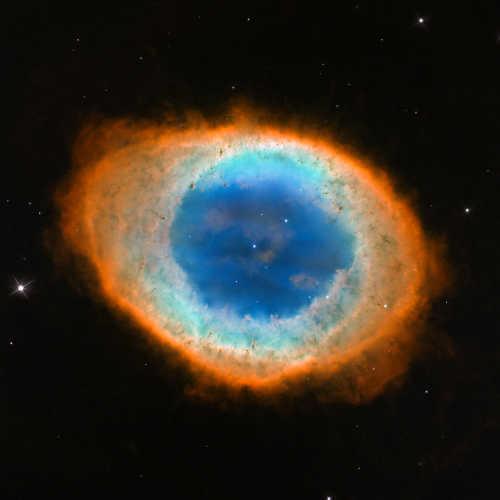
The Ring Nebula’s distinctive shape makes it a popular illustration for astronomy books. But new observations by NASA’s Hubble Space Telescope of the glowing gas shroud around an old, dying, sun-like star reveal a new twist.
“The nebula is not like a bagel, but rather, it’s like a jelly doughnut, because it’s filled with material in the middle,” said C. Robert O’Dell of Vanderbilt University in Nashville, Tenn.
O’Dell leads a research team that used Hubble and several ground-based telescopes to obtain the best view yet of the iconic nebula.
The images show a more complex structure than astronomers once thought and have allowed them to construct the most precise 3-D model of the nebula.
“With Hubble’s detail, we see a completely different shape than what’s been thought about historically for this classic nebula,” O’Dell said. “The new Hubble observations show the nebula in much clearer detail, and we see things are not as simple as we previously thought.”
The Ring Nebula is about 2,000 light-years from Earth and measures roughly 1 light-year across. Located in the constellation Lyra, the nebula is a popular target for amateur astronomers.
Previous observations by several telescopes had detected the gaseous material in the ring’s central region.
But the new view by Hubble’s sharp-eyed Wide Field Camera 3 shows the nebula’s structure in more detail.
O’Dell’s team suggests the ring wraps around a blue, football-shaped structure. Each end of the structure protrudes out of opposite sides of the ring.
The nebula is tilted toward Earth so that astronomers see the ring face-on. In the Hubble image, the blue structure is the glow of helium.
Radiation from the white dwarf star, the white dot in the center of the ring, is exciting the helium to glow.
The white dwarf is the stellar remnant of a sun-like star that has exhausted its hydrogen fuel and has shed its outer layers of gas to gravitationally collapse to a compact object.
O’Dell’s team was surprised at the detailed Hubble views of the dark, irregular knots of dense gas embedded along the inner rim of the ring, which look like spokes in a bicycle wheel.
These gaseous tentacles formed when expanding hot gas pushed into cool gas ejected previously by the doomed star. The knots are more resistant to erosion by the wave of ultraviolet light unleashed by the star.
The Hubble images have allowed the team to match up the knots with the spikes of light around the bright, main ring, which are a shadow effect. Astronomers have found similar knots in other planetary nebulae.
All of this gas was expelled by the central star about 4,000 years ago. The original star was several times more massive than our sun.
After billions of years converting hydrogen to helium in its core, the star began to run out of fuel. It then ballooned in size, becoming a red giant.
During this phase, the star shed its outer gaseous layers into space and began to collapse as fusion reactions began to die out. A gusher of ultraviolet light from the dying star energized the gas, making it glow.
The outer rings were formed when faster-moving gas slammed into slower-moving material. The nebula is expanding at more than 43,000 miles an hour, but the center is moving faster than the expansion of the main ring. O’Dell’s team measured the nebula’s expansion by comparing the new Hubble observations with Hubble studies made in 1998.
The Ring Nebula will continue to expand for another 10,000 years, a short phase in the lifetime of the star. The nebula will become fainter and fainter until it merges with the interstellar medium.
Studying the Ring Nebula’s fate will provide insight into the sun’s demise in another 6 billion years. The sun is less massive than the Ring Nebula’s progenitor star, so it will not have an opulent ending.
“When the sun becomes a white dwarf, it will heat more slowly after it ejects its outer gaseous layers,” O’Dell said. “The material will be farther away once it becomes hot enough to illuminate the gas. This larger distance means the sun’s nebula will be fainter because it is more extended.”
In the analysis, the research team also obtained images from the Large Binocular Telescope at the Mount Graham International Observatory in Arizona and spectroscopic data from the San Pedro Martir Observatory in Baja California, Mexico.