How to resolve AdBlock issue?
Refresh this page
How to resolve AdBlock issue?
Refresh this page
Lake County News,California
  • Home
    • Registration Form
  • News
    • Education
    • Veterans
    • Community
      • Obituaries
      • Letters
      • Commentary
    • Police Logs
    • Business
    • Recreation
    • Health
    • Religion
    • Legals
    • Arts & Life
    • Regional
  • Calendar
  • Contact us
    • FAQs
    • Phones, E-Mail
    • Subscribe
  • Advertise Here
  • Login

News

Retirement doesn’t just raise financial concerns – it can also mean feeling unmoored and irrelevant


Retirement doesn’t just lead to concerns about money. It also raises questions about one’s usefulness in the world. LaylaBird/E+ via Getty images

Most discussions of retirement focus on the financial aspects of leaving the workforce: “How to save enough for retirement” or “How do you know if you have enough money for retirement?”

But this might not be the biggest problem that potential retirees face. The deeper issues of meaning, relevance and identity that retirement can bring to the fore are more significant to some workers.

Work has become central to the modern American identity, as journalist Derek Thompson bemoans in The Atlantic. And some theorists have argued that work shapes what we are. For most people, as business ethicist Al Gini argues, one’s work – which is usually also one’s job – means more than a paycheck. Work can structure our friendships, our understandings of ourselves and others, our ideas about free time, our forms of entertainment – indeed our lives.

I teach a philosophy course about the self, and I find that most of my students think of the problems of identity without thinking about how a job will make them into a particular kind of person. They think mostly about the prestige and pay that come with certain jobs, or about where jobs are located. But when we get to existentialist philosophers such as Jean-Paul Sartre and Simone de Beauvoir, I often urge them to think about what it means to say, as the existentialists do, that “you are what you do.”

How you spend 40 years of your life, I tell them, for at least 40 hours each week – the time many people spend at their jobs – is not just a financial decision. And I have come to see that retirement isn’t just a financial decision, either, as I consider that next phase of my life.

Usefulness, tools and freedom

For Greek and Roman philosophers, leisure was more noble than work. The life of the craftsperson, artisan – or even that of the university professor or the lawyer – was to be avoided if wealth made that possible.

The good life was a life not driven by the necessity of producing goods or making money. Work, Aristotle thought, was an obstacle to the achievement of the particular forms of excellence characteristic of human life, like thought, contemplation and study – activities that express the particular character of human beings and are done for their own sake.

And so, one might surmise, retirement would be something that would allow people the kind of leisure that is essential to human excellence. But contemporary retirement does not seem to encourage leisure devoted to developing human excellence, partly because it follows a long period of making oneself into an object – something that is not free.

German philosopher Immanuel Kant distinguished between the value of objects and of subjects by the idea of “use.” Objects are not free: They are meant to be used, like tools – their value is tied to their usefulness. But rational beings like humans, who are subjects, are more than their use value – they are valuable in their own right, unlike tools.

And yet, much of contemporary work culture encourages workers to think of themselves and their value in terms of their use value, a change that would have made both Kant and the ancient Greek and Roman philosophers wonder why people didn’t retire as soon as they could.

A couple sit at their kitchen table with a laptop open and their bills spread out in front of them.
Retiring could also mean giving up an identity. FatCamera/ E+ via Getty images

‘What we do is what we are’

But as one of my colleagues said when I asked him about retirement: “If I’m not a college professor, then what am I?” Another friend, who retired at 59, told me that she does not like to describe herself as retired, even though she is. “Retired implies useless,” she said.

So retiring is not just giving up a way of making money; it is a deeply existential issue, one that challenges one’s idea of oneself, one’s place in the world, and one’s usefulness.

One might want to say, with Kant and the ancients, that those of us who have tangled up our identities with our jobs have made ourselves into tools, and we should throw off our shackles by retiring as soon as possible. And perhaps from the outside perspective, that’s true.

But from the participant perspective, it’s harder to resist the ways in which what we have done has made us what we are. Rather than worry about our finances, we should worry, as we think about retirement, more about what the good life for creatures like us – those who are now free from our jobs – should be.The Conversation

Marianne Janack, John Stewart Kennedy Professor of Philosophy, Hamilton College

This article is republished from The Conversation under a Creative Commons license. Read the original article.

Lucerne man held on $1 million bail for assaulting and injuring police officers

Cletus Manuel Rouillard. Lake County Jail photo.

LAKEPORT, Calif. — A Lucerne man has been arrested and is being held in the Lake County Jail on $1 million bail after he assaulted two Lakeport Police officers on Saturday.

Cletus Manuel Rouillard, 21, was taken into custody on three felonies and two misdemeanors on Saturday evening following the incident.

Lakeport Police Chief Dale Stoebe told Lake County News that shortly before 7:15 p.m. Saturday, officers contacted two people in a domestic argument for the second time in approximately 20 minutes.

During this second contact, Rouillard — who had been consuming alcohol prior to the officers’ arrival — became very agitated and confrontational with the other party, in violation of a peaceful contact restraining order, Stoebe said.

Stoebe said the officers attempted to handcuff Rouillard after advising that he was being arrested, at which time he became physically combative with the officers.

During the physical resistance to the arrest, Rouillard choked and caused head trauma to one of the officers, Stoebe said.

“Another officer suffered a head laceration before Rouillard was handcuffed and transported away from the scene,” Stoebe said.

A medical call was dispatched shortly before 7:30 p.m. Saturday in the area of Lakeshore Boulevard at Green Street on the report of multiple people with injuries, according to radio traffic.

Stoebe said Rouillard and one police officer received treatment for minor injuries and were released.

“The officer is recovering away from work for a few days,” Stoebe said.

Rouillard was booked into the Lake County Jail on attempted second-degree murder on a peace officer, which is the charge for which the $1 million bail is set; along with felony battery on a police officer with injury, and obstructing or resisting an officer.

He also was arrested on misdemeanors of contempt of court for disorderly behavior and obstructing or resisting a peace officer or emergency medical technician.

He is due to appear in Lake County Superior Court for arraignment on Wednesday.

Email Elizabeth Larson at This email address is being protected from spambots. You need JavaScript enabled to view it.. Follow her on Twitter, @ERLarson, or Lake County News, @LakeCoNews.

Bill requiring teaching about impact on Indigenous people during Spanish mission and gold rush eras heads to governor

When teaching about the Spanish mission and gold rush eras, California public schools would be required to teach the true history of the impact on California Native Americans during those periods if AB 1821 — now headed to the governor — is approved.

The full Assembly passed the bill Saturday night.

Assemblymember James C. Ramos authored the legislation.

“This bill builds upon my previous legislation, the California Indian Education Act, approved in 2022,” Ramos said. “For far too long California’s First People and their history have been ignored or misrepresented. Classroom instruction about the Mission and Gold Rush periods fails to include the loss of life, enslavement, starvation, illness and violence inflicted upon California Native American people during those times. These historical omissions from the curriculum are misleading.”

“I am proud to have co-sponsored AB 1821 by Assembly Ramos, and to see this important legislation pass the Senate floor,” said State Superintendent of Public Instruction Tony Thurmond, a bill sponsor. “This legislation will help ensure curriculum on California’s Spanish mission and Gold Rush Era accurately captures the treatment and impact of Native Americans during these significant eras in state history. This initiative supports California’s diverse students to be seen, heard, and understood in their instructional materials, and to foster a deeper appreciation for our Native communities’ history and cultures.”

In sponsoring the measure, San Manuel Band of Mission Indians Tribal Council Chairwoman Lynn Valbuena stated, “I am proud to have co-sponsored AB 1821 by Assembly Ramos, and to see this important legislation pass the Senate floor. This legislation will help ensure curriculum on California’s Spanish mission and Gold Rush Era accurately captures the treatment and impact of Native Americans during these significant eras in state history. This initiative supports California’s diverse students to be seen, heard, and understood in their instructional materials, and to foster a deeper appreciation for our Native communities’ history and cultures.”

Late last year, a poll released by the Institute of Governmental Studies showed strong support to require California schools to incorporate teaching about Native American tribes’ history and culture. An overwhelming 80% of respondents were in support of a requirement such as AB 1821.

In 2022, Gov. Gavin Newsom signed AB 1703 — the California Indian Education Act — into law. It encourages local educational agencies to create California Indian Education Task Forces to develop curriculum about the history and culture of tribes native or residing in their region. Although AB 1703 was a significant step toward inclusion of native voices, it stopped short of requiring the change in curriculum. AB 1821 would take that extra step.

A third bill sponsor is the Soboba Band of Luiseno Indians. A partial list of other supporters include the Santa Ynez Band of Chumash Indians, Tule River Tribe, California Teachers Association, California Tribal Business Alliance, California State PTA, ACLU California Action, Los Angeles County Office of Education, California Association for Bilingual Education and California Charter Schools Association.

Governor convenes special session to prevent gas price spikes

Gov. Gavin Newsom has called for a special session of the Legislature to address the pernicious problem of gasoline price spikes at the pump — and save Californians hundreds of millions of dollars annually.

Price spikes on consumers are profit spikes for oil companies, and Newsom’s office said they’re overwhelmingly caused by refiners not backfilling supplies when they go down for maintenance.

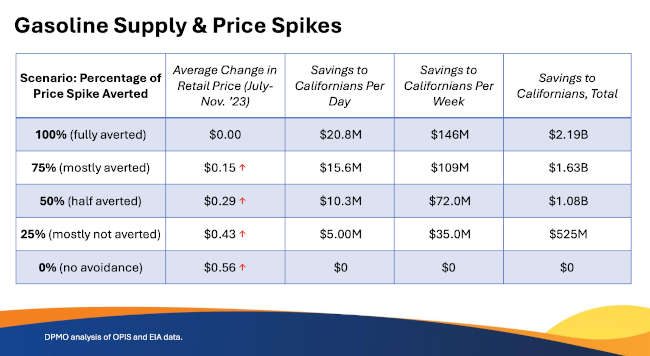
If this proposal had been in effect last year, the Governor’s Office said Californians could have saved hundreds of millions — if not billions — of dollars at the pump as evidenced by a Division of Petroleum Market Oversight, or DPMO, analysis, shown in the chart below.


“It should be common sense for gas refineries to plan ahead and backfill supplies when they go down for maintenance to avoid price spikes,” Newsom said. “But these price spikes are actually profit spikes for Big Oil, and they’re using the same old scare tactics to maintain the status quo. We look forward to working with our Legislative partners during the special session to act on this urgently needed legislation. Calling the session now allows the Legislature to begin that work immediately so that the state can resolve this important matter to establish the necessary rules to prevent price spikes next year and beyond.”

Senate President pro Tempore Mike McGuire (D-North Coast) said the Legislature has been working on this California Made and Clean Energy Package for months, and some of these proposals have been in discussions for the better part of a year.

“The Senate always had the votes and was ready to get these important measures across the finish line this legislative year and deliver the relief Californians need at the pump and on their electricity bills. We won’t be convening a special session this fall, but we look forward to continuing conversations with the governor and speaker about this critical issue in the days and weeks to come,” McGuire said.

Preventing gas price spikes

The governor’s special session is set to focus on passing his plan to save Californians money at the pump.

It would authorize the California Energy Commission, or CEC, to require petroleum refiners to maintain a minimum inventory of refined fuel throughout the distribution chain to avoid supply shortages that create higher prices at the pump for consumers.

It would also authorize the CEC to require refiners to plan for resupply during scheduled refiner maintenance. Text of the proclamation calling for a special session is available here.

Following gasoline price spikes in 2022, Governor Newsom called for a special session and worked in partnership with the Legislature to sign into law a package of reforms holding Big Oil accountable. California’s new watchdog found that higher gasoline prices were caused by a suspicious market transaction, refinery maintenance without properly preparing for it, and more.

In January of this year, the watchdog sent Gov. Newsom and the legislature a letter outlining specific proposals to reform California’s gasoline spot market, which included a minimum inventory requirement to prevent price spikes due to lack of stable supply.

The state’s gasoline price watchdog also found that, in 2023, gasoline prices spiked largely due to refineries going offline without adequately planning to backfill supplies, which caused refining margins to spike as spot and retail prices jumped — indicating that refinery margins made up the largest proportion of the price spikes between July and September 2023.

Americans love nature but don’t feel empowered to protect it, new research shows


People enjoy spending time in nature but don’t always feel they have the ability to protect it. John Greim/LightRocket via Getty Image

Climate change has been in the news for more than 40 years. It’s typically covered as a scientific or political issue. However, social scientists like me have found that feelings and values are what drive people toward broad, collective change – not charts, graphs or images.

Surveys confirm that the majority of Americans now believe that climate change is real. But many adults seem to feel too exhausted, defeated or powerless to do anything about it.

I am leading a large multiyear research project funded by the National Science Foundation that examines how to tap into morals, ethics and spirituality to create enduring behavioral shifts on this issue. In the pilot study for this project, which has not been published yet, we recently surveyed 275 U.S. adults to understand their relationship with and feelings toward the natural world.

This is a first step toward understanding how to start communicating differently about climate change. Climate change is altering weather patterns, temperatures and seasons, which people are now beginning to feel in nearly all locations in the world.

Many people said that when they thought of nature, it raised happy memories of climbing trees, stomping in puddles or watching sunsets. But underneath, they described fraught relationships with the environment – a tense blend of love, longing, guilt and worry.

Climate change threatens the famed cherry trees around the Tidal Basin in Washington. Warmer spring weather is accelerating bloom dates, and climate-driven flooding is damaging the park.

No predetermined answers

We used an open-ended survey that allowed respondents to answer however they wished, without predetermined choices. For example, we asked “What is your personal relationship with nature?” and gave respondents a blank box to write down their own interpretation.

Open-ended questions are coded line by line by a team of researchers – a time-consuming process that limits the number of survey participants. Large surveys typically use close-ended questions that are more straightforward to analyze and are easier to administer to larger numbers of people.

However, using this approach meant that responses were not limited or prompted by a researcher’s ideas. The themes we found arose out of participants’ own thoughts and feelings.

How do people think about and engage with nature?

To understand people’s relationships with nature, we asked several questions. In one set we asked, “How are humans and nature related? What is the role of humans in nature?” Over half of respondents (53%) noted that we should care for and preserve Earth. Some 45% explicitly mentioned the benefits of nature for human health and well-being. And 27% discussed how humans depend on Earth and its resources.

About a quarter of responses (26%) mentioned that humans can choose to be positive or negative forces in nature. This was closely followed by statements that humans take too much from nature (23%).

People with cameras, looking out to sea
Visitors to Maine’s Acadia National Park gather to watch the sunrise from Cadillac Mountain. Acadia and other parks have adopted timed-entry reservation systems to manage crowding. AP Photo/Robert F. Bukaty

When analyzing another question, “What is your personal relationship with nature?” we noted prominent themes and how participants tended to connect them to one another. For instance, participants reported that, to them, nature represented beauty, health, joy, childhood and escape.

To connect with nature, respondents said they commonly engaged in activities such as taking walks outdoors, going camping, watching sunsets or gardening. However, many said that barriers – such as time constraints, lack of physical access or being distracted by technology – prevented them from connecting with nature in the ways they wanted.

Wanting to do better

Underlying all of this were strong feelings of love, longing, worry and guilt. These emotions showed up most commonly in responses – usually through a literal statement, although sometimes by alluding to the emotion.

When discussing love, participants were most direct. They usually simply said, “I love it, honestly” or “Love it.” Longing was often expressed in slightly more varied ways, such as stating “It makes me sad to not be outside as much as I would hope to,” or “Wish I could go hiking and other things to get closer.”

Worry and guilt emerged in responses such as: “I try my best to respect the environment and take care of it. I know I can do better”; “I take care of it the best I can, but I wouldn’t say I make any large gestures either”; and “I don’t appreciate it enough.” One person simply responded: “Appreciation, respect, care, sadness.”

This question had asked, “What is your personal relationship with nature?” We did not guide respondents to list their feelings. Yet, the responses were laden with emotions.


No sense of how to help

The way in which people talk about or portray an issue – their words, symbols, phrases or images – is called a frame. Frames highlight a subset of an issue, which then generally becomes people’s primary way of thinking about something.

Positive self-efficacy frames – in other words, a belief that people can make a difference – have been largely absent from conversations about climate change. Political or distant environmental frames are more common.

For example, prominent images typically contain political figures or distant environmental impacts, such as smokestacks or melting ice. These tend to leave people feeling powerless or feeling that they have little to offer.

Our survey findings reflect these frames. People feel longing, guilt and worry toward the environment, with virtually no mention of hope, excitement or empowerment.

From paralysis to engagement

Social scientists have been learning through climate change research that some emotions paralyze and others catalyze. Is it possible to reduce paralysis and match love for nature with hope?

Other surveys show that Americans’ concern for future generations is rising, that they are worried about harm to plants and animals and that nearly all groups see human actions as the cause of these concerns. However, as long as people lack a personal sense that they have the ability to make change, they won’t take steps such as telling political leaders to act.

Our next phase of research will build on findings from this survey by examining how ethical, moral and spiritual considerations influence behavior. We want to know what’s required for these ideas to invoke a sense of personal empowerment that’s necessary to take action.

When someone focuses on their connection with one another and future generations, it draws on a different set of ethics and sense of self – and that can motivate action.The Conversation

Jessica Eise, Assistant Professor, Indiana University

This article is republished from The Conversation under a Creative Commons license. Read the original article.
EcoArts Sculpture Walk returns to Middletown’s Trailside Park

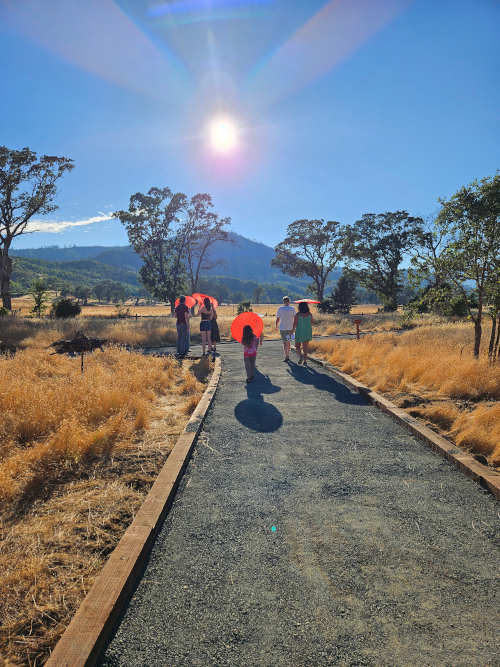
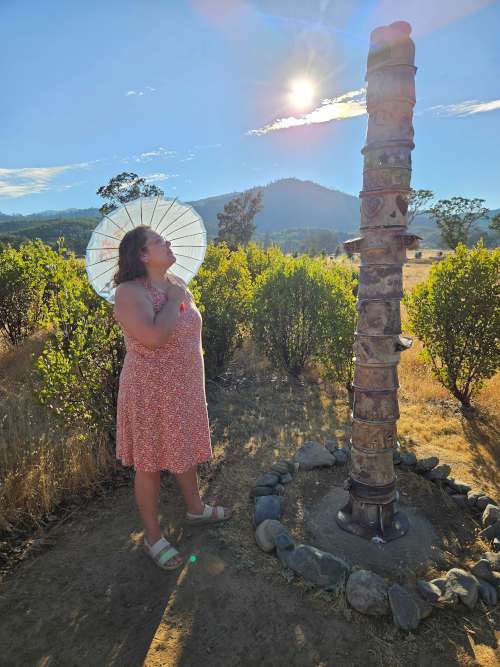
Red parasols were distributed to participants during the grand opening of the EcoArts Sculpture Walk at Middletown Trailside Nature Preserve in Middletown, California, on Aug. 10, 2024. Photo by Esther Oertel.

MIDDLETOWN, Calif. — For the first time since the COVID-19 pandemic, an EcoArts Sculpture Walk is open to the public at the Middletown Trailside Nature Preserve.

The sculptures, 15 in all, are fashioned from natural materials, which, in some cases, were gathered from the park itself. The pieces are scattered along meandering paths within a space that is resiliently recovering from, but still reflects, damage from the 2015 Valley fire.

The EcoArts Sculpture Walk was initially the brainchild of contributing artist Karen Turcotte and her husband, John Williams, and was inspired by the work of British environmental artist Andy Goldsworthy.

The first sculpture walk opened in 2003, and new walks were installed yearly until the Valley fire destroyed the 2015 installation. The walk was briefly resurrected in 2019, and now, after a hiatus of four years, has returned to the park.

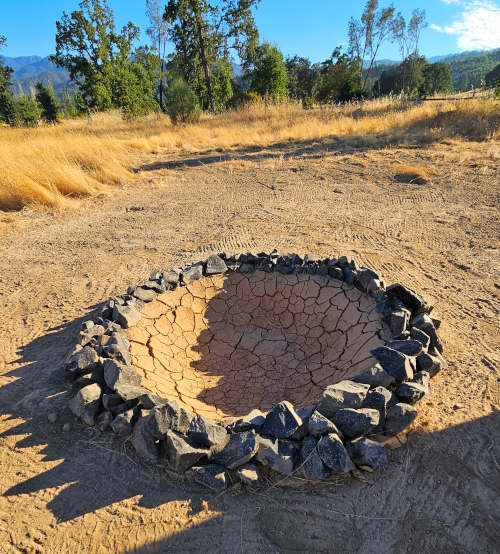
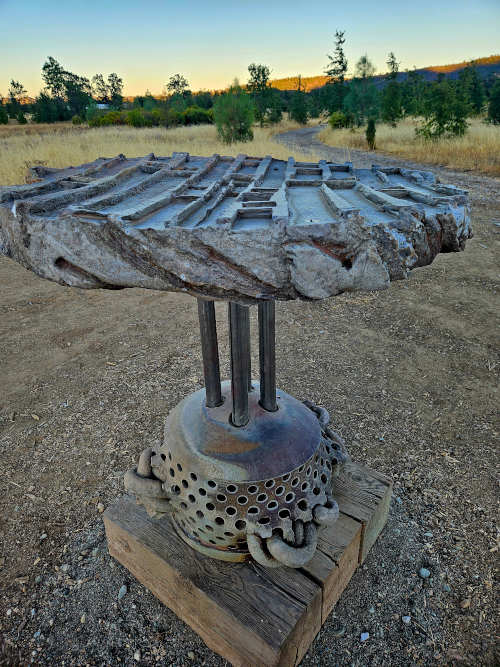
"Obsidian Bowl" by Karen Turcotte is a nod to the geology of Lake County, as well as a symbol of dealing with or overcoming illness. Photo by Esther Oertel, Middletown Trailside Nature Preserve in Middletown, California, on Aug. 10, 2024.

The works are intended to engage the observer in a dialog with nature. Some are designed to enhance the existing environment by attracting beneficial fauna such as birds or native bees.

There have been 15 such exhibits at Trailside Park, and the current one, as well as numerous past installations, have been managed by the Middletown Art Center and its executive director, Lisa Kaplan.

Said Kaplan, “There is so much to say about this awesome project, from what we have learned about the imperative for a reciprocal relationship with nature and each other, to local natural history from descendants of the original peoples of this place, to our collective recovery post-Valley fire, which is also reflected in the park’s growth and resilience.”

She added, “The purpose of this project is to raise awareness about social justice and ecological issues, to provide access to all, for collaboration in co-creating artwork, and to provide a place to experience wonder and facilitate learning for visitors.”

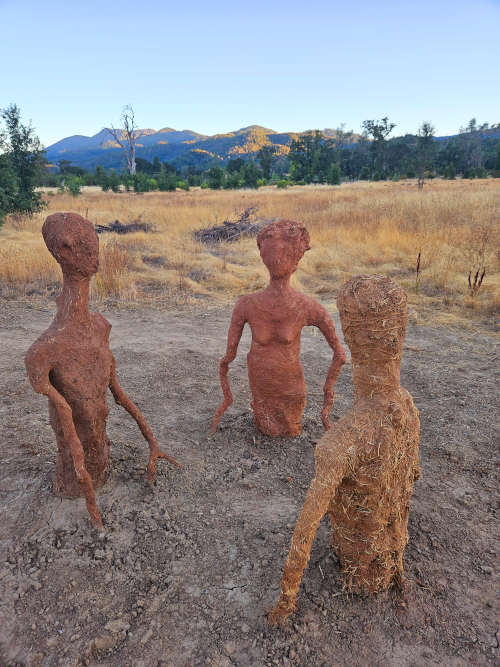
Earth clay as well as natural materials from Middletown Trailside Nature Preserve in Middletown, California, form "From Earth to Earth" by Lisa Kaplan. Photo by Esther Oertel, on Aug. 10, 2024.

Many of the works are collaborations between artists or with members of the community at large.

Emily Scheibel, for example, was assisted by Lower Lake High School students in her creation of “Anulus Unitatus” (or “Rings of Creation”).

“From Earth to Earth,” Kaplan’s piece, was created and installed with help from the youth of Jack’s Lavender Farm, an organization which “cultivates opportunities” for Lake County teens.

Cancer patients and their caregivers contributed to the installation of Turcotte’s piece, “Obsidian Bowl,” which, in part, is representative of dealing with, or coming through, illness. Turcotte herself has survived lung cancer.

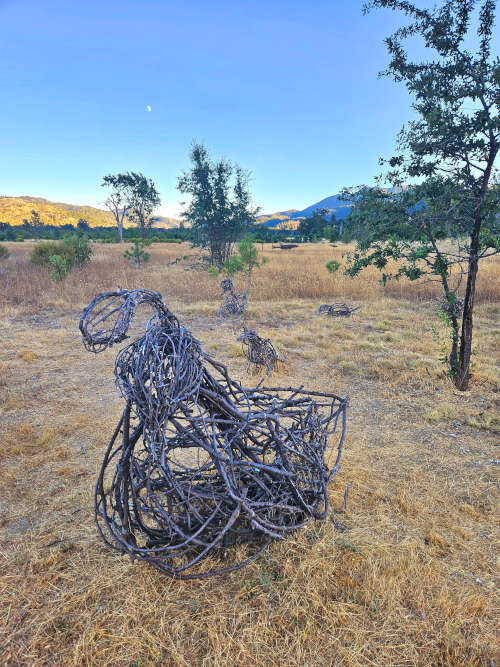
"Sika-ka" ("Quails") was created by Corine Pearce and Laura Kennedy using, in part, bent and woven oak cuttings from the park. Photo by Esther Oertel, Middletown Trailside Nature Preserve in Middletown, California, on Aug. 10, 2024.

Reciprocity was funded by the California Arts Council, with funding administered and supported regionally by the Upstate California Creative Corps.

Numbers of local agencies, organizations and individuals contributed support to the project, including Lake County Public Services, Lake County Parks, Trails and Recreation, District 1 Supervisor Moke Simon, the Sierra Club Lake Group, attorney Dennis Fordham and Barbara Clark of the Lake County Arts Council.

Middletown Trailside Nature Preserve is open from dawn until dusk and is located at 21436 Dry Creek Cutoff, off Highway 175. The exhibit can be found by entering the park on the south side of the parking lot.

"Shade," a structure by Greg Clouse, provides a space to display "Web of Life" by Alicia Farnsworth, an intricate mosaic mural depicting a collage of species (both animal and plant) that can be found in the park at various times of the year. Photo by Esther Oertel, Middletown Trailside Nature Preserve in Middletown, California, on Aug. 10, 2024.

The Middletown Art Center, in addition to their coordination of the EcoArts Sculpture Walk, offers art and writing classes, hosts exhibitions and cultural events, and is a locus for Lake County artists.

To learn more about this valuable Lake County resource and to consider a membership, please visit their Web site at www.middletownartcenter.org.

Esther Oertel is a freelance correspondent for Lake County News.

Alexis Haylock of Angwin, California views Emily Scheibel's "Anulus Unitatis" ("Rings of Creation"), which provides reed tubes for the propagation of native Mason bees and nesting spaces for birds. Photo by Esther Oertel, Middletown Trailside Nature Preserve in Middletown, California, on Aug. 10, 2024.

Multicolored stone sculpture "Mestizaje Germination" by Jaymie Hernandez de la Torre represents the creation of something new. Photo by Esther Oertel, Middletown Trailside Nature Preserve in Middletown, California, on Aug. 10, 2024.


"Great Basin," a work in ceramic by Scott Parady, represents, among other things, the wheel and its impact on human development. Photo by Esther Oertel, Middletown Trailside Nature Preserve in Middletown, California, on Aug. 10, 2024.
  • 372
  • 373
  • 374
  • 375
  • 376
  • 377
  • 378
  • 379
  • 380
  • 381

Community

  • Lake County Wine Alliance offers sponsor update; beneficiary applications open 

  • Mendocino National Forest announces seasonal hiring for upcoming field season

Public Safety

  • Lakeport Police logs: Thursday, Jan. 15

  • Lakeport Police logs: Wednesday, Jan. 14

Education

  • Woodland Community College receives maximum eight-year reaffirmation of accreditation from ACCJC

  • SNHU announces Fall 2025 President's List

Health

  • California ranks 24th in America’s Health Rankings Annual Report from United Health Foundation

  • Healthy blood donors especially vital during active flu season

Business

  • Two Lake County Mediacom employees earn company’s top service awards

  • Redwood Credit Union launches holiday gift and porch-to-pantry food drives

Obituaries

  • Rufino ‘Ray’ Pato

  • Patty Lee Smith

Opinion & Letters

  • The benefits of music for students

  • How to ease the burden of high electric bills

Veterans

  • CalVet and CSU Long Beach team up to improve data collection related to veteran suicides

  • A ‘Big Step Forward’ for Gulf War Veterans

Recreation

  • Wet weather trail closure in effect on Upper Lake Ranger District

  • Mendocino National Forest seeking public input on OHV grant applications

  • State Parks announces 2026 Anderson Marsh nature walk schedule 

  • BLM lifts seasonal fire restrictions in central California

Religion

  • Kelseyville Presbyterian to host Ash Wednesday service and Lenten dinner Feb. 18

  • Kelseyville Presbyterian Church to hold ‘Longest Night’ service Dec. 21

Arts & Life

  • Auditions announced for original musical ‘Even In Shadow’ set for March 21 and 28

  • ‘The Rip’ action heist; ‘Steal’ grounded in a crime thriller

Government & Politics

  • Lake County Democrats issue endorsements in local races for the June California Primary

  • County negotiates money-saving power purchase agreement

Legals

  • March 3 hearing on ordinance amending code for commercial cannabis uses

  • Feb. 12 public hearing on resolution to establish standards for agricultural roads

How to resolve AdBlock issue?
Refresh this page