How to resolve AdBlock issue?
Refresh this page
How to resolve AdBlock issue?
Refresh this page
Lake County News,California
  • Home
    • Registration Form
  • News
    • Education
    • Veterans
    • Community
      • Obituaries
      • Letters
      • Commentary
    • Police Logs
    • Business
    • Recreation
    • Health
    • Religion
    • Legals
    • Arts & Life
    • Regional
  • Calendar
  • Contact us
    • FAQs
    • Phones, E-Mail
    • Subscribe
  • Advertise Here
  • Login

News

California’s fentanyl task force seizes over 8.8 million fentanyl pills


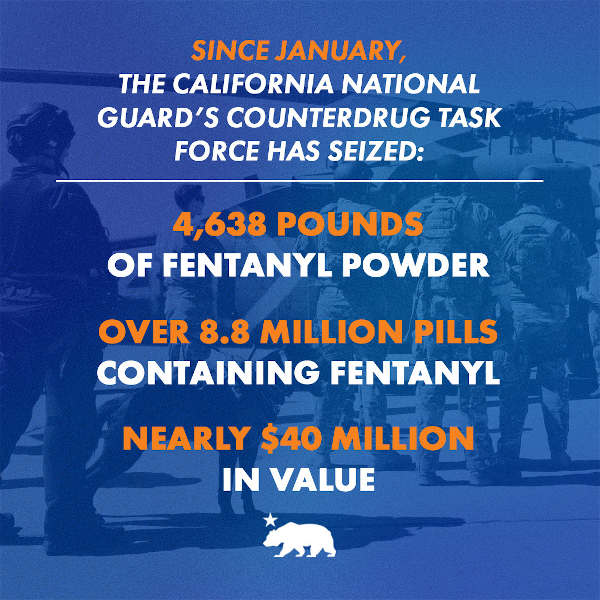
The California National Guard’s Counterdrug Task Force has seized almost 4,638 pounds of fentanyl powder and more than 8.8 million pills containing fentanyl since January 2024.

These seizures are valued at nearly $40 million.

The task force helps local and federal partners take deadly fentanyl off the street, focusing on ports of entry along the southern border.

“California’s work to address illicit fentanyl entering into our state continues to produce strong results. We’ll continue to address the opioid epidemic by all means necessary – including by getting fentanyl off our streets and providing communities with access to the treatment and life-saving medications they need,” said Gov. Gavin Newsom.

The task force focuses on gathering information to interdict illegal narcotics trafficking, utilizing air and ground assets to build criminal investigations, and supporting personnel at border ports of entry to stop illicit narcotics trafficking.

CalGuard members with the Counter Drug Taskforce are embedded in cross-government initiatives to combat transnational criminal organizations and the trafficking of illegal narcotics — like fentanyl.

In June, Newsom doubled down on the deployment of CalGuard involved in the task force by increasing the number of service members interdicting fentanyl and other drugs at U.S. ports of entry from 155 to nearly 400.

Last year, the governor increased the number of CalGuard service members deployed to interdict drugs at U.S. ports of entry along the border by approximately 50%.

The operations CalGuard supported resulted in the record seizure of 62,224 pounds of fentanyl in 2023 — a 1066% increase since 2021.

CalGuard’s coordinated drug interdiction efforts in the state are funded in part by California’s $30 million investment to expand CalGuard’s work to prevent drug trafficking by transnational criminal organizations. Fentanyl is primarily smuggled into the country by U.S. citizens through ports of entry.

This adds to the governor’s efforts to address fentanyl within California, including by cracking down on fentanyl in communities across the state, including San Francisco.

Addressing the opioid crisis

California is taking aggressive action to end the fentanyl and opioid crisis. The Governor’s Master Plan for Tackling the Fentanyl and Opioid Crisis provides a comprehensive framework to deepen the impact of these investments, including aggressive steps to support overdose prevention efforts, hold the opioid pharmaceutical industry accountable, crack down on drug trafficking, and raise awareness about the dangers of opioids, including fentanyl.

The state launched opioids.ca.gov, a one-stop tool for Californians seeking resources for prevention and treatment, as well as information on how California is working to hold Big Pharma and drug traffickers accountable in this crisis.

This week, California launched the Facts Fight Fentanyl campaign to educate Californians on the dangers of fentanyl and how to prevent overdoses and deaths. This effort will provide critical information about fentanyl and life-saving tools such as naloxone.

As part of Governor Newsom’s Master Plan for Tackling the Fentanyl and Opioid Crisis, over-the-counter CalRx-branded naloxone is now becoming available across the state. Through the Naloxone Distribution Project, CalRx-branded over-the-counter naloxone HCL nasal spray, 4 mg, will be available for free to eligible organizations through the state or for sale for $24 per twin-pack through Amneal.

In support of President Biden’s bilateral cooperation agreement with China on counternarcotics, the governor spoke with Chinese President Xi Jinping in October about combating the transnational shipping of precursor chemicals used to create fentanyl.

Measure strengthening Native American children and family rights in Indian Child Welfare cases heads to governor

The California Assembly on Wednesday approved a bill safeguarding existing state statutes protecting Indian children, families and the rights of tribes in child welfare cases.

Assemblymember James C. Ramos (D-San Bernardino) authored the measure, AB 81, that makes changes to placement of children in Indian child welfare cases.

“We, as Native Americans, are all too familiar with governmental removal of Indian children from their families. AB 81 is aimed at fortifying the federal Indian Child Welfare Act, or ICWA, established in 1978 because large numbers of children were being removed from tribal families and placed in non-Indian families, away from their relatives and culture,” said Ramos.

“This bill helps to ensure that every effort is made to keep California Native American children in their communities,” Ramos added. “Last year the U.S. Supreme Court upheld the decades-old ICWA law and the rights of Native families and communities. AB 81 adds another layer of protection against the travesties that compelled ICWA’s creation and future challenges.”

The lawmaker, the first and only California Native American elected to the Legislature, noted that the battle to protect ICWA brought back memories of the U.S. boarding school era when Indian children were forcefully separated from their families as a means to erase their culture and coerce assimilation.

A recent Department of Interior report found that almost 1,000 Native students died at the schools and suffered physical and psychological abuse.

AB 81 strengthens protections for California Indian children in the welfare and institutions code by requiring clear notice of proceedings to parents, direct lineal ancestors and custodians of the child, and the right to court-appointed counsel in any removal, placement, or termination proceeding.

It also enshrines the states duty to consult with local federally and non-federally recognized tribes regarding the placement of native children in their custody.

“We appreciate the ongoing work of Assemblymember Ramos to address tribal matters in our state. We also want to thank the Legislature for recognizing the importance of strengthening the Indian Child Welfare Act in California, and the Governor’s office for working with us to advance this critical legislation. Morongo has worked for many years at the state and federal level to protect tribal children and families, including our efforts in helping secure last year’s decisive U.S. Supreme Court victory upholding ICWA. AB 81 advances the essential rights of tribal children and tribes in child welfare proceedings,” said Morongo Band of Mission Indians Tribal Chairman Charles Martin.

“The California Tribal Families Coalition is grateful to the California Legislature for advancing AB 81 to the governor’s desk, and to all the tribes and stakeholders who provided input and support to pass this crucial bill that will safeguard state statutes that protect tribal children and families with policies that are comprehensive, consistent, and clear,” said Co-Executive Director of the California Tribal Families Coalition Blair Kreuzer.

AB 81 is also supported by the Alliance for Children’s Rights, ACLU California Action, and Agua Caliente Band of Cahuilla Indians.

The governor has until Sept. 30 to sign or veto the bill.

Supervisors approve plans for new sheriff’s office headquarters project

LAKEPORT, Calif. — The Board of Supervisors heard an update on the plans to convert the former Lakeport Armory into the new Lake County Sheriff’s Office headquarters and approved the remodel’s plans.

Public Services Director Lars Ewing, along with Undersheriff and Sheriff-elect Luke Bingham, presented the update during the board’s Tuesday morning meeting.

The county obtained the armory, located on seven acres at 1431 Hoyt Ave., in a land swap with the state that was completed in January of 2022.

The state gave the county the armory in exchange for a vacant 15.5-acre property at 15837 18th Ave. in Clearlake which is to be used for an affordable housing development.

On Tuesday, Patty Esposito and Jimmy Ng, architect with Dewberry, the firm hired to work on designing the project, explained aspects of it.

Esposito said that on May 2, 2023, Dewberry had a kickoff meeting with county rep and sheriff’s stakeholders to look at what the project needed to succeed.

The facility is expected to be in use up to 40 years, and will need a flexible work space to accommodate staff growth over time. The goal is to have professional and inviting spaces, with natural light and durable and timeless fixtures and finishes, all while being budget conscious, Esposito said.

She said the existing building footprint is not large enough to accommodate all departments, so the emergency operations center will remain in its current location with plans to expand at a future date.

Esposito said they added a second floor to an existing large opening that is available, which can be used for training and large events, and will be available for future growth.

Ng said the project will include repaving and restriping to address Americans with Disabilities Act requirements. There also will be a new elevator to reach the second floor.

The floorplan includes space for the agency’s many departments: the civil bureau, records, finance, criminal investigations, evidence processing and storage, a fitness room and locker rooms, enforcement and patrol departments, briefing rooms and a booking station. The second floor will have room for meetings, training and office space.

Ewing said the cost estimate for construction is $16.7 million, which includes a $1 million contingency with solar power also factored in.

The cost with furnishings, fixtures and equipment, and audio visual equipment is expected to bring the total cost to $20 million, Ewing said.

He explained that the second story will not go above the existing roof and is a mezzanine within the existing armory bay. “We needed the space for expansion.”

Leaving out the mezzanine as a shell and keeping it for future buildout is cost effective and saves $1.5 million, Ewing said.

Bingham said that if that second story is needed in 10 or 15 years, building it then would upend the sheriff's operations. Having it included now in its basic form would mean less disruption.

He said the intention is to have training classes there and to make it available to county staff in other departments.

Board Chair Bruno Sabatier asked about the current square footage in the sheriff’s office headquarters on Martin Street.

Bingham estimated that the current space is between 16,000 to 17,000 square feet, with the armory facility to be a little over 26,000 square feet with the second story.

Sabatier questioned waiting to build out the second floor. “We can only anticipate that that cost will increase as time goes on.”

He also raised issues about landscaping and having vegetation too close to the buildings. Ewing said the final plans would have to be approved by the fire marshal and Lakeport Fire Protection District.

Ewing reported that the federal American Rescue Plan Act, or ARPA, funding needed to complete the project needs to be dedicated by the end of this year.

Supervisor Jessica Pyska moved to approve the plans and specifications, which Supervisor Moke Simon seconded. The board’s vote was unanimous.

Email Elizabeth Larson at This email address is being protected from spambots. You need JavaScript enabled to view it.. Follow her on Twitter, @ERLarson, or Lake County News, @LakeCoNews.

Division of Boating and Waterway urges safe boating this Labor Day weekend

California boaters enjoy a fun and safe day on the water while wearing U.S. Coast Guard-approved life jackets. Photo from the Division of Boating and Waterways.

As Labor Day weekend approaches, California State Parks Division of Boating and Waterways, or DBW, is reminding boaters to prioritize safety while enjoying the state’s beautiful waterways.

This holiday weekend is a popular time for recreational boating, and DBW encourages everyone to follow best practices to ensure a safe and enjoyable experience on the water.

“Safety should always be a top priority when boating,” said Deputy Director Ramona Fernandez. “Remember to wear your life jacket, observe waterway rules, and be mindful of other boaters. Responsible boating practices help ensure everyone can enjoy their Labor Day weekend while staying safe and having fun.”

Follow these safety tips for a safe and responsible time on the water:

Wear your life jacket: Ensure you have a U.S. Coast Guard-approved life jacket of the appropriate size and activity type for each person onboard. Children under 13 are required to wear a properly fitted, U.S. Coast Guard-approved life jacket while on a moving vessel. According to the U.S. Coast Guard recreational boating statistics, in 2023, 87 percent of drowning victims were not wearing life jackets.

Get your California Boater Card: Complete an approved safe boating course and obtain your California Boater Card. California law requires boaters 60 and younger to carry a California Boater Card. Beginning Jan. 1, 2025, all operators of motorized vessels regardless of age will be required to obtain and carry one while on the water. This includes personal watercraft (PWC), vessels with trolling motors, and sailboats with motors. Visit CaliforniaBoaterCard.com for more information.

Be prepared: Before heading out on the water, check weather conditions, file a float plan, and ensure you have the proper safety equipment, including life jackets, fire extinguishers, and sound signaling device. Refer to the ABCs of California Boating for more information on required equipment and other safety tips.

Avoid alcohol: Alcohol impairs judgment and reaction times. In California, it is against the law to operate a boat or water ski with a blood alcohol concentration (BAC) of 0.08 percent or higher. Officers may also arrest boaters with a BAC of less than 0.08 percent if conditions are deemed unsafe. BUI convictions can result in up to six months in jail and/or fines of up to $1,000. Two convictions within seven years could add a jail term of up to one year. Boaters caught operating under the influence may also have their voyage terminated and their vessel impounded.

Observe waterway rules: Follow all posted signage and be aware of local regulations and boating rules.

Practice responsible boating: Maintain a safe speed, be aware of your surroundings, and respect other boaters.

Help keep our waterways clean: Implement clean and green boating practices such as always carrying oil absorbents on board and bringing everything back that you took out on the water including food, garbage, and fishing line.

For more information on safe and responsible boating practices, please visit the California State Parks Division of Boating and Waterways website at www.dbw.parks.ca.gov.

Biden administration’s negotiated price cuts for 10 common prescription drugs likely to save Medicare billions, beginning in 2026


The Biden administration announced on Aug. 16, 2024, the reduced prices of the first 10 drugs it has negotiated with pharmaceutical companies over their Medicare prices.

Provisions authorizing these negotiations were part of the Inflation Reduction Act, which took effect in 2022, but these lower prices aren’t scheduled to take effect until 2026.

The drugs are purchased through Medicare Part D, a prescription drug coverage program for Americans who are 65 and older. The 10 medications were used by 9 million patients with Medicare coverage in 2023, and they accounted for US$56.2 billion in total Medicare spending. Had the negotiated prices been in place that year, the government estimates that Medicare would have saved about $6 billion.

To put this in perspective: Total annual spending on prescription drugs in the U.S. exceeds $405 billion, and Part D alone spends more than $215 billion.

As a scholar who researches the politics of health policy, I remain skeptical that negotiations will end up having a substantial impact on the U.S. health care system in the foreseeable future, even if the law survives ongoing legal and implementation challenges.

At the same time, I do expect that many older adults will reap substantial savings on their out-of-pocket spending on prescription drugs over the coming years. But that will primarily happen due to other Inflation Reduction Act provisions.

Cutting drug costs for Medicare enrollees

The Inflation Reduction Act allows the Centers for Medicare & Medicaid Services to negotiate prices with the companies that make some of the most expensive drugs in the Medicare program, including life-saving cancer and diabetes treatments like Imbruvica and Januvia.

Democrats have hailed these drug pricing provisions as game-changing. Vice President Kamala Harris, who is now running for president, is making efforts to rein in drug prices part of her election campaign.

Former President Donald Trump, however, has been relatively quiet on the issue. Public opinion polls show overwhelming public support for the policy.

Medicare will soon begin to negotiate prices for more drugs, including 30 over the next two years.

If the policy continues to move forward as planned, the drug price negotiation provision is expected to save the U.S. government about $98.5 billion by 2031.

The Biden administration hopes that some of these cost savings will be passed down to Americans 65 and older through reduced Medicare Part D premiums and lower out-of-pocket costs. The White House also hopes to reduce the federal deficit by $237 billion.

Other important benefits for older adults

While negotiations over Medicare drug prices have received the most attention, the Inflation Reduction Act included other provisions that might be even more beneficial for older adults.

These include limiting out-of-pocket spending by older adults on prescription drugs to no more than $2,000 annually by 2025, limiting the growth of Medicare Part D premiums, providing rebates if certain drug price increases outpace inflation, eliminating out-of-pocket costs for vaccines and providing premium subsidies to low-income people 65 and up.

A Black female pharmacist shows Black woman some prescription medications.
Government negotiations with pharmaceutical companies over drug pricing should lower medical costs for many people 65 and older. Marko Geber/DigitalVision via Getty Images

Strong industry resistance, but companies negotiated

Despite their vocal opposition and their ongoing public relations campaign that has attacked this process, all affected U.S. drugmakers decided to engage in the price negotiations.

The daunting alternatives, including paying a penalty that could run as high as 95% of their U.S. pharmaceutical product sales, and a requirement to pull their drugs from the Medicare and Medicaid markets, proved to be strong incentives.

However, the manufacturers of medications have been fighting the measure in court. And despite several losses, this battle will likely continue for the foreseeable future, with uncertain outcomes.

Why US drug prices are so high

Americans pay substantially more for prescription drugs compared with people who live in countries with similar economies. For example, per capita pharmaceutical spending in the U.S. amounted to $1,432 compared to $1,042 in Germany and $766 in France in 2022.

The reasons for this disparity are multilayered and include the overall complexity of the U.S. health care system and the lack of transparency in the drug supply chain. Of course, many other countries also directly set prices for drugs or use their monopoly over health services to drive down costs.

Drug costs impose a big burden on Americans. People who are 65 and older are particularly affected, with 1 in 5 not taking all of their medications as prescribed due to high costs.

Older adult customer standing at a pharmacy checkout stand, with pharmacist explaining something.
The first 10 drugs selected for negotiated pricing can be picked up at a pharmacy. Maskot/Getty Images

Weighing the prospects of price negotiations

In my view, the government’s efforts are a step in the right direction. The potential for real savings for Americans 65 and older will undoubtedly grow as more drug prices are negotiated.

Yet, some real concerns remain.

Even if the negotiated lower prices survive the industry’s legal challenges, it’s possible that future Republican administrations won’t embrace this policy, as Republicans have historically opposed price negotiations for Medicare.

The true effect for patients with Medicare will likely be much smaller than it appears. That’s because the Medicare program and patients often already receive discounts on many of these drugs. These discounts will now be eliminated.

In addition, the pharmaceutical industry has a history of skillfully exploiting loopholes that may further limit the financial impact. Manufacturers have already told shareholders that they expect limited impacts on their profits.

It’s also too soon to tell if this is going to be a win for all Americans. It’s possible that Americans who aren’t covered by Medicare may actually see prices go up, even on these same drugs. Working Americans could thus wind up shouldering ever larger burdens to deliver this support for older adults.

This article includes passages that were included in a previous article published on Aug. 30, 2023.The Conversation

Simon F. Haeder, Associate Professor of Public Health, Texas A&M University

This article is republished from The Conversation under a Creative Commons license. Read the original article.

New research finds shrinking prime age worker population being filled by older workers

A new research report published by the Employee Benefit Research Institute, or EBRI, taking a historical look at labor force participation and employment data in the United States found the prime working age population (25-64 years old) has significantly fallen and is being filled by older workers.

At the same time, the labor force participation rate of those ages 65 or older has not reached its pre-pandemic level, while that of the prime working age population has reached that level.

The report, “Trends in Labor Force Participation and Employment of Americans Ages 16 or Older,” examines the U.S. civilian labor force through December 2023, using data from the U.S. Census Bureau’s Current Population Survey.

As the Baby Boom generation has aged, the American labor force has also grown older. The new research evaluates several labor force questions relating to the civilian noninstitutionalized American population, including the labor force participation rates by age and gender, shares of the U.S. population and the U.S. civilian labor force by age and gender. This study examines these trends as far back as 1975.

Key findings in the report include:

• The share of the labor force that is of prime working ages (ages 25–64) has significantly fallen since the mid-1990s despite the labor force participation rates of individuals of these ages remaining near mid-1990s levels. The decrease is being driven by the smaller number of people of these ages (meaning that younger and older Americans are needed to cover this decrease). So far, the older population has been filling the gap in the labor force, as those younger than age 25 are at near record-low levels for their share of the labor force.

• Beginning 2008, the U.S. population (ages 16 or older) became increasingly composed of those ages 65 or older. By 2023, this age category made up the largest share of the population. Americans ages 16-24 made up the smallest proportion of this population, while those ages 45-54 made up the second smallest share.

• When analyzing the U.S. population ages 16 or older by age and gender, females ages 65 or older made up the largest proportion by a sizable margin. However, males of the same ages tended to make up a comparatively larger share of the labor force than females, with the labor force gaps being smallest among the youngest and oldest age ranges.

• The labor force participation rates of those ages 16 or older were overall relatively constant from 1975-2023. However, participation rates rose for females and fell for males, though both genders had lower participation rates in 2023 than in 2008.

• Labor force participation rates of White Americans ages 16 and older declined from 2000-2023, with the rates for Black and Hispanic Americans also being lower in 2023 than in 2000. However, the labor force participation rates for Black and Hispanic Americans increased sharply from 2021–2023 after falling in 2020, while this was not the case for White Americans.

“Despite the difference in labor force participation (LFP) rates between 1975 and 2023 being less than 2 percentage points, significant changes in labor force patterns and composition have occurred over the past several decades. The LFP rates decreased for men and increased for women over this timespan, though female LFP rates have trended down since the 1990s, resulting in a lower overall LFP in recent years. A large decline in the LFP rate was observed among those ages 16-19 at the beginning of the 2000s, while those ages 65 and over have had an increase in the LFP rate,” explained Craig Copeland, director, Wealth Benefits Research, EBRI.

“The age of the labor force will play an important role in companies’ workforce development. At present, the aging of the Baby Boom generation has resulted in an increased share of older individuals in the labor force,” Copeland continued. “However, members of this generation are almost all at least in their 60s, and the next generation, Gen X, is much smaller. So, a decrease in the share of workers ages 55 or older is imminent. How quickly this outcome results will be determined by whether the Baby Boom generation has continual higher labor force participation rates at ages over 65 than what has occurred in the past.”

The Employee Benefit Research Institute is a non-profit, independent and unbiased resource organization that provides the most authoritative and objective information about critical issues relating to employee benefit programs in the United States. The organization also coordinates activities for the Center for Research on Health Benefits Innovation, Financial Wellbeing Research Center, Retirement Security Research Center and produces a variety of leading industry surveys during the year. For more information, visit www.ebri.org.
  • 375
  • 376
  • 377
  • 378
  • 379
  • 380
  • 381
  • 382
  • 383
  • 384

Community

  • Lake County Wine Alliance offers sponsor update; beneficiary applications open 

  • Mendocino National Forest announces seasonal hiring for upcoming field season

Public Safety

  • Lakeport Police logs: Thursday, Jan. 15

  • Lakeport Police logs: Wednesday, Jan. 14

Education

  • Woodland Community College receives maximum eight-year reaffirmation of accreditation from ACCJC

  • SNHU announces Fall 2025 President's List

Health

  • California ranks 24th in America’s Health Rankings Annual Report from United Health Foundation

  • Healthy blood donors especially vital during active flu season

Business

  • Two Lake County Mediacom employees earn company’s top service awards

  • Redwood Credit Union launches holiday gift and porch-to-pantry food drives

Obituaries

  • Rufino ‘Ray’ Pato

  • Patty Lee Smith

Opinion & Letters

  • The benefits of music for students

  • How to ease the burden of high electric bills

Veterans

  • CalVet and CSU Long Beach team up to improve data collection related to veteran suicides

  • A ‘Big Step Forward’ for Gulf War Veterans

Recreation

  • Wet weather trail closure in effect on Upper Lake Ranger District

  • Mendocino National Forest seeking public input on OHV grant applications

  • State Parks announces 2026 Anderson Marsh nature walk schedule 

  • BLM lifts seasonal fire restrictions in central California

Religion

  • Kelseyville Presbyterian to host Ash Wednesday service and Lenten dinner Feb. 18

  • Kelseyville Presbyterian Church to hold ‘Longest Night’ service Dec. 21

Arts & Life

  • Auditions announced for original musical ‘Even In Shadow’ set for March 21 and 28

  • ‘The Rip’ action heist; ‘Steal’ grounded in a crime thriller

Government & Politics

  • Lake County Democrats issue endorsements in local races for the June California Primary

  • County negotiates money-saving power purchase agreement

Legals

  • March 3 hearing on ordinance amending code for commercial cannabis uses

  • Feb. 12 public hearing on resolution to establish standards for agricultural roads

How to resolve AdBlock issue?
Refresh this page