 How to resolve AdBlock issue?
News
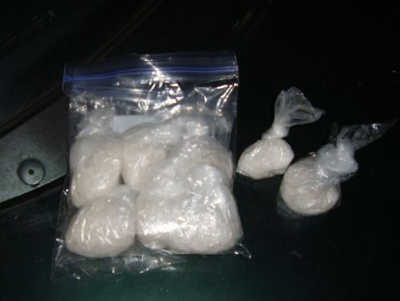
CLEARLAKE, Calif. – Two Clearlake men were arrested and methamphetamine valued at $22,000 was seized following a vehicle stop last week.
Juan Jose Chavez, 47, and 35-year-old Jorge Enrique Rodriguez were arrested following the stop, which took place on the evening of Friday, Dec. 27, according to Lt. Steve Brooks of the Lake County Sheriff's Office.
Just after 5 p.m. that day a patrol deputy was traveling along Dam Road in Clearlake when he observed ahead of him a green Dodge Dakota with an expired registration tab. Brooks said the deputy conducted an enforcement stop of the vehicle in the 15000 block of Dam Road.
The deputy contacted the driver of the vehicle, who was identified as Chavez. Brooks said the deputy requested Central Dispatch conduct a records check of Chavez, which revealed he did not have a valid driver’s license.
A records check also was conducted on Rodriguez, Chavez's passenger, which showed he was on formal felony probation out of Lake County for the sales of methamphetamine, Brooks said.
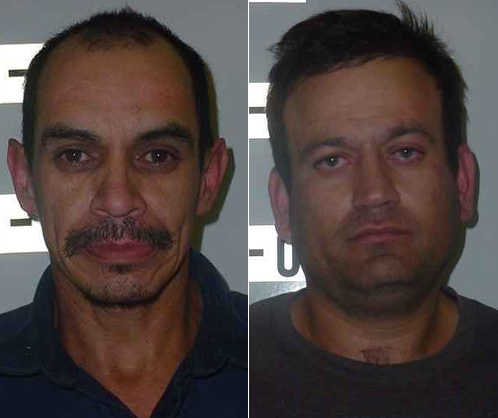
The deputy conducted a search of Rodriguez and located two large plastic bags containing a white crystalline substance, inside his front pants pocket. Brooks said the deputy determined that both of the bags contained methamphetamine.
A detailed search of the passenger area of the vehicle produced two glass meth pipes which were located under the front seat, Brooks said.
Directly under the driver’s seat of the vehicle was a large plastic bag containing six individually packaged bags of methamphetamine. Brooks said the total weight of the methamphetamine was 219.54 grams or 7.70 ounces, which has a current street value of approximately $22,000.
Brooks said Rodriguez was arrested for the possession of a controlled substance for sale, transportation of a controlled substance and a felony probation violation. Chavez was arrested for possession of a controlled substance for sale, transportation of a controlled substance and possession of controlled substance paraphernalia.
On Monday both men remained in custody, Chavez on an immigration and Rodriguez for a felony probation violation, according to jail records.
Both were transported to the Lake County Hill Road Correctional Facility and booked, Brooks said.
The Sheriff’s Narcotics Task Force can be reached through its anonymous tip line at 707-263-3663.

LAKE COUNTY, Calif. – The California Highway Patrol is urging motorists to begin the new year responsibly – if the celebration plans include alcohol, designate a driver before the festivities begin.
The CHP will be ringing in the new year on the roadway with motorists as part of a maximum enforcement period (MEP), which begins at 6 p.m. on Tuesday, Dec. 31, and continues through 11:59 p.m. on Wednesday, Jan. 1.
“In an effort to promote safety on California’s roadways we will have every available officer on patrol throughout the holiday travel period,” said Commissioner Joe Farrow. “With all the excitement and celebration, the holidays can be a particularly deadly time due to an increased number of impaired drivers on the roads.”
During last year’s New Year’s MEP, which was 4 ¼ days in length, 41 people were killed in collisions statewide. Half of the vehicle occupants who died within CHP jurisdiction were not wearing a seat belt.
In addition, CHP officers made more than 1,400 arrests for driving under the influence throughout the 102-hour traffic safety effort.
This holiday season, the CHP joins with the National Highway Traffic Safety Administration for their aggressive “Drive Sober or Get Pulled Over” enforcement campaign.
In addition, the public is encouraged to call 9-1-1 if they suspect another driver of being under the influence.
Be prepared to provide the dispatcher with the location, make, model and license plate number of the vehicle, and any other pertinent information.
“Our hope is that drivers will make responsible decisions ahead of time,” added Commissioner Farrow. “There are plenty of transportation alternatives to getting behind the wheel. Designate a sober driver, take a taxi, or use public transportation. We want everyone to start the New Year off right and safely.”
The mission of the California Highway Patrol is to provide the highest level of safety, service, and security to the people of California.
NORTHERN CALIFORNIA – With water officials bracing for a possible third consecutive dry year in California, the Department of Water Resources will conduct the season’s first snow survey on Friday, Jan. 3.
This survey’s results likely will be far different than last winter’s initial readings which showed water content in the snowpack at 150 percent of normal for the date, just as California was turning dry after wet storms in November and December.
Monday's scant snowpack dramatically illustrates the result of the near-record dry weather we have had since last January.
Statewide electronic readings indicated that Monday's snowpack water content was only 20 percent of normal for the date.
The snowpack normally provides about a third of the water we use in California as it slowly melts into streams and reservoirs in spring and early summer.
Manual readings taken by DWR and scores of cooperating agencies on Friday and on or about the first of each month through May will augment and check the accuracy of real-time electronic readings.
Although anticipating dismal water content readings this week, DWR weather watchers note that it’s early in the season and this winter could still turn out average or wet.
The concern, however, is that irrigation-dependent San Joaquin Valley farms and some other areas will suffer if we go into a third consecutive dry year without the cushion of reservoir storage that we had this calendar year (2013) due to the storms in late 2012 before California began sliding toward drought. A third dry year would also bring continued higher wildfire risks.
Lake Oroville in Butte County, the State Water Project’s (SWP) principal reservoir, today is at only 41 percent of its 3.5 million acre-foot capacity (66 percent of its historical average for the date).
Shasta Lake north of Redding, California’s and the federal Central Valley Project’s (CVP) largest reservoir, is at 37 percent of its 4.5 million acre-foot capacity (58 percent of average for the date).
San Luis Reservoir, a critical south-of-Delta reservoir for both the SWP and CVP, is a mere 29 percent of its 2 million acre-foot capacity (43 percent of average for the date) due both to dry weather and Delta pumping restrictions last winter to protect salmon and Delta smelt.
Delta water is pumped into the off stream reservoir in winter and early spring for summer use in the Bay Area, San Joaquin Valley, Central Coast and Southern California.
The continuing dry weather prompted DWR Director Mark Cowin on Dec. 13 to mobilize a drought management team “to offset potentially devastating impacts to citizen health, well-being and our economy.”
Gov. Edmund G. Brown Jr. has united DWR and other agencies in an Interagency Drought Task Force.
DWR and other agencies will streamline transfers of water from areas of relative abundance to areas of critical need, monitor water supply impacts in small rural communities whose groundwater sources are stressed by prolonged dry conditions, and take other steps to mitigate the effects of dry weather.
In November, DWR announced an initial allocation of only five percent of the amount of State Water Project water requested for calendar year 2014. Although the initial allocation is an early-season, conservative estimate of how much water DWR anticipates it will be able to deliver, the five percent initial estimate for 2014 and for calendar year 2010 are the lowest ever.
The 2010 initial allocation, made on the heels of the 2007-2009 drought, was eventually increased by winter storms to 50 percent of the slightly more than 4 million acre-feet of water requested by the 29 public agencies that collectively deliver water to more than 25 million Californians and nearly a million acres of irrigated farm land.
The final SWP allocation for calendar year 2013 was 35 percent of the slightly more than 4 million acre-feet requested. In 2012, the final allocation was 65 percent. It was 80 percent in 2011, up dramatically from an initial allocation of 25 percent.
The final allocation was 50 percent in 2010, 40 percent in 2009, 35 percent in 2008, and 60 percent in 2007. The last 100 percent allocation – difficult to achieve even in wet years because of Delta pumping restrictions to protect threatened and endangered fish – was in 2006.
Law enforcement officer fatalities dropped for the second year in a row to the lowest level in six decades and the number of officers killed in firearms-related incidents this year was the fewest since the 1800s, according to preliminary data compiled and released Monday in an annual research bulletin published by the National Law Enforcement Officers Memorial Fund.
According to the report, 111 federal, state, local, tribal and territorial officers were killed in the line of duty nationwide in 2013.
This was the fewest number of fatalities for the law enforcement profession since 1959 when 110 officers died.
This year’s total was eight percent fewer than 2012 when 121 officers made the ultimate sacrifice.
“The only good news is zero deaths, but this very significant drop in law enforcement fatalities the past two years is extremely encouraging,” declared NLEOMF Chairman and Chief Executive Officer Craig W. Floyd.
“Our organization, in partnership with others, is working hard to create a new culture of safety in law enforcement that no longer accepts deaths and injuries as an unavoidable part of the job,” Floyd said. “This year’s officer fatality report is strong evidence that this intensified effort to promote law enforcement safety is making a difference.”
The No. 1 cause of officer fatalities in 2013 was traffic-related incidents, which claimed 46 lives, according to the report.
Thirty-three officers were killed in firearms-related incidents this past year, which was a 33 percent drop from 2012 and is the lowest number since 1887 when 27 officers were shot to death, the report showed.
Thirty-two officers died due to other causes in 2013, including 14 who suffered heart attacks while performing their duties.
Just two years ago, officer fatalities spiked to 169, which led to a number of new initiatives aimed at promoting law enforcement safety.
Among them were: an increasing number of agencies requiring officers to wear bullet-resistant vests; the formation of the National Officer Safety and Wellness Group by the U.S. Department of Justice; and the VALOR program launched by U.S. Attorney General Eric Holder to provide training to help prevent violence against officers and to help officers survive violent encounters when they do occur.
Since 2011, all categories of officer fatalities have dropped by 34 percent and firearms-related deaths have declined by 54 percent.
Key data as of Dec. 29, 2013:
- Traffic-related incidents declined 4 percent in 2013 (46) compared to 2012 (48). Of these 46 officers, 31 were killed in auto crashes, 11 were struck outside their vehicle, and four were killed in motorcycle crashes.
- Firearms-related fatalities declined by 33 percent in 2013 (33) compared to 2012 (49). Of the 33 officers, seven officers were shot and killed in ambush attacks, six officers were shot and killed while responding to a disturbance call, five officers were killed while conducting an investigative activity, three officers were killed while responding to a domestic disturbance call, three officers were feloniously killed during a traffic stop, three officers were shot and killed while responding to a robbery in progress and three officers were killed while attempting to arrest a suspect. Two officers were inadvertently shot and killed and one officer was killed during a burglary in progress.
- Of the 32 officers who died due to other causes, 18 were caused by job-related illnesses; six officers fell to their death or died as a result of an injury sustained in a fall, two officers drowned while attempting to assist victims during a flash flood, two officers were stabbed to death, one officer was killed in a helicopter crash, one officer was killed in a boat related accident, one officer was killed by an explosive device and an officer was electrocuted.
- During the past year, more officers were killed in Texas (13) than any other state; followed by California (10); Mississippi and New York (7); and Arkansas (6).
- Nine officers killed in 2013 served with federal law enforcement agencies. Nine of the officers who died during the past year served with correctional agencies. Four of the 111 fatalities were female. On average, the officers who died in 2013 were 42 years old and had served for 13 years.
The statistics released by the NLEOMF are based on preliminary data compiled and do not represent a final or complete list of individual officers who will be added to the National Law Enforcement Officers Memorial in 2014.
For a complete copy of the preliminary report on 2013 law enforcement fatalities, visit www.LawMemorial.org/ResearchBulletin .
LAKE COUNTY, Calif. – The new year will arrive this week amidst warmer winter temperatures.
The National Weather Service is predicting that the week ahead will have daytime highs that look more like fall than winter.
No rain, however, is in the forecast.
Monday, Tuesday and Wednesday are predicted to be mostly sunny, with temperatures in the low to mid 60s, with partly cloudy nights and temperatures in the low to mid 40s.
On Monday, an east wind of about 5 miles per hour is anticipated, becoming calm in the afternoon. A light east northeast wind is forecast for Tuesday, becoming light and variable in the evening. No winds are forecast for the rest of the week.
New Year's Day is forecast to have a daytime high of 67 degrees, with a nighttime low of 43.
Thursday, also expected to be mostly sunny, is forecast to have a daytime high of 68 degrees with a nighttime low of 44, the highest temperatures of the week.
From there, temperatures are expected to drop slightly, with Friday to have a daytime high of 66 degrees and nighttime low of 41, followed by 62 degrees on Saturday and 40 on Saturday night.
Email Elizabeth Larson at
LAKE COUNTY, Calif. – Four cats are cleared and waiting for new homes at Lake County Animal Care and Control this week.
The three females and one male – ranging in age from 9 months to 10 years – will be spayed or neutered and vaccinated before being sent to their new homes.
In addition to spaying or neutering, cats that are adopted from Lake County Animal Care and Control are microchipped before being released to their new owner. License fees do not apply to residents of the cities of Lakeport or Clearlake.
If you're looking for a new companion, visit the shelter. There are many great pets there, hoping you'll choose them.
The following cats at the Lake County Animal Care and Control shelter have been cleared for adoption (other cats pictured on the animal control Web site that are not listed here are still “on hold”).

Gray male tabby
This gray male tabby is 3 years old.
He has a short coat and gold eyes. Shelter staff did not report if he has been altered.
He's in cat room kennel No. 3, ID No. 38612.
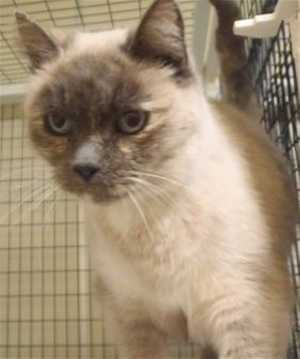
Siamese mix
This female Siamese mix cat is 10 years old.
She has blue eyes and a short coat, and is spayed.
Find her in cat room kennel No. 5, ID No. 38699.

Tortie point
This calico with tortie point markings is 9 months old.
She has a short coat and has not yet been spayed.
Find her in cat room kennel No. 84a, ID No. 38527.

Tortie point
This calico with tortie point markings is 9 months old.
She has a long coat and has not yet been spayed.
Find her in cat room kennel No. 85a, ID No. 38526.
Adoptable cats also can be seen at http://www.co.lake.ca.us/Government/Directory/Animal_Care_And_Control/Adopt/Cats_and_Kittens.htm or at www.petfinder.com .
Please note: Cats listed at the shelter's Web page that are said to be “on hold” are not yet cleared for adoption.
To fill out an adoption application online visit http://www.co.lake.ca.us/Government/Directory/Animal_Care_And_Control/Adopt/Dog___Cat_Adoption_Application.htm .
Lake County Animal Care and Control is located at 4949 Helbush in Lakeport, next to the Hill Road Correctional Facility.
Office hours are Monday through Friday, 8 a.m. to 5 p.m., and 1 p.m. to 3 p.m., Saturday. The shelter is open from 10:30 a.m. to 4:30 p.m. Monday through Friday and on Saturday from 1 p.m. to 3 p.m.
Visit the shelter online at http://www.co.lake.ca.us/Government/Directory/Animal_Care_And_Control.htm .
For more information call Lake County Animal Care and Control at 707-263-0278.
Email Elizabeth Larson at