 How to resolve AdBlock issue?
News
COBB, Calif. – A Christmas morning fire damaged a Cobb home and destroyed a motorhome parked nearby.
The fire at 949 Pamela Drive in Cobb was reported just after 11 a.m. Wednesday, according to Cal Fire Battalion Chief Greg Bertelli.
Bertelli said the home was 50-percent involved by the time firefighters from Cal Fire and South Lake County Fire arrived on scene.
He said the family that lived in the two story home got out of it safely, accompanied by all of their pets.
Firefighters were able to hold the fire to the half of the home that was burning when they arrived, but Bertelli estimated 70 percent of the residence had fire and smoke damage.
Due to concerns about the fire's potential to spread into the nearby wildland, Bertelli said a Cal Fire helicopter from Howard Forest was brought in to assist.
While the home itself wasn't a total loss, a motorhome parked next to it was destroyed, Bertelli said.
Bertelli said firefighters had to contend with numerous small propane tanks that were exploding, with some of the explosions believed to have been tires on the motorhome.
“That hindered our operation a little bit,” he said.
He said firefighters contained the fire in about an hour.
Bertelli said the fire's cause remains under investigation.
“It looks like it may have started from the outside of the house,” he said.
The residents were not referred to Red Cross for housing assistance, as they have relatives next door who are offering them a place to stay, according to Bertelli.
Radio reports estimated that mop up and overhaul would take three hours.
Bertelli asked community members to continue to exercise special caution due to the year's abnormally dry conditions and the resulting potential for fires.
Although it's now winter – not normally a time associated with fires – Cal Fire this year extended the fire season to Dec. 16, with the lack of rain and potential for fires continuing to be a concern for officials.
Email Elizabeth Larson at
UPPER LAKE, Calif. – Law enforcement is on the scene of a Christmas morning shooting that has resulted in one fatality.
The incident was reported shortly before 10 a.m. at 1475 Hunter Point Road, off of Elk Mountain Road outside of Upper Lake.
Northshore Fire Protection District firefighters were dispatched to a report of a male shooting victim at the residence, according to radio traffic.
Radio reports indicated the homeowner shot the male suspect, who was allegedly attempting to rob him.
Initially, Central Dispatch called a REACH air ambulance to the scene to transport the victim.
At around 10:15 a.m. firefighters and REACH were canceled after it was determined that the suspect had died from his wounds.
There also were concerns that a second suspect remained at large, according to radio reports.
Reports from the scene indicated the California Highway Patrol was assisting the Lake County Sheriff's Office at the scene.
Additional information will be posted as it becomes available.
Email Elizabeth Larson at
CLEARLAKE, Calif. – A Christmas Eve fire destroyed a Clearlake home.
The fire, located at 3685 Cottonwood St., was first dispatched shortly after 8:30 p.m. Tuesday, according to radio reports.
Lake County Fire Protection District Chief Willie Sapeta said by the time firefighters arrived on scene minutes later, the stick-built single family home already was about 60-percent involved, with flames coming out of the carport.
He said the family that lived in the residence – along with their pets – safely evacuated and were unharmed.
Two engines and a water tender from Lake County Fire responded, with two engines also coming from Cal Fire, he said.
Sapeta said firefighters had to contend with downed and arcing power lines, which blocked their access to the structure.
Firefighters knocked down the fire within about 10 minutes, with mop up and overhaul taking about an hour, Sapeta said. Pacific Gas and Electric was called to the scene and arrived around 9:30 p.m. to deal with the lines.
The older structure was a complete loss, with Sapeta estimating damages of between $80,000 and $90,000.
He said investigators are working to determine the fire's cause an origin.
The displaced family was not referred to Red Cross for temporary housing, Sapeta said. Instead, they have a motorhome in which they will be staying.
Email Elizabeth Larson at
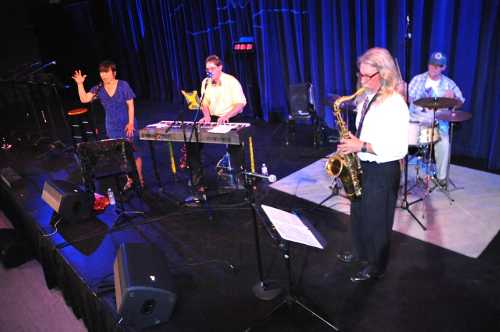
LAKEPORT, Calif. – Lake County Live! continues through its second year with the 24th show on Sunday, Dec. 29, at the Soper-Reese Community Theatre in Lakeport.
The show starts at 6 p.m.
This second anniversary show breaks new ground, in that it will be a two-hour performance featuring the music of Majide! with Paul Kemp, Machiko, Jim Leonardis, Lynn Clark and Bear Kamoroff, along with the Lake County Live! players, including Richard Smith, Pamela Bradley, Vicky Parish Smith, Kris Andre and Nick Reid.
“We're excited to present our first extended show and broadcast,” said show creator, host and producer Doug Rhoades. “We will be celebrating two years of presenting local talent to the community, with great music by Majide! and guests, along with our usual cast of characters and, as always, a few surprises.”
He added, “I think this show will be the high point of our last two seasons, with fantastic music, comedy and a chance for all to celebrate the holiday season and dance.”
Come join the audience in the theater or listen at home on KPFZ, Lake County Community Radio at 88.1 FM or streamed live on the Internet at www.kpfz.org .
Tickets as always are only $5.
Doors open at 5:30 p.m. All guests are asked to be seated by 5:45 p.m.
Tickets are available at the theater box office at 275 S. Main St. on Friday from 10:30 a.m. to 5:30 p.m., at the Travel Center at 1265 S. Main St. in Lakeport or online at www.soperreesetheatre.com .
The show is sponsored by KPFZ, www.lakeconews.com , the Soper-Reese Community Theatre, Lake County Community Co-op, and the Blue Wing Saloon and Tallman Hotel in Upper Lake.
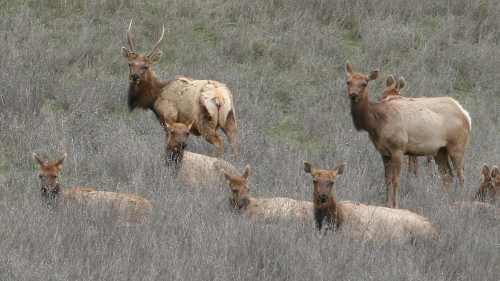
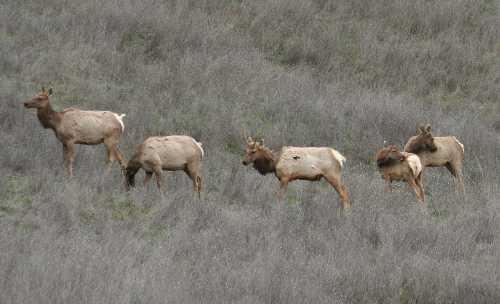
NORTHERN CALIFORNIA – Healthy herds of tule elk (Cervus canadensis ssp. nannodes) make their home in the Berryessa Snow Mountain region.
This subspecies of elk found only in California had been hunted and poached so extensively that by 1870 they were actually thought to be extinct.
Thanks to conservation efforts, including those by California cattle baron Henry Miller in 1873 – who spared and protected a mating pair on his ranch – and the California Department of Fish and Wildlife, which in 1969 protected a herd of 80 head in the Cache Creek area and in 1978 protected another herd in Lake County, the state population of these handsome and unique elk has grown to more than 4,000. Their range now extends from the Central Valley to the coast.
The tule elk are sometimes inaccurately referred to as “dwarf elk” because they are generally smaller in size than other species, like the Rocky Mountain Elk.
The smaller size of most tule elk is attributed in part to genetics and in part to their diet which consists of a variety of grasses, leaves, reeds and forbs (such as sunflowers and milkweed), and aquatic vegetation when available.
Although most tule elk bulls weigh between 450 and 500 pounds, and the cows weigh around 350 to 425 pounds, the California Department of Fish and Wildlife records for the elk in the Grizzly Island Wildlife Area at Suisun City weighing in at about 900 pounds.
Still, even a 500-pound male is a pretty awesome sight. Standing at up to 5 feet high at the shoulder, adult males can be about 7 feet long and sport a rack of heavy six-point antlers which by themselves can weigh upwards of 40 pounds.
The antlers, often confused with horns (which are slow-growing permanent structures), are made of solid bone and are shed and regrown every year. In the spring, new antlers are covered with a webwork of blood vessels and tissue known as “velvet” that feeds the bone as it grows (at a rate of about 1 inch per day).
The velvet is gone by the summer, and in the winter the antlers themselves are shed.
A common myth is that the points on the elk’s headgear reflect its age. That’s not accurate. Twelve years is an average lifespan for these elk (although some can live as long as a quarter century), but they will still only generate about six points on their rack.
If you see a “spike bull,” a young elk with unbranched antlers, you know he’s less than 2 years old.
During the breeding season in the fall, mature bull elk “in rut” will use their antlers in part to intimidate younger males, but also as weapons against well-matched bulls to establish dominance when less violent alternatives like vocalization, called “bugling,” and posturing fail.
As his prize for winning, the dominant male does 80 percent of the breeding in the herd.
Mated females will have their calves, weighing in at around 20 pounds at birth, a little more than eight months later, usually in May and June. The youngsters are weaned within a few months, just as their spotted coat is replaced by the traditional “tule-elk-tan” coat, and immediately join the herd.
Viewing these creatures can be a lot of fun, but for your own safety and the safety of the elk, follow these basic guidelines:
- View the elk at a distance. Using the telephoto setting on your camera, a scope or binoculars are ideal.
- Never get between a cow and her calf.
- Never put yourself between a dominant bull and his harem, or any bull and its rival.
- Whisper, watch quietly and keep your movements slow.
Oh, and if you come across some antlers that have been shed, leave them where they are. Rodents and deer use them as a source of calcium.
If you want a souvenir of your find, take a photo of the antlers to share with your friends and family.
Tuleyome Tales is a monthly publication of Tuleyome, a conservation organization with offices in Woodland and Napa, Calif. For more information and an online species guide for the Berryessa Snow Mountain region, go to www.tuleyome.org . Mary K. Hanson is an amateur naturalist and photographer, and executive assistant/membership coordinator for Tuleyome.
NORTHERN CALIFORNIA – On Christmas Eve, Gov. Edmund G. Brown Jr. announced that he has granted 127 pardons.
The individuals granted pardons all completed their sentences and have been released from custody for more than a decade without further criminal activity.
Individuals who have been convicted of a crime in California may apply to the governor for a pardon.
Most applicants for a pardon have obtained a certificate of rehabilitation, which is an order from a superior court declaring that a person convicted of a crime is now rehabilitated.
A gubernatorial pardon may be granted to people who have demonstrated exemplary behavior and have lived productive and law-abiding lives following their conviction.
Pardons are not granted unless they are earned, the Governor's Officer reported.
When a pardon is granted, the California Department of Justice and the Federal Bureau of Investigation are notified so that they may update their records on the applicant.
The pardon is filed with the secretary of state and the legislature, and it is a public record.
Among those granted pardons by the governor on Tuesday were several people from around the North Coast and Northern California.
They include:
– Donald Keith Hewitt, sentenced in May 1989 in Mendocino County Superior Court for transporting marijuana. He served one year and nine months on probation, was discharged in March 1991 and received his certificate of rehabilitation in June 2005.
– Randall Cerefino Lamb, sentenced in January 1978 in Mendocino County Superior Court for possession of a controlled substance. He served two years on probation and was discharged in February 1980. He received his certificate of rehabilitation in 1990 and now lives in France.
– Marshall Christopher McKay, sentenced in August 1973 in Sonoma County Superior Court for transportation of a controlled substance for sale. He served three years on probation and was discharged in August 1976. McKay received his certificate of rehabilitation in December 2012.
– Charles Edward Rafferty, who was sentenced in October 1990 in Napa County Superior Court for the sale and furnishing of marijuana. He served three years on probation and was discharged in October 1993. Rafferty, who now lives in Oregon, received his certificate of rehabilitation in August 2009.
– David Allan Newton, who was sentenced in November 1991 in Butte County Superior Court for petty theft with prior misdemeanor offenses. He served one year and six months on probation, two years in prison and 13 months on parole, and was discharged in July 1995. He received his rehabilitation certificate this past January. Newton is active in his community and volunteers at his church.
– Arlette Adelle Wendlandt (Large), sentenced in November 1995 in Humboldt County Superior Court to two years and five months on probation for burglarizing a home and taking food to feed her children. Wendlandt, who was discharged in June 1998, received her certificate of rehabilitation in January 2006. The governor's pardon noted that she has worked in chemical dependency recovery centers, is active in her community, and has been clean and sober for more than 14 years.
The full list of pardons can be seen below.