 How to resolve AdBlock issue?
News
NORTH COAST, Calif. – A Ukiah teenager alleged to have been responsible for a New Year's Day stabbing turned himself in to authorities on Thursday evening.
Victor De La Cruz, 16, surrendered to Mendocino County Sheriff's detectives in Sonoma County, according to a report from Capt. Greg Van Patten.
Van Patten said the teen's surrender was facilitated by a private attorney from Ukiah.
De La Cruz is alleged to have stabbed a 20-year-old male numerous times in the neck and abdomen early on Wednesday morning, Van Patten said.
At 4:45 a.m. that day Coyote Valley Tribal Police and Mendocino County Sheriff's deputies were dispatched to a reported stabbing in the 100 block of Campbell Drive on the Coyote Valley Rancheria, according to Van Patten's report.
Van Patten said that when the officers and deputies arrived they found the victim bleeding profusely, with life-threatening injuries.
Medical personnel transported the victim to Ukiah Valley Medical Center. Van Patten said the man later was flown to an out-of-area hospital for additional medical treatment.
Officers and deputies interviewed several witnesses and learned the victim had been involved in an argument with De La Cruz, Van Patten said.
The argument escalated into a physical confrontation, which Van Patten said resulted in De La Cruz stabbing the victim numerous times before fleeing on foot.
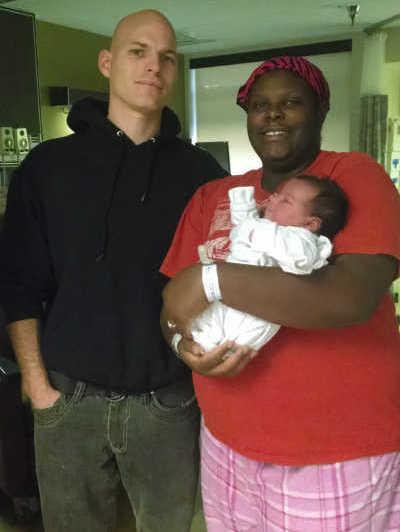
CLEARLAKE, Calif. – A Clearlake couple on Wednesday welcomed a baby girl who is the county's first baby of the new year.
Tarah Murphy and Randy Weaver gave birth to Azayla Weaver at 10:34 a.m. New Year's Day at St. Helena Hospital Clear Lake, according to hospital spokesperson Michelle Van Hoff.
The little girl weighed 9 pounds and was 21 inches long, Van Hoff said.
Van Hoff said the couple and their new baby received a gift basket donated by Walmart.
Rebecca Southwick, spokesperson for Sutter Lakeside Hospital in Lakeport, said Thursday afternoon that so far this year no new babies have arrived at that hospital's birthing center.
Southwick said Sutter Lakeside annually welcomes close to 340 new births. An annual birth count for St. Helena Hospital Clear Lake was not immediately available.
From 1996 to 2012, Lake County averaged approximately 662 births annually, according to data records from the California Department of Public Health and Department of Finance.
There were 739 babies born in 2012 – the most recent year for which numbers are available. The most births for any one year between 1996 and 2012 was 742 in 2007, according to the state statistics.
Email Elizabeth Larson at
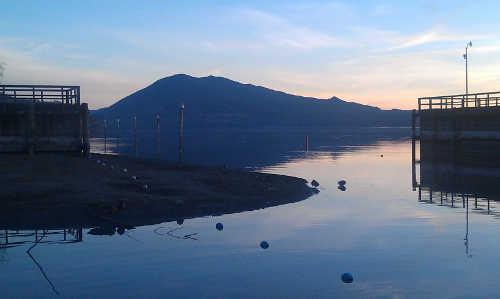
LAKE COUNTY, Calif. – While snow and freezing temperatures are hitting many parts of the United States, the year 2014 has gotten off to a warm and dry start in Lake County and much of the rest of California.
And that isn't likely to change any time soon, according to forecasters.
California's rainy season traditionally runs from October to March, but so far there has been little rain in that time frame.
A new report from the National Oceanic and Atmospheric Administration says that California had a record-low level of precipitation in 2013. The agency also reported that November 2013 had the highest overall global temperature on record.
The US Drought Monitor's latest report has Lake County listed as being in “severe drought,” with NOAA's most recent US Seasonal Drought Outlook, released Dec. 19, showing that most of California – including Lake County – in currently in persistent drought conditions that could intensify.
Last week AccuWeather.com also reported that 2013 was California's driest year on record, as Lake County News has reported.
In an interview this week with Lake County News, Ken Clark, an AccuWeather senior meteorologist based in California, said there has been a “tremendous lack of rainfall” around the region.
San Francisco's amount of rainfall in 2013 was at roughly 16 percent of normal, according to AccuWeather, with Sacramento posting 31 percent of normal and Redding 38 percent of normal.
For the rest of the winter, “The chance of getting anywhere close to normal is out of the question,” said Clark, with seasonal models leading forecasters to predict below to well below normal precipitation through March, when the rainy season ends.
The benefits of several days of rain Lake County experienced in late November were essentially wiped out by a windstorm that dried up vegetation and did an estimated $6 million in damage, according to local officials.
Conditions this fall and early winter have been so dry that Cal Fire didn't call an official end to the fire season until Dec. 16, nearly a month and a half later than in 2012.
Cal Fire Battalion Chief Greg Bertelli told Lake County News in a recent interview that county residents need to continue to exercise caution because of the unseasonably dry conditions.
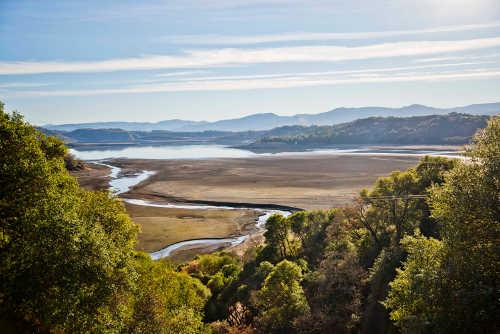
Clear Lake normally is filling up at this time of year. US Geological Survey records – which track the lake's depth consistently going back to 1912 – show that the lake usually is lowest in the months of October through the first half of December, at which point rain starts to raise the lake level.
On Wednesday the lake had a mean – or average – level of 0.60 feet Rumsey, with Rumsey being the special measurement used for Clear Lake based on the Grigsby Riffle, a rock sill located near Lower Lake at the confluence of Cache and Seigler creeks.
According to USGS records, Wednesday's reading is the lowest Jan. 1 mean level since Jan. 1, 1991, when the mean level was 0.32 feet Rumsey.
The historical mean level for Jan. 1 from 1913 through 2010 is 2.84 feet Rumsey, the USGS reported.
Yolo County Flood Control and Water Conservation District, which holds the water rights to Clear Lake and to Indian Valley Reservoir, reported that between Oct. 1 and and Dec. 23 there was less than an inch of precipitation – 0.67 to be exact – impacting Clear Lake, compared to 18.34 inches for the same period in 2012.
The Indian Valley Reservoir area has had only slightly more rain – also less than an inch, at 0.86 – compared to 10.05 inches between Oct. 1 and Dec. 23, 2012, the district reported.
Like Clear Lake, Indian Valley Reservoir's levels are well below normal.
For comparison, on Dec. 23, 2012, the reservoir's storage was 81,485 acre feet (an acre foot is the amount of water needed to cover an acre in one foot of water, or 43,560 cubic feet). The most recent data available – from this past Dec. 18 – showed storage had dropped to 14,437 acre feet.
Those low numbers are in keeping with a prediction for a drier-than-normal winter that AccuWeather made late last summer, Clark said.
While December 2012 was very wet, once January arrived, “The spigots were turned off,” said Clark, with 20 to 30 percent of normal rainfall the rest of the winter.
He said forecasters knew going into 2013 – on the heels of a very dry winter, spring and summer – that it wasn't going to be good news for the rest of the year or for the beginning of 2014.
Looking at the forecast in the first week of the new year, no rain is predicted. Clark said one computer forecast model seems to indicate a small amount of rain around Jan. 7 or 8.
However, he added, “I don't see any rain at least in the foreseeable future.”
In making their forecasts, AccuWeather's meteorologists draw on a number of sources, such as short-term computer models of the atmosphere that are issued four times a day, along with longer-term seasonal models that give overall weather patterns for three-month periods, and North American and Pacific upper atmosphere oscillation, Clark explained.
There also is electronic snow survey data, a key measurement because of the importance of the state's snowpack as a water source.
The California Department of Water Resources will hold its first manual snow survey of the season this Friday, but online data shows that the statewide snowpack is averaging 20 percent of normal.
“Unfortunately, I don't see that changing any time soon,” said Clark.
Clark said he expects to see less snow – not more – in the months ahead.
“There is a heck of a lot of ground that needs to be made up and that isn't very likely,” he said.
Based on the available information and weather models, Clark said it will be a drier than normal winter for Lake County and the rest of California.
If the next three to four months have below-normal precipitation, Clark said the state could be looking at some very detrimental water restrictions for agriculture.
Follow Clark's weather blog at http://www.accuweather.com/en/weather-blogs/clark .
Email Elizabeth Larson at
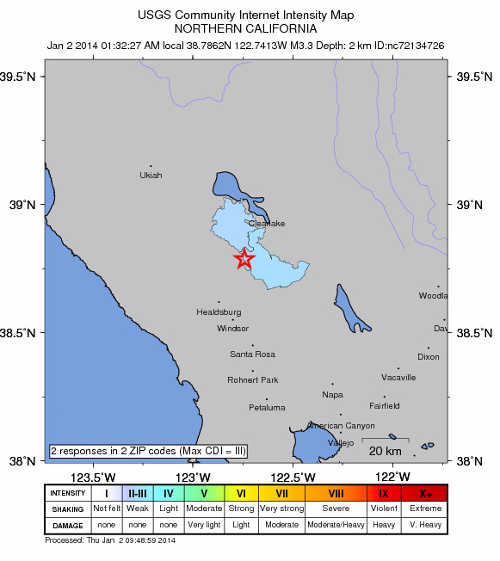
COBB, Calif. – A 3.3-magnitude earthquake shook the Cobb area early Thursday morning.
The quake occurred at 1:32 a.m., according to the US Geological Survey.
It was recorded at a depth of 1.2 miles, and was centered just northeast of The Geysers geothermal steamfield and 13 miles south southwest of Clearlake, the US Geological Survey reported.
The survey received shake reports from Kelseyville and Middletown.
Email Elizabeth Larson at
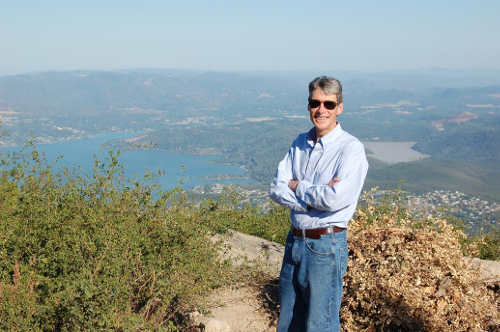
UPPER LAKE, Calif. – Dr. Harry Lyons, biology and ecology professor at the Clear Lake Campus of Yuba College will give a presentation on Lake County's unique geology on Wednesday, Jan. 8.
The talk will begin at 6:30 p.m. at the Rodman Preserve Nature Education Center, located at 6350 Westlake Road near Upper Lake.
The program is being presented by the Lake County Land Trust.
The title of Dr. Lyons’ talk is: “How Did ‘Here’ Get Here?”
Lyons, a favorite local science professor who has an in-depth understanding of the county's geology and Clear Lake, points out that with the exception of local volcanoes, Lake County was formed elsewhere and delivered on plates from the Pacific by almost endless tectonic forces.
Reservations for this lecture are required as space is limited. Please register for the lecture by contacting the Lake County Land Trust office at 707-262-0707.
Registration is needed by Tuesday, Jan. 7.
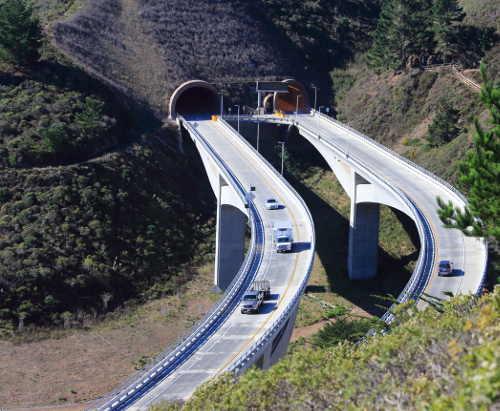
Caltrans is highlighting a few transportation infrastructure projects completed this past year to help improve mobility, safety and sustainability throughout California's transportation system.
“From opening new tunnels and bridges to repairing structures damaged by catastrophic fire, Caltrans helped strengthen and preserve California's great transportation infrastructure,” said California State Transportation Agency Secretary Brian Kelly. “With this work and the emerging active transportation program, Caltrans will remain committed to safety, mobility and sustainability in our transportation system as it heads into the new year.”
Caltrans made nearly $2.5 billion of improvements to the state highway system through 542 completed contracts in 2013 while also awarding 433 major highway construction contracts with a value of more than $2.7 billion.
Caltrans also continued to restore, upgrade and protect infrastructure statewide, including more than 88,000 miles of striping on state highways and 155,000 cubic yards of litter and debris removal.
“As 2013 comes to a close, Caltrans is highlighting a small sample of the hundreds of completed infrastructure projects that improved transportation for millions of Californians,” said Caltrans Director Malcolm Dougherty. “In 2014, Caltrans will build on this momentum and continue delivering a safer, more mobile and sustainable transportation system for California.”
Thirteen of the notable 2013 transportation infrastructure projects in California, organized by region, included:
NORTHERN CALIFORNIA
Interstate 80 Improvement from Auburn to Nevada
In October, Caltrans finished rebuilding 90 miles of Interstate 80 between Auburn and the Nevada state line. Infrastructure improvements also included rebuilding seven bridges, improving lighting and drainage and adding new traffic monitoring systems.
One of California's critical economic arteries as well as one of the nation's three continuous coast-to-coast highways, this interstate moves $4.7 million worth of commerce closer to its destination every hour.
State Route 99 Elverta Road
In the Sacramento area, Caltrans and the County of Sacramento constructed a new interchange at State Route 99 and Elverta Road, which optimized traffic flow and safety for motorists by eliminating the last traffic signal along the 40-mile route between Yuba City and Sacramento.
Rim Fire Repairs to State Route 120
Caltrans employees worked around the clock to reopen State Route 120 into Yosemite National Park after the Rim Fire burned approximately 257,000 acres in late summer.
In just 18 days, crews removed more than 1,800 damaged trees, repaired almost 800 guardrail posts and replaced numerous signs to reconnect visitors with this vital link to Yosemite National Park.
BAY AREA
Devil's Slide tunnels construction
In March, Caltrans opened the first new highway tunnels in California in nearly 50 years when it cut the ribbon on the Tom Lantos Tunnels, popularly known as the Devil's Slide Project, which are now the longest tunnels in California.
The $439 million project features two 4,200-foot-long tunnels, 32 jet-powered fans for ventilation and 10 fireproof shelters between the tunnels to protect the public.
San Francisco-Oakland Bay Bridge
In September, Caltrans opened the new San-Francisco-Oakland Bay Bridge, which is designed to withstand the strongest earthquake estimated by seismologists to occur over a 1,500-year period.
The new span also includes a bike and pedestrian path that will be extended onto Treasure Island after the old eastern span is removed.
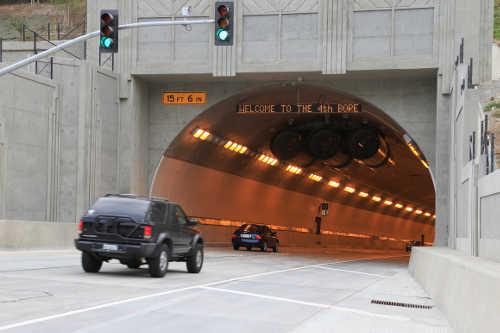
Fourth Bore of the Caldecott Tunnel
In November, Caltrans opened the new fourth bore of the world-class Caldecott Tunnel on State Route 24, providing two dedicated tunnels in each direction to aid more than 160,000 commuters daily and ending the 50-year-old process of manually reversing the flow of traffic twice per day along the middle bore.
The fourth bore has been designated as a regional lifeline structure and is designed to reopen to emergency traffic within 72 hours of a major earthquake.
CENTRAL VALLEY
Philip S. Raine Safety Roadside Rest Area
As part of its effort to reduce greenhouse gas emissions and save taxpayer money, Caltrans received Leadership in Energy and Environmental Design (LEED) Platinum certification-the highest possible environmental rating-by the U.S. Green Building Council (USGBC) for the Philip S. Raine Roadside Rest Area on State Route 99 in Tulare County.
The Raine facility, one of 233 buildings in California to achieve this milestone, is one hour south of Fresno near Tipton and serves more than four million visitors annually.
Caltrans has previously earned LEED Gold certification for its Los Angeles office and LEED Silver certification for the district office in Marysville.
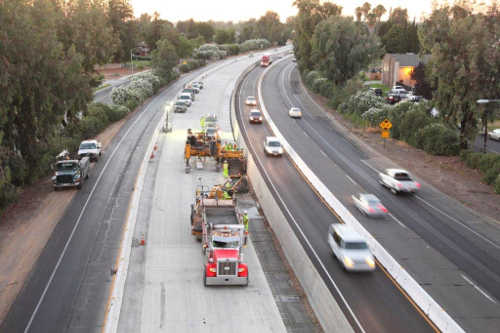
State Route 99 Madera rehabilitation
Among the 26 Proposition 1B projects in the State Route 99 Corridor Program, this was Caltrans' first to use of the “design build” project delivery method that combined design and construction into one contract.
Opened on time and on budget, the $37 million project was funded entirely by Proposition 1B and benefits 65,000 commuters, tourists and truckers daily in this critical corridor.
CENTRAL COAST
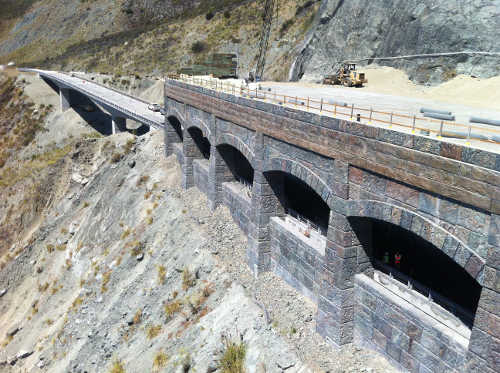
State Route 1 Pitkins Curve Bridge and Rockshed Project
In December, a $39 million a permanent slide repair project on State Route 1 along the Big Sur coast in Monterey County was completed to install a bridge and rock shed at Pitkins curve, one of the toughest highway maintenance challenges along California's central coast.
Extensive landslides had occurred on the route, often severing travel on the highway for weeks at a time.
SAN DIEGO
Otay Mesa East Port of Entry
Caltrans and its partners recently broke ground on the first of three segments of the $717 million State Route 11/Otay Mesa East Port of Entry (POE) Project.
Once completed, the four-lane highway will connect about 2.5 miles from SR-905 south to the proposed Otay Mesa East POE at the U.S.-Mexico border.
The new freeway will reduce the frequent wait times for commercial trucks at the Otay Mesa POE and for vehicles at the San Ysidro POE.
LOS ANGELES
Interstate 5/State Route 14 carpool connector
Caltrans broke ground on four major highway widening projects on Interstate 5 in 2013 as part of a $1.8 billion effort that will expand this crucial California commerce corridor from six to ten lanes, including a carpool lane in each direction.
The new I-5/SR-14 carpool connector reduced travel time for Los Angeles area motorists who can now transition between I-5 and SR-14 without leaving the carpool lane.
Interstate 5/State Route 2 tanker fire repair
Caltrans worked around the clock to shore up the tunnel at the Interstate 5/State Route 2 interchange in July after a tanker fire caused extensive damage to pavement, walls, support columns, drainage and lighting.
Caltrans proceeded with $16.5 million worth of repairs and improvements to fix the damage and increase safety while improving visibility with bright paint and LED lights.
INLAND EMPIRE
Colton Crossing Project
Caltrans and its partners delivered this rail improvement in Colton south of Interstate 10 eight months earlier than its scheduled 2014 completion and $109 million below the estimated $202 million cost.
The concrete overpass speeds up cargo and cuts diesel emissions from waiting trains.
The project will save $241 million in travel time and reduce greenhouse gas emissions by 34,000 tons of CO2 equivalent annually.
In addition to these regional achievements, Caltrans reported a decade-high 84 percent pavement health rating in 2013, out of the 50,000 lane miles it maintains.
While Caltrans typically receives just 17 percent of the funding needed to keep pavement in good condition, one-time contributions from the voter-approved 2006 Proposition 1B transportation bond and the 2009 Recovery Act made more projects possible.
Caltrans also sold nearly $22 million worth of excess property originally acquired for transportation projects, which was more than $4 million higher than the properties' estimated market value.
In 2013, Caltrans also furthered its goal of building a more sustainable transportation system.
During the 2012-13 fiscal year, ridership rose to a record 5.6 million passengers on three intercity passenger rail lines funded by the state, and over the past ten years ticket revenues from the three lines have skyrocketed from $44 million to $102 million.
Caltrans also released the California State Rail Plan, which lays out a long-term vision for freight and passenger rail.
In 2014, Caltrans will build on this momentum by implementing the new Active Transportation Program to fund human-powered transportation projects and programs.
The new program is the nation's largest state commitment to bicycling, walking and other active transportation.