How to resolve AdBlock issue?
Refresh this page
How to resolve AdBlock issue?
Refresh this page
Lake County News,California
  • Home
    • Registration Form
  • News
    • Education
    • Veterans
    • Community
      • Obituaries
      • Letters
      • Commentary
    • Police Logs
    • Business
    • Recreation
    • Health
    • Religion
    • Legals
    • Arts & Life
    • Regional
  • Calendar
  • Contact us
    • FAQs
    • Phones, E-Mail
    • Subscribe
  • Advertise Here
  • Login

News

Get ready to kick off the Big Read

LAKE COUNTY, Calif. — The 2024 NEA Big Read is kicking off its next series of events in Lake County this week.

The Lake County Library received an $8,000 grant to host the National Endowment for the Arts’ Big Read this year with programs that focus on the book “The Bear” by Andrew Krivak.

The following is the list of upcoming events, all of which are free.

“Aging, Dying and Afterlife” book discussion
Noon, Saturday, Sept. 21
Location: Upper Lake Library, 310 Second St.
Discuss the themes of grief, death and acceptance with the Aging, Dying and Afterlife book club.

Big Read 2024 Outdoor Kickoff
2 p.m. Saturday, Sept. 21
Location: Anderson Marsh State Historic Park Ranch House, 8400 Highway 53, Lower Lake
Join the Lake County Library, Clear Lake State Park, Museums of Lake County, and California Department of Fish and Wildlife to learn about the NEA Big Read, the book selection, local protected lands, local history, and local fish and wildlife. Participants will learn about local resources and how we can do our part to take care of our land and wildlife.

An Evening for Grief Support
5:30 p.m. Wednesday, Sept. 25
Location: Lakeport Library, 1425 N. High St.
Join an evening with Hospice Services of Lake County and Lake County Behavioral Health to learn about local grief, bereavement, and mental health supportive services and discuss how it relates to grief and loss in the “The Bear.”

Game On! Family Game Time with the Big Read
2 p.m. Tuesday, Oct. 1
Location: Lakeport Library, 1425 N. High St.
Bring the family for a bow and arrow craft activity inspired by “The Bear.”

Creative Writing Workshop with Georgina Marie Guardado
3:30 p.m. Tuesday, Oct. 1
Location: Redbud Library, 14785 Burns Valley Road, Clearlake
Join a free writing workshop inspired by “The Bear.” All levels, genres and ages are welcome. Lake County Poet Laureate Emerita Georgina Marie Guardado will lead the workshop.

Data shows home sales and prices down

LAKE COUNTY, Calif. — The latest information from the Lake County Association of Realtors shows a drop in home prices and home sales this summer.

Over the month of July, a total of 77 single family homes were sold through the multiple listing service, compared to 76 in June and 89 sold a year ago during the month of July 2023. These include traditionally built “stick-built” houses as well as manufactured homes on land.

There were six sales of mobile homes in parks in July, compared to nine sold in June and five sold in July last year. For bare land (lots and acreage) 18 were sold in July, compared to 23 sold in June, and 29 were sold during that time period the previous year in July 2023.

There are 452 “stick built” and manufactured homes on the market right now. If the rate of sales stays the same at 77 homes sold per month, there are currently 5.87 months of inventory on the market.

That means that if no new homes are brought to the market for sale, in 5.87 months, all of these homes would be sold and there would be no homes available for sale. Less than 6 months of inventory is generally considered to be a “sellers’ market” while more than 6 months of inventory is often called a “buyers’ market.”

The inventory has crept downward a bit from June, when 6.1 months of inventory was available. Agents are currently reporting a lot of buyers looking but few writing offers on properties.

The total percentage of homes bought for all cash in July: 30% (compared to 34% for June and 38% for a year ago in July 2023); 42% were financed by Fannie Mae or Freddie Mac (“conventional loans”) compared to 39% for June and 34% for July 2023; 16% were financed by FHA (compared to 17% in June and 18% in July 2023); 8% were financed by the VA or CalVet (compared to 7% in June and 1% for July 2023); 5% had other financing such as private loans, USDA, or seller financed notes (compared to 3% in June, and compared to 9% for July 2023). None of the closed sales in April were reported as an assumable loan that was assumed by the buyer.

The homes in July sold at an average of 97% of the asking price at the time the property went under contract, but an average of 94% when compared to the original asking price when the property first came on the market. This means that the asking home prices had been reduced from their original list prices before an offer was accepted.

In June, homes sold for 97% of the asking price at the time the property went under contract, and 94% of the original asking price. A year ago in July, homes were also selling at 97% of the asking price at the time the property went under contract and at 94% when compared to the original asking price.

The average time on the market for residential properties in July was 91 days, compared to 71 days in June and 50 days a year ago in July 2023.

The median sale price of a single family home in Lake County in July was $250,000, which is much lower than the $330,000 median sale price for June, and also lower than the median sale price a year ago of $320,000 during July 2023. This would indicate that during July, many more lower priced homes were selling to bring the median sale price down compared to June and
compared to a year ago in July.

The median asking price of homes on the market right now is $375,000; in June the median asking price was $395,000.

By now you’ve probably read or heard about the significant changes happening in real estate and how those changes will affect home buyers and sellers.

One of the new requirements is that buyers must sign a written buyer representation agreement before touring a home with an agent. This is a positive development for both consumers and agents because it facilitates conversations to help homebuyers better understand the process and learn the right questions to ask agents, including what they’re going to do for their clients and how they get paid for their services.

The agreement explains how your Realtor will act as your dedicated and professional guide. It also outlines their ethical and fiduciary duties to represent you to the best of their ability and records exactly what and how they will be paid for their services.

The terms of the agreement are negotiated between you and your Realtor. Together, you decide how long the representation lasts, and when and if to extend or end the agreement.

National Voter Registration Day takes place Sept. 17

LAKE COUNTY, Calif. — Tuesday, Sept. 17, is National Voter Registration Day, and the Lake County Registrar of Voters Office encourages eligible Californians to make sure they are registered to vote or update their voter registration information.

National Voter Registration Day efforts are designed to ensure every eligible voter has the opportunity to register to vote or update their voter registration information in order to be prepared for future elections.

Elections staff will set up a booth at the Lake County Farmer’s Market at Library Park, 225 Park St. in Lakeport, on Tuesday, Sept. 17, from 10 a.m. to 1 p.m.

Eligible students, ages 16 and 17, can be civically engaged by pre-registering to vote. If students pre-register to vote, they will automatically become voters when they turn 18 years old.

Eligible individuals can register to vote online at https://registertovote.ca.gov/ or at the Lake registrar’s office at 325 N. Forbes St. in Lakeport.

Voter registration forms are also available at all Lake County Libraries and post offices. If you require a voter registration form be mailed to you, call the elections office at 707-263-2372.

How researchers measure wildfire smoke exposure doesn’t capture long-term health effects − and hides racial disparities


Fine particulate matter from wildfires can cause long-term health harms. Gary Hershorn/Getty Images

Kids born in 2020 worldwide will experience twice the number of wildfires during their lifetimes compared with those born in 1960. In California and other western states, frequent wildfires have become as much a part of summer and fall as popsicles and Halloween candy.

Wildfires produce fine particulate matter, or PM₂.₅, that chokes the air and penetrates deep into lungs. Researchers know that short-term exposure to wildfire PM₂.₅ increases acute care visits for cardiorespiratory problems such as asthma. However, the long-term effects of repeated exposure to wildfire PM₂.₅ on chronic health conditions are unclear.

One reason is that scientists have not decided how best to measure this type of intermittent yet ongoing exposure. Environmental epidemiologists and health scientists like us usually summarize long-term exposure to total PM₂.₅ – which comes from power plants, industry and transportation – as average exposure over a year. This might not make sense when measuring exposure to wildfire. Unlike traffic-related air pollution, for example, levels of wildfire PM₂.₅ vary a lot throughout the year.

To improve health and equity research, our team has developed five metrics that better capture long-term exposure to wildfire PM₂.₅.

Measuring fluctuating wildfire PM₂.₅

To understand why current measurements of wildfire PM₂.₅ aren’t adequately capturing an individual’s long-term exposure, we need to delve into the concept of averages.

Say the mean level of PM₂.₅ over a year was 1 microgram per cubic meter. A person could experience that exposure as 1 microgram per cubic meter every day for 365 days, or as 365 micrograms per cubic meter on a single day.

While these two scenarios result in the same average exposure over a year, they might have very different biological effects. The body might be able to fend off damage from exposure to 1 microgram per cubic meter each day, but be overwhelmed by a huge, single dose of 365 micrograms per cubic meter.

For perspective, in 2022, Americans experienced an average total PM₂.₅ exposure of 7.8 micrograms per cubic meter. Researchers estimated that in the 35 states that experience wildfires, these wildfires added on average just 0.69 micrograms per cubic meter to total PM₂.₅ each year from 2016 to 2020. This perspective misses the mark, however.

For example, a census tract close to the 2018 Camp Fire experienced an average wildfire PM₂.₅ concentration of 1.2 micrograms per cubic meter between 2006 to 2020. But the actual fire event had a peak exposure of 310 micrograms per cubic meter – the world’s highest level that day.

Orange haze blanketing a city skyline, small silhouette of a person taking a photo by a streetlight
Classic estimates of average PM₂.₅ levels miss the peak exposure of wildfire events. Angela Weiss/AFP via Getty Images

Scientists want to better understand what such extreme exposures mean for long-term human health. Prior studies on long-term wildfire PM₂.₅ exposure focused mostly on people living close to a large fire, following up years later to check on their health status. This misses any new exposures that took place between baseline and follow-up.

More recent studies have tracked long-term exposure to wildfire PM₂.₅ that changes over time. For example, researchers reported associations between wildfire PM₂.₅ exposure over two years and risk of death from cancer and any other cause in Brazil. This work again relied on long-term average exposure and did not directly capture extreme exposures from intermittent wildfire events. Because the study did not evaluate it, we do not know whether a specific pattern of long-term wildfire PM₂.₅ exposure was worse for health.

Most days, people experience no wildfire PM₂.₅ exposure. Some days, wildfire exposure is intense. As of now, we do not know whether a few very bad days or many slightly bad days are riskier for health.

A new framework

How can we get more realistic estimates that capture the huge peaks in PM₂.₅ levels that people are exposed to during wildfires?

When thinking about the wildfire PM₂.₅ that people experience, exposure scientists – researchers who study contact between humans and harmful agents in the environment – consider frequency, duration and intensity. These interlocking factors help describe the body’s true exposure during a wildfire event.

In our recent study, our team proposed a framework for measuring long-term exposure to wildfire PM₂.₅ that incorporates the frequency, duration and intensity of wildfire events. We applied air quality models to California wildfire data from 2006 to 2020, deriving new metrics that capture a range of exposure types.

Five heat maps of California paired with bar graphs of exposures over time
The researchers proposed five ways to measure long-term wildfire PM₂.₅ exposure. Casey et al. 2024/PNAS, CC BY-NC-ND

One metric we devised is number of days with any wildfire PM₂.₅ exposure over a long-term period, which can identify even the smallest exposures. Another metric is average concentration of wildfire PM₂.₅ during the peak week of smoke levels over a long period, which highlights locations that experience the most extreme exposures. We also developed several other metrics that may be more useful, depending on what effects are being studied.

Interestingly, these metrics were quite correlated with one another, suggesting places with many days of at least some wildfire PM₂.₅ also had the highest levels overall. Although this can make it difficult to decide between different exposure patterns, the suitability of each metric depends in part on what health effects we are investigating.

Environmental injustice

We also assessed whether certain racial and ethnic groups experienced higher-than-average wildfire PM₂.₅ exposure and found that different groups faced the most exposure depending on the year.

Consider 2018 and 2020, two major wildfire years in California. The most exposed census tracts, by all metrics, were composed primarily of non-Hispanic white individuals in 2018 and Hispanic individuals in 2020. This makes sense, since non-Hispanic white people constitute about 41.6% and Hispanic people 36.4% of California’s population.

To understand whether other groups faced excess wildfire PM₂.₅ exposure, we used relative comparisons. This means we compared the true wildfire PM₂.₅ exposure experienced by each racial and ethnic group with what we would have expected if they were exposed to the state average.

We found that Indigenous communities had the most disproportionate exposure, experiencing 1.68 times more PM₂.₅ than expected. In comparison, non-Hispanic white Californians were 1.13 times more exposed to PM₂.₅ than expected, and multiracial Californians 1.09 times more exposed than expected.

Person holding child, sitting by two other people; in the foreground, a child approaches the camera
Better metrics for long-term PM2.5 exposure can help researchers better understand who’s most vulnerable to wildfire smoke. Eric Thayer/Stringer via Getty Images News

Rural tribal lands had the highest mean wildfire PM₂.₅ concentrations – 0.83 micrograms per cubic meter – of any census tract in our study. A large portion of Native American people in California live in rural areas, often with higher wildfire risk due to decades of poor forestry management, including legal suppression of cultural burning practices that studies have shown to aid in reducing catastrophic wildfires. Recent state legislation has removed liability risks of cultural burning on Indigenous lands in California.

Understanding the drivers and health effects of high long-term exposure to wildfire PM₂.₅ among Native American and Alaska Native people can help address substantial health disparities between these groups and other Americans.The Conversation

Joan Casey, Associate Professor of Environmental and Occupational Health Sciences, University of Washington and Rachel Morello-Frosch, Professor of Environmental Science, Policy and Management and of Public Health, University of California, Berkeley

This article is republished from The Conversation under a Creative Commons license. Read the original article.
NASA finds summer 2024 hottest to date

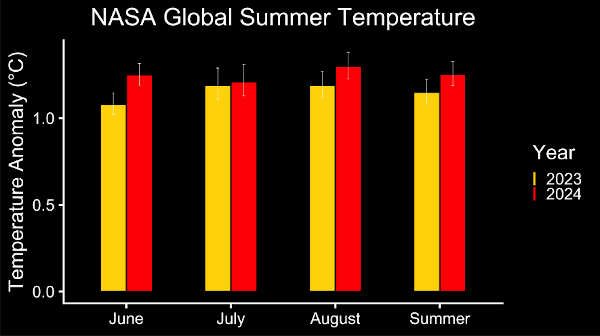
This bar graph shows GISTEMP summer global temperature anomalies for 2023 (shown in yellow) and 2024 (shown in red). June through August is considered meteorological summer in the Northern Hemisphere. The white lines indicate the range of estimated temperatures. The warmer-than-usual summers continue a long-term trend of warming, driven primarily by human-caused greenhouse gas emissions. NASA/Peter Jacobs.


August 2024 set a new monthly temperature record, capping Earth’s hottest summer since global records began in 1880, according to scientists at NASA’s Goddard Institute for Space Studies, or GISS, in New York. The announcement comes as a new analysis upholds confidence in the agency’s nearly 145-year-old temperature record.

June, July, and August 2024 combined were about 0.2 degrees Fahrenheit (about 0.1 degrees Celsius) warmer globally than any other summer in NASA’s record — narrowly topping the record just set in 2023. Summer of 2024 was 2.25 F (1.25 C) warmer than the average summer between 1951 and 1980, and August alone was 2.34 F (1.3 C) warmer than average. June through August is considered meteorological summer in the Northern Hemisphere.

“Data from multiple record-keepers show that the warming of the past two years may be neck and neck, but it is well above anything seen in years prior, including strong El Niño years,” said Gavin Schmidt, director of GISS. “This is a clear indication of the ongoing human-driven warming of the climate.”

NASA assembles its temperature record, known as the GISS Surface Temperature Analysis (GISTEMP), from surface air temperature data acquired by tens of thousands of meteorological stations, as well as sea surface temperatures from ship- and buoy-based instruments. It also includes measurements from Antarctica. Analytical methods consider the varied spacing of temperature stations around the globe and urban heating effects that could skew the calculations.

The GISTEMP analysis calculates temperature anomalies rather than absolute temperature. A temperature anomaly shows how far the temperature has departed from the 1951 to 1980 base average.

New assessment of temperature record

The summer record comes as new research from scientists at the Colorado School of Mines, National Science Foundation, the National Atmospheric and Oceanic Administration (NOAA), and NASA further increases confidence in the agency’s global and regional temperature data.

“Our goal was to actually quantify how good of a temperature estimate we’re making for any given time or place,” said lead author Nathan Lenssen, a professor at the Colorado School of Mines and project scientist at the National Center for Atmospheric Research (NCAR).

The researchers affirmed that GISTEMP is correctly capturing rising surface temperatures on our planet and that Earth’s global temperature increase since the late 19th century — summer 2024 was about 2.7 F (1.51 C) warmer than the late 1800s — cannot be explained by any uncertainty or error in the data.

The authors built on previous work showing that NASA’s estimate of global mean temperature rise is likely accurate to within a tenth of a degree Fahrenheit in recent decades. For their latest analysis, Lenssen and colleagues examined the data for individual regions and for every month going back to 1880.

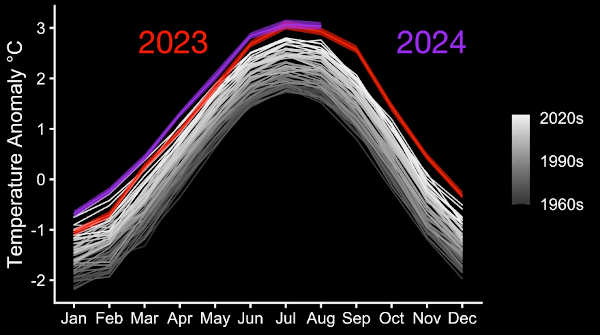
This visualization of GISTEMP monthly temperatures with the seasonal cycle derived from the Global Modeling and Assimilation Office’s MERRA-2 model compares 2023 (in red) and 2024 (in purple), with a transparent ribbon around each indicating the confidence intervals from the new GISTEMP uncertainty calculation. The white lines show monthly temperatures from the years 1961 to 2022. June, July, and August 2024 combined were about 0.2 degrees Fahrenheit (about 0.1 degrees Celsius) warmer globally than any other summer in NASA’s record — narrowly topping the record set in 2023. NASA/Peter Jacobs/Katy Mersmann.


Estimating the unknown

Lenssen and colleagues provided a rigorous accounting of statistical uncertainty within the GISTEMP record. Uncertainty in science is important to understand because we cannot take measurements everywhere. Knowing the strengths and limitations of observations helps scientists assess if they’re really seeing a shift or change in the world.

The study confirmed that one of the most significant sources of uncertainty in the GISTEMP record is localized changes around meteorological stations. For example, a previously rural station may report higher temperatures as asphalt and other heat-trapping urban surfaces develop around it. Spatial gaps between stations also contribute some uncertainty in the record. GISTEMP accounts for these gaps using estimates from the closest stations.

Previously, scientists using GISTEMP estimated historical temperatures using what’s known in statistics as a confidence interval — a range of values around a measurement, often read as a specific temperature plus or minus a few fractions of degrees. The new approach uses a method known as a statistical ensemble: a spread of the 200 most probable values. While a confidence interval represents a level of certainty around a single data point, an ensemble tries to capture the whole range of possibilities.

The distinction between the two methods is meaningful to scientists tracking how temperatures have changed, especially where there are spatial gaps. For example: Say GISTEMP contains thermometer readings from Denver in July 1900, and a researcher needs to estimate what conditions were 100 miles away. Instead of reporting the Denver temperature plus or minus a few degrees, the researcher can analyze scores of equally probable values for southern Colorado and communicate the uncertainty in their results.

What does this mean for recent heat rankings?

Every year, NASA scientists use GISTEMP to provide an annual global temperature update, with 2023 ranking as the hottest year to date.

Other researchers affirmed this finding, including NOAA and the European Union’s Copernicus Climate Change Service. These institutions employ different, independent methods to assess Earth’s temperature. Copernicus, for instance, uses an advanced computer-generated approach known as reanalysis.

The records remain in broad agreement but can differ in some specific findings. Copernicus determined that July 2023 was Earth’s hottest month on record, for example, while NASA found July 2024 had a narrow edge.

The new ensemble analysis has now shown that the difference between the two months is smaller than the uncertainties in the data. In other words, they are effectively tied for hottest.

Within the larger historical record the new ensemble estimates for summer 2024 were likely 2.52-2.86 degrees F (1.40-1.59 degrees C) warmer than the late 19th century, while 2023 was likely 2.34-2.68 degrees F (1.30-1.49 degrees C) warmer.

Sally Younger is a senior science writer for NASA.

Veterans Stand Down event planned for Sept. 18

James Haley from the American Legion at the Veterans Stand Down in 2023. Courtesy photo.


Veterans, family members, and active-duty personnel of all walks of life are invited to learn more about VA services and community resources available to them.

CLEARLAKE, Calif. — Lake County Vet Connect members will host the annual Veterans Stand Down, an outreach event for local and Mendocino County veterans and active-duty personnel who will benefit from learning more about veterans services and other community resources available to them.

Scheduled for Wednesday, Sept. 18, from 10 a.m. to 4:30 p.m., the event will be at American Legion Post Konocti located at 14470 Austin Road in Clearlake.

Lake Transit will provide veterans free rides to the Stand Down. Lunch will be served by Vet Connect and Sutter Health volunteers.

Resources to be offered include a significant number of services such as Veterans Members Services, a new Veterans Medical Services mobile unit, Vet Works, disability services, Nation's Finest Veteran's Services, audiology consultations, One Step Away, housing and homeless assistance, emergency preparedness, Woodland Community College, Lake County Behavioral Health, substance abuse counseling services, employment assistance, advance care planning and legal consultations.

Personal supplies and clothing will be distributed to eligible veterans attending.

“Many veterans have either been reluctant to apply for services including health services or don’t even know that they are eligible for services,” said Lake County Veteran Service Officer Saul Sanabria. “This event is an opportunity to investigate what healthcare, and other beneficial resources may be available to them.”

Hundreds of local veterans have been served by the Veterans Stand Down and the Vet Connect office.

“Over the past year I have been given a wealth of knowledge that I would have never tried to discover on my own. For this, I will be forever grateful to the countless number of people who are a part of this veteran’s program,” said Air Force Veteran Jovanie Otei.

The Vet Connect committee currently falls under the auspices of the Lake County United Veterans Council and is establishing its own nonprofit status.

Members are asking the public to spread the word regarding the Stand Down and benefits available to local veterans.

“In the military, ‘Stand Down’ afforded battle-weary soldiers the opportunity to renew their spirits, enjoy warm meals, receive medical and dental care, mail and receive letters, and enjoy the camaraderie of friends in a safe environment,” said Vet Connect Chair Steve Boone.

“Today, ‘Stand Down’ refers to grassroots, community-based intervention programs designed to help our nation’s vulnerable veterans remain safe and receive the services they need to achieve a healthy lifestyle. At risk veterans are invited to a single location and provided access to the community resources needed to begin addressing their individual problems,” Boone said.

For more information, contact Boone at 707-533-0717 or Janine Smith-Citron at 707-263-6222.

Janine Smith-Citron is development director for Hospice Services of Lake County.
  • 361
  • 362
  • 363
  • 364
  • 365
  • 366
  • 367
  • 368
  • 369
  • 370

Community

  • Lake County Wine Alliance offers sponsor update; beneficiary applications open 

  • Mendocino National Forest announces seasonal hiring for upcoming field season

Public Safety

  • Lakeport Police logs: Thursday, Jan. 15

  • Lakeport Police logs: Wednesday, Jan. 14

Education

  • Woodland Community College receives maximum eight-year reaffirmation of accreditation from ACCJC

  • SNHU announces Fall 2025 President's List

Health

  • California ranks 24th in America’s Health Rankings Annual Report from United Health Foundation

  • Healthy blood donors especially vital during active flu season

Business

  • Two Lake County Mediacom employees earn company’s top service awards

  • Redwood Credit Union launches holiday gift and porch-to-pantry food drives

Obituaries

  • Rufino ‘Ray’ Pato

  • Patty Lee Smith

Opinion & Letters

  • The benefits of music for students

  • How to ease the burden of high electric bills

Veterans

  • CalVet and CSU Long Beach team up to improve data collection related to veteran suicides

  • A ‘Big Step Forward’ for Gulf War Veterans

Recreation

  • Wet weather trail closure in effect on Upper Lake Ranger District

  • Mendocino National Forest seeking public input on OHV grant applications

  • State Parks announces 2026 Anderson Marsh nature walk schedule 

  • BLM lifts seasonal fire restrictions in central California

Religion

  • Kelseyville Presbyterian to host Ash Wednesday service and Lenten dinner Feb. 18

  • Kelseyville Presbyterian Church to hold ‘Longest Night’ service Dec. 21

Arts & Life

  • Auditions announced for original musical ‘Even In Shadow’ set for March 21 and 28

  • ‘The Rip’ action heist; ‘Steal’ grounded in a crime thriller

Government & Politics

  • Lake County Democrats issue endorsements in local races for the June California Primary

  • County negotiates money-saving power purchase agreement

Legals

  • March 3 hearing on ordinance amending code for commercial cannabis uses

  • Feb. 12 public hearing on resolution to establish standards for agricultural roads

How to resolve AdBlock issue?
Refresh this page