 How to resolve AdBlock issue?
News
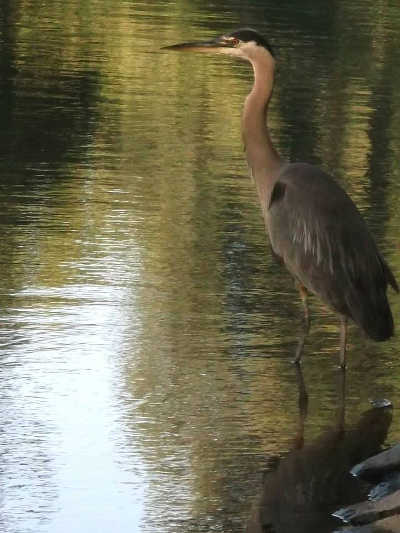
Two of the most common herons in the local region are the great blue heron (Ardea Herodias), the largest heron in the United States standing about 4-feet tall with a 6-foot wingspan, and the green heron (Butorides virescens) the smallest of the herons standing only about 18-inches tall, about the size of a crow.
Finding them is relatively easy since they both like ponds, the margins of rivers, irrigation canals and flooded fields – and taking photos and video of them is a lot of fun.
Aside from their stately size, the great blue herons are easily recognizable by their plumage which is generally a dark gray-lavender overall streaked on the breast with black, white and rust.
The heron’s face is usually white, with a black stripe leading from its yellow eyes to the longer plumage at the back of the head.
When breeding, the blues sport longer plumes on their backs, breasts and upper thighs, their lower legs look more orange, and the rim around the bill turns blue. March is one of the best months to see them all decked out in their mating attire.
In California, the great blue herons are nonmigratory, and prefer to roost above ground in tall trees during the night.
The females build nests out of twigs provided by the males, and can lay up to 8 eggs in a clutch. Both parents incubate the eggs and provide for their hatchlings.
The babies can fly when they’re about 2 months old. These herons generally live about 10 years, but some have been known up to 23 years.
Although they are expert fishermen and primarily eat fish, crustaceans, insects and amphibians, great blue herons will eat just about anything they can catch, including other smaller birds and rodents.
Their basic fishing and capturing technique consists of a slow, almost motionless stance, and then a sharp stab with their bill which impales the prey.
The much smaller green heron is a little more sophisticated hunter. It’s one of the few birds that uses “lures” like feathers, bugs, or berries to attract fish.
It pitches its “bait” out onto the surface of the water, and then waits for something come by and snap at it. If the bait drifts, the heron will run along the bank looking for an opportunity to regain it. I actually saw a green heron at a local pond use discarded Cheetos as his “bait” for the small fish in the pond.
Hah! They prefer a diet of fish, but will also eat bugs, snails, reptiles, spiders and smaller rodents when they can catch them.
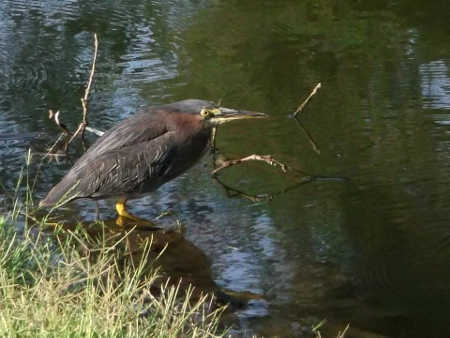
At a distance, green herons look more chestnut brown than green, and it’s only when you get close that you can see the dark green sheen on its back, wing and top-knot feathers.
During mating season, or when startled by trespassers, the Heron will lift the long feathers on its head in display.
Breeding usually takes place between March and July. The male selects the nesting site but, like the male great blue heron, leaves the construction of the nest to the female.
She usually lays about three to five pale blue or greenish eggs, and both she and her mate care for their young until they’re fledged (in about a month). Green herons can live up to seven years, although a shorter lifespan is more common.
The green heron’s numbers in the United States have declined about 2 percent every year (an accumulated drop of about 53 percent between 1966 and 2010). They’re not on any “high concern” list yet, but their numbers are being watched regularly. The biggest threat to them is the loss of habitat through the draining and development of wetland areas.
When you go out hiking in the region, take your camera with you, and keep an eye out for these two beauties. Their distinct coloring and waterside antics always make for great photo-taking opportunities.
Tuleyome Tales is a monthly publication of Tuleyome, conservation organization with offices in Woodland and Napa, Calif. Mary K. Hanson is an amateur naturalist and photographer who is currently serves as executive assistant to Tuleyome’s executive director. For more information about Tuleyome, go to www.tuleyome.org . All photographs are by Mary K. Hanson; used with permission.
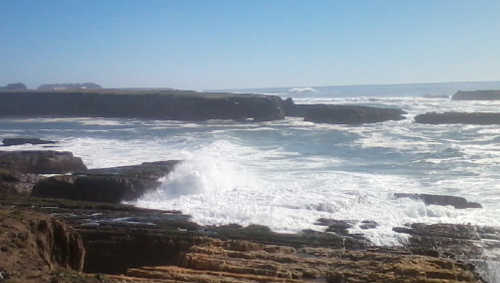
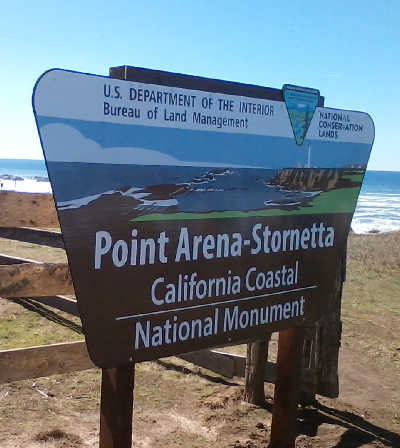
NORTH COAST, Calif. – On March 11, President Barack Obama used his authority under the Antiquities Act to issue a proclamation adding the 1665-acre Point Arena-Stornetta Public Lands to the California Coastal National Monument, allowing the monument to “walk on shore” (in the words of California Bureau of Land Management Director Jim Kenna) for the first time.
Under the management of the BLM Ukiah field office since 2004, Point Arena-Stornetta is located on Mendocino County’s south coast adjacent to Manchester State Beach and the Point Arena Lighthouse.
It includes more than two miles of Pacific coastline with natural bridges, tide pools, waterfalls, sinkholes and blowholes, as well as two miles of the Garcia River, the Garcia estuary, a quarter-mile of beach adjacent to Manchester State Park, and a five-acre island called Sea Island Rocks.
The area is recognized not only for breathtaking scenic values, but also for outstanding natural resources that include riparian corridors, extensive coastal wetlands, wind-sculptured stands of cypress, wildflower-strewn meadows, and shifting sand dunes, a varied ecosystem which taken as a whole provides significant wildlife habitat.
Otters and seals gambol in the surf, brown pelicans sail by in characteristic single file, and countless gulls and shorebirds call the area home.
Overwhelming public enthusiasm for adding this spectacular area to the monument was obvious last November, when a standing-room-only crowd of at least 300 people crammed into the diminutive Point Arena city hall to welcome Secretary of the Interior Sally Jewell, Congressman Jared Huffman, BLM Deputy Director Neil Kornze, and countless other federal, state, and local dignitaries.
When Secretary Jewell asked if she should recommend that the president give Point Arena-Stornetta monument status, every hand in the room reached towards the sky (including her own).
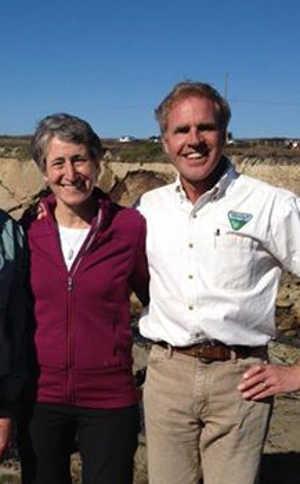
On March 12, the day after the presidential declaration, Secretary Jewell came back to the coast to join numerous other agency officials, representatives of Congressmen Mike Thompson and Jared Huffman, local tribal members, and many community activists in a day of rejoicing at the culmination of so many years of collaborative effort.
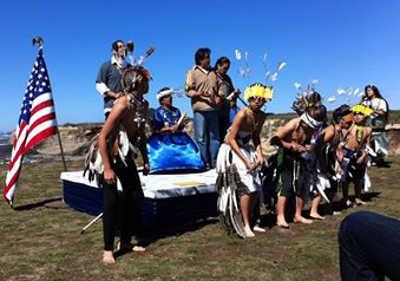
Hundreds of people gathered on a headland under a bright blue sky full of wheeling gulls and before a backdrop of crashing surf to hug, cheer, applaud, wave flags and listen to a succession of speakers marvel at the place, and affirm the solidarity of the community in making this achievement possible.
Members of the Point Arena/Manchester Band of Pomo Indians opened the gathering with a prayer and dances, and students from Pacific Community Charter School closed it by singing “This Land is Your Land.”
In between Secretary Jewell pointed out that “great places drive local economies and “it takes a village to make a monument.”
She also mentioned to President Obama’s belief in our “moral obligation to leave these lands better than we found them,” and as did Mike Boots of the President’s Council on Environmental Quality referred to the President’s fulfillment of his State of the Union promise to “use my authority to protect more of our pristine federal lands for future generations.”
This was a day of pure joy, a celebration of a spectacular landscape, of the communities that cherish its wonders, and of the most admirable attributes of this our nation.
Victoria Brandon is chair of the Sierra Club Redwood Chapter in Northern California.
LAKE COUNTY, Calif. – Six dogs are being offered for adoption at Lake County Animal Care and Control.
They range in age from 5 months to 4 years, and include five males and one female.
The dogs include mixes of Rottweiler, Chihuahua, Labrador Retriever, basset hound, boxer and pit bull.
Dogs that are adopted from Lake County Animal Care and Control are either neutered or spayed, microchipped and, if old enough, given a rabies shot and county license before being released to their new owner. License fees do not apply to residents of the cities of Lakeport or Clearlake.
If you're looking for a new companion, visit the shelter. There are many great pets hoping you'll choose them.
In addition to the animals featured here, all adoptable animals in Lake County can be seen here: http://bit.ly/Z6xHMb .
The following dogs at the Lake County Animal Care and Control shelter have been cleared for adoption (additional dogs on the animal control Web site not listed are still “on hold”).

'Skippy'
“Skippy” is a 3-year-old male Chihuahua mix.
He weighs 10 pounds, has a short buff coat and has been neutered.
Find him in kennel No. 2, ID No. 39112.

Male Chihuahua mix
This male Chihuahua mix is of undetermined age.
He weighs 7.6 pounds, and has a short brown and white coat. It was not reported if he has been neutered.
He's in kennel No. 5, ID No. 39172.

Boxer-pit bull terrier mix
This male boxer-pit bull terrier mix is 5 months old.
He has a short brown brindle coat, weighs 30 pounds and has been neutered.
Find him in kennel No. 6, ID No. 39135.

Rottweiler mix
This female Rottweiler mix is 2 years old.
She has a short black and brown coat, is large in size and has not been spayed.
She's in kennel No. 11, ID No. 39225.

'Dillon'
“Dillon” is a 3-year-old male basset hound-retriever mix.
He weighs 42 pounds, has a short tan and white coat, and has been neutered.
Find him in kennel No. 14, ID No. 27834.
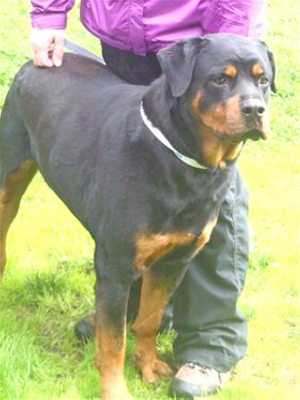
'Duke'
“Duke” is a 4-year-old male Rottweiler mix.
He weighs 122 pounds, has a docked tail and has been neutered.
He's in kennel No. 33, ID No. 39158.
To fill out an adoption application online visit http://www.co.lake.ca.us/Government/Directory/Animal_Care_And_Control/Adopt/Dog___Cat_Adoption_Application.htm .
Lake County Animal Care and Control is located at 4949 Helbush in Lakeport, next to the Hill Road Correctional Facility.
Office hours are Monday through Friday, 8 a.m. to 5 p.m., and 1 p.m. to 3 p.m., Saturday. The shelter is open from 10:30 a.m. to 4:30 p.m. Monday through Friday and on Saturday from 1 p.m. to 3 p.m.
Visit the shelter online at http://www.co.lake.ca.us/Government/Directory/Animal_Care_And_Control.htm .
For more information call Lake County Animal Care and Control at 707-263-0278.
Email Elizabeth Larson at

In the giant system that connects Earth to the sun, one key event happens over and over: solar material streams toward Earth and the giant magnetic bubble around Earth, the magnetosphere helps keep it at bay.
The parameters, however, change: The particles streaming in could be from the constant solar wind, or perhaps from a giant cloud erupting off the sun called a coronal mass ejection, or CME.
Sometimes the configuration is such that the magnetosphere blocks almost all the material, other times the connection is long and strong, allowing much material in.
Understanding just what circumstances lead to what results is a key part of protecting our orbiting spacecraft from the effects of such space weather.
Now, for the first time, a study shows that in certain circumstances a pool of dense particles normally circling Earth, deep inside the magnetosphere, can extend a long arm out to meet – and help block – incoming solar material.
“It's like what you might do if a monster tried to break into your house. You'd stack furniture up against the front door, and that's close to what the Earth is doing here,” said Brian Walsh, a space scientist at NASA's Goddard Space Flight Center in Greenbelt, Md. “The material that is usually much nearer Earth stacks up against the outer boundary of the magnetosphere, throttling the interaction there and stopping solar material from entering.”
In the March 6 issue of Science Express, Walsh and his colleagues compared observations from the ground and in space during a solar storm on Jan. 17, 2013.
This was a fairly moderate solar storm caused by a CME impacting Earth's magnetosphere for several hours. As the CME encountered the boundary of the magnetosphere, its magnetic fields and those around Earth realigned in a process called magnetic reconnection, which allowed energy and solar material to cross the boundary into the magnetosphere.
NASA's three THEMIS – for Time History of Events and Macroscale Interactions during Substorms – spacecraft were in the right place at the right time, flying through the magnetosphere's boundary approximately 45 minutes apart, and caught this interaction.
Closer to Earth, scientists could also study the sphere of cold dense gas at the very top of our atmosphere. This region is called the plasmasphere and it's made of what's known as plasma, a gas made of charged particles.
GPS signals travel through the plasmasphere and they travel at different speeds depending on how thick or thin the plasmasphere is along the journey. Tracking the GPS radio signals, therefore, can help researchers map out the properties of the plasmasphere.

“A colleague who works with these kind of observations said I had to see some interesting data showing a plume from the ground,” said Walsh. “And I typed in the dates and saw that it was a date when THEMIS was in the right position. So, for the first time, we could make a comparison.”
THEMIS showed that the tongue of this cold, dense plasmasphere material stretched all the way up to the magnetic reconnection point where the CME had made contact with the magnetopause.
The three sets of THEMIS observations demonstrated that the plume had a dramatic impact on the characteristics of the magnetic reconnection region.
“It wouldn't work if the magnetic reconnection happened for only a few minutes,” said David Sibeck the project scientist for THEMIS at NASA Goddard. “But if it lasts long enough, the whole magnetosphere gets involved. This tongue of the plasmasphere surges out, adding another layer of protection, curbing the magnetic reconnection.”
As scientists try to better understand the space weather system around Earth, they rely on multipoint observations such as this to connect what's seen on the ground to what's seen in space.
In this case THEMIS data connected to GPS data, but such combinations are increasingly being used to watch how Earth is affected by its closest star.
Eventually such observations could lead to improvements in space weather predictions, which would be as useful for spacecraft operators as terrestrial weather forecasts are for us here on Earth.

COBB, Calif. – An early Friday morning structure fire destroyed a home on Cobb Mountain.
The fire in the two-story, wood-framed structure was first dispatched shortly after 3 a.m. in the area of Rainbow Drive and Bottle Rock Road, according to radio reports.
Cal Fire Battalion Chief Greg Bertelli said that when firefighters arrived at the scene, the residence was fully involved, as were numerous outbuildings.
Bertelli said he was not sure if anyone had been living in the home, but no one was in the residence at the time firefighters arrived and there were no injuries.
Cal Fire and South Lake County Fire responded, and Lake County Fire Protection District resources were started but later canceled, Bertelli said.
Due to the area having no hydrants, Bertelli said additional water tenders were requested.
It took about two hours to put the fire out, with some of it spreading into nearby wildland, Bertelli said.
He noted that the situation could have been more challenging if there had been wind, as there had been earlier in the week.
Bertelli said investigators were on scene during the day to determine the cause. A final conclusion hadn't yet been reached on Friday.
A total estimated dollar loss was not yet available on Friday, Bertelli said.
Email Elizabeth Larson at
California's seasonal flu deaths increased still more over the past week, with this season's total number of deaths now more than three times that of last year, according to state health officials.
Dr. Ron Chapman, director of the California Department of Public Health (CDPH) and state health officer, said Friday that the number of confirmed influenza-related deaths in persons under 65 years of age reported in the state has increased by 14, to a total of 332 confirmed deaths for the 2013-14 flu season.
Seven of the 332 are pediatric deaths. There are an additional 19 deaths under investigation and not yet confirmed, Chapman's office reported.
The 332 confirmed influenza-associated deaths this season have been reported by the following jurisdictions: Alameda (7), Butte (1), Calaveras (2), Contra Costa (7), El Dorado (2), Fresno (22), Glenn (1), Humboldt (1), Imperial (2), Kern (9), Kings (7), Lake (1), Lassen (1), Long Beach (7), Los Angeles (54), Madera (3), Marin (2), Mendocino (4), Merced (5), Monterey (5), Nevada (1), Orange (15), Riverside (15), Sacramento (27), San Bernardino (23), San Diego (30), San Francisco (3), San Joaquin (7), San Luis Obispo (1), San Mateo (6), Santa Barbara (3), Santa Clara (18), Santa Cruz (3),
Shasta (3), Siskiyou (2), Solano (3), Sonoma (6), Stanislaus (13), Sutter (1), Tulare (4), Tuolumne (1), Ventura (3) and Yolo (1).
By this time last year, CDPH had received reports of 47 influenza fatalities in persons under 65 years of age. In the entire 2012-13 flu season 106 deaths were reported, according to Chapman's report.
The great majority of reported influenza deaths in persons under 65 years of age have occurred in people with underlying medical conditions. Outpatient visits and hospitalizations are at or below expected baseline levels for this time of year. The influenza-season activity status remains local.
Those at highest risk – the elderly, pregnant women, infants, or those with other health conditions – who have flu symptoms should contact their physician promptly in order to get the most effective treatment. Symptoms include fever, cough, sore throat, runny or stuffy nose, muscle or body aches, headaches and fatigue.
Influenza vaccine remains available and there is no widespread shortage of antivirals for treatment. CDPH continues to closely monitor statewide influenza activity and resources.
For information on local vaccinations, call Lake County Public Health, 707-263-1090 or 800-794-9291.