 How to resolve AdBlock issue?
News
The California Department of Public Health is reporting an increase in measles cases across California this year that is 10 times the number of cases reported at this time last year.
CDPH said it has received reports of 32 confirmed measles cases in California residents so far in 2014. Cases have occurred throughout California. This time last year, only three measles cases had been reported.
“Immunization is the best defense against measles, with 99 percent of persons developing immunity after two doses,” said Dr. Ron Chapman, state health officer and director of CDPH. “With an outbreak in the Philippines and measles transmission ongoing in many parts of the world outside of North and South America, we can expect to see more imported cases of this vaccine-preventable disease.”
Imported cases can spread to the community, especially among unvaccinated persons, including infants too young to be vaccinated.
The 32 measles cases have been reported in Alameda (1), Contra Costa (4), Los Angeles (10), Orange (6), Riverside (5), San Mateo (1), San Diego (4) and Santa Clara (1) counties.
High immunization rates in California have kept preventable childhood diseases, such as measles, at record lows during the past 20 years.
Since 2000, when measles was declared eliminated in the United States, the number of cases per year in California has ranged from 4-40 cases.
In that time, almost all measles cases in the United States have been linked to travel to areas of the world where measles still circulates.
Among the California cases with onset in 2014, seven had traveled to the Philippines, where a large outbreak is occurring, two had traveled to India and one had traveled to Vietnam, where measles is endemic.
Measles is a highly contagious viral disease that is spread through the air when someone who is ill with the disease coughs or sneezes.
Symptoms begin with a fever that lasts for a couple of days, followed by a cough, runny nose, red, watery eyes and rash. The rash typically appears first on the face, along the hairline, and behind the ears and then affects the rest of the body.
Infected people are usually contagious for about eight days, four days before their rash starts and four days after.
Complications can include diarrhea, ear infections and pneumonia. Death can occur from severe complications. Infants, pregnant women and immunocompromised persons are more susceptible to complications from measles.
“We want to do everything we can to prevent measles cases and we must do everything possible to limit the disease from spreading,” said Chapman.
Children are recommended to get their first dose of MMR (measles, mumps and rubella) vaccine at 12 to 15 months. The second dose of MMR is usually administered before children start kindergarten at 4 to 6 years.
Immunized adults do not need boosters. However, anyone born since 1957 who has not had two doses of vaccine may still be vulnerable to measles and should ask their doctor about getting immunized.
Unvaccinated Californians who are traveling outside of North or South America should receive MMR vaccine before they go. Infants who are traveling can be vaccinated as young as six months of age (though they should also have the two standard doses of MMR vaccine after their first birthday).
Individuals getting ready to travel abroad can find helpful information about travel vaccines on the Centers for Disease Control and Prevention Web site at http://wwwnc.cdc.gov/travel/destinations/list .
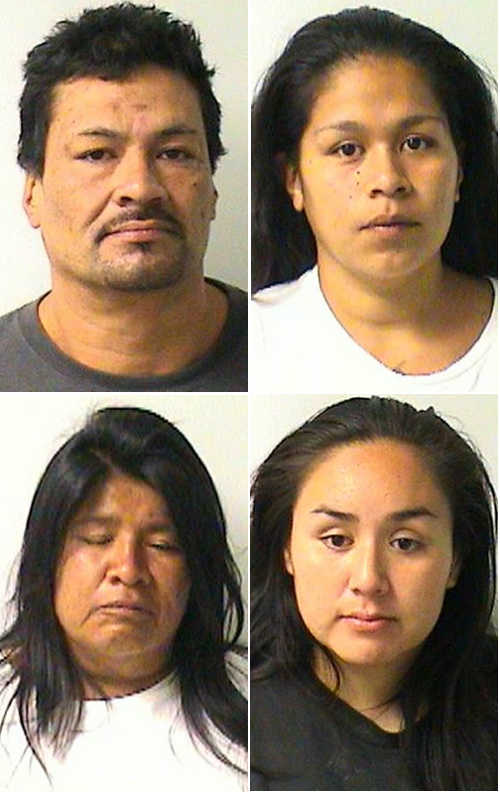
LAKEPORT, Calif. – A man and three women were arrested on Saturday as the result of an investigation into a woman's assault, with the female suspects additionally charged with robbery.
Leonso Paul Rangel, 42; Teena Maria Rangel, 26; Deena Tess Chavez, 26; and 42-year-old Andrea Melanie McCloud, all from Lakeport, were arrested in the case, according to Lt. Steve Brooks of the Lake County Sheriff's Office.
At 6:45 p.m. March 15 deputies contacted the victim who said she was walking on Mission Way in Lakeport, Brooks said.
The woman told deputies she was contacted by Leonso Rangel, who invited her inside his residence and said he wanted to talk to her, Brooks said. When she walked inside, Rangel shut the door and said she gave him some chemical that was messing with his body.
Brooks said the victim explained that a friend of hers gave Rangel some marijuana and for some reason Rangel thought she had something to do with it. She said he appeared to be under the influence of some type of drug, due to his violent behavior.
The victim explained that Rangel grabbed her by the neck and slammed her head against a wall. He then told her that if she did not leave the reservation, he would kill her himself. The victim said she was scared for her life and believed he would carry out the threat, according to Brooks.
The victim said she left Rangel’s residence and was waiting for a friend to give her a ride, so she could leave the area, Brooks said. While waiting she was contacted by Teena Rangel, Chavez and McCloud.
Brooks said the victim said Chavez was the first to punch her in the face and body with a closed fist. Chavez then shoved her towards Teena Rangel, who knocked her to the ground and began kicking her.
The victim said McCloud grabbed her by the hair, while Teena Rangel removed a diamond ring from her finger and took her purse. She said all three females took personal property from her and searched her pockets, Brooks said.
The victim remembered being kicked approximately 10 times in the head and body during the assault and was sure all three females had kicked her, according to Brooks.
Brooks said medics from Station 55 responded and transported the victim to Sutter Lakeside Hospital for medical treatment.
Leonso Rangel was arrested for battery and criminal threats. Teena Rangel, Andrea McCloud and Deena Chavez were arrested for battery and robbery. All four suspects were transported to the Lake County Hill Road Correctional Facility and booked.
Leonso Rangel's bail was set at $5,000, and jail records indicated he later was released after posting the required bail percentage.
On Tuesday afternoon, Teena Rangel, McCloud and Chavez all remained in custody, with bail set at $150,000 each, according to jail records. Their booking sheets indicated they were due in court on Tuesday for arraignment.
NORTHERN CALIFORNIA – Congressman Mike Thompson (D-St. Helena) has led a bipartisan letter with Reps. Joe Heck (R-NV), Steve Pearce (R-NM), Jared Huffman (D-CA), John Garamendi (D-CA) and Juan Vargas (D-CA) calling on President Barack Obama to protect local clean energy royalties from harmful budget cuts.
The letter urged the president to not repeal the sharing of geothermal royalty payments with counties, including Lake, which has received millions of dollars in the payments.
In fiscal year 2013 alone, Lake County received more than $802,000 in geothermal royalties, while for the same time period Sonoma County received more than $1.1 million.
Because of the high burdens that geothermal production places on the counties where it is developed, counties currently share in the revenue of the federal receipts.
Revenue sharing was targeted for cuts in the president’s recently released fiscal year 2015 budget.
“When a community invests in developing geothermal energy, they deserve to get their fair share in returns on those investments,” said Thompson.
“Stripping counties of these returns is a short sighted, fiscally irresponsible plan that will have no meaningful impact on deficit reduction,” he continued. “It will rob counties of the funds they depend on to pay for things such as public safety, road maintenance and law enforcement. I will work with my Republican and Democratic colleagues in both the House and Senate to make sure any budget passed by Congress doesn’t include the President’s proposed geothermal cuts.”
Geothermal revenue sharing was first started through the bipartisan Energy Policy Act of 2005.
Congress decided that because of the high burdens geothermal production places on the counties where it is developed, the counties should share in the revenue.
Counties use geothermal revenues to pay for governmental services, such as road maintenance, public safety and law enforcement, and conservation easements.
Many of the counties receiving revenue from geothermal receipts are small, rural counties facing uncertain budget situations, Thompson's office reported. The loss of such revenue for these counties could result in the elimination or reduction of essential services.
Revenue sharing also has made counties vested partners in the continued development of geothermal energy – a clean, renewable, and domestic energy source that provides jobs in rural areas.
Ending this sharing would negatively impact counties while having no meaningful deficit reduction impact, Thompson's office said.
Over a 10-year period, revenue sharing accounts for less than one tenth of 1 percent of the federal debt, Thompson reported.

LAKEPORT, Calif. – The Clear Lake High School Academic Decathlon team is in the midst of its final preparations for a trip to the California Academic Decathlon competition later this week.
The state championship begins early this Friday and continues through Sunday at the Hyatt Regency Sacramento Hotel, Inderkum High School and Memorial Auditorium in Sacramento.
The final event, the Super Quiz Team Relay, will be held at Sacramento’s Memorial Auditorium on Saturday afternoon. The awards ceremony takes place Sunday morning.
This year's theme is World War I.
Clear Lake High's team won the county championship on Feb. 2, and earned the right to travel to Sacramento to face the best schools from 38 counties.
The team's final score was 35,164, winning by more than 3,000 points, team member Asia Jones told the Lakeport Unified School Board last month.
“Winning by 3,000 points is huge,” Jones said.
Jones also reported that she and her teammates took home a total of 46 medals from the county competition.
The nine-member team has three students from three academic levels – Honors, with a grade point average of 3.75 to 4.00; Scholastic, 3.00 to 3.74 GPA; and Varsity, GPA of 2.99 or below.
Team members compete in disciplines including speech, interview, essay, science, economics, music, mathematics, social science, arts, and language and literature.
According to Clear Lake High School Principal Steve Gentry, the school's Academic Decathlon team won the county competition 16 times from 1981 to 1997.
There was then a gap in the school's participation before it rejoined the event in the last several years.
School officials reported that it was the students who asked to reform a team and to get an Academic Decathlon class together.
Philip Leighton and Abby LaBar took the lead in seeking out the school's support, guaranteeing a win, the school reported.
“This was a great class. Two of the students have been on the team for four years, others for two or three years; they were the driving force in making this a class and a team,” said Academic Decathlon Coach Jim Rogers.
In turn, the students have worked hard and brought home another trophy.
Clear Lake High will compete in Division III at the state event.
Email Elizabeth Larson at
CLEARLAKE, Calif. – Assemblymember Mariko Yamada (D-Davis), in partnership with North Coast Opportunities (NCO) and Goodwill, is hosting a free workshop to help families file their taxes.
The workshop will be held from 10 a.m. to 2 p.m. Saturday, March 22, at the Yuba College Clear Lake Campus, located at 15880 Dam Road Extension in Clearlake.
“I am proud to work with local organizations to provide this free resource and assist Lake County residents,” Assemblymember Yamada stated. “Our goal is to help individuals and families build toward a more secure financial future and claim the tax credits for which they are eligible.”
Families earning up to $52,427 from wages or self-employment are eligible for free tax preparation assistance and may receive a maximum of $6,143 in Earned Income Tax Credit (EITC).
Many people who have not qualified for EITC in the past may qualify this year because of a change in marital status, the addition of children, or changes in their income, but eligible workers must specifically claim the EITC on their federal income tax returns in order to receive the credit.
Appointments are required for tax assistance, and can be made by calling the NCO Volunteer Network at 707-467-3236.
Taxpayers must bring the following items to the workshops to complete their tax form:
- Photo identification.
- Valid Social Security cards for the taxpayer, spouse and dependents (a signature of both spouses is required for a joint return, so both parties must be present. Dependents do not need to be present). Valid ITIN number will be accepted.
- Birth dates for primary, secondary and dependents to be claimed on the tax return.
- Wage and earning statement(s) Form W-2, W-2G, 1099-R, from all employers.
- Interest and dividend statements from banks (Forms 1099).
- A copy of last year's federal and state returns, if available.
- Bank routing numbers and account numbers for direct deposit.
- Other relevant information about income and expenses including total paid for day care provider's identifying number.
For questions or for more information on additional free tax assistance workshops in the region, please visit www.asm.ca.gov/yamada or call Assemblymember Yamada’s District Office at 530-662-7867 or 707-552-4405.
Colon cancer incidence rates have dropped 30 percent in the U.S. in the last 10 years among adults 50 and older, primarily due to the widespread uptake of colonoscopy, with the largest decrease in people over age 65.
Colonoscopy use has almost tripled among adults ages 50 to 75, from 19 percent in 2000 to 55 percent in 2010.
The findings come from “Colorectal Cancer Statistics, 2014,” published in the March/April issue of CA: A Cancer Journal for Clinicians.
The article and its companion report, “Colorectal Cancer Facts & Figures,” were released Monday by American Cancer Society researchers as part of a new initiative by the National Colorectal Cancer Roundtable to increase screening rates to 80 percent by 2018.
Colorectal cancer, commonly called colon cancer, is the third most common cancer and the third leading cause of cancer death in men and women in the United States.
Its slow growth from precancerous polyp to invasive cancer provides a rare opportunity to prevent cancer through the detection and removal of precancerous growths. Screening also allows early detection of cancer, when treatment is more successful.
As a result, screening reduces colorectal cancer mortality both by decreasing the incidence of disease and by increasing the likelihood of survival.
The 2013 Lake County Health Needs Assessment found that colon cancer deaths in Lake County had gone down since 2010, but that rates still were nearly twice the state rate and more than four times above the national objective.
That report also found that Lake County residents “do not receive colorectal screening to the same extent as adults statewide.”
Tracking the incident rate reduction
Using incidence data from the National Cancer Institute’s Surveillance, Epidemiology, and End Results (SEER) program and the Centers for Disease Control and Prevention’s National Program of Cancer Registries, as provided by the North American Association of Central Cancer Registries (NAACCR), researchers led by Rebecca Siegel, MPH found that during the most recent decade of data (2001 to 2010), overall incidence rates decreased by an average of 3.4 percent per year.
However, trends vary substantially by age. Rates declined by 3.9 percent per year among adults aged 50 years and older, but increased by 1.1 percent per year among men and women younger than 50.
That increase was confined to tumors in the distal colon and rectum, patterns for which a rise in obesity and emergence of unfavorable dietary patterns has been implicated.
Most strikingly, the rate of decline has surged among those 65 and older, with the decline accelerating from 3.6 percent per year during 2001-2008 to 7.2 percent per year during 2008-2010.
The “larger declines among Medicare-eligible seniors likely reflect higher rates of screening because of universal insurance coverage,” the authors write. “In 2010, 55 percent of adults aged 50 to 64 years reported having undergone a recent colorectal cancer screening test, compared with 64 percent of those aged 65 years and older.”
Like incidence, mortality rates have also declined most rapidly within the past decade.
From 2001 to 2010, rates decreased by approximately 3 percent per year in both men and women, compared with declines of approximately 2 percent per year during the 1990s.
“These continuing drops in incidence and mortality show the lifesaving potential of colon cancer screening; a potential that an estimated 23 million Americans between ages 50 and 75 are not benefiting from because they are not up to date on screening,” said Richard C. Wender, M.D., American Cancer Society chief cancer control officer. “Sustaining this hopeful trend will require concrete efforts to make sure all patients, particularly those who are economically disenfranchised, have access to screening and to the best care available.”
The American Cancer Society is one of dozens of groups joining together to launch an effort to increase the nation’s colorectal cancer screening rate to 80 percent by the year 2018.
Members of the National Colorectal Cancer Roundtable (NCCRT, an organization co-founded by the American Cancer Society and the U. S. Centers for Disease Control and Prevention) are focused on dramatically increasing colorectal cancer screening rates in the U.S. over the next four years, and increasing awareness of the potential for early detection and prevention of this cancer.