 How to resolve AdBlock issue?
News
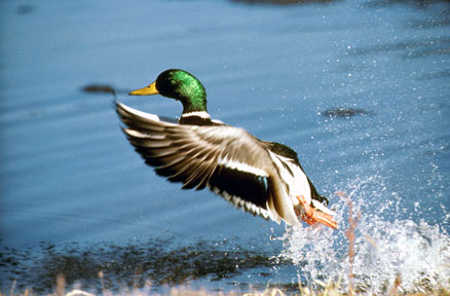
The California Department of Fish and Wildlife (CDFW) has completed its 2014 waterfowl breeding population survey.
The resulting data indicate the total number of breeding ducks (all species combined) remains similar to last year. The number of breeding mallards, however, has declined 20 percent compared to 2013.
The total number of breeding ducks is estimated at 448,750 compared to 451,300 last year. This estimate is 23 percent below the long-term average.
The estimated breeding population of mallards is 238,700, a decrease from 298,600 in 2013, which is below the long-term average.
CDFW attributes the decline to very low precipitation and poor habitat conditions. However, many other species increased in number this year.
“Habitat conditions were poor the last two years in both northeastern California and the Central Valley and the production of young ducks was reduced as a result, so a lower breeding population was expected in 2014,” said CDFW’s Waterfowl Program Biologist Melanie Weaver. “We would expect another low year of duck production from these two important areas in California in 2014. However, habitat conditions in northern breeding areas are reported to be better than average.”
CDFW has conducted this survey using fixed-wing aircraft since 1955. The California Waterfowl Association, under contract with CDFW, assists CDFW by surveying a portion of the transects using a helicopter.
The population estimates are for the surveyed areas only, although surveyed areas include the majority of the suitable duck nesting habitat in the state.
These areas include wetland and agricultural areas in northeastern California, the Central Valley from Red Bluff to Bakersfield, and the Suisun Marsh.
The majority of California’s wintering duck population originates from breeding areas surveyed by the U.S. Fish and Wildlife Service (USFWS) in Alaska and Canada, and these results should be available in July.
CDFW survey information, along with similar data from other Pacific Flyway states, is used by the USFWS and the Pacific Flyway Council when setting hunting regulations for the Pacific Flyway states, including California.
The federal regulation frameworks specify the outside dates, maximum season lengths and maximum bag limits.
Once CDFW receives the USFWS estimates and the frameworks for waterfowl hunting regulations from the USFWS, CDFW will make a recommendation to the Fish and Game Commission regarding this year’s waterfowl hunting regulations.
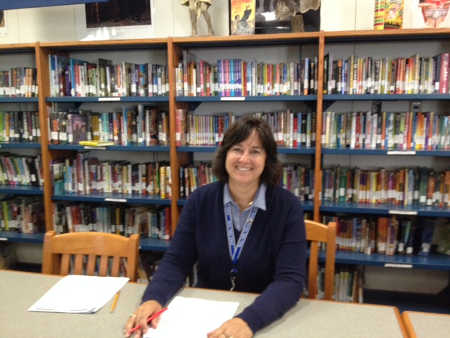
LAKE COUNTY, Calif. – Kathy Perkins, a first grade teacher at Burns Valley School in Konocti Unified School District, has been selected as the 2014-15 Lake County Teacher of the Year.
Tim Gill, senior director of educational services at Lake County Office of Education, said Perkins will represent Lake County in the upcoming California Teacher of the Year competition.
Perkins holds a bachelor of arts degree from California State University, Sonoma in liberal arts.
She has been teaching for 23 years, the past eight at Burns Valley where her current project is the Little Free Library.
The Little Library is home to books that can be taken home by children and families. The books can then be kept, returned or replaced by other books.
“Getting books into the hands of the children of our community is the key to the project,” Perkins said. “I feel good about being able to infuse literacy and reading into our community with this project.”
Chris Schoeneman, principal of Burns Valley School, said Perkins is an instrumental member of the Burns Valley School team.
“She approaches teaching with a student-centered mindset that focuses on each individual child and what they need to be successful in their learning. A constant professional, Mrs. Perkins strives to see achievement in both her classroom and in her school. It is with this perspective that she has become a grade-level, school-level, and district-level leader,” said Schoeneman.
He added, “Her compassion for the under-privileged, enthusiasm for exploring new ideas, calmness in the face of adversity, dedication to her craft, thoughtfulness of others, brilliance in her creativity and design, and great sense of humor are all gifts she brings to work every day. She puts others first and strives to see a better world abound for our students, staff members, families and our community.”
Each year the school districts in the county select one exemplary teacher as their District Teacher of the Year. A committee of community leaders then interviews these candidates.
The criteria for selection of the Lake County Teacher of the Year is based upon the state and national requirements, which include professional development activities, commitment to the improvement of the educational system, personal attributes, creativity and ability to communicate ideas effectively, and professional skills in delivering curriculum and instruction to students.
This year’s selection committee members were Pamela Bordisso, Tim Gill, Nyla Norris, Jo Bennett and the Lake County Teacher of the Year for 2013-14, Erica Boomer.
The outstanding District Teachers of the Year for 2014-15 are Karen Facey, Kelseyville Unified School District; Angel Hayenga, Upper Lake Union High School District; Kristen Hiatt, Lakeport Unified School District; Charlene Norwood, Upper Lake Union Elementary District; and Davina Pyzer, Middletown Unified School District.
Perkins and the District Teachers of the Year will be honored for their exceptional achievement at an event this fall.
For more information on the upcoming award ceremony, please contact Shelly Mascari at the Lake County Office of Education,
LAKE COUNTY, Calif. – The work of elections officials here in Lake County and around the state is continuing, as absentee and provisional ballot counting continues to take place.
On Friday, California Secretary of State Debra Bowen's office reported that approximately 926,069 ballots statewide remained to be counted following the close of polls in the statewide primary race on Tuesday.
In Lake County, approximately 6,053 ballots remain to be counted, the Secretary of State's Office reported.
The Secretary of State Office's report said that total includes 5,263 absentee or vote by mail ballots, and 743 provisional ballots, which voters use in cases where their names are not on polling place rosters due to clerical or other errors.
There also are 47 ballots in the “other” category, which includes damaged ballots that could not be machine read and need to be remade, and ballots diverted by optical scanners for further review, Bowen's office reported.
The Lake County Registrar of Voters Office confirmed to Lake County News on Friday that the 6,053 total was current, and that those ballots had come in after May 28. Absentee processing had begun on May 12.
That all ballots aren't counted on election day is the norm, according to Bowen.
“With the popularity of voting by mail and the ability voters have to cast a provisional ballot to ensure they are not disenfranchised, county elections officials' work continues for up to a month after election day,” Bowen said in a post-election statement. “Accuracy is the most important element in democracy.”
For context, in Lake County's June 2010 primary, there were 3,766 ballots – 3,081 absentees ballots, 148 votes cast on eSlate election machines and 537 provisionals – that remained uncounted after election night, the Lake County Registrar of Voters reported at that time.
In November 2010, 4,500 absentee ballots and 872 provisional ballots were still being counted after election day, election officials said.
Election officials processing absentee ballots must confirm each voter’s registration status, verify each voter’s signature on the vote-by-mail envelope, and ensure each person did not vote elsewhere in the same election, according to Bowen's report.
In the case of provisionals, Bowen said all voters who cast such ballots must be researched to ensure that they were registered and did not vote more than once.
As such, not all provisional ballots may end up being counted, which is the case in past local elections, when some have been disqualified.
For example, in November 2010, Lake County election officials reported receiving 764 provisionals but only counting 699 of them, while in November 2008 there were 649 provisionals issued and 521 counted, according to election records.
There also is the manual audit of ballots from 1 percent of the precincts in the county, which must be done to ensure the results are accurate. The Lake County Registrar of Voters will conduct its manual count on Tuesday, June 17.
Absentee voting has continued to grow and outnumber precinct voters in Lake County over the last several years.
That trend, along with the impact of 2011 redistricting – which Registrar of Voters Diane Fridley said in June 2012 resulted in about 1,000 voters being changed from precinct to absentee voting – can be included in the factors influencing the larger number of absentees reported in this week's election.
In previous interviews, Fridley – who currently is on medical leave, with Maria Valadez acting as interim registrar – told Lake County News that the ballot tally that continues after election day doesn't tend to change candidates' placement, although percentages become more accurate.
As a comparison, in the June 2010 primary, when it also was a three-way sheriff's race, initial results on election day had then-candidates Frank Rivero, Rod Mitchell and Jack Baxter with 4,297 votes (38.5 percent), 3,852 votes (34.5 percent) and 3,008 votes (27 percent), respectively.
When another 3,637 absentee and provisional ballots were added to the final tally, the numbers changed but there was little adjustment in percentage: Rivero, 5,682 votes (38.4 percent); Mitchell, 5,078 votes (34.3 percent); Jack Baxter, 4,024 votes (27.2 percent).
Bowen reported that county election officials have until July 4 to certify the final election results to her office.
She, in turn, has until July 11 to review the materials, resolve any reporting discrepancies and compile the 58 county reports for complete election results.
Email Elizabeth Larson at
LAKEPORT, Calif. – Two samples of Culex tarsalis mosquitoes collected in near Upper Lake this past Tuesday tested positive for West Nile virus, county officials reported.
“This is even earlier than last year, which set a record for the earliest West Nile virus activity in Lake County mosquitoes,” said Jamesina Scott, Ph.D., district manager and research director of the Lake County Vector Control District. “In 2013 we had 62 West Nile virus-positive mosquito samples from locations all over the county, and this looks like we’re going to have another early start to a long and busy West Nile virus season.”
In addition to the two mosquito samples, West Nile virus has been detected in three dead birds in Lake County in 2014.
Statewide, 13 California counties have detected West Nile virus this year, mainly in mosquitoes and dead birds. No human cases have been reported in California this year.
While fewer than one percent of individuals (about 1 in 150 people) infected with West Nile virus will develop severe illness from West Nile virus infection, the disease can cause symptoms that can last for several weeks, and neurologic effects can be permanent.
In some individuals, the infection can be fatal. People over age 50 and diabetics are at risk for the more severe forms of the disease.
“Since there is no West Nile Virus vaccine for humans, the best protection is to prevent mosquito bites,” says Lake County Health Officer, Dr. Karen Tait. “Taking precautions against mosquito bites is a habit that should be practiced consistently as long as mosquitoes are active.”
“Staying indoors during early morning and evening hours, keeping window screens in good repair, wearing protective clothing and use of insect repellents according to package instructions will help reduce your risk of catching the infection,” according to Dr. Tait.
“This weekend’s high temperatures are going to help push the virus along,” said Dr. Scott. “Both the mosquitoes and the virus thrive in warm temperatures.”
The mosquitoes that transmit WNV develop in out-of-service swimming pools and spas, animal watering troughs, ornamental ponds, and other sources of standing water.
The district has free mosquito-eating fish to control mosquitoes in these sources. Residents are encouraged to contact the district to report neglected pools, request service for mosquito problems, or to get mosquito fish at 707-263-4770 or to fill out a service request online at www.lcvcd.org .
The Lake County Vector Control District traps and tests mosquitoes throughout the county to identify the areas that have the highest risk, and targets those areas for source reduction and treatment using an integrated vector management program.
Residents with questions, or who would like help with a mosquito problem should contact the Lake County Vector Control District at 707-263-4770 or visit the district Web site at www.lcvcd.org .
For more information about West Nile virus, visit http://www.westnile.ca.gov/ .
Information about mosquito repellents can be found on the US Centers for Disease Control and Prevention Web site at http://www.cdc.gov/westnile/faq/repellent.html .

LAKEPORT, Calif. – Discounted presale ride wristbands for the Butler Amusements carnival at the Lake County Spring Fair are available now in the main office of the Lake County Fairgrounds.
The Lake County Spring Fair, now in its second year, takes place Friday, June 20, through Sunday, June 22, at the fairgrounds, 401 Martin St. in Lakeport.
Several spectacular rides that have never before visited Lake County will be included on the midway.
New to Lake County, the Freak Out seats 16 people who are secured by over-the-shoulder harnesses as their legs dangle from their seats.
Once the ride begins, the seats rotate at an increasing rate as the entire boom swings horizontally. Passengers swing out over the midway, directly over the heads of those watching from the ground.
The ride’s high point is reached as the boom reaches a height of over 40 feet, while the entire ride towers 70 feet above the ground.
Also new, the Raptor has the familiar look of a classic scrambler, but with an extra special kick that multiplies the fun and excitement.
Four arms are connected to seats in pods of three. Each pod of seats spin counterclockwise while the entire arm turns counterclockwise giving riders the feeling of being in the center of a crazy vortex. The Raptor has 18 seats and can hold 2 adults per seat.
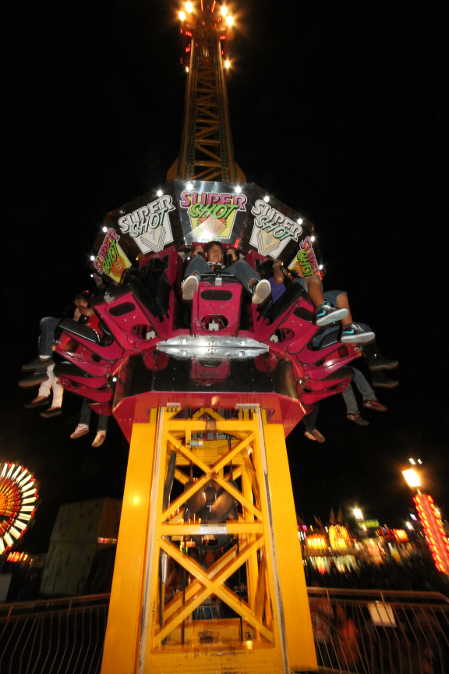
The world-class Super Shot Drop Tower is one of Butler Amusements’ most unique rides. Unlike any other ride on the midway, the Super Shot brings a new dimension of thrills to carnival visitors. 12 passengers are loaded into each circular passenger station.
Over-the-shoulder harnesses secure patrons while they are gently lifted up the 90 foot tower. Once the passenger station reaches the top, it is released in an accelerated free-fall and riders experience G-forces in excess of three and a half times normal gravity.
Riders are then cushioned by a magnetic braking system stopping the station before it reaches the base of the tower. The Super Shot has never before been on a Lake County midway.
Clear Lake High School student, Katlyn Thomasson, said she is most looking forward to riding the Freak Out and the Raptor, and that “the ride list looks awesome! I can’t wait for the rides to get here!” while Kelseyville High graduating senior Jeanie Johnson said “the Ring-O-Fire and the Super Shot are my favorites!”
While the new spectacular rides are geared towards adult and teen thrill seekers, the carnival will include a variety of rides for the younger set as well.
A beautiful, handcrafted, 28 foot Americana-themed carousel featuring 24 jumping horses and two chariots will provide gentle fun for parents and children to create memories while they enjoy the sights and sounds of the Lake County Spring Fair.
A Looney Tooter cartoon-themed train, a teacup ride, a lollipop swing, and dune-buggy themed Jump-Around will join the carousel.
Additional rides that will appeal to the tweens in the crowd include a Ring-O-Fire ride named the Fire Ball, a Tilt-A-Whirl, a Graviton and a Voyager virtual reality ride. A variety of other rides, games and food selections will round out the carnival.
One day unlimited ride wristbands cost $20 each prior to the Lake County Spring Fair, a savings of $5 from the cost of each ticket.
Discounted presale ride wristbands are available now in the main office of the Lake County Fairgrounds.
The main office is open Monday through Friday, 8 a.m. until noon and 1 to 5 p.m.
More information can be obtained at www.lakecountyfair.com or by calling 707-263-6181.
All regular admission tickets are $5 each for those age six and over, and can be purchased in advance as well.
The Spring Fair also will feature motorized grandstand shows each evening, two stages of musical entertainment, a car show on Saturday and Sunday, vocational education project displays, a laser tag emporium, and a variety of fair food and other commercial displays.
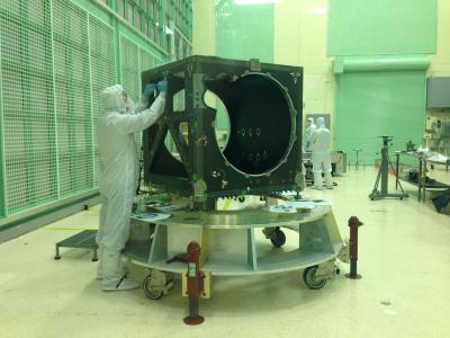
To build a satellite that will measure all the bumps and dips of our dynamic Earth, engineers started with a black box, built of a composite honeycomb material to make it as light as possible.
The structure was precisely manufactured with an opening to allow lasers to beam to Earth, and other windows sized for a telescope that will capture photons that bounce off our planet and return to the satellite.
The box was measured and marked to denote where the assembly of aligned mirrors, electronics, lasers and photon detectors would be attached.
It must be tough enough to handle the rigors of a rocket launch and years in a harsh space environment; here on Earth, the box structure must be hardy enough to withstand tests engineers use to simulate those conditions.
The box structure at the core of the Ice, Cloud and land Elevation Satellite-2, or ICESat-2, instrument was delivered to a clean room at NASA's Goddard Space Flight Center in Greenbelt, Maryland, in May.
A team of 250 engineers, fabricators and scientists has now started the official integration and testing stage of the laser instrument.
“There's lots of activity, we're moving from looking at all the different subsystems, to looking at the overall system coming together. It's really exciting to move forward into that realm,” said Cathy Richardson, instrument manager with the ICESat-2 mission.
The team will have a half-dozen components ready for delivery in June. “It's not just a drawing. It's an actual, real piece of hardware, that's getting tested and showing that it's meeting requirements.”
ATLAS assembly
ICESat-2's instrument, called the Advanced Topographic Laser Altimeter System, or ATLAS, will measure the elevation of Earth's surfaces, from ice sheets to forests to oceans.
Its six beams will generate a more detailed elevation portrait than single beam of original ICESat, which flew from 2003 to 2009.
And with the beams paired, scientists will be able to measure surface slope and better calculate height changes.
To measure elevation, ATLAS beams light with a green laser that pulses 10,000 times a second. Only a few photons will bounce off the surface and return to the satellite, but an incredibly sensitive detector counts those that do come back.
Using the time of the photons' return trip, the speed of light and some geometry, scientists can determine the distance the photons traveled and, therefore, the height of Earth below the satellite's orbit.
ATLAS will provide scientists with measurements that create a global portrait of Earth's elevation, and will gather data that can precisely track change, including melting glaciers and thinning sea ice.
“ICESat-2 will revolutionize our understanding of ice sheet and sea ice changes and processes,” said Thorsten Markus, ICESat-2 project scientist. “I think it's one of the most exciting missions out there. There's so much opportunity for real discoveries.”
The satellite will observe Earth in a new way, he said, which makes it technically challenging. But this also opens the door for discoveries not yet imagined.
After years of calculations and computer models and discussions, Markus said, it's exciting to see the hardware come together.
In addition to the box structure – the body of the satellite – the ATLAS team has also built the instrument's optical bench.
The bench is a rectangular platform on which the lasers, mirrors, fiber optic cables, a star-tracker and more will be attached precisely into place. The precision is key – there's little leeway for photons to go astray.
“Our whole job on the optical bench is to align everything – it's critical,” said Carol Lilly, Integration and Testing Lead for ATLAS at Goddard.
Before even leaving the instrument, the green laser bounces off a number of mirrors and is split into six beams.
When they return to the satellite's telescope, those photons have to bounce off mirrors and hit optical fibers less than one-one hundredth of an inch (half-millimeter in diameter) – or else they aren't counted.
“If any of the optics move too much and we can't stay aligned, the science measurements can't be made,” Richardson said. Teams will work on ATLAS's box structure and its optical bench simultaneously, to increase efficiency.
Still, the real key to building a satellite, Lilly noted, is to assemble a team of talented engineers and technicians.
“The people here doing the work are really experts in what they do and are really talented,” she said. “It wouldn't work nearly as well as it does around here if we didn't have these expert technicians doing the job.”
Putting it to the test
Each instrument component is put through environmental testing before it's delivered to the ATLAS clean room at Goddard, so that if something doesn't pass one of the tests it can be fixed.
“You test as you fly,” Lilly said. To simulate launch conditions, a vibration chamber will shake the components while a separate test will blast them with sound.
To simulate space, the components will be subjected to temperature extremes in Goddard's thermal vacuum chambers and to electromagnetic interference.
The box structure and optical bench were put through their own testing in April. The ATLAS team outfitted the structures with weights to simulate the mass of the components and then tested their response to hot and cold temperatures.
They ended with an extended hot period called a “bake-out” to burn off potentially contaminating chemicals in the adhesives.
During the vibration test, the crew carefully lowered the joined box and bench onto a shaker table and bolted it in place. They jolted it in several directions, monitoring any damage with a tangle of red wires affixed to certain points.
When the testing was complete, the crew taped up exposed or sharp areas, so that the harness and other components wouldn't catch. They hooked up several small heaters, which will keep ATLAS at a constant temperature, and installed posts where wires and cables and more will attach.
Engineers are assembling and testing other components in buildings across the Goddard campus. In March, the 2.6-foot (0.8-meter), 46-pound (20.8 kilograms) telescope arrived. The telescope captures the photons returning from Earth and focuses them on the fibers that lead to the detector.
It's made of beryllium, a light material that minimally expands or contracts in the changing temperatures ATLAS will experience in orbit.
With testing equipment such as lasers and mirrors, engineers will check the telescope's focus, the size of the spots photons focus on, and other optical properties.
After testing it at room temperature, the team will move the telescope assembly to a thermal vacuum chamber, where they will fire a laser and test the telescope at temperature extremes – from minus 22 to 122 F (minus 30 to 50 C).
“It has to work at all temperatures,” said Bente Eegholm, ATLAS's receiver telescope assembly lead.
The telescope and most of the other components will be delivered to the clean room this fall, Richardson said; the lasers themselves will come later. And by November 2016, the team is scheduled to have ATLAS completed and tested, ready to ship to Orbital Science Corp. in Arizona.
There, ATLAS will be attached to the spacecraft bus, and the entire ICESat-2 will be shipped to Vandenberg Air Force Base in California for launch.