 How to resolve AdBlock issue?
News
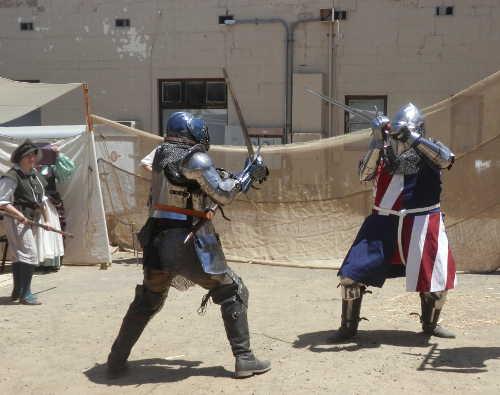
LOWER LAKE, Calif. – Medieval mayhem and merriment were in evidence at Tuscan Village, home of Terrill Cellar Winery, in Lower Lake during the sixth annual Lake Renaissance Festival.
Sword-fighting knights clad in full armor, fair maidens dressed to the nines, barbarians with maces, prisoners in shackles, scalawags, peasants and noblemen converged on the village for two days of artistic fun.
The Memorial Weekend event featured stories of old, costumed actors engaging with guests, time tradition music, magic and medieval contests of strength and humorous and historical performances.
Lake Renaissance Festival Founder Tom Wilsey said the event is more than just fun.
“We are teaching history and history is important. These are great stories that actually happened,” he said. “Hopefully, we can give (our guests) a taste of history, culture and fun.”
Wilsey said history was abundant at every turn and performances were spectacular, especially the duals, which he said included the participation of a swordsman who earned a gold medal for the US Team in Spain.
Throughout the quaint village, artisans peddled wares from hand-tooled leather masks and warrior gear to decorative gourds, healing stones, jewelry and renaissance attire.
Hungry guests feasted on sausage and sauerkraut, steamed artichokes and turkey legs big enough to satisfy the most barbaric of appetites.
To quench the thirst, Jose Rodriguez, a beekeeper from Willows, offered chilled cups of mead, which is wine made from fermented honey instead of grapes.
“Many scholars believe that mead is the ancestor of all fermented drinks, predating event the cultivation of soil,” he said, adding that its history dates back about 30,000 years. “It may have been accidentally discovered when old tree stumps serving as homes for bees were flooded during the rains and the fermentation process took place naturally.”
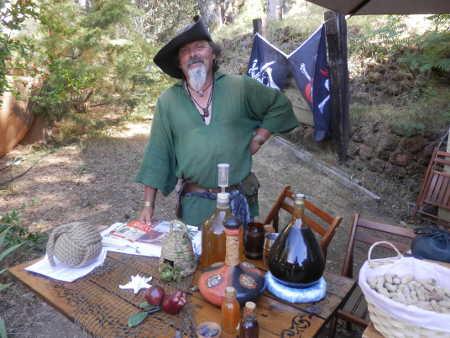
Rodriguez said, according to legend, the term “honeymoon” comes from the ancient tradition of drinking mead for a full cycle of the moon.
“Due to belief in its magical and health generating properties, the newly married couple were to drink mead for the first month of their marriage to ensure that the union would be a fruitful one,” he said.
Rodriguez said he has been participating in renaissance festivals for about four years; however, his participation at the event in Lower Lake was his first as a vendor.
“Tuscan Village is ideally suited for the renaissance festival. I like the smaller faires. The bigger faires are too commercial,” he said.
Brad Terrill, venue and winery owner, opened his cellar to guests for wine tasting as well.
He said he appreciates the opportunity to welcome the renaissance festival and envisions Tuscan Village as a place to stimulate art and culture in Lake County.
Wilsey and his wife, Lisa, who coordinates events at Tuscan Village, said the venue will host the Black Magick Metal Fest July 5 and 6. The event will feature a selection of local and Northern California underground metal bands.
Also planned is a harvest/reggae festival in October.
Email Denise Rockenstein at

LAKE COUNTY, Calif. – With Lake County's famous clean air, as certified by the State's Air Resource Board, and our location, location, location nestled between the coast and Central Valley, it's rare for us to see coastal or valley fog.
However, if you are lucky, you may experience the dramatic “bridal fog” which spills over the top of Mount St. Helena from time to time.
Situated in all of this clean air, we do, however, get to observe a wide variety of cloud formations.
Observing clouds can become habit-forming, and is an enjoyable form of weather-watching.
Within each layer of our atmosphere you can often “read” what is going on above you.
Think of clouds as aerial weather labs, as translating the clouds is frequently used to predict weather.
Meteorologists watch altostratus clouds in the middle-altitude for one form of weather, the higher cirrus clouds for another, and in the lower levels of the altitude they may watch cumulus clouds.
Although people have been watching clouds since ancient times, clouds weren't classified scientifically until the 1800s when the French naturalist Chevalier de Lamarck wrote up a cloud-types publication, and simultaneously Englishman, Luke Howard, who was a chemist, wrote an essay on clouds for a literary club called, “On the Modification of Clouds.”

Today forecasters separate Luke Howard's cloud categories into two main groups: clouds that are “heaped” which cause unstable air currents, and clouds that are “layered.” Layered clouds originate in stable air.
If you have a desire to become a connoisseur of clouds, you may delight in the sheer variety that can be distinguished from the fluffy-looking white stuff.
In the lexicon of clouds you can delight in cloud varieties, species and even what Audubon's “Field Guide to Weather” calls “accessory clouds.”
Then you can toss around cloud lingo such as, fibratus (clouds which appear almost straight or have curved filaments like cirrus clouds), nebulous (clouds without pronounced features), fractus (those clouds that appear shredded) or opacus ( a sheet of cloud that may hide the moon or even the sun). There are dozens of delightful words to depict clouds!
“The air up there in the clouds is very pure and fine, bracing and delicious. And why shouldn't it be? – it is the same the angels breathe.” – Mark Twain, from “Roughing It.”
Kathleen Scavone, M.A., is an educator, potter, writer and author of “Anderson Marsh State Historic Park: A Walking History, Prehistory, Flora, and Fauna Tour of a California State Park” and “Native Americans of Lake County.” She also writes for NASA and JPL as one of their “Solar System Ambassadors.” She was selected “Lake County Teacher of the Year, 1998-99” by the Lake County Office of Education, and chosen as one of 10 state finalists the same year by the California Department of Education.
LAKE COUNTY, Calif. – With the county's weather conditions becoming increasingly dry and set to hit the century mark, the National Weather Service in Sacramento issued a red flag warning on Saturday evening that is to extend through the beginning of the week.
The warning, which lasts until 5 p.m. Monday, is due to low humidity, breezy north winds and high temperatures.
A red flag warning means that critical fire weather conditions are either occurring or will occur shortly, and could contribute to extreme fire behavior.
The National Weather Service said hot and very dry conditions are forecast to continue over interior Northern California during the next several days.
High pressure is moving into the area, which will increase north to east winds for parts of the region through Monday. Forecasters said winds are expected to be from 7 to 15 miles per hour, with gusts up to 25 miles per hours in some areas.
Poor overnight humidity recovery in the range of 25 to 40 percent is expected to cause daytime humidity to drop as low as 5 to 15 percent, the National Weather Service reported.
The forecast calls for a slight cooling trend to begin on Tuesday and, with it, improving humidity recoveries.
The National Weather Service's forecast shows that temperatures around the lake are expected to top 100 degrees on Sunday and Monday, backing down into the high 90s on Tuesday and low 90s on Wednesday, and high 80s for the rest of the week.
Email Elizabeth Larson at
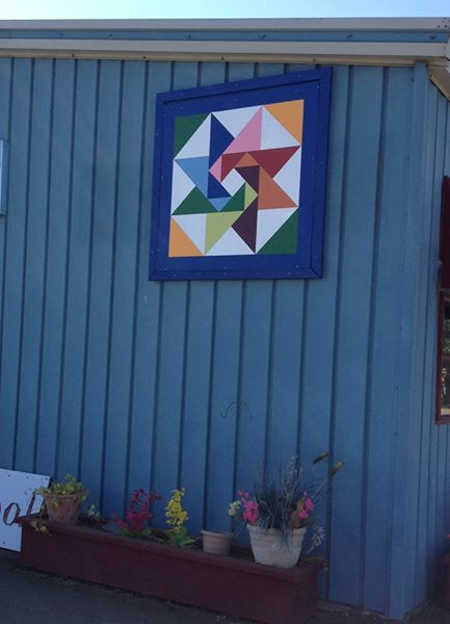
KELSEYVILLE, Calif. – The 52nd quilt block to be installed on the Lake County Quilt Trail is located on Kelseyville Appliance at 3532 N. Main St.
The 4-foot by 4-foot quilt is called “Spin Cycle,” which is very appropriate for this Kelseyville business.
Mary and Dave Morse have owned Kelseyville Appliance for more than 20 years. They are members of Kelseyville Business Association, with Mary serving as president of the association for many terms.
The Morses are instrumental in the success of Kelseyville’s Christmas in the Country, and every year you may find them decorating up and down Main Street.
Dave and Mary Morse are an integral part of Kelseyville’s slogan, “A Friendly Country Town.”
The Lake County Quilt Trail is an agricultural and tourism project designed to promote community pride.
The quilt block was drawn and painted by the Lake County Quilt Trail team, a group of dedicated quilters, graphic artists, painters, writers, carpenters and a videographer.
For more information about the Lake County Quilt Trail visit www.lakecountyquilttrail.com or go to https://www.facebook.com/pages/Lake-County-Quilt-Trail/187014251326163 .
LAKE COUNTY, Calif. – Several large dogs are available for adoption at Lake County Animal Care and Control this week.
The dogs are mixes of Labrador Retriever, pit bull, beagle, hound and Shar Pei, and range in age from 11 weeks to 6 years.
Dogs that are adopted from Lake County Animal Care and Control are either neutered or spayed, microchipped and, if old enough, given a rabies shot and county license before being released to their new owner. License fees do not apply to residents of the cities of Lakeport or Clearlake.
If you're looking for a new companion, visit the shelter. There are many great pets hoping you'll choose them.
In addition to the animals featured here, all adoptable animals in Lake County can be seen here: http://bit.ly/Z6xHMb .
The following dogs at the Lake County Animal Care and Control shelter have been cleared for adoption (additional dogs on the animal control Web site not listed are still “on hold”).

'Clark'
“Clark” is a 4-month-old male hound-Shar Pei mix puppy.
He has a short chocolate-colored coat and has been neutered.
Find him in kennel No. 15, ID No. 39407.
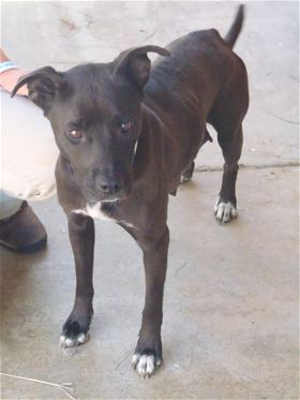
'Sasha'
“Sasha” is a 2-year-old female pit bull terrier mix.
She has a short black and brown coat, weighs 43 pounds and has not been spayed.
She's in kennel No. 24, ID No. 39914.
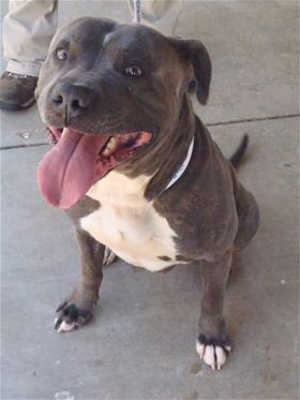
'Blue'
“Blue” is a 2-year-old male pit bull terrier mix.
He has a medium-length blue coat, weighs 73 pounds and has not been neutered.
Find him in kennel No. 28, ID No. 39852.
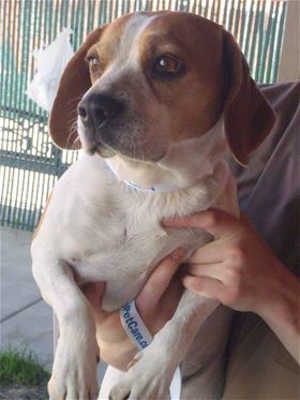
Female beagle mix
This female beagle mix is 6 years old.
She has a short white and brown coat, weighs 32 pounds and has been spayed.
She's in kennel No. 30, ID No. 39493.
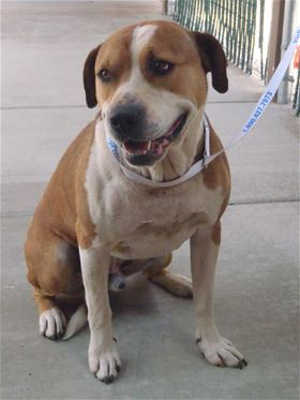
'Rusty'
“Rusty” is a 4-year-old male hound mix.
He has a short tricolor coat, weighs 72 pounds and has been neutered.
Shelter staff said he is very mellow with great manners, and would make a great family pet with no cats.
He is heartworm positive but this is treatable; please contact the shelter with any questions.
He's in kennel No. 31, ID No. 39789.

Pit bull terrier mix puppy
This male pit bull terrier mix puppy is 11 weeks old.
He has a short brown brindle and white coat, weighs 10 pounds and has not been neutered.
He's in kennel No. 32a, ID No. 39792.
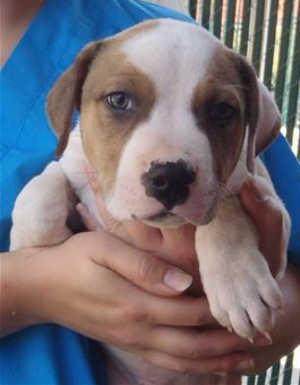
Pit bull terrier mix puppy
This male pit bull terrier mix puppy is 11 weeks old.
He has a short tan and white coat, weighs 12 pounds and has not been neutered.
Find him in kennel No. 32b, ID No. 39793.
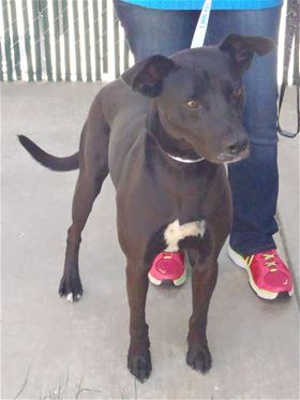
'Cricket'
“Cricket” is a 4-year-old female Labrador Retriever-shepherd mix.
She has a short black and white coat, weighs 55 pounds and has been spayed.
She's in kennel No. 34, ID No. 39720.
To fill out an adoption application online visit http://www.co.lake.ca.us/Government/Directory/Animal_Care_And_Control/Adopt/Dog___Cat_Adoption_Application.htm .
Lake County Animal Care and Control is located at 4949 Helbush in Lakeport, next to the Hill Road Correctional Facility.
Office hours are Monday through Friday, 8 a.m. to 5 p.m., and 1 p.m. to 3 p.m., Saturday. The shelter is open from 10:30 a.m. to 4:30 p.m. Monday through Friday and on Saturday from 1 p.m. to 3 p.m.
Visit the shelter online at http://www.co.lake.ca.us/Government/Directory/Animal_Care_And_Control.htm .
For more information call Lake County Animal Care and Control at 707-263-0278.
Email Elizabeth Larson at
A spacecraft from Earth is about to do something no spacecraft has ever done before: orbit a comet and land on its surface.
Right now, the European Space Agency's Rosetta probe is hurtling toward Comet 67P/Churyumov-Gerasimenko.
A ScienceCast on the comet can be seen here: https://www.youtube.com/watch?v=4x-u3v_CTcM&;feature=youtu.be .
The spacecraft's mission is to study the comet at close-range as it transforms from a quiet nugget of ice and rock, frozen solid by years spent in deep space, to a sun-warmed dynamo spewing jets of gas and dust into a magnificently evolving tail.
“Comet 67P is coming alive,” said Claudia Alexander, project scientist for the U.S. Rosetta Project at JPL. “And it is even more active than I expected.”
Launched in 2004, Rosetta has spent the past few years in hibernation as it chased the comet across the Solar System. In January of 2014, with its destination in sight, Rosetta woke up and turned on its cameras.
At first, the comet looked like a dimensionless pinprick, inactive except for its quiet motion through space. Then, on May 4 a bright cloud appeared around the nucleus.
“It's beginning to look like a real comet,” said Holger Sierks of the Max Planck Institute for Solar System Research in Germany where Rosetta's OSIRIS science camera was built.
“It is hard to believe,” he said, “that only a few months from now, Rosetta will be deep inside this cloud of dust and en route to the origin of the comet’s activity.”
Spacecraft from NASA, ESA and other space agencies have flown by comets before. A whole armada of spacecraft visited Comet Halley in the mid-1980s, an international event which still serves as a touchstone of comet research.
Other notable examples include NASA's Stardust mission, which flew through the tail of Comet Wild in 2004 and returned the samples to Earth two years later; and the Deep Impact spacecraft, which in 2005 dropped a projectile into Comet 9P/Tempel, blowing a hole in its nucleus so that researchers could look inside.
Flybys are informative, but Rosetta will do much more.
“A flyby is just a tantalizing glimpse of a comet at one stage in its evolution,” pointed out Alexander. “Rosetta is different. It will orbit 67P for 17 months. We'll see this comet evolve right before our eyes as we accompany it toward the sun and back out again.”
The most exciting moment of the mission will likely come in November when a European-built lander descends from the spacecraft and touches down on the comet's surface. The lander’s name is “Philae” after an island in the Nile, the site of an obelisk that helped decipher – you guessed it – the Rosetta Stone.
Because a comet has little gravity, the lander will anchor itself with harpoons. “The feet may drill into something crunchy like permafrost, or maybe into something rock solid,” Alexander speculated.
Once it is fastened, the lander will commence an unprecedented first-hand study of a comet’s nucleus while Rosetta continues to monitor developments overhead.
Although Rosetta is a European mission, NASA has contributed some important instruments to the spacecraft, and US scientists are just as eager as their European counterparts for Rosetta to arrive.
The recent photos have helped mission controllers pinpoint 67P and start a series of maneuvers that will slowly bring the spacecraft in line with the comet in time for an August rendezvous.
“Our target is ahead,” said Alexander, “and Rosetta is chasing it down!”
Dr. Tony Phillips works for the National Aeronautics and Space Administration.