 How to resolve AdBlock issue?
News
High above Earth, more than 20 miles above sea level, a diaphanous layer of ozone surrounds our planet, absorbing energetic UV rays from the sun.
It is, essentially, sunscreen for planet Earth. Without the ozone layer, we would be bathed in dangerous radiation on a daily basis, with side effects ranging from cataracts to cancer.
People were understandably alarmed, then, in the 1980s when scientists noticed that manmade chemicals in the atmosphere were destroying this layer.
Governments quickly enacted an international treaty, called the Montreal Protocol, to ban ozone-destroying gases such as CFCs then found in aerosol cans and air conditioners.
On Sept. 16, 1987, the first 24 nations signed the treaty; 173 more have signed on in the years since.
Fast forward 27 years. Ozone-depleting chemicals have declined and the ozone hole appears to be on the mend. The United Nations has called the Montreal Protocol “the most successful treaty in UN history.” Yet, despite Montreal's success, something is not … quite … right.
A new study by NASA researchers shows that a key ozone-depleting compound named carbon tetrachloride (CCl4) is surprisingly abundant in the ozone layer.
“We are not supposed to be seeing this at all,” said NASA atmospheric scientist Qing Liang.
Between 2007 and 2012, countries around the world reported zero emissions of CCl4, yet measurements by satellites, weather balloons, aircraft, and surface-based sensors tell a different story.
A study led by Liang shows worldwide emissions of CCl4 average 39 kilotons per year, approximately 30 percent of peak emissions prior to the international treaty going into effect.
In the 1980s, chlorofluorocarbons became well-known to the general public. As the ozone hole widened, “CFC” became a household word. Fewer people, however, have heard of CCl4, once used in applications such as dry cleaning and fire-extinguishers.
“Nevertheless,” says Liang, “CCl4 is a major ozone-depleting substance. It is the 3rd most important anthropogenic ozone-depleting compound behind CFC-11 and CFC-12.”
Levels of CCl4 have been declining since the Montreal Protocol was signed, just not as rapidly as expected. With zero emissions, abundances should have dropped by 4% per year. Instead, the decline has been closer to 1 percent per year.
To investigate the discrepancy, Liang and colleagues took CCl4 data gathered by NOAA and NASA and plugged it into a NASA computer program, the 3-D GEOS Chemistry Climate Model.
This sophisticated program takes into account the way CCl4 is broken apart by solar radiation in the stratosphere as well as how the compound can be absorbed and degraded by contact with soil and ocean waters. Model simulations pointed to an unidentified ongoing current source of CCl4.
“It is now apparent there are either unidentified industrial leakages, large emissions from contaminated sites, or unknown CCl4 sources,” said Liang.
Another possibility is that the chemistry of CCl4 might not be fully understood. Tellingly, the model showed that CCl4 is lingering in the atmosphere 40 percent longer than previously thought.
“Is there something about the physical CCl4 loss process that we don't understand?” she wondered.
It all adds up to a mystery in the ozone layer.
Liang's research was published online in the Aug. 18 issue of Geophysical Research Letters.
Dr. Tony Phillips works for the National Aeronautics and Space Administration.
CLEARLAKE, Calif. – The Konocti County Water District said it is remedying a strong smell in the water it's supplying to its customers.
“We’re having some odor issues in our distribution system,” General Manager Frank Costner said Friday.
The district serves an estimated 4,300 customers in Clearlake.
Some of those customers in recent days have described water that both tastes and smells bad. Costner said the district has been getting a lot of calls as a result.
Costner explained that the lake has “turned over” in the area where the district's intake is located at Mike Thompson Harbor at Redbud Park.
Dying and decaying algae around the intake has caused “a really bad odor,” he said.
Some of that odor, Costner said, made it through the district's treatment process.
“We’ve gotten a handle on it now,” he said, adding that the odor issue should be clearing up within the next few days.
Costner said that the water still meets all primary drinking water standards.
Earlier this summer, the district was facing serious concerns about water supply and was struggling to keep up with demand, as Lake County News has reported.
However, Costner said the district is not in emergency mode at this time.
“We're doing well,” with lots of water in the district's storage tanks and the district now able to keep up with customer demand, he said.
Costner said the district is still planning to implement a water conservation plan at some point in the near future.
Email Elizabeth Larson at
UPPER LAKE, Calif. – After a two-day effort, firefighters brought the Saratoga Fire to full containment on Friday.
The fire burned a total of 100 acres since it began at around 4 p.m. Wednesday on Highway 20 near Saratoga Springs Road, west of Upper Lake, according to a Friday evening report from Cal Fire.
A vehicle crash sparked the fire, which went on to burn one nearby home along Highway 20.
The vehicle's driver, 52-year-old Shellie Denise Boulais of Jackson, was arrested for misdemeanor driving under the influence.
Boulais remained in custody on Friday, with bail set at $30,000, according to Lake County Jail records.
In addition to Cal Fire, a multiagency response that included Lakeport Fire, Northshore Fire and the US Forest Service was engaged in the incident.
Email Elizabeth Larson at
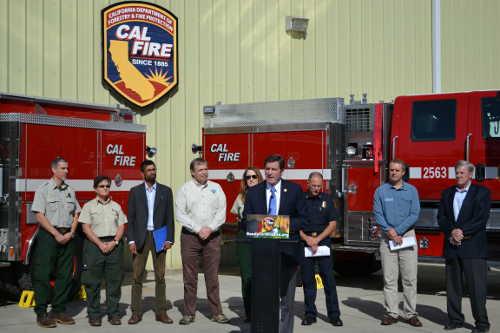
NORTHERN CALIFORNIA – With federal resources set aside for combating wildfires rapidly depleting, the federal government will soon be forced to divert funds that are currently reserved for wildfire prevention, like dry brush removal and controlled burns, making future extreme wildfires more likely.
On Friday, Congressman John Garamendi (D-Fairfield), the former deputy secretary of the U.S. Interior Department under President Bill Clinton, was joined by federal and state agencies combating wildfires and conservation groups at a press conference at a Cal Fire facility in Davis to sound the alarm and to urge immediate action to rectify this dangerous situation.
Over the last 12 years, the U.S. Forest Service has had to transfer $3.2 billion from other accounts to pay for active fire suppression. In 2013 alone, they had to transfer $505 million, and critical projects were cancelled as a result.
Federal depletion of funds directly impacts state-managed lands, as wildfires can quickly spread between jurisdictions.
This year, California has experienced 4,503 wildfires, burning nearly 700,000 acres of land.
On Friday, there were eight active fires in California, including the Saratoga Fire in Lake County, which is in Garamendi's Third Congressional District.
The risk of wildfires is exacerbated by climate change and droughts, making the fire season last 60 to 80 days longer than it did in the 1980s
“We find ourselves in a vicious cycle,” Congressman Garamendi said. “When we run out of money to fight wildfires, and that happens frequently, we dip into the very funds that help prevent wildfires. We ultimately spend a lot more money combating disasters than we would have if we prevented those disasters from ever occurring. An ounce of prevention is worth a pound of cure. There’s bipartisan support to end this foolishness. All we need is an opportunity for a vote.”
“An emergency or reserve fund, similar to what California utilizes to address the extraordinary costs of wildland firefighting, is important so that emergency firefighting costs in federal responsibility areas do not impact the federal funds budgeted for forest health, vegetation management and fire prevention program activities,” said Chief Ken Pimlott, Cal Fire director.
The Wildfire Disaster Funding Act of 2014
In July, Congressman Garamendi and 195 Democratic Members of Congress signed onto a discharge petition that would force consideration of H.R. 3992, the bipartisan Wildfire Disaster Funding Act of 2014. If 218 voting Members of Congress sign a discharge petition, the bill is automatically brought to the House Floor for a vote.
H.R. 3992 has 60 Republican and 71 Democratic cosponsors and calls for a $2.7 billion fund each year for seven years to be set aside as a cash reserve that the Forest Service and Interior Department could turn to once their own firefighting allotments ran out.
The bill also treats the worst one percent of wildfires as natural disasters, like earthquakes or hurricanes, freeing up emergency resources for suppression to help prevent the need to raid fire prevention funds.
This legislation has been stalled in committee, with the Majority Leadership unwilling to bring it to a vote on the House floor.
The administration’s solution
At the press conference, officials from the U.S. Forest Service and Bureau of Land Management underscored the importance of the National Cohesive Wildland Fire Management Strategy and the President’s Fiscal Year 2015 budget proposal to change how fire suppression costs are budgeted to treat extreme fire seasons the way other emergency disasters are treated.
“We appreciate the opportunity to get together with our interagency cooperators and the Congressman to talk about the critical issue of wildfire in California and across the nation,” said Jeanne Wade Evans, deputy regional forester at the U.S. Forest Service.
“We are confronting a new chapter in wildland fire management, requiring a cooperative, integrated approach to restore and maintain healthy landscapes, prepare communities for fire season, and better address the nation's wildland fire threat,” said Jim Kenna, Bureau of Land Management California state director.
Concerns of conservationists
When wildfires are made more likely, homes and businesses are needlessly put at risk, natural habitats are pointlessly destroyed, wildlife is needlessly killed and displaced, air and water quality are harmed, and recreational opportunities in the wild are ruined.
“We applaud Congressman Garamendi and his fellow congressional members on their efforts to address one of the biggest, most dangerous problems facing the West,” said David Bischel, president of the California Forestry Association. “We can no longer continue to chase forest fires. It is not sustainable for our forests, watersheds, air quality, and wildlife. Large wildfires have put unnatural stress on our ecosystems, but with proper funding future damage can be mitigated with preventive treatments.”
“Passing the bipartisan Wildfire Disaster Funding Act is one of the smartest actions members of Congress can take this year to help our national parks and federal public lands,” said Neal Desai, Pacific Region field director of the National Parks Conservation Association. “We thank Congressman Garamendi for his commitment to solving real problems facing our nation’s beloved national parks.”
“Research shows forest management restores the forests that support our lives and livelihoods. We need to invest in science-based restoration actions – including selective thinning and controlled burning,” said Ed Smith, forest ecologist for The Nature Conservancy of California. “This proactive restoration work is much safer and less costly than fighting fires reactively, and saves lives and property and benefits nature.”
Parents and children each have expectations of one another. Unfortunately, life does not always meet expectations and may lead to parents and children becoming estranged from each other.
Estrangement often leads to the unhappy parent disinheriting their estranged child(ren). Why do these unfortunate situations come to pass? What usually happens? What alternatives are there?
I have seen many different scenarios, but some are more common than others.
The most common grievances parents have with their estranged child’s behavior relate to the following: (1) drug or alcohol addiction; (2) failure to become self-sufficient and using the parent’s resources; (3) problems related the child’s spouse; (4) illegal lifestyles; (5) verbal and/or physical abuse; and (6) cessation of communications which denies parents any relationship with grandchildren.
I have seen how these problems greatly upset and trouble the parents to the point where they decide that they should disinherit their child.
What happens then?
When the parent dies, any children who are not disinherited will have to deal with the grievances and trouble created by the disinherited child, who may feel cheated and bitter towards the other children who inherit what would have been his/her share of the estate.
Depending on whether or not these included children wish to preserve any relationship with the excluded child, they may chose to share some portion of what they receive to make peace.
Alternatively, the disinherited child may bring a will or trust court action to invalidate the parent’s estate plan, with the hope of receiving an intestate share equal to the other children’s shares.
The court action will upset other children, particularly any child who is in charge of administering the estate. It will also diminish how much is left to distribute.
Sometimes the parents and the children reconcile, which may take place at the end of life.
For example, a client’s daughter ended her drug addiction, got her life together and became a loving and useful daughter again. Her parents once again included her in their wills.
More often, it seems, the parents and children remain apart and do not reconcile.
Sometimes, the children will feel remorse after the parent’s death and regret the years of estrangement. This may be more likely when the estrangement was simply because the parent and child drifted apart from each other and were not actually hostile towards one another.
What alternative to completely disinheriting the child are open to the unhappy parent?
Until such time as when (if ever) the parent and child are reconciled, the parent may consider the following estate planning alternatives regarding the estranged child: (1) leaving the child a reduced inheritance; (2) leaving the child an inheritance in further trust with stipulations that encourage and motivate the child to reform his/her behavior; (3) leaving some or all of the child’s inheritance to that child’s own children (who may themselves be the objects of neglect or abuse).
The first option, leaving the child a reduced inheritance, recognizes the child as once having been a part of the parent’s life. It also provides an incentive to the child not to contest the will or trust.
The second option, leaving the child’s inheritance in further trust, will help prevent the inheritance from being squandered or abused, further enabling the child’s problematic behaviors.
The third option, leaving some or all the inheritance to the grandchildren, recognizes that the grandchildren are not to blame for their parent’s choices and behavior. It prevents inadvertent punishment of the grandchildren by allowing them to be recognized in the estate while bypassing the individual who was intended to be disinherited.
Each option has its place in estate planning and can be further explored with a qualified estate planner.
Dennis A. Fordham, attorney (LL.M. tax studies), is a State Bar Certified Specialist in Estate Planning, Probate and Trust Law. His office is at 870 S. Main St., Lakeport, California. Fordham can be reached by e-mail at
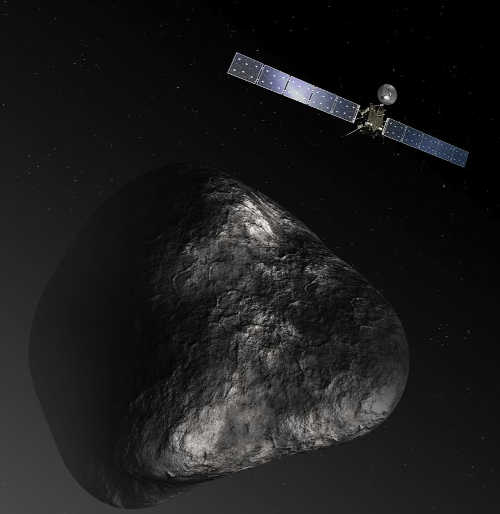
A NASA instrument aboard the European Space Agency’s (ESA's) Rosetta orbiter has successfully made its first delivery of science data from comet 67P/Churyumov-Gerasimenko.
The instrument, named Alice, began mapping the comet’s surface last month, recording the first far-ultraviolet light spectra of the comet’s surface.
From the data, the Alice team discovered the comet is unusually dark – darker than charcoal-black – when viewed in ultraviolet wavelengths. Alice also detected both hydrogen and oxygen in the comet’s coma, or atmosphere.
Rosetta scientists also discovered the comet’s surface so far shows no large water-ice patches. The team expected to see ice patches on the comet’s surface because it is too far away for the sun’s warmth to turn its water into vapor.
“We’re a bit surprised at just how unreflective the comet’s surface is and how little evidence of exposed water-ice it shows,” said Alan Stern, Alice principal investigator at the Southwest Research Institute in Boulder, Colorado.
Alice is probing the origin, composition and workings of comet 67P/Churyumov-Gerasimenko, to gather sensitive, high-resolution insights that cannot be obtained by either ground-based or Earth-orbiting observation.
It has more than 1,000 times the data-gathering capability of instruments flown a generation ago, yet it weighs less than nine pounds (four kilograms) and draws just four watts of power.
The instrument is one of two full instruments on board Rosetta that are funded by NASA. The agency also provided portions of two other instrument suites.
Other U.S. contributions aboard the spacecraft are the Microwave Instrument for Rosetta Orbiter (MIRO), the Ion and Electron Sensor (IES), part of the Rosetta Plasma Consortium Suite, and the Double Focusing Mass Spectrometer (DFMS) electronics package for the Rosetta Orbiter Spectrometer for Ion Neutral Analysis (ROSINA). They are part of a suite of 11 total science instruments aboard Rosetta.
MIRO is designed to provide data on how gas and dust leave the surface of the nucleus to form the coma and tail that gives comets their intrinsic beauty. IES is part of a suite of five instruments to analyze the plasma environment of the comet, particularly the coma.
To obtain the orbital velocity necessary to reach its comet target, the Rosetta spacecraft took advantage of four gravity assists (three from Earth, one from Mars) and an almost three-year period of deep space hibernation, waking up in January 2014 in time to prepare for its rendezvous with 67P/Churyumov-Gerasimenko.
Rosetta also carries a lander, Philae, which will drop to the comet’s surface in November 2014.
The comet observations will help scientists learn more about the origin and evolution of our solar system and the role comets may have played in providing Earth with water, and perhaps even life.
Dr. Tony Phillips works for the National Aeronautics and Space Administration.