How to resolve AdBlock issue?
News
The International Space Station has been called a stepping stone to other worlds.
NASA hasn't forgotten, however, that the behemoth space station is also on the doorstep of Earth.
“We're seeing the space station come into its own as an Earth-observing platform,” said Julie Robinson, chief scientist for the International Space Station Program. “It has a different orbit than other Earth-observing satellites. It's closer to Earth, and it sees Earth at different times of day with a different schedule.”
In short, the space station offers something unique to the study of our home planet.
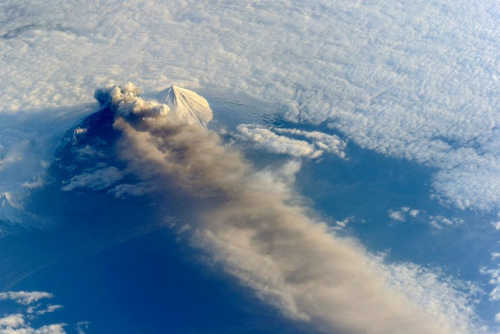
Sometimes astronauts in low Earth orbit to see what regular satellites do not. In May 2013 for example, astronauts on board the International Space Station photographed a fresh eruption of the Pavlof Volcano in the Aleutian Islands.
Their oblique perspective revealed the three dimensional structure of the ash plume, which was only 20,000 feet high, but many times longer. Down-looking satellites could not get the same kind of 3D information.
Low Earth orbit turns out to be a great place to study the planet below. In recent years astronauts trained to photograph Earth have gathered data on desert dust, coral reefs, urban growth, pollution, glaciers, hurricanes, lightning, river deltas, volcanic plumes, Northern and Southern Lights and much more.
Now, however, NASA is taking the space station's Earth-observing capabilities to a whole new level. Before the end of the decade, six NASA Earth science instruments will be mounted to the station to help scientists study our changing planet.
The upgrades began this month: On Sept. 20, a SpaceX resupply rocket blasted off from Cape Canaveral carrying the first NASA Earth-observing instrument to be mounted on the exterior of the space station: ISS-RapidScat will monitor ocean winds for climate research, weather predictions and hurricane science.
Next up is the Cloud-Aerosol Transport System – “CATS” for short – a laser radar that can measure clouds along with airborne particles such as pollution, mineral dust, and smoke. CATS will follow ISS-RapidScat on another SpaceX flight targeted for December.
Two more Earth science instruments are slated to launch in 2016. First, SAGE III will measure ozone and other gases in the upper atmosphere to help scientists assess how the ozone layer is recovering. Second, the Lightning Imaging Sensor will monitor thunderstorm activity around the globe.
Those instruments are already built and ready to fly. In July, NASA selected proposals for two new instruments: The Global Ecosystem Dynamics Investigation, “GEDI,” and the ECOsystem Spaceborne Thermal Radiometer Experiment on Space Station, “ECOSTRESS,” will give scientists new ways to observe how forests and ecosystems are affected by climate change. Both will be completed before the end of the decade.
Stephen Volz, associate director of flight programs in the Earth Science Division at NASA Headquarters explains the rapid pace of new sensors: “With the space station we don't have to build a whole new spacecraft to gather new data – it's already there. Designing instruments for the space station also gives us a chance to do high-risk, high-return instruments in a relatively economical way.”
The biggest spacecraft in Earth orbit is now paying serious attention to our home planet. For more news from low-Earth orbit, stay tuned to http://science.nasa.gov/ .
Dr. Tony Phillips works for the National Aeronautics and Space Administration.
LAKE COUNTY, Calif. – Residents around Lake County welcomed the rain that arrived on Wednesday and Thursday, although the amounts did little to improve the local drought outlook.
The latest rainfall totals showed that the Boggs Mountain area led in total rain, reporting 0.51 of an inch through the 24-hour period ending at 3 p.m. Thursday, according to the National Weather Service.
Other amounts reported through Thursday afternoon included 0.18 of an inch on Mt. Konocti, 0.21 inch at the Indian Valley Reservoir, 0.23 inch at Wilbur Springs, 0.24 inch at Witter Springs, 0.25 inch at Hough Springs, 0.28 inch in Hidden Valley Lake, 0.29 inch in Lakeport, 0.30 inch in Lower Lake, 0.42 on Cow Mountain Ridge, 0.46 inch in Pine Grove and 0.48 inch at the High Glade Lookout.
So far, the rainfall hasn't appeared to have had any impact on the level of Clear Lake, which on Thursday night was at -0.43 feet Rumsey, the special measure used just for the lake.
According to data from the Yolo County Flood Control and Water Conservation District – which controls the main water rights to Clear Lake – there has been 10.47 inches of precipitation impacting the lake to date this year, compared to 22.84 inches at this time in 2013.
Similarly, the Indian Valley Reservoir – which also provides water for Yolo Flood – reported no impact from the recent rain on the reservoir, where there has been 10.75 inches of rain to date, compared to 16.87 inches by September 2013.
The latest US Drought Monitor report, released Thursday, continues to list most of California – including Lake County – in the “exceptional” drought category, with more than 51 million people affected by the drought conditions.
In Lake County, there still is some possibility of more rain on Friday, according to the forecast.
The National Weather Service is predicting a 20-percent chance of showers during the night and nighttime hours Friday around most of Lake County, with the weather to clear over the weekend and through next week.
Temperatures over the coming week are expected to top out in the low 80s during the day and the high 50s during the night, with some light winds expected, according to the forecast.
Email Elizabeth Larson at

LAKEPORT, Calif. – The members of the Lake County Symphony Association Fundraising Committee has come up with a new way to have fun while raising funds for the organization.
It’s what’s hoped to be an annual affair called “The Harvest BBQ and Dance,” slated this year for Saturday, Oct. 11, at Rancho de la Fuente, located at 2290 Soda Bay Road in Lakeport, just south of Konocti Vista Casino.
“This dinner dance promises to be one of the major social events of the year for our organization,” said association President Ed Bublitz.
Bublitz said income generated from the event will help to support the Lake County Symphony and Youth Orchestra, as well as string programs for beginning and intermediate musicians.
Music for the dance will be provided by the LC Diamonds, one of Lake County’s most popular bands, while dinner will feature barbecued pulled pork with all the trimmings, prepared by the staff of Yuba College Culinary Department.
Beer and wine will be available at a no-host bar. A raffle will offer a tub holding a wide selection of Lake County’s finest wines as the prize.
Space is limited so Lake County Symphony Association members are urged to get their reservations early.
Doors will open at 5:30 p.m. with dinner served from 6 to 6:45 p.m.
Music will start at 7 p.m., with dancing until 10 p.m.
Cost for the dinner dance is $45 per person.
Reservations can be made online at
The U.S. Environmental Protection Agency announced a proposal to eliminate mercury pollution from dental offices nationwide.
These new Clean Water Act standards would cut discharges of dental amalgam – a mixture of mercury and other metals that dentists use to fill cavities.
Under this proposal, dentists must use devices to remove mercury and other toxic metals before they go down the drain.
“This proposed rule would cut mercury and toxic metal discharges to public wastewater systems by at least 8.8 tons a year nationwide,” said Jared Blumenfeld, EPA’s regional administrator for the Pacific Southwest. “Bay Area communities already require dentists to use amalgam capture devices and have seen their mercury pollution levels drop nearly 75 percent. Now the rest of California and the nation will see these same benefits.”
About half the mercury that enters public water treatment systems comes from dental offices that do not use amalgam separators.
When mercury from amalgam is discharged into water bodies, it can be transformed into methylmercury, a highly toxic form of mercury that builds up in fish, shellfish and fish-eating animals.
People can be harmed by methylmercury when they eat contaminated fish and shellfish. Methylmercury is a neurotoxin which impairs brain and nervous system development and function.
Many states and local wastewater districts have started mercury pollution control programs that require amalgam separators in dentist offices. Amalgam separators remove 90 to 95 percent of mercury and other metal waste.
Under the San Francisco Bay Regional Watershed Mercury control program, virtually all Bay Area cities and public water systems have successful mandatory dental amalgam separator programs, but this is not the case in most other communities and states.
EPA estimates that up to 120,000 dental offices in the U.S. use or dispose of amalgam fillings that contain mercury. Almost all of these offices discharge to sanitary sewers that flow to wastewater treatment plants.
While most offices use some practices to reduce amalgam discharges to the sewers, they are not nearly as effective as amalgam separators.
Because 40 to 50 percent of dentists across the country already use amalgam separators thanks to state and local programs, the new rule may result in installation of separators in up to 60,000 dental offices nationwide.
EPA estimates put the total annual cost of the proposed rule at $44 million to $49 million and a new streamlining proposal will cut state and local oversight costs by a similar amount.
This action is one way the U.S. is meeting the goals of the Minamata Convention on Mercury, an international environmental agreement that addresses human activities contributing to widespread mercury pollution.
EPA will accept public comments on the proposal for 60 days following publication in the Federal Register and expects to finalize the rule in September 2015.
For more information visit http://water.epa.gov/scitech/wastetech/guide/dental/ .
NICE, Calif. – A Napa woman suffered major injuries Wednesday night when she was hit by a vehicle on Highway 20.
Laurel Johnson, 23, was struck on Highway 20 west of Howard Avenue in Nice, according to a report from the California Highway Patrol's Clear Lake Area office.
At 7:40 p.m. Wednesday Gerald Stahr, 78, of Stonyford was driving his 2006 Chevrolet eastbound at an unknown speed in the rain, the CHP said.
Johnson, who was wearing a camouflage dress, appeared to be walking eastbound on the highway in the eastbound lane, not crossing the highway. There is no crosswalk in the area where she was hit, the CHP said.
“Due to the dark, rainy conditions, and the fact that Johnson was wearing dark-colored clothes, Stahr was late to observe her walking in the lane to the front of his vehicle,” the report said.
Stahr applied the brakes and swerved to the left but was not able to avoid hitting Johnson, the CHP said.
Johnson's head struck the windshield of Stahr's vehicle, and then she rolled off and under the vehicle as it came to a stop, according to the report.
The CHP said she suffered unknown head trauma and lacerations and was transported from the scene. Stahr was not injured.
Radio reports indicated a Northshore Fire ambulance transported her to Sutter Lakeside Hospital.
When contacted by Lake County News on Thursday with a request for a condition update on Johnson, hospital officials said they could not provide it due to privacy laws.
Officer Glen Thomas is investigating the crash.
Email Elizabeth Larson at
LAKE COUNTY, Calif. – Lake County's participation in the annual statewide Coastal Cleanup removed more than four times as much trash from local waterways as it did last year, thanks to a record number of volunteers.
The 30th annual California Coastal Cleanup Day, held Saturday morning, had an estimated 850 cleanup sites across the state, according to the California Coastal Commission, which sponsors the cleanup.
Lake – which had four focus sites – was one of 55 counties that participated in the cleanup, which the commission said is state's largest volunteer event.
Statewide, with 75 percent of the cleanup sites reporting, the Coastal Commission said there were 54,124 volunteers who picked up 576,571 pounds of trash and 109,494 pounds of recyclable materials, for a total of 686,065 pounds or 343 tons.
The cleanup doesn't just focus on the coast, but also inland waters like Clear Lake and local creeks.
“It was absolutely outstanding,” said Carolyn Ruttan, invasive species program coordinator for Lake County Water Resources, who organized the local cleanup.
The county of Lake had three gathering sites for volunteers: Holiday Harbor in Nice, the Big Oak Shopping Center in Clearlake Oaks and the Lake County Fire Protection District station in Clearlake, with Shady Acres Campground in Clearlake sponsoring a fourth location.
Across those four sites there were 55 volunteers, a number “way higher than we've ever had,” said Ruttan.
Ruttan said the Saturday cleanup covered 14 miles of creek and lakeside.
Those 55 volunteers collected 8,700 pounds of trash, which included 200 pounds of recyclables, and filled 71 trash bags, Ruttan said.
For comparison, the 2013 event had three dozen volunteers who removed 1,680 pounds of trash and recyclables.
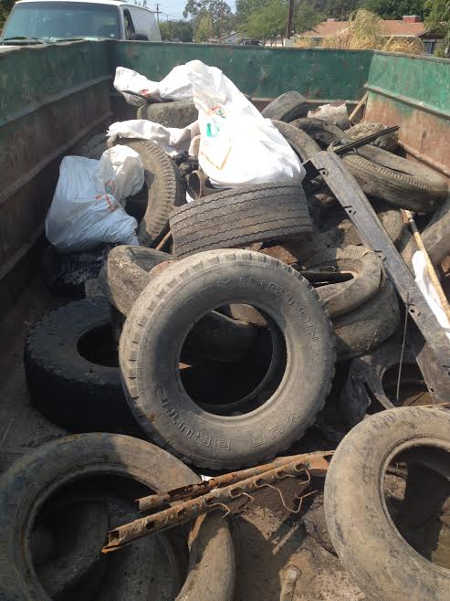
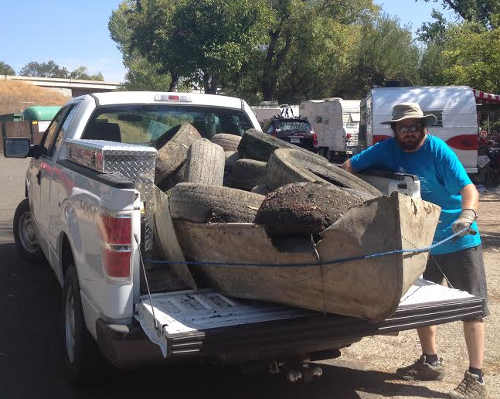
She said volunteers removed 90 tires and hundreds of feet of fishing line.
Despite the fact that Redbud Audubon Society has set up fishing line receptacles at docks around Clear Lake, “We need to do more about fishing line,” Ruttan said, noting it “gets entrapped in all these gorgeous critters that are using our lake,” often killing them.
Among the big finds was an aluminum boat volunteers pulled from the lake, as well as a shopping cart, a lot of clothing, three car batteries – “I've no idea how they wound up in the lake,” Ruttan said – and disintegrating dock floats.
Ruttan found two-thirds of a $20 bill near the Clearlake fire station gathering site, adding she intends to frame it as a memento of the cleanup.
The Coastal Commission said the winners of the 2014 Most Unusual Item contest included a volunteer in Ventura County who found a polar bear costume on the coast, and for inland California, a volunteer in San Joaquin County found a preserved blowfish ornament.
Based on data from past cleanups, the commission said that 60 to 80 percent of the debris on California's beaches and shorelines is made up of single-use disposable plastic items that originate on land, traveling through storm drains, creeks, or rivers to the beaches and ocean.
This year the Coastal Commission also continued an effort, initiated during the 2010 Coastal Cleanup, to reduce the environmental footprint of the cleanup.
The commission reported that it asked volunteers to bring their own reusable bag or bucket and reusable gloves to the event, rather than using the single-use disposable plastic items that were available at every site.
Thanks to this effort, the commission was able to order almost 50,000 fewer trash bags for this year’s event than in prior years, and early reports indicate that the popularity of the effort is growing.
The latest reports show that 11,489 volunteers brought at least one reusable item from home for use during this year’s cleanup, the commission said.
Email Elizabeth Larson at