 How to resolve AdBlock issue?
News

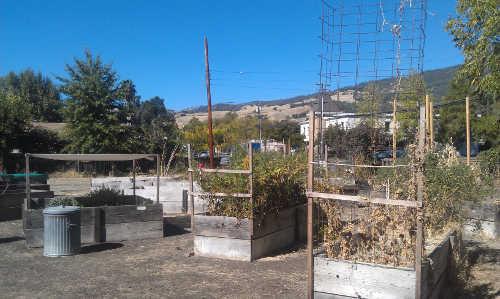
LUCERNE, Calif. – The community garden that for nearly a decade has served Lucerne residents was hit by a burglary last week, which resulted in the loss of an expensive pump used to bring water from the lake.
The garden is located on the lake side of Highway 20 at 13th Avenue.
Robert Patton, who for three years has managed the garden for Lucerne Friends of Locally Owned Water, or FLOW, said someone cut the locks on the garden's storage shed and stole a solar pump valued at $1,000, along with its copper wiring.
He believes the garden was burglarized sometime between noon Wednesday and 2 p.m. Thursday.
Patton said he has reported the theft to the Lake County Sheriff's Office.
The county-owned property features several garden boxes that the group has built, as well as several trees, including two older fig trees.
This year, seven people signed up for the garden boxes, which Patton said are rented for about $25 to $30 a year.
However, the pilferage of fruits and vegetables grown at the garden – which has increased during the recession – was particularly bad this summer, Patton said.
Even before some of the vegetables were ripe they were picked and taken, but not by the people who had paid to grow them, he said.
“They took every onion, every beet, every carrot,” Patton said Sunday afternoon, overlooking the dying remnants of the garden.
He said the garden also lost its wheelbarrow and continues to have other items stolen on a regular basis.
“This is the first time they've broke into our shed,” he said.
Patton said the garden could use donations and more help to make better use of the land.
“There's a lot of things we can do here,” said Patton.
Anyone with information about the whereabouts of the stolen equipment, or who would like more information about volunteering or making a donation to the garden, can contact Patton at 707-318-8983 or
Email Elizabeth Larson at
LUCERNE, Calif. – Visiting Marymount California University professor Dr. Allen Franz will be giving a guest lecture series at Marymount's Lakeside Campus in Lucerne.
The first lecture in the series, “Water, the Essential Molecule” will take place from 7 to 8 p.m. Wednesday, Oct. 8. at the campus, 3700 Country Club Drive.
Dr. Franz, an environmental anthropologist, has been a Marymount faculty member for more than 30 years in Southern California, and has conducted multidisciplinary research in Latin America, Europe and Africa, as well as California and other Western states.
In recent years he has been selected to lead a National Science Foundation program for college instructors on geology, climate and ecology of Yosemite and the Sierra Nevada, and as a collaborator in a National Endowment for the Humanities Summer Field Institute on “Nature and History at the Nation's Edge: A Field Institute in Environmental and Borderlands History.”
We've all heard that water covers 70 percent of the Earth, and makes up 70 percent of our bodies. What is it about water that makes it so vital to life as we know it?
This presentation will provide background on the basic physics, chemistry and astronomy of water—what's special about the water molecule, and how common is water in the Solar System and the wider cosmos?
Here on Earth, what are the factors that shape where water goes and what it does?
Water in Lake County, and anywhere else on Earth, depends on these dynamics.
Contact Michelle Scully,
LAKE COUNTY, Calif. – Two male cats are waiting for new homes at Lake County Animal Care and Control this week.
Offered this week are a cool black male cat and a gray tuxedo cat.
In addition to spaying or neutering, cats that are adopted from Lake County Animal Care and Control are microchipped before being released to their new owner. License fees do not apply to residents of the cities of Lakeport or Clearlake.
If you're looking for a new companion, visit the shelter. There are many great pets there, hoping you'll choose them.
In addition to the animals featured here, all adoptable animals in Lake County can be seen here: http://bit.ly/Z6xHMb .
The following cats at the Lake County Animal Care and Control shelter have been cleared for adoption (other cats pictured on the animal control Web site that are not listed here are still “on hold”).
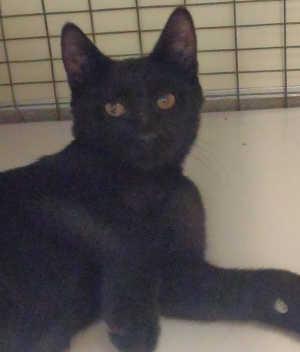
'Jack'
“Jack” is a young domestic short hair cat.
He has an all-black coat.
He's in cat room kennel No. 88, ID No. 762.
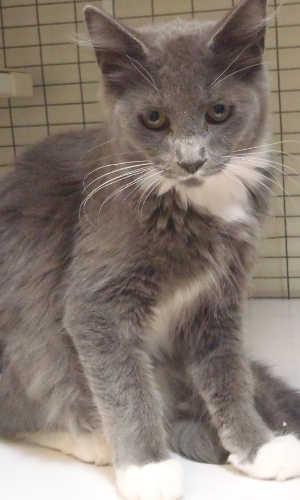
Gray tuxedo cat
This male domestic short hair has a gray tuxedo coat.
He's in cat room No. 35, ID No. 818.
Adoptable cats also can be seen at http://www.co.lake.ca.us/Government/Directory/Animal_Care_And_Control/Adopt/Cats_and_Kittens.htm or at www.petfinder.com .
Please note: Cats listed at the shelter's Web page that are said to be “on hold” are not yet cleared for adoption.
To fill out an adoption application online visit http://www.co.lake.ca.us/Government/Directory/Animal_Care_And_Control/Adopt/Dog___Cat_Adoption_Application.htm .
Lake County Animal Care and Control is located at 4949 Helbush in Lakeport, next to the Hill Road Correctional Facility.
Office hours are Monday through Friday, 8 a.m. to 5 p.m., and 1 p.m. to 3 p.m., Saturday. The shelter is open from 10:30 a.m. to 4:30 p.m. Monday through Friday and on Saturday from 1 p.m. to 3 p.m.
Visit the shelter online at http://www.co.lake.ca.us/Government/Directory/Animal_Care_And_Control.htm .
For more information call Lake County Animal Care and Control at 707-263-0278.
Email Elizabeth Larson at
LAKEPORT, Calif. – Lakeport's fifth annual Oktoberfest event on Saturday celebrated German culture with food, music and racing dachshunds.
The Lake County Chamber of Commerce hosted the event on Main Street from 11 a.m. to 9 p.m.
A highlight of the day was the Dachshund Derby, which pitted the fastest little dogs against each other in pursuit of cash prizes and other goodies.
This year's winner in the miniature division was “Bube,” an Iowa-born, 3-year-old miniature long-haired dachshund owned by Judy Six of Lakeport.
Bube – which Six said means “jack of hearts” in German – was defending his win in last year's event.
Six said that after Bube's 2013 win, she wanted to race him again to see if his speed in the racing setting was a fluke.
“It wasn't,” she said after the race.
Six used some strategy and preparation in getting Bube ready for the race, including walking the course and making sure she had plenty of his favorite treat – beef hearts – on hand.
It worked, and Bube raced to first place, followed by Echo, owned by Upper Lake resident Nicky Phillips. A dachshund named Lydia placed third.
After the race, Phillips and Echo visited with Bube, with the two dogs cordially touching noses.
Phillips has had the 2-year-old Echo since she was a puppy.
Echo is deaf, so Phillips used hand signals to help guide her during the racing competition.
Bube received a $75 cash prize for his owner, while Echo received a bag of treats from Rainbow Ag for her performance.
Six said she intends to retire Bube from racing, explaining that the annual Dachshund Derby meant to be a fun event. “Everyone should get a chance.”
Six does have another competitor she'll be training for next year's competition – “Hank,” a 1-year-old dachshund mix.
Hank was entered in the races on Saturday. He competed in a heat of four dogs, three of which didn't move from the starting line.
To see a sampling of the day's highlights, including the Dachshund Derby, see the video above.
Email Elizabeth Larson at
LAKE COUNTY, Calif. – Set your alarms: Between 3:30 and 4:30 a.m. Wednesday, Oct. 8, there will be a total lunar eclipse.
This will be the second eclipse to occur in 2014.
The Oct. 8 eclipse will last for approximately 60 minutes.
There will not be another eclipse until September 2015.
A lunar eclipse happens when the sun, Earth and moon are lined up, with the moon in the earth’s shadow.
Since the moon has no light of its own – it shines with reflected sunlight – it ceases to shine when in the Earth’s shadow.
You can still see the moon during an eclipse, but it will be very faint.

The moon may change color during an eclipse, orange-red being the most common.
Lunar eclipses have played an important part in history.
For example, in 1503 Columbus used his knowledge of when an eclipse would occur to intimidate the indigenous population.
Since you got up early to view the eclipse, you may want to note Jupiter rising in the east.
Jupiter is the largest of the planets, and the brightest object in the morning skies.
If you have binoculars or even a small telescope, you can see Jupiter’s four brightest moons.

Before we go, we should take note of changing constellations in the evening night skies.
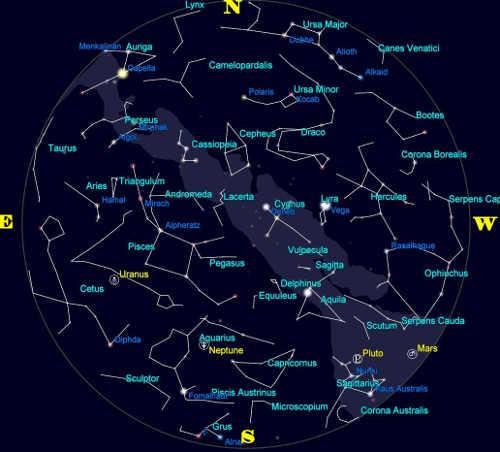
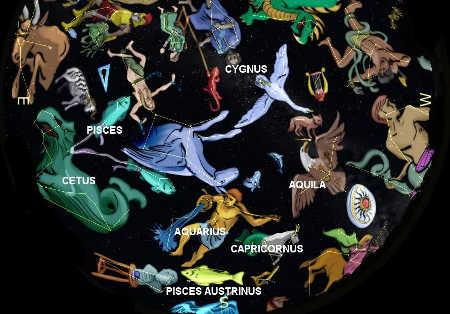
Our star chart shows the high flying winged summer constellations – Cygnus the Swan and Aquila the Eagle – beginning to sink in the west.
The fall constellations gain prominence, and many are at home in water, Capricornus the Sea Goat, Pisces the Fish, Pisces Austrinus the Southern Fish, Cetus the Whale, and Aquarius the Water Bearer.
John Zimmerman is a resident of Lake County and has been an amateur astronomer for more than 50 years. For more information about astronomy and local resources, visit his Web site at www.lakecountyskies.com .
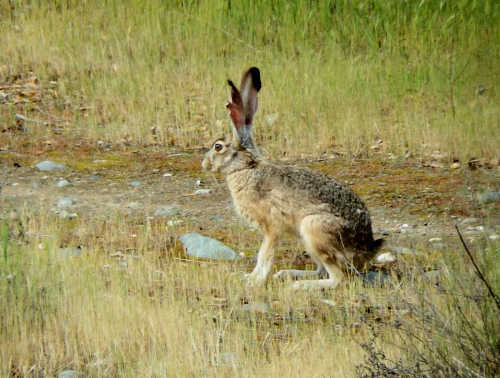
NORTHERN CALIFORNIA – We see them everywhere it seems, those agouti-furred critters with the huge ears we commonly refer to as jackrabbits.
But did you know that jackrabbits aren’t “rabbits” at all? They’re hares.
Hares differ from rabbits in size (hares are larger, have longer ears and bigger hind feet), speed (they’re faster than rabbits), and coloring (their fur is peppered with black markings).
Rabbits often live in underground burrows called “warrens,” but hares don’t. They prefer to spend their time in ruts or hollows on the ground’s surface or under the cover of grasses and shrubs.
And whereas baby rabbits (commonly called bunnies) are born underground, furless and blind, baby hares (called leverets) are born above ground and are fully furred with their eyes open so they can leave the nest and forage on their own very quickly after birth.
In fact, they’re so self-sufficient that the mother jackrabbit doesn’t protect or even stay with her well-camouflaged offspring during those times when the leverets aren’t nursing.
Female jackrabbits (which are generally larger than their male counterparts) aren’t too keen on preparing extensive nests for their babies either. They dig or commandeer shallow depressions in the ground, called “forms,” and drop the leverets in them. Sometimes the mother may line the form with fur, but more often than not, they’re left barren.
Jackrabbits can breed several times a year, and each litter can have up to 6 or 8 young in it. In this region, breeding times are usually in late winter or late summer, so that the offspring are born when young plants are most prevalent (in the spring and fall). An adult jackrabbit can weigh up to 9 pounds and grow to be about 2 feet long.
Big eaters (a little more than a dozen jackrabbits can eat as much in a day as a full grown cow!), the jackrabbit’s diet consist of a variety of grasses, coarse leaves, twigs, berries and other plant material. And, yes, they also eat their own feces, but only the “first pooped” version.
When the jackrabbit evacuates for the first time after a meal, the extruded pellets are green and filled precious moisture and vitamins (produced when the food passes through the intestinal tract). The jackrabbit immediately eats these pellets to gain the optimal fluid and nutrition from their meal.

When they expel the pellets for a second time, the pellets are brown – which is the form in which we usually see them – and, being of no further use to the jackrabbit, they are promptly ignored.
The jackrabbit’s most distinguishing feature is, of course, its set of large ears.
The ears not only allow the jackrabbits to hear exceptionally well, they also act as a kind of shock absorber when the jackrabbit runs. Jackrabbits can hit speeds up to 45 miles per hour, and the ears help to dispel some of the inertia that builds up in it head and body (allowing the jackrabbit to focus more clearly with its eyes as it runs).
The ears are also used to heat and cool the jackrabbit through a process called “thermoregulation.”
Blood vessels in the ears expand or contract to help the jackrabbit regulate its body temperature. The system works so well, in fact, that studies were actually done through the University of Arizona to replicate the process in building construction, utilizing a series of liquid-filled bladders in the walls that could expand or contract to help moderate the inside temperature of the building!
In the wild, most jackrabbits live a short life (1 to 5 years), and populations are usually well-controlled by predators that use the hares as the mainstay of their diet.
Commonly, jackrabbits constitute important prey species for hawks, owls, eagles, coyote, foxes and other animals.
It’s not uncommon to see the jackrabbits dashing across the landscape in a zig-zag pattern, and leaping occasionally (up to 10 feet) to confuse and avoid predators.
So, there you have it: Jackrabbits – more than meets the eye… or the ear.
Tuleyome Tales is a monthly publication of Tuleyome, a nonprofit conservation organization based in Woodland and Napa, Calif. For more information about Tuleyome go to www.tuleyome.org . Mary K. Hanson is an amateur naturalist and photographer and author of The Chubby Woman’s Walkabout blog.