 How to resolve AdBlock issue?
News
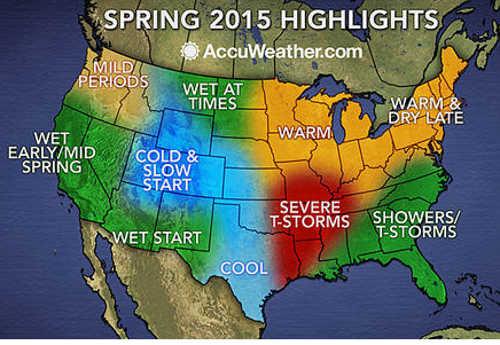
AccuWeather reports that though Punxsutawney Phil saw his shadow on Groundhog Day, forecasting six more weeks of winter for the United States, AccuWeather meteorologists say that might not be the case nationwide.
The Midwest and Northeast are forecast to have a milder start to spring than last year. Meanwhile, colder air will accompany unsettled weather across the central and southern Rockies.
Overall, severe weather season will ramp up compared to the past three years, as more widespread warm air will prompt unstable conditions.
In California, drought problems will continue to build despite a few late-season snowstorms and rain in March and April.
Where will winter maintain its grip?
In line with Phil's prognostication, a longer, late-winter pattern is expected to continue across the central and southern Rockies.
A supply of moisture will set the stage for more rounds of snow for the region.
"Skiers, I think you're going to have some good skiing weather for the Rockies going into March and maybe even April as well," AccuWeather.com Lead Long-Range Forecaster Paul Pastelok said.
In the Midwest and Northeastern states, chilly shots will linger into March. The cool air will be punctuated by milder days, but overall, the eastern half of the nation will have to wait until May for prolonged warmth.
To make matters worse for warm weather lovers, the opportunity exists for a late-season snowstorm around March.
A quicker start to spring is in the offing for much of the Northwest.
At the start of the season, Seattle and Portland are forecast to run several degrees above normal. Both cities will likely average a few degrees above normal overall for the three-month period.
Severe weather events to be more frequent than in past three years
Those near northern Florida and southeastern Georgia may experience some early-season severe weather in March and April.
"East Texas, such as Houston and Dallas, and maybe even into parts of Louisiana, those are the places to focus on early in the spring," Pastelok said.
By April and May, severe weather will work its way into the Tennessee Valley as well.
The number of spring severe weather events has been below normal for the past couple of years, especially the number of tornadoes.
On average, around 1,300 tornadoes hit the United States each year, according to the Storm Prediction Center.
Since 2012, the United States has averaged around 900 tornadoes per year.
"We've had slow starts with stable air hanging around longer through the spring season. This year's a little different."
Warmer air will be more widespread across the country this season, increasing the instability of the atmosphere.
"I think we're going to have a lot more tornadoes for the spring season compared to the last couple of years, with it really picking up as we get into April and May in the more traditional areas down south."
Little Rock, Arkansas; Memphis, Tennessee; and Jackson, Mississippi; will be the focus in the heart of severe weather season.
Drier air will work its way across the central and northern Plains at times that could hold back the severe weather in those areas. Places like Oklahoma City, Oklahoma, and Wichita, Kansas, could catch a break.
"We're looking farther east than west," Pastelok said.
Spring flooding won't hinder planting season
For areas that traditionally receive spring flooding, including the northern Plains and Midwest, this spring won't bring any extreme conditions.
"With the lack of heavy snowfall in the more prone areas this winter and not much heavy rainfall for the early spring, we may get by pretty good this year without much flooding for these areas," Pastelok said.
"The weather setup will give these areas a drier ground and a chance for early warmth, maybe even some early heat, going into May," Pastelok said.
Conditions will be decent for farmers in traditional Midwest growing areas with no major disruptions to planting.
California drought woes to continue into spring
Though more snow is on the way for California into the spring season, it's not expected to be enough to put an end to the state's drought woes.
After a steady supply of rain and snow early in the winter, a second surge of precipitation could arrive for California in late March or early April.
The focus will likely be on the central and northern valleys, but even the Desert Southwest could see improvement all the way into early spring.
"I think conditions have improved a little bit, and I think that they'll get another boost going into April," Pastelok said.
"We just don't think they're going to get enough to put an end to the drought. They're still going to have some problems."
This story has been updated to reflect that both vehicle occupants were women.
MIDDLETOWN, Calif. – A single-vehicle crash on Wednesday evening resulted in two people being flown to regional trauma centers.
The crash involving an SUV occurred at around 5 p.m. on Highway 29 at Spruce Grove Road South, according to Battalion Chief Mike Wink of Cal Fire and the South Lake County Fire Protection District.
He said the SUV went off the road and rolled several times.
The vehicle's two occupants were both injured and had to be flown out of the county for treatment, Wink said.
The CHP reported on Thursday that the vehicle’s occupants were two women.
Wink said air ambulances came from Lakeport and Ukiah for transport, as helicopters from Sonoma County couldn't make the trip due to the developing storm system making its way into the region.
A REACH air ambulance responded to a landing zone set up at the scene to transport one of the patients, while the second patient was taken by ground ambulance to St. Helena Hospital Clear Lake, where a CalStar air ambulance picked the patient up at the helipad, according to Wink.
Additional information about the wreck will be posted as it becomes available.
Email Elizabeth Larson at
HIDDEN VALLEY LAKE, Calif. – A Hidden Valley Lake resident's discovery of an unusual item in the mail led to a hazmat response on Wednesday afternoon.
Battalion Chief Mike Wink of Cal Fire and the South Lake County Fire Protection District said district personnel were dispatched to a possible hazmat situation at the mailboxes on Hartmann Road at 3:45 p.m.
He said a local resident opened some mail, found an unknown substance wrapped in plastic that they were not expecting.
“That's when they called us,” said Wink.
In such cases, Wink said they have to assume the worst – that it might be a dangerous substance – and mount a full response.
Numerous local agencies responded to the incident, Wink said.
In addition to Cal Fire and South Lake County Fire, the Lake County Sheriff's Office, Lake County Fire Protection District, the Lake County Hazmat Team and the US Postal Service's Middletown postmaster were on the scene.
As the hazmat team worked to identify the substance, “We had to isolate the area,” Wink noted, which meant that residents were unable to get their mail.
The hazmat team was able to determine that the substance was not hazardous, and the incident was terminated in about two hours, or just before 6 p.m., said Wink.
Wink said the US Postal Service is continuing its own investigation into the substance and its presence in the mail.
Email Elizabeth Larson at
CLEARLAKE, Calif. – A fire on Tuesday afternoon did significant damage to a Clearlake home, but the quick arrival of firefighters stopped the structure from being destroyed.
The fire was reported before 2 p.m. at 3174 Eighth St., according to Lake County Fire Protection District Battalion Chief Charlie Diener.
The older model mobile home was occupied at the time, but the family got out without any injuries, Diener said.
He said the fire was reported immediately, with firefighters getting on scene quickly and stopping the fire within just a few minutes.
“It was a good stop,” he said.
Diener responded to the scene, along with Chief Willie Sapeta, an engine and a water tender.
The fire was contained to a back bedroom, he said.
While the residence was not destroyed, Diener said it was “significantly damaged,” with smoke damage throughout the structure.
Diener said the fire appears to have started in a couch cushion and may have been caused by a cigarette.
It was the second home fire the district dealt with in as many days.
A fire destroyed a double-wide mobile home on Second Street on Monday, as Lake County News has reported.
Email Elizabeth Larson at
LAKEPORT, Calif. – The Clear Lake Team Bass Tournament will take place in Lakeport on Saturday, Feb. 28, and Sunday, March 1.
Now in its 28th year, this popular homegrown tournament brings participants from many states – not just California – with more than 100 teams participating annually.
The Lake County Chamber of Commerce and Konocti Vista Casino are partnering to host the tournament. Konocti Vista, also a major sponsor, is the site of the event.
Organizers said the tournament is based upon a “100-percent payback” format, meaning that every cent of the registration fee is returned to the participants in prize money.
In order to continue this format, the Lake County Chamber seeks sponsorships from local businesses to cover the expenses necessary to produce the tournament.
The expenses to be covered are awards from first to fifth place for the winning teams, along with team trophies on Saturday and Sunday for the team which brings in the biggest fish of the day.
The public is invited to attend the weigh-ins, held at 3 p.m. both days.
The awards will take place in the casino banquet hall at 5 p.m. on Sunday, March 1.
Applications for the tournament can be found at E Ticket Tackle and Clear Lake Outdoors in Lakeport; Limit Out Tackle in Clearlake Oaks and Clearlake Bait & Tackle in Clearlake.
They also can be found at www.lakecochamber.com and at the chamber office, 875 Lakeport Blvd. at Vista Point in Lakeport.
The entry fee is still $200 for a team of two fishermen.
Applications will be accepted at the chamber office until 4:30 p.m. Friday, Feb. 27.
For more information, contact the Lake County Chamber of Commerce at 707-263-5092.
While much of California has so far endured an exceptionally dry 2015, the State Water Resources Control Board announced that the statewide urban water conservation rate climbed to 22 percent in December, aided by a very wet end of 2014.
Additionally, total water use by individual Californians continued to decline in December, another positive development as the state is threatened by a fourth consecutive dry year. Encouraged by the newest data, State Water Board officials called on Californians to continue conserving as the drought persists.
“Today’s announcement is welcome news that demonstrates the importance of outdoor water savings,” said State Water Board Chair Felicia Marcus on Tuesday. “We have just gone through the driest January on record and it appears we are entering a fourth year of drought, which is awful to contemplate but we must. Conservation is still the smartest and most cost effective way to deal with this difficult drought.”
In the most recent survey of nearly 400 urban water retailers, the amount of water conserved by the state’s large urban water agency customers statewide jumped from 10 percent in November to 22 percent in December, in year-over-year water use comparisons.
While wet conditions in December reduced the need for outdoor water use, likely contributing to the dramatic reduction, the results reflect a steady improvement in water conservation among nearly all the state’s hydrologic regions.
“This was a wet December in most of the state, and people got the message not to water on top of the rain – that is good news,” Marcus said. “Our challenge will be to keep outdoor irrigation to a minimum as we move into the warmer spring months.”
The December data represents the highest water savings rate since the state’s largest retail water suppliers began reporting in July, when the State Water Board adopted the Emergency Water Conservation Regulation which requires water suppliers and residents to work together to save water during the drought, primarily through reduced outdoor water use.
Since data collection began in July, more than 134 billion gallons of water have been saved compared with last year – enough to supply 1.8 million California residents for a year.
For December, nearly all of the state’s hydrologic regions exhibited the best water conservation numbers since data reporting began.
As part of its efforts to build on conservation gains statewide, State Water Board members held a water conservation workshop in Los Angeles in December to consider additional conservation ideas and get input from water districts, environmentalists, and water policy experts.
At its next board meeting on Feb. 17, the Board will hear presentations by staff on what ideas were suggested and what actions could be implemented by the State Water Board to sustain and possibly improve statewide water conservation efforts during 2015.
While board members were pleased to see improved water conservation in December, they discussed the importance of the State Water Board having measures in place for 2015 to assist water districts and their customers to ensure water conservation remains a priority for all Californians.
Reducing outdoor water use will be one focus of those measures. On average, in peak warmer months, outdoor water use contributes to 50 percent on average of the water used every day by urban residents. Other steps for consideration could include reinforcing habits and practices aimed at reducing indoor water use. These measures could also include extending or strengthening the current regulations, adding new limitations, or focusing on specific practices or geographies.
“We need to treat water as the precious resource that it is. We need to be sensitive to the fact that many Californians don’t have or barely have enough water to drink, cook and bathe,” said Marcus. “Hundreds of thousands of acres of agriculture have been fallowed, thousands of people are out of work, and fish and wildlife are struggling. Each individual act of conservation – such as letting the lawn go brown or fixing leaks – can add up to huge savings if enough people act.”
Water conservation efforts net water savings
Year over year monthly residential water savings statewide increased to 22.2 percent in December, up substantially from 9.9 percent in November.
Broken down by hydrologic region, the results show that some parts of the state saved more water in December than any month since reporting requirements began over the summer.
For example, the Central Coast hydrologic region decreased water use by 29 percent in December compared to the same time in 2013, achieving the highest savings of any hydrologic region.
Central Coast was followed by the following:
– Tulare Lake hydrological region (27.42 percent water use decrease over December 2013);
– South Coast hydrologic region (23.18 percent water use decrease over December 2013);
– San Francisco Bay hydrologic region (21.61 percent water use decrease over December 2013);
– Sacramento River hydrologic region (21.37 percent water use decrease over December 2013);
– San Joaquin River (18.94 percent water use decrease over December 2013);
– North Coast (15.92 percent water use decrease over December 2013);
– North Lahontan (14.19 percent water use decrease over December 2013);
– and Colorado River (6.69 percent water use decrease over December 2013).
The South Coast hydrologic region showed impressive gains, with 23.18 percent savings for December, compared to the 3.2 percent water conservation for November.
With 56 percent of all the residential water customers statewide in the South Coast region, this conservation result significantly improved the December statewide average for residential water savings.
Prior to December, the highest statewide conservation rate was the 11.6 percent water savings rate for August, compared with August 2013 water use. California urban water use is generally the highest June through October.
The report also found that in December, 94 percent of the water agencies reporting had instituted outdoor water use restrictions.
Outdoor water use restrictions are a key requirement for urban water suppliers under the Emergency Water Conservation Regulation because outdoor watering accounts for as much as 80 percent of urban water use in some areas.
Decline in per capita daily water use continues statewide
In addition to the December conservation data, the State Water Board also reported residential gallons per-capita per day (R-GPCD) for December.
The report estimates daily water use by residential customers for nearly 400 urban water agencies statewide.
The statewide R-GPCD average for December was 67.2 gallons per person – a significant drop from November, when the statewide average use was 88.9 gallons per person, per day.
State Water Board staff continues to study this trend in an effort to understand what is driving the reduction in water use in some hydrologic regions, but not others.
Some of the R-GPCD drop was expected as outdoor watering tends to go down when cooler temperatures or precipitation arrive.
The water use reports are a requirement of the Emergency Water Conservation Regulation adopted by the State Water Board in July and are provided to the Board monthly by urban water suppliers, along with total water conservation for each month. The complete report is posted here.
According to the R-GPCD data, water use varies widely by hydrologic region and showed consistent declines in water use during this fourth month of reporting. At the low end, the San Francisco Bay region averaged 53 gallons per person per day. On the high end, the Colorado River region averaged 151 gallons per person per day.
Examples of some communities with the respective R-GPCD averages for December 2014 in various hydrologic areas (in parenthesis) include:
– California-American Water Company Monterey District (Central Coast) with 33 R-GPCD;
– San Francisco Public Utilities Commission (San Francisco Bay) with 40 R-GPCD;
– City of Santa Cruz (Central Coast) with 41 R-GPCD;
– City of San Diego (South Coast), with 46 R-GPCD;
– San Jose Water Co. (San Francisco Bay), with 53 R-GPCD;
– City of Santa Rosa (North Coast) with 56 R-GPCD;
– City of Stockton (San Joaquin River) with 57 R-GPCD;
– Los Angeles Department of Water and Power (South Coast), with 62 R-GPCD;
– City of Fresno (Tulare Lake), with 62 R-GPCD;
– City of Sacramento (Sacramento River) with 63 R-GPCD;
– City of Riverside (South Coast), with 63R-GPCD;
– Sacramento County Water Agency (Sacramento River), with 78 R-GPCD;
– California Water Services Company, Bakersfield (Tulare Lake) with 81 R-GPCD.
In his Jan. 17, 2014, Emergency Drought Proclamation, Governor Brown called for Californians to voluntarily reduce their water use by 20 percent.
The trend of increasing reductions and specific local data shows that many California communities have met and even exceeded the call to conserve. However, more can and must be done to protect water supplies should the drought persist.
Current forecasts indicate that Californians cannot count upon a wet winter to end the drought.
The Emergency Water Conservation Regulation will be in effect until April 25, 2015, and will likely be extended if drought conditions persist.
The State Water Board will closely monitor the implementation of the regulations and the weather over the coming months to determine if further restrictions are needed.
During 2014, the State Water Board took action to increase access to recycled water in an effort to augment scarce water supplies.
Water recycling is the use of treated municipal wastewater for beneficial purposes, such as agricultural and landscape irrigation, industrial processes, and replenishing ground water basins.
In March, the Board approved new low-interest financing terms for water recycling projects to help California produce an additional 150,000 acre-feet of recycled water annually.
The effort makes $800 million available for projects that will be eligible for funding such as recycled water treatment, distribution and storage facilities that can be completed by 2017.
In June, the Board adopted a general order that makes it easier for communities to use non-potable recycled water for agriculture, landscape and golf course irrigation, and other uses.
During the year, various regional boards took action to approve the use of recycled water for local projects under their jurisdiction.