 How to resolve AdBlock issue?
News
LAKE COUNTY, Calif. – New canine friends are waiting to meet you this week at the Lake County Animal Care and Control shelter.
This week's dogs feature mixes of Australian Shepherd, border collie, boxer, cattle dog, Chihuahua, Labrador Retriever, pit bull and shepherd.
Dogs that are adopted from Lake County Animal Care and Control are either neutered or spayed, microchipped and, if old enough, given a rabies shot and county license before being released to their new owner. License fees do not apply to residents of the cities of Lakeport or Clearlake.
If you're looking for a new companion, visit the shelter. There are many great pets hoping you'll choose them.
In addition to the animals featured here, all adoptable animals in Lake County can be seen here: http://bit.ly/Z6xHMb .
The following dogs at the Lake County Animal Care and Control shelter have been cleared for adoption (additional dogs on the animal control Web site not listed are still “on hold”).

Border collie mix
This female border collie mix has a tricolor coat.
Shelter staff said she has a very sweet disposition.
She's in kennel No. 3, ID No. 2398.

'Mimi'
“Mimi” is a Chihuahua mix.
She has a short white and tan coat.
Mimi is in kennel No. 4a, ID No. 2055.

Male Chihuahua mix
This male Chihuahua mix has a short white coat.
He's in kennel No. 4b, ID No. 2321.

Labrador Retriever-cattle dog mix
This male Labrador Retriever-cattle dog mix has a short tan and white coat.
Shelter staff said he is very good around other dogs, and showed many calming signals, like sniffing the ground, looking away and turning his body sideways. He was perfectly calm on a leash.
He's in kennel No. 5, ID No. 2227.

Female pit bull mix
This female pit bull terrier mix has a short brown brindle and white coat.
Shelter staff said she has no food aggression and would be fine with children ages 7 and older. She is not good with cats, but she would be great with other dogs, male or female.
They said that, overall, she is a wonderful and loving girl.
She's in kennel No. 7, ID No. 2241.

'Pepper'
“Pepper” is a female Labrador Retriever mix.
Shelter staff said Pepper is a great dog, and would be great with an active family.
She would be fine with cats, and other dogs – male or female – and she shows no food aggression either.
The shelter is offering a low adoption fee on Pepper.
Find Pepper in kennel No. 8, ID No. 1473.

Male shepherd
This male shepherd mix has a short black and tan coat.
Shelter staff said he does great with other dogs, both male and female. He has shown some food aggression, but shelter staff said that can be addressed through training and management.
He's in kennel No. 11, ID No. 2367.

'Diesel'
“Diesel” is a boxer mix with a short black and white coat.
Shelter staff said Diesel needs a home with no livestock or farm animals, but seems fine with cats.
He's in kennel No. 16, ID No. 2270.

'Dozer'
“Dozer” is a male pit bull terrier mix with a short white and buff-colored coat.
Shelter staff said he is a great dog who would be suited to a home with a submissive female and no cats. He is fine with children ages 10 and above.
Find Dozer in kennel No. 27, ID No. 2377.

'Tippy'
“Tippy” is a female Australian Shepherd.
Shelter staff said they do not know her background, but she needs a home with women only, as she is very afraid of men.
Tippy is good with other dogs and has been fine with mellow children.
She is being fostered; ID No. 2142.
To fill out an adoption application online visit http://www.co.lake.ca.us/Government/Directory/Animal_Care_And_Control/Adopt/Dog___Cat_Adoption_Application.htm .
Lake County Animal Care and Control is located at 4949 Helbush in Lakeport, next to the Hill Road Correctional Facility.
Office hours are Monday through Friday, 11 a.m. to 5 p.m., and 11 a.m. to 3 p.m., Saturday. The shelter is open from 11 a.m. to 4 p.m. Monday through Friday and on Saturday from 11 a.m. to 3 p.m.
Visit the shelter online at http://www.co.lake.ca.us/Government/Directory/Animal_Care_And_Control.htm .
For more information call Lake County Animal Care and Control at 707-263-0278.
Email Elizabeth Larson at

Researchers from Brown University have used satellite data to detect deposits of glass within impact craters on Mars.
Though formed in the searing heat of a violent impact, the glasses just might provide a delicate window into the possibility of past life on the Red Planet.
Over the last few years, several research groups have shown that, here on Earth, ancient biosignatures can be preserved in impact glass.
One of those studies, led by Brown geologist Peter Schultz and published last year, found organic molecules and even plant matter entombed in glass formed by an impact that occurred millions of years ago in Argentina.
Schultz suggested that similar processes might preserve signs of life on Mars, if indeed they were present at the time of an impact.
“The work done by Pete and others showed us that glasses are potentially important for preserving biosignatures. Knowing that, we wanted to go look for them on Mars and that's what we did here,” said Kevin Cannon, a Ph.D. student at Brown and the lead author of the new research. “Before this paper no one had been able to definitively detect them on the surface.”
Cannon and co-author Jack Mustard, professor of Earth, environmental and planetary sciences at Brown, showed that large glass deposits are present in several ancient yet well-preserved craters scattered across the Martian surface.
The study suggests that glass deposits are relatively common impact features on Mars and could be targets for future exploration.
The research is published online in the journal Geology.
Picking out the glassy deposits was no easy task. To identify minerals and rock types remotely, scientists measure the spectra of light reflected off the planet's surface. But impact glass doesn't have a particularly strong spectral signal.
“Glasses tend to be spectrally bland or weakly expressive, so signatures from the glass tend to be overwhelmed by the chunks of rock mixed in with it,” Mustard said. “But Kevin found a way to tease that signal out.”
In the lab, Cannon mixed together powders with a similar composition of Martian rocks and fired them in an oven to form glass. He then measured the spectral signal from that glass.
Once he had the signal from the lab glass, he used an algorithm designed to pick out similar signals in data from the Compact Reconnaissance Imaging Spectrometer for Mars (CRISM), which flies aboard NASA's Mars Reconnaissance Orbiter. Mustard is the deputy principal investigator for the instrument.
The technique was able to pinpoint deposits around several crater central peaks, the craggy mounds that often form in the center of a crater during a large impact. The fact that the deposits were found on central peaks is a good indicator that they have an impact origin.
Knowing that impact glass can preserve ancient signs of life -- and now knowing that such deposits exist on the Martian surface today – opens a potential new strategy in the search for ancient Martian life, the researchers say.
“We think these could be interesting targets for future exploration,” Mustard said. In fact, Mustard and Cannon have a particular spot in mind.
One of the craters found to contain glass is called Hargraves, and it's located near the Nili Fossae trough, a 400-mile-long depression that stretches across the Martian surface.
The region is one of the leading landing site contenders for the Mars 2020 rover, a mission that aims to cache soil and rock samples for possible future return to Earth.
Nili Fossae trough is already of scientific interest because the crust in the region is thought to date from when Mars was a much wetter place.
The region is also rife with what appear to be ancient hydrothermal fractures, warm vents that could have provided energy for life to thrive just beneath the surface.
“If you had an impact that dug in and sampled that subsurface environment, it's possible that some of it might be preserved in a glassy component,” Mustard said. “That makes this a pretty compelling place to go look around, and possibly return a sample.”
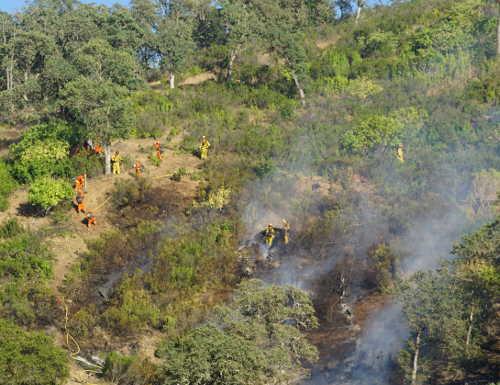
CLEARLAKE OAKS, Calif. – Firefighters have contained a wildland fire that burned several acres near Clearlake Oaks on Saturday evening.
The Sulphur Fire, contained just before 8 p.m., burned four acres, according to Cal Fire Capt. Will Schunk.
The incident was first reported shortly before 5:15 p.m. on Sulphur Bank Road near the Elem Colony, Cal Fire reported.
Firefighters arriving on scene found the fire making a run up the hillside, burning in brush and oak woodland, scanner reports indicated.
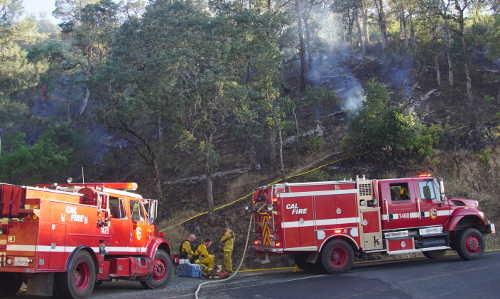
Cal Fire, Northshore Fire, Kelseyville Fire and Lake County Fire responded, Cal Fire Battalion Chief Greg Bertelli said.
The California Highway Patrol also was on scene to keep traffic away from the fire area, which was up a steep hillside along Sulphur Bank Drive.
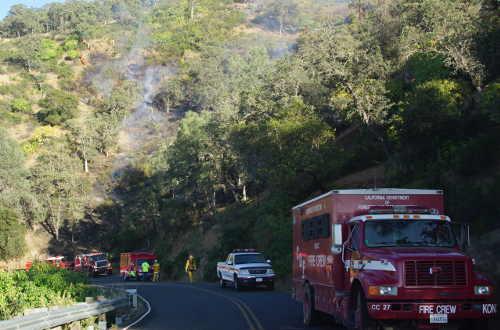
Cal Fire sent aircraft including air attacks, two helicopters and three air tankers from Mendocino and Sonoma counties to work the blaze, based on reports from the scene.
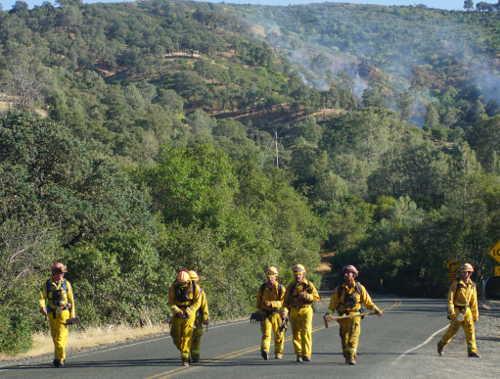
The agency said 126 personnel were working the incident, along with eight engine/truck companies, one water tender, four fire crews, four overhead or command personnel, and two bulldozers.
There were no structures threatened, Cal Fire said.
Bertelli said Sulphur Bank Road was to remain closed temporarily due to the presence of fire equipment.
The fire's cause remains under investigation, Bertelli said.
Bertelli said firefighters have roped off what they have concluded is the area of the fire's origin.
“We're going to keep chain of custody through the night,” he said.
He added, “We've done a preliminary fire investigation,” with a Cal Fire prevention officer to arrive on Sunday to continue the investigative work.
Two engines will remain at the scene through the night, and will be relieved by two new engines and a hand crew on Sunday morning, Bertelli said, with those relief crews expected to be committed about half a day.
The fire came hours after Cal Fire and several local fire agencies conducted a fire exercise in the Clearlake area, as Lake County News has reported.
Bertelli said the fire exercise had gone well, and had been kept relatively short in case an actual incident arose.
Email Elizabeth Larson at
MIDDLETOWN, Calif. – Pacific Gas and Electric offered community members an update this week about a cleanup project at a former geothermal waste collection site near Middletown.
The Middletown Area Town Hall, or MATH, hosted the presentation at its meeting Thursday evening at the Middletown Senior Center.
The presentation and a question-and-answer session takes place from the 17:14 minute mark to the 55:40 minute mark in the video above.
Geothermal Inc. operated the facility from 1976 to 1986 on 40 acres of a 460-acre property on Butts Canyon Road.
Rob Saur, PG&E's project manager for the site, explained that the dump facility consisted of evaporation ponds and solid waste disposal trenches which received waste from the exploration, development and operations at The Geysers energy field and power plant.
He said the waste materials – consisting primarily of drilling muds, drill cuttings, sump and plant process water – have been tested and are not hazardous.
After Geothermal Inc. went bankrupt, the 17 companies and agencies that had sent waste there – including PG&E – became responsible for the landfill closure, Saur said. PG&E took over the responsibility of the facility's closure and maintenance after purchasing the property in 2003.
Saur said the site closure took place between 2003 and 2006 under a plan approved by the Central Valley Regional Water Quality Control Board.
The closure entailed consolidating the waste materials into a single, closed, six-acre landfill that has a cap over it. As part of that process, he said they had to solar evaporate 21 million gallons out of the ponds in order to remove the muds and waste material, which was moved to the closed landfill.
Once the wastes were in the landfill, Saur said the wastes were capped with a high-density plastic layer, covered with a coarse drainage layer, over which was placed a clean soil cover and native grasses. He said the cap is meant to eliminate future infiltration of stormwater and rainwater through the waste material that's in the landfill.
As part of the closure, PG&E was required to create a separation between the bottom of the landfill and the groundwater, Saur said.
To do that, they lowered the spillway of nearby Freeman Lake and planted 32 acres of eucalyptus trees around the landfill. He said the trees' deep root systems tap into the water and act as pumps, pulling up the water and lowering the water level around the landfill. He said PG&E also created four acres of new wetlands and restored additional habitat.
Since the closure was completed, PG&E has been performing ongoing maintenance activities at the site which include inspection and maintenance of the closed landfill and tree plantings, mowing grass on the property and utilizing goats to create a fire break around the landfill, and trimming the trees, Saur said.
The work also includes groundwater and surface water monitoring. “Groundwater samples have been collected from this site for over 20 years, and we continue to do that today, and we'll be doing it far into the future as well,” Saur said.
PG&E collects samples from groundwater and surface water, and sends those samples to a laboratory for analysis, with the results reported to the State Water Board on a semiannual basis, he said.
Saur said the results of the testing before the closure and currently has shown that there are elevated concentrations of total dissolved solids – chloride, boron and sulfate – in the groundwater in the landfill's immediate vicinity.
Between 2011 and 2014, PG&E performed extensive studies to evaluate the effectiveness of the implemented closure. Saur said that work included drilling, installing equipment to measure water levels, field studies, testing of different alternatives and used a tool to help them predict future groundwater conditions.
Regarding the current closure status, Saur said the closure requirements have been met – except they have not been able to achieve the required year-round 5-foot separation between the groundwater and the waste. He said the groundwater impacts are stable and limited to the landfill's immediate vicinity.
Saur said PG&E is committed to achieving the separation requirement. Late last year, they began studies which led in April to the submission of a feasibility study and corrective action plan to the State Water Board for review.
PG&E looked at more than a dozen technologies and options to achieve the separation requirement, including underground barrier walls, groundwater extraction trenches, planting more trees around the landfill and removing some of the waste from the areas where they can't get the separation, Saur said.
Saur said PG&E proposed to the State Water Board to make drainage improvements to move stormwater from the landfill, which has been infiltrated by stormwater, and to build an underground barrier wall made of concrete slurry 20 feet into the ground to divert groundwater away from the landfill.
He said PG&E anticipates the State Water Board will approve the plan this year. Once that's done, they plan perform field work – possibly as early as this summer – to collect data to finalize design and engineering for the drainage work and the wall.
The drainage improvements are expected to take place in late summer or early fall, with the underground barrier likely to take place in the summer or fall of next year, Saur said.
Saur said that after the work is completed, PG&E will continue to monitor the site to ensure that the measure are successful.
Prior to the field work, PG&E will distribute work notices, place phone calls and emails to neighbors, and will provide updates to MATH as requested, Saur said. PG&E also is available by phone at all times for concerned community members.
PG&E received certification from the Wildlife Habitat Council for habitat created during the closure activities, Saur said.
Middletown High School students have been coming out to the site for the last few years to help monitor the wildlife habitat and to learn about closure and restoration activities. Saur said the company is looking forward to continuing working with the school in the next school year.
Following his presentation, Saur, along with Tracy Craig of PG&E Community Relations and Brian Bottari of the company's governmental affairs department, answered questions about life expectancy of the project, the materials used for capping, monitoring well locations and testing samples.
Asked about the plastic cap, which is underground, Saur said it's permanent, and is expected to last at least 50 years. It's inspected and will be replaced if there are problems.
MATH Board member Charlotte Kubiak asked why the waste materials had to be kept away from the groundwater if the materials aren't hazardous.
Saur said the materials were neither toxic nor hazardous, but the property was a disposal site that took waste – at the level between where household garbage would have been taken and a hazardous waste dump site – and so PG&E had to follow the state's closure requirements.
Kubiak asked about how to find out how the site was impacting groundwater and therefore the drinking water.
“We do not think that it's affecting the drinking water here,” said Saur, noting that PG&E has been monitoring the site for more than 20 years. They know where the groundwater impacts associated with the landfill are – they're in the landfill vicinity – and they have a robust monitoring network that will continue to help them monitor impacts.
Linda Diehl-Darms said it was important to let people know that the original dump site's linings were not good – which Saur acknowledged – and they leaked materials into the groundwater.
“Is there still a plume that goes towards Middletown in the groundwater?” she asked.
Saur said they think a lot of the groundwater impacts were the result of when the unlined ponds were in operation, before the facility was closed. He said the muds went into the ponds and water that came into contact with the wastes leached into the groundwater.
“These impacts have been there for many years and, yes, there is a groundwater plume there, still, but it is stable and in an isolated area,” Saur said.
Monica Rosenthal asked about the location of the site's monitoring wells. Saur said there are dozens of wells, the majority of them on the waste site, with some off site.
To test them, PG&E checks the water levels, pumps up the water, takes samples and sends those off for laboratory analysis, Saur said. The wells – in all directions around the landfill – are monitored on a quarterly or semiannual basis.
Dave Rosenthal asked the distance of the wells from the dump site. Saur said the furthest one away is located a quarter of a mile from the site.
Tom Darms raised questions about whether or not the groundwater would go around the underground barrier, and why a lining wasn't put into the bottom of the landfill.
Saur said they've looked at conditions in wet and dry years by using a groundwater model. He said they believe the underground barrier will work even in wet years.
As for a lining, he said the drilling muds in the landfill are basically the same materials as would have been used to line the landfill, so they didn't feel there was value in removing all the waste and then putting it back.
“It's important to note that we're not going at this alone. There is a very stringent regulatory agency over our shoulder on all of this. You don't have to take our word for it,” said Bottari.
The final question came from Kubiak, who asked the PG&E representatives if they would drink water from the tap if they lived in Middletown.
They said yes.
Community members who have questions or concerns can contact PG&E's environmental remediation hotline, 866-247-0581 or
Email Elizabeth Larson at
LAKE COUNTY, Calif. – Cal Fire is planning live fire training exercises in Lake County on Saturday.
The training will take place from 7:30 a.m. to noon at Highway 53 and Old Highway 53 by Pond Road in Clearlake.
Along with Cal Fire, Kelseyville Fire Protection, Northshore Fire Protection District, South Lake Fire Protection District, Lake County Fire Protection District and Lakeport Fire District also will be participating.
The United States Forest Service is committed to active wildland fires in Northern California and will not be participating.
This training will include burning approximately two acres on the dam face, which will allow Lake County Special Districts to conduct its annual inspection of the dam.
The exercise also will provide realistic wildland fire conditions to train firefighters in various tactical operations, which will include firing operations, helicopter safety, hoselays and communications.
Due to the current drought conditions, the training will provide firefighters additional training using water conservation measures.
NORTHERN CALIFORNIA – With drought conditions continuing into the summer months, the State Water Resources Control Board on Friday announce that there is insufficient water available for senior water right holders with a priority date of 1903 or later in the San Joaquin and Sacramento watersheds and the Delta.
The need for further curtailment of more senior rights and curtailments in other watersheds is being assessed weekly.
Notices are being sent to water right holders that direct recipients to stop diversions of water to protect more senior water rights and releases of previously stored water, as required by state law.
Diversion of water when water is not available under the right holder’s date of priority is unauthorized and unlawful. Violations are subject to fines up to $1,000 per day and $2,500 per acre-foot of water unlawfully diverted, cease and desist orders, or prosecution in court.
Senior water right holders with priority dates earlier than 1903 in the affected watersheds can continue to divert water in accordance with their water right. In addition, those who have previously stored water under a valid right may continue to hold that water or release it for beneficial use.
While this is the first time during the current drought that senior water right holders have been given notice that water is not available to serve their water right priority, it is not unprecedented. Some senior water right holders were curtailed during the drought of the late 1970s.
The water-curtailment actions taken Friday by the State Water Resources Control Board emphasize the importance of the California water-rights system, and the pressing need to improve supplies, according to California Farm Bureau Federation President Paul Wenger.
“The water-rights system was created to deal with unreliable, and often scarce, supplies, and we have scarcity that California hasn’t seen in many, many years, if ever,” Wenger said. “As the water-rights system responds to shortage in this extraordinary year, we must pursue long-term efforts to reduce the underlying scarcity that plagues us.”
Wenger noted that the additional cuts in water for food and farm production will deepen the impact of the four-year drought on rural parts of California.
The solution for California water shortages must come ultimately from aggressive efforts to improve supplies, Wenger said.
Water rights affected by this notice
Friday's curtailment notices affect 276 pre-1914 appropriative water rights held by 114 right holders. The notices do not affect any riparian right holders.
The water rights affected include:
– On the Sacramento River, 127 water rights with a priority date of 1903 or later are curtailed, affecting water rights held by 86 right holders.
– On the San Joaquin River, 24 water rights with a priority date of 1903 or later are curtailed, affecting water rights held by 14 right holders.
– In the Delta, 125 water rights with a priority date of 1903 or later are curtailed, affecting water rights held by 14 right holders.
The following uses are listed for the pre-1914 water rights affected by Friday’s notices:
– 135 water rights held by 53 right holders for irrigation, stockwatering, and/or livestock as the sole water use; and
– 208 water rights held by 80 right holders for irrigation, stockwatering, or livestock as at least one of the claimed water uses.
Among the districts impacted is the Yolo County Flood Control and Water Conservation District, which is curtailed in what it can take from Cache Creek in Lake County. The district also holds the main water rights for Clear Lake and for Indian Valley Reservoir.
Friday's action is based on reported diversion demands, estimates of natural flows and actual stream flows. Conditions in these and other watersheds continue to be monitored, and curtailment notices for other watersheds and for more senior water right holders in these watersheds may be imminent.
Some water right holders may have other, more senior rights to fall back on, or have water stored in reservoirs that they can still access. If that’s not available they will have to find other sources of water, such as groundwater or purchased water, if available. Water right holders are cautioned that groundwater resources are significantly depleted in some areas.
An explanation of state water rights
California water rights law is based on seniority. In dry years, when there isn’t enough water in the system to serve all water right holders, those with more junior rights are required to stop diverting water from rivers and streams before restrictions are imposed on more senior right holders.
The Water Commission Act of 1913, which took effect in 1914, created California’s system of water rights and the distinction between junior and senior appropriative water rights.
Senior water right holders are those claiming appropriative water rights established prior to the Water Commission Act and riparian water rights. Riparian water rights are rights granted to owners of land abutting a stream or river.
In most instances, riparian rights share equal priority to the available natural flow and have seniority over appropriative water rights (both pre-1914 and post-1914). For appropriative rights, the priority system is based on the concept of “first in time, first in right.”
The State Water Board administers California’s system of water rights and is authorized to prevent illegal diversions of water. Illegal diversions include taking water at times when there is insufficient water available under the priority of right held by the diverter.
The State Water Board issued two letters earlier this year warning all water-right holders that their rights may be curtailed due to drought conditions.
Last year, the State Water Board issued curtailment notices to more than 5,000 diverters on five watersheds statewide. Among them was the Hidden Valley Lake Community Services District, as Lake County News has reported.
In April and early May of this year, the State Water Board issued curtailment notices for all post-1914 water rights in the Sacramento and San Joaquin River watersheds and the Delta. Curtailment notices were issued in the Scott River and Deer Creek watersheds as well.
In May, the Hidden Valley Lake Community Services District was hit with another curtailment notice – after having received one last year – which General Manager Roland Sanford said they are disputing.
In addition, the State Water Board approved a proposal from riparian water right holders in the Sacramento-San Joaquin River Delta on May 22 to voluntarily cut back water use in exchange for assurances that they would not face enforcement actions in the event that their riparian water rights are curtailed more severely later during the June-September growing season. Riparian water right holders had until June 1 to elect to participate in the voluntary program.
The senior water rights affected by Friday's notice add to the growing number of water rights restricted by the state’s ongoing drought as demand far outstrips supply in key Northern California watersheds.
As of the Friday notice, a total of 8,721 junior water rights and 276 senior water rights in the Sacramento-San Joaquin River watersheds and Delta have been notified that there is insufficient water in the system to serve their rights.
To determine the need for curtailments, the State Water Board uses monthly diversion data and sorts that data by watershed, water right type and priority date. Water flow used for power generation that is diverted and returned back to the water course is removed from the analysis.
The demands for water use by type of right are summed and plotted graphically to display junior and senior water right needs.
To assess supply, monthly and daily natural flow data from the Department of Water Resources (DWR) are plotted with DWR estimates of return flows and additional minor tributary flows. The resulting Supply vs. Demand Curve indicates curtailment is needed when demand outstrips supply.
For this curtailment, several scenarios of delta and tributary demand were analyzed to produce conservative curtailment priority dates. As supplies continue to decline through the summer, it is expected that more senior rights will be subject to curtailment. As supply increases in the fall or winter, the State Water Board will lift the curtailment as soon as appropriate using the same procedure.
The State Water Board maintains a Web page to assist water right holders in several key watersheds to plan for possible limits on water supply availability. The Web page, titled “Watershed Analysis” ( http://www.waterboards.ca.gov/waterrights/water_issues/programs/drought/analysis/ ), details projected water supply, demand and availability for the watersheds most likely to face restrictions during the drought as demand outstrips available water supply.
Information on the drought is available at the State Water Board’s drought Web site, http://www.waterboards.ca.gov/waterrights/water_issues/programs/drought/index.shtml .