 How to resolve AdBlock issue?
News

CLEARLAKE OAKS, Calif. – Lake County Sheriff's deputies and Search and Rescue personnel are searching for a suicidal woman who went missing Saturday morning in Clearlake Oaks.
Shannon Sharee Gullickson, 36, is the subject of the search, according to a sheriff's office report.
On Saturday at approximately 9:37 a.m. Lake County Sheriff's deputies were dispatched to the area of Konocti Drive in Clearlake Oaks for a female, identified as Gullickson, attempting to harm herself, the agency said.
Prior to deputies arriving on scene Gullickson ran away from the area. Authorities said she was last seen walking down Konocti Drive towards Lakeview Court.
Gullickson was last seen wearing all black clothing, according to the report. She is described as 5 feet 5 inches tall and 170 pounds, with black hair and brown eyes. Recent social media posts by Gullickson indicate that she may have purple highlights in her hair.
If you know of Gullickson’s whereabouts or if you see her please contact the Lake County Sheriff’s Office immediately at 707-263-2690.
LAKEPORT, Calif. – Join the Friends of the Lake County Museum for a New Year's celebration at the Historic Courthouse Museum from 1 to 4 p.m. Saturday, Jan. 9.
The staff at the Historic Courthouse Museum will be present to answer questions and show off all that they have planned for the museum in 2016.
Get a sneak peek at the upcoming exhibits and events. This also is a chance to learn more about what the Friends of the Lake County Museum group does and how you could be a part of this great group of people who help support the museum.
There will be hot cider, homemade goodies, live music and an opportunity to relax after the stressful holiday season.
This event is free and open to the public and will start at 1 p.m. but the cider and treats will be available the whole afternoon.
The museum is wheelchair accessible.
The Historic Courthouse Museum is located at 255 N. Main St., Lakeport, telephone 707-263-4555.
LAKE COUNTY, Calif. – The California Highway Patrol's Clear Lake Area office will conduct a driving under the influence and driver's license safety checkpoint on Sunday, Jan. 3.
The checkpoint will occur somewhere within the unincorporated area of Lake County.
The CHP said its goal is to ensure the safe passage of each and every motorist by targeting roads where there is a high frequency of intoxicated or unlicensed drivers.
The sobriety/driver's license checkpoint is a proven effective tool for achieving this goal and is designed to augment existing patrol operations, the agency said.
Vehicles will be checked for drivers who are under the influence of alcohol or drugs, or driving unlicensed, the CHP said.
The CHP said it wants to send a clear message to those individuals who consider driving and mixing alcohol or drugs, or driving when unlicensed, that they will be caught and their vehicle will be towed away.
Funding for this program was provided by a grant from the California Office of Traffic Safety through the National Highway Traffic Safety Administration.
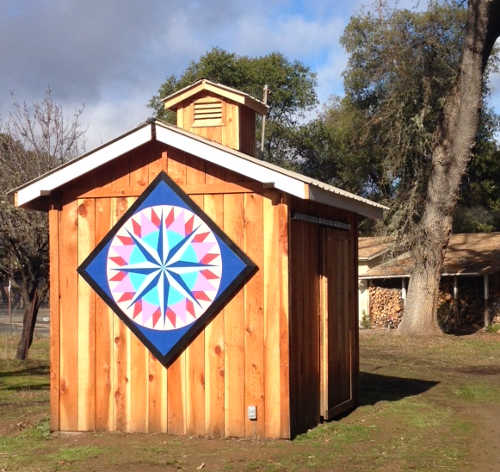
KELSEYVILLE, Calif. – The 80th quilt block on the Lake County Quilt Trail is “Carl’s Compass.”
It has been installed on Karlene and John Ellis’ outbuilding located near their gate on 2090 Bell Hill Road in Kelseyville.
“Carl’s Compass,” which is a rendition of a traditional quilt block called mariner’s compass, is in honor of Karlene’s dad, Carl Padgett, symbolizing his 25 years of service in the US Coast Guard.
Karlene and John Ellis received the property in 2002 from her father.
Carl Padgett’s love for farming and fishing in Lake County was lived every day on his 9.9 acres of walnuts.
He purchased the property in the early 1970s. A new home was built in 2011 and original buildings from the 1930s are being restored.
The Lake County Quilt Trail is an agricultural and tourism project designed to promote community pride.
The 4-foot by 4-foot quilt block was drawn and painted by the Lake County Quilt Trail team.
The Lake County Quilt Trail is a group of dedicated volunteer quilters, graphic artists, painters, writers, carpenters and a videographer.
For more information about the Lake County Quilt Trail visit www.lakecountyquilttrail.com or visit the group's Facebook page at https://www.facebook.com/Lake-County-Quilt-Trail-187014251326163/?fref=ts .
Researchers have found a new way to measure the pull of gravity at the surface of a star. For distant stars with planets orbiting them, this information is key in determining whether any of those planets can harbor life.
The new method is described in a study published today in Science Advances. The research was led by University of Vienna's Thomas Kallinger and involved UBC Professor Jaymie Matthews as well as astronomers from Germany, France and Australia.
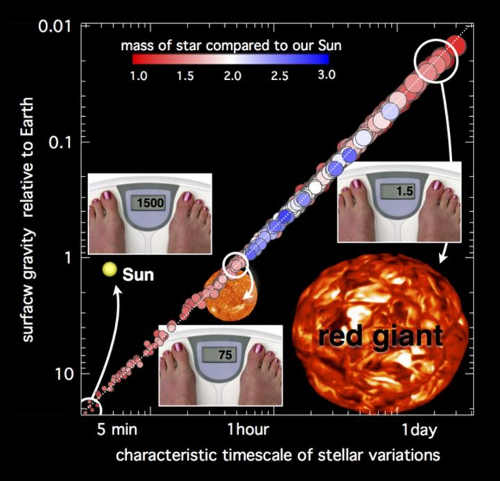
Knowing the surface gravity of a star is essentially knowing how much you would weigh on that star. If stars had solid surfaces on which you could stand, then your weight would change from star to star.
The Sun is hotter than a sauna, but don't expect to lose weight there. You'd weigh 20 times more than on Earth. A red giant star (the far-future fate of our Sun) has a much weaker pull at its surface, so you'd be 50 times lighter.
The new method allows scientists to measure surface gravity with an accuracy of about four per cent, for stars too distant and too faint to apply current techniques.
Since surface gravity depends on the star's mass and radius (just as your weight on Earth depends on its mass and radius), this technique will enable astronomers to better gauge the masses and sizes of distant stars.
It will play an exciting role in the study of planets beyond the Solar System, many so distant that even the basic properties of the stars they orbit can't be measured accurately.
"If you don't know the star, you don't know the planet," said study co-author, UBC Professor Jaymie Matthews. "The size of an exoplanet is measured relative to the size of its parent star. If you find a planet around a star that you think is Sun-like but is actually a giant, you may have fooled yourself into thinking you've found a habitable Earth-sized world. Our technique can tell you how big and bright is the star, and if a planet around it is the right size and temperature to have water oceans, and maybe life."
The new technique called the autocorrelation function timescale technique, or timescale technique for short, uses subtle variations in the brightness of distant stars recorded by satellites like Canada's MOST and NASA's Kepler missions.
Future space satellites will hunt for planets in the 'Goldilocks Zones' of their stars. Not too hot, not too cold, but just right for liquid water oceans and maybe life. Future exoplanet surveys will need the best possible information about the stars they search, if they're to correctly characterize any planets they find.
"The timescale technique is a simple but powerful tool that can be applied to the data from these searches to help understand the nature of stars like our Sun and to help find other planets like our Earth," said Kallinger, the study's lead author.
LOWER LAKE, Calif. – The Konocti Unified School District is among nine California organizations that have received federal grants to connect child nutrition programs with local farmers and ranchers through its Farm to School Program.
The US Department of Agriculture said the grant recipients in California will receive $672,795.
They're among 74 projects in 39 states that will receive $4.8 million in the fundings.
“Farm to school programs work – for schools, for producers, and for communities,” said USDA Secretary Tom Vilsack. “By serving nutritious and locally grown foods, engaging students in hands-on lessons, and involving parents and community members, these programs provide children with a holistic experience that sets them up for a lifetime of healthy eating. With early results from our Farm to School Census indicating schools across the nation invested nearly $600 million in local products, farm to school also provides a significant and reliable market for local farmers and ranchers.”
USDA’s Farm to School Grants fund school districts, state and local agencies, tribal nations, agricultural producers, and nonprofit organizations in their efforts to increase local foods served through child nutrition programs; teach children about food and agriculture through garden and classroom education; and develop schools’ and farmers’ capacities to participate in farm to school.
Awards ranging from $20,000 to $100,000 are distributed in four different grant categories: Planning, Implementation, Support Service, and Training.
Konocti Unified School District received a $45,000 planning grant to increase the use of locally-grown foods in school meals, and the number of students that participate in those meals, by embedding farm to school best practices into school culture.
Strategies the district will use include working with multiple schools, increasing local foods in summer meals, revising policies to facilitate local procurement, increasing school vegetable production, aligning experiential education with Common Core state standards, and engaging the community through marketing and promotion.
For the 2016 school year, the federal grants will serve more than 5,211 schools and 2.9 million students, nearly 40 percent of whom are eligible for free or reduced-price meals.
Farm to School programs help support California farmers and provide healthy, California-grown food to school children. CDFA strongly supports California’s Farm to School programs through its Office of Farm to Fork, which provides farm to school resources and helps California schools connect with California farmers through the online California Farmer Marketplace.
The other eight California grant recipients are as follows:
Center for Ecoliteracy, Berkeley
Grant Type: Support Service; $100,000
“California Thursdays” is a collaboration between the Center for Ecoliteracy and a network of school districts to serve freshly prepared school meals made from California-grown food. The network includes 42 districts that collectively serve over 250 million meals annually. This project will implement two new efforts: (1) a two-day training program to build capacity and provide technical expertise to nutrition services leaders, and (2) a robust website that features a public interface to improve communications and access to resources among the network.
County of Sonoma Department of Health Services, Santa Rosa
Grant Type: Support Service; $94,580
The Sonoma County Department of Health Services in California will work with key partners to expand farm to preschool programs at fifteen school-based pre-kindergarten sites serving low income families throughout Sonoma County. Activities will include Harvest of the Month educational tasting kits of farm fresh produce; procurement of locally grown foods into pre-kindergarten meal programs; increased hands-on learning in on-site gardens; and the development of comprehensive wellness policies that include farm to preschool language.
National Farm to School Network, San Francisco
Grant Type: Training – National; $49,665
The National Farm to School Network will conduct advanced trainings to support school food service/nutrition directors and farmers/producers in sustaining and expanding their farm to school work. Training will be held in conjunction with the 8th National Farm to Cafeteria Conference happening June 2 through 4, 2016, in Madison, WI.
Pasadena Unified School District, Pasadena
Grant Type: Implementation; $100,000
Pasadena Unified School District, previously a FY 2014 USDA Farm to School planning grantee, will systematically link fresh food procurement and preparation through staff and teacher training; classroom curriculum; and experiential activities for students in cafeterias, school gardens, and field trips to create an integrated, well-coordinated, and district-wide farm to school approach.
Plumas Unified School District, Quincy
Grant Type: Planning; $45,000
Plumas Unified School District will develop a five year plan to expand the existing school gardens and production greenhouse to all 13 prekindergarten-12th grade public schools. Teachers, ranchers, farmers, social service agencies, and interested community members will be invited to provide input in developing a sustainable garden education and local procurement plan. Representatives from the three neighboring counties will be included to explore a regional approach.
Sacramento City Unified School District, Sacramento
Grant Type: Implementation; $100,000
Sacramento City Unified School District, in partnership with the Food Literacy Center and Soil Born Farms, designed a farm to school project to include procurement of fresh vegetables, garden education, and nutrition education. This project will introduce a new vegetable each month to students in three pilot elementary schools and then to students throughout the district.
The Edible Schoolyard Project, Berkeley
Grant Type: Training – National; $45,050
This project will pilot a new Edible Schoolyard Intensive professional development program for farm to school practitioners from across the country to increase the ability of maturing farm to school programs to sustain long-term success by educating participants about how to forge strong relationships between school food service staff, school leaders, and classroom, garden, and kitchen educators.
Yolo County Department of Agriculture, Woodland
Grant Type: Support Service; $93,500
Building on the last three years of operating a successful farm to school program focused on procurement, this project will engage with local school districts to (1) acquire data on the quantity and frequency of foods being served through the meal programs, (2) track crop data for translation into yield for local farms, (3) provide training and writing services with farms to obtain their Good Agricultural Practices certification, and (4) provide services such as curated farm tours, farm availability listings, and business guidance for producers.