 How to resolve AdBlock issue?
News
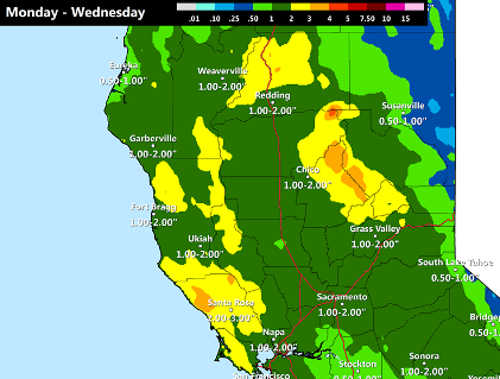
LAKE COUNTY, Calif. – More storms are heading toward Lake County and much of Northern California in the coming week, forecasters said Saturday.
The National Weather Service issued a special weather statement for areas including Lake County, warning of unsettled weather over the next several days.
Forecasters said a series of Pacific frontal systems will arrive this week.
On Sunday, light precipitation is expected, but additional storms to follow are expected to bring more rain. Tuesday is anticipated to have the most rain, with snow expected over the 4,500-foot elevation mark.
A generally wet pattern is expected to continue through late this week, according to the forecast.
The specific Lake County forecast predicts up to half an inch of rain on Sunday and as much as another quarter of an inch on Sunday night, with up to a quarter of an inch on Monday.
Overall, from Monday through Wednesday the National Weather Service is predicting between 2 and 3 inches of rain for Lake County, and about 1 inch of snow in the mountains in the county's northern section.
Chances of showers in Lake County are predicted through Saturday, with daytime highs into the low 50s and nighttime lows into the high 20s.
Email Elizabeth Larson at
California's forests are home to the planet's oldest, tallest and most-massive trees.
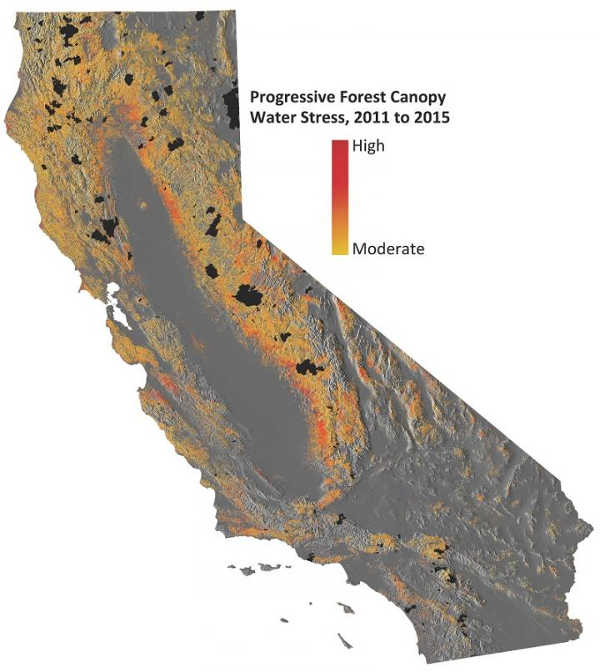
New research from Carnegie's Greg Asner and his team reveals that up to 58 million large trees in California experienced severe canopy water loss between 2011 and today due to the state's historic drought.
Their results are published in Proceedings of the National Academy of Sciences.
In addition to the persistently low rainfall, high temperatures and outbreaks of the destructive bark beetle increased forest mortality risk.
But gaining a large-scale understanding a forest's responses to the drought, as well as to ongoing changes in climate, required more than just a picture of trees that have already died.
A higher-tech approach was necessary; so Asner and his team used the laser-guided imaging spectroscopy tools mounted on the Carnegie Airborne Observatory (CAO) to measure the full impact of the drought on California's forests for the first time.
They combined the CAO data with more-traditional satellite data going back to 2011.
Their new approach revealed a progressive loss of water in California's forest canopies over the four-year span.
Mapping changes in canopy water content tells scientists when trees are under drought stress and greatly aids in predicting which trees are at greatest death and fire risk.
“California relies on its forests for water provisioning and carbon storage, as well as timber products, tourism, and recreation, so they are tremendously important ecologically, economically, and culturally,” Asner explained. “The drought put the forests in tremendous peril, a situation that may cause long-term changes in ecosystems that could impact animal habitats and biodiversity.”
The team's advanced tools showed that about 41,000 square miles of forest containing up to 888 million large trees experienced measurable losses of canopy water between 2011 and 2015.
Of this group, up to 58 million large trees reached water loss thresholds that the scientists deemed extremely threatening to long-term forest health.
Given the severity of the situation, even with increased precipitation due to El Nino, if drought conditions reoccur in the near future, the team predicts that there would be substantial changes to already significantly weakened forest structures and systems.
“The Carnegie Airborne Observatory's research provides invaluable insight into the severity of drought impacts in California's iconic forests. It will be important to bring their cutting-edge data and expertise to bear as the state seeks to address the effects of this epidemic of dying trees and aid in the recovery of our forests,” said Ashley Conrad-Saydah, deputy secretary for climate policy at the California Environmental Protection Agency.
Since day one of CAO flight operations, Asner has been engaged with forest managers and officials from the California EPA and Department of Forestry and Fire Protection to inform decision-makers on the severity of forest water losses from the drought and beetle outbreaks.
The team's results also helped motivate the California governor's recent proclamation of a state of emergency for dead and dying trees across the state.
The latest CAO maps of forest vulnerability were recently transmitted to both state and federal partners.
“Our high-resolution mapping approach identifies vulnerable trees and changing landscapes,” Asner added. “Continued airborne and satellite monitoring will enable actions on the ground to mitigate a cascade of negative impacts from forest losses due to drought, as well as aid in monitoring forest recovery if and when the drought subsides.”
This study was supported by the David and Lucile Packard Foundation.
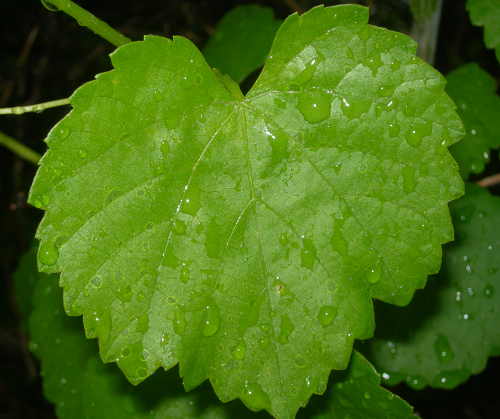
“Let us celebrate the occasion with wine and sweet words.” – Plautus
LAKE COUNTY, Calif. – The tradition of celebrating the new year with sparkling wine spans back more than 1,500 years.
The bubbles that arise so cheerfully from the festive libation come from carbon dioxide in the wine due to fermentation.
Technically, the bubbly can own the moniker “Champagne” only if it is produced in the Champagne region of France. Other fizzy wines worldwide include Brachetto or Spumante (Italy) or Australia's Shiraz.
Here in Lake County where our wine regions are bursting at the seams with somewhere around 35 premium wineries, there are a handful who produce a bubbly, or sparkling wine: Thorn Hill, Steele Wines, Olof Cellars, according to the book, “Lake County Wine Guide.”
The fine wines for which Lake County is famous are due to the soil, climate and elevations found here. Lake County elevations range from 1,000 feet in Middletown, 1,318 feet in Clearlake, to 4,722 feet at Cobb Mountain.
The history of the grape stretches back to the Tertiary period of geologic time. Fossils of leaves and seeds have been excavated from the mounds of the pile-dwellers of the lakes located in south-central Europe.
Evidence of humankind's fondness for grapes has been shown in mosaics made during 2440 B.C, in Egypt.
Viticulture is thought to have begun in Asia Minor between, and south of the Caspian and Black Seas. It is here, where most botanists agree, that Vitis vinifera, the original grape species from which all cultivated grapes are derived, began.
It is said that grape growing then moved to the eastward and westward directions. The Phoenicians are thought to have brought winegrape varietals to Greece, then Rome and France.
By the second century A.D., vine cuttings were brought to Germany and established there. Southern California was introduced to viticulture by the missionaries in the late 1700s.
With the mission's northward movements, so followed grape growing, extending to where soil and weather conditions were extremely hospitable for the task.
Wild vines were found by the missionaries of San Diego, thought to be Vitis girdiana, native to the region. These grapes were large and sour, hence the padres introduction of the variety which they had been cultivating farther south, which was vinifera.
Grape growing and winemaking in Lake County are not new ventures. Pioneers brought in grapes and began to produce wine around the Gold Rush days. At the turn of the twentieth century there were 36 wineries in production.
Then, when prohibition struck, vines were replaced in Lake County by pears and walnuts. As the railroad never made it to isolated Lake County, this, too was a contributing factor to the disappearance of the wine trade in Lake County until 1977.
When Lillie Langtry purchased the Guenoc Ranch, outside of Middletown, in 1888, she renamed the ranch “Langtry Farms.”
Lillie Langtry (or, Lily, as she is sometimes known) was born Emilie Charlotte LeBreton on October 13, 1853, and was world famous for her great beauty, charm and acting.
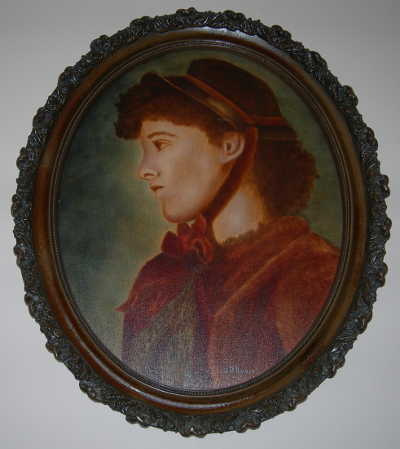
There were already established fruit orchards and vineyards on the land. Lillie was highly adept at marketing, and one of her strategies was to market her wine with her likeness on the label.
She imported a French winemaker, Henry Duchelles, for her winery. Her colorful lifestyle always made Lillie's visits to Lake County an event for the local folk.
Lillie had an ongoing love affair and friendship with Prince Albert Edward of Wales, the future King of England, which spanned over 20 years.
She began her stage acting in England, and made her American debut in New York, with Oscar Wilde as her advance man in 1882. It was Oscar who introduced Lillie to Freddie Gebhard, the wealthy Baltimore playboy, who lived on the ranch with Lillie.
Freddie purchased the adjoining 3,000 acres with its hunting lodge. When Freddie wasn't living in Lillie's home, where he had his own bedroom (adjoining Lillie's) he resided in his lodge.
For up-to-the-minute information on Lake County's wineries visit these Web sites:
– Lake County Winegrape Growers: http://www.lakecountywinegrape.org/ ;
– Lake County Winery Association Facebook: https://www.facebook.com/LakeCountyWineryAssociation/ ;
– Lake County Winegrape Commission: http://www.lakecountywinegrape.org/about/winegrape-commission/ .
Kathleen Scavone, M.A., is an educator, potter, writer and author of “Anderson Marsh State Historic Park: A Walking History, Prehistory, Flora, and Fauna Tour of a California State Park” and “Native Americans of Lake County.” She also writes for NASA and JPL as one of their “Solar System Ambassadors.” She was selected “Lake County Teacher of the Year, 1998-99” by the Lake County Office of Education, and chosen as one of 10 state finalists the same year by the California Department of Education.
LAKE COUNTY, Calif. – Lake County Animal Care and Control is starting off the new year with a big selection of dogs needing new homes.
Adoptable dogs offered this week include mixes of Australian Shepherd, border collie, cattle dog, Dalmatian, hound, husky, Labrador Retriever, Leonberger, pit bull, shepherd and terrier.
Dogs that are adopted from Lake County Animal Care and Control are either neutered or spayed, microchipped and, if old enough, given a rabies shot and county license before being released to their new owner. License fees do not apply to residents of the cities of Lakeport or Clearlake.
If you're looking for a new companion, visit the shelter. There are many great pets hoping you'll choose them.
In addition to the animals featured here, all adoptable animals in Lake County can be seen here: http://bit.ly/Z6xHMb .
The following dogs at the Lake County Animal Care and Control shelter have been cleared for adoption (additional dogs on the animal control Web site not listed are still “on hold”).

Labrador Retriever-Dalmatian mix
This male Labrador Retriever-Dalmatian has a short black coat with white markings.
He also has one blue eye and one brown eye.
Shelter staff said he has a low energy level and is good with other dogs.
He's in kennel No. 5, ID No. 4138.

'Parkah'
“Parkah” is a male shepherd-retriever mix.
He's a handsome fellow with a short tan coat with white and black markings.
Shelter staff said he would do well in a home with no other dogs.
He's in kennel No. 8, ID No. 4220.
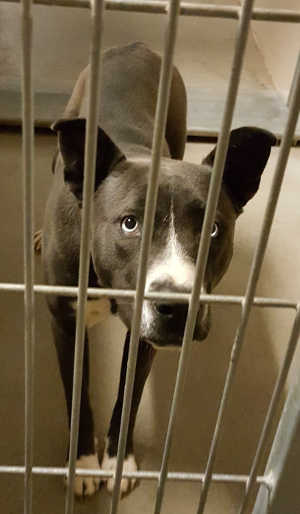
Border collie-husky mix
This female border collie-husky mix has a short gray and white coat.
She's in kennel No. 9, ID No. 4217.
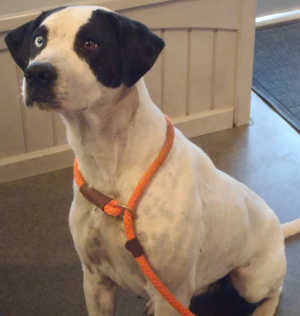
Cattle dog mix
This female cattle dog mix has a short white coat with black markings, and one brown and one blue eye.
Shelter staff said she has great manners, knows how to sit and lie down. She is a little hesitant about being indoors – she may only have been an outside dog – but is adapting well. She's good with other dogs. Based on her evaluation, she seems to like male dogs more than females.
“She will melt your heart in minutes,” shelter staff said.
She's in kennel No. 10, ID No. 4152.
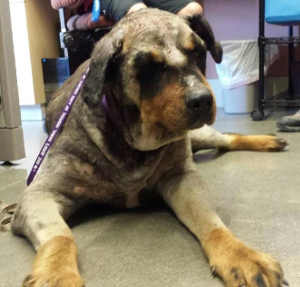
'Cache'
“Cache” has had a rough year. He was rescued from the area of the Jerusalem fire this summer and adopted, but later returned because of an issue with his adopter's cat.
Shelter staff said he's a gentle, mellow giant that is part Leonberger. He's looking for a special person to give him a home for the rest of his life.
Cache is in kennel No. 11, ID No. 3101.

Pit bull mix
This female pit bull mix has a short gray coat with white markings.
Shelter staff said she is great with other dogs and is very people friendly, just wanting to sit in your lap. She has a low energy level and would do well in home with children.
She's in kennel No. 18, ID No. 3194.

Pit bull terrier
This female pit bull terrier mix has a short black coat with white markings.
Shelter staff said she was brought in as a stray and is hoping her family will come for her.
She is in kennel No. 19, ID No. 4213.
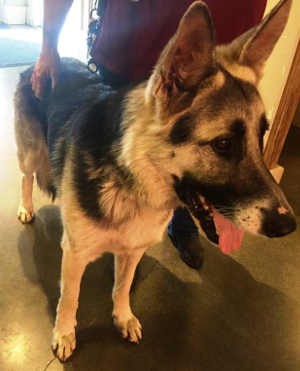
German Shepherd mix
This male German Shepherd mix has a silver and black coat with white markings.
Shelter staff said he is a beautiful boy who does not have any problems with food aggression, and is tolerant with being handled and having his feet, tail and skin pulled with no problems.
He does fine with other dogs, male or female. He has a lot of potential, and just needs somebody who will work with him.
Find him in kennel No. 22, ID No. 4116.

Shepherd-pit bull terrier mix
This young female shepherd-pit bull terrier mix has a short brown brindle coat.
Shelter staff describe her as a cuddle bug. She has no food aggression and gets along well with cats. While she gets nervous around more excited dogs, when introduced to a calmer shepherd mix, she was much more comfortable with him. She would love someone who is calm and patient with her.
She is in kennel No. 23b, ID No. 4201.
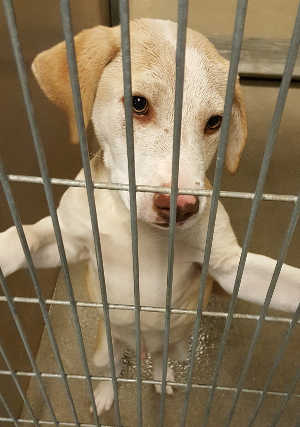
Labrador Retriever-hound mix
This male Labrador Retriever-hound mix pup has a short cream-colored coat with light brown markings.
He came to the shelter because his human is in rehab and his caretaker can no longer keep him.
He's in kennel No. 25, ID No. 4115.

Pit bull terrier puppies
Two pit bull puppies are available to new homes.
They are in kennel No. 26b, ID No. 4228.
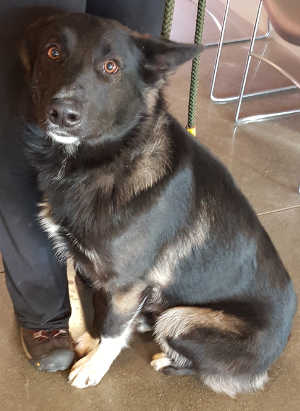
Shepherd-Australian Shepherd mix
This male shepherd-Australian Shepherd mix has a black coat with tan and white markings.
Shelter staff said he is a handsome and sweet boy.
He's in kennel No. 31, ID No. 4197.
To fill out an adoption application online visit http://www.co.lake.ca.us/Government/Directory/Animal_Care_And_Control/Adopt/Dog___Cat_Adoption_Application.htm .
Lake County Animal Care and Control is located at 4949 Helbush in Lakeport, next to the Hill Road Correctional Facility.
Office hours are Monday through Friday, 11 a.m. to 5 p.m., and 11 a.m. to 3 p.m., Saturday. The shelter is open from 11 a.m. to 4 p.m. Monday through Friday and on Saturday from 11 a.m. to 3 p.m.
Visit the shelter online at http://www.co.lake.ca.us/Government/Directory/Animal_Care_And_Control.htm .
For more information call Lake County Animal Care and Control at 707-263-0278.
Email Elizabeth Larson at

A new way to test one of the basic principles underlying Einstein's theory of General Relativity using brief blasts of rare radio signals from space called Fast Radio Bursts is 10 times, to one-hundred times better than previous testing methods that used gamma-ray bursts, according to a paper just published in the journal Physical Review Letters.
The paper received additional highlighting as an "Editor's Suggestion" due to "its particular importance, innovation, and broad appeal," according to the journal's editors.
The new method is considered to be a significant tribute to Einstein on the 100th anniversary of his first formulation of the Equivalence Principle, which is a key component of Einstein's theory of General Relativity.
More broadly, it also is a key component of the concept that the geometry of spacetime is curved by the mass density of individual galaxies, stars, planets, and other objects.
Fast Radio Bursts are super-brief blasts of energy – lasting just a few milliseconds. Until now, only about a dozen Fast Radio Bursts have been detected on Earth. They appear to be caused by mysterious events beyond our Milky Way Galaxy, and possibly even beyond the Local Group of galaxies that includes the Milky Way.
The new technique will be important for analyzing the abundance of observations of Fast Radio Bursts that advanced radio-signal observatories, now being planned, are expected to detect.
"With abundant observational information in the future, we can gain a better understanding of the physical nature of Fast Radio Bursts," said Peter Mészáros, Holder of the Eberly Family Chair in Astronomy and Astrophysics and Professor of Physics at Penn State, the senior author of the research paper.
Like all other forms of electromagnetic radiation including visible light, Fast Radio Bursts travel through space as waves of photon particles.
The number of wave crests arriving from Fast Radio Bursts per second – their "frequency" – is in the same range as that of radio signals.
"When more-powerful detectors provide us with more observations," Mészáros said, "we also will be able to use Fast Radio Bursts as a probe of their host galaxies, of the space between galaxies, of the cosmic-web structure of the universe, and as a test of fundamental physics."
The impact of the new method using Fast Radio Bursts is expected to increase significantly as more of the bursts are observed, and if their origin can be established more firmly.
"If Fast Radio Bursts are proven to originate outside the Milky Way Galaxy, and if their distances can be measured accurately, they will be a new powerful tool for testing Einstein's Equivalence Principle and for extending the tested energy range down to radio-band frequencies," Mészáros said.
Einstein's Equivalence Principle requires that any two photons of different frequencies, emitted at the same time from the same source and traveling through the same gravitational fields, should arrive at Earth at exactly the same time.
"If Einstein's Equivalence Principle is correct, any time delay that might occur between these two photons should not be due to the gravitational fields they experienced during their travels, but should be due only to other physical effects," Mészáros said. "By measuring how closely in time the two different-frequency photons arrive, we can test how closely they obey Einstein's Equivalence Principle."
More specifically, Mészáros said the test that he and his coauthors developed involves an analysis of how much space curvature the photons experienced due to massive objects along or near their path through space.
He said, "Our test of Einstein's Equivalence Principle using Fast Radio Bursts consists of checking by how much does a parameter – the gamma parameter – differ for the two photons with different frequencies."
Mészáros said his research team's analysis of the less-than-a-dozen recently detected Fast Radio Bursts "supersedes by one to two orders of magnitude the previous best limits on the accuracy of the Einstein Equivalence Principle," which were based on gamma rays and other energies from a 1987 supernova explosion, supernova 1987A.
"Our analysis using radio frequencies shows that the Einstein Equivalence Principle is obeyed to one part in a hundred million," Mészáros said. "This result is a significant tribute to Einstein's theory, on the hundredth anniversary of its first formulation."
CLEARLAKE OAKS, Calif. – The Lake County Sheriff's Office said a woman who deputies had been searching for has been located.
Shannon Shareen Gullickson, 36, had gone missing Saturday morning in Clearlake Oaks after attempting to harm herself.
The sheriff's office did not immediately offer details about where she was found.
The agency thanked all community members for their assistance in the search.