 How to resolve AdBlock issue?
News
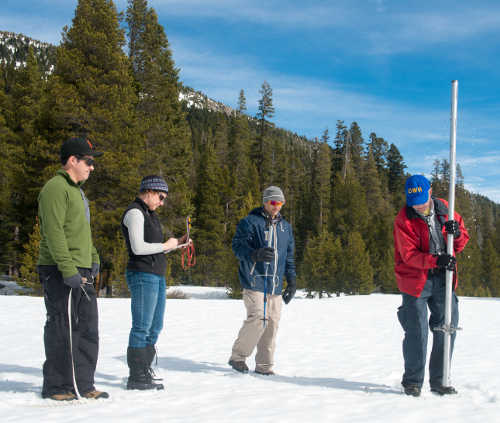
The statewide snowpack – source of much of the California’s water supply – is only 83 percent of the March 1 average, the result of moderate precipitation since last October and relatively warm temperatures.
“Mother Nature is not living up to predictions by some that a ‘Godzilla’ El Niño would produce much more precipitation than usual this winter,” said DWR Director Mark Cowin. “We need conservation as much as ever.”
The Department of Water Resources (DWR) conducted its third media-oriented snowpack survey of the season Tuesday 90 miles east of Sacramento just off Highway 50 in the Sierra Nevada. Phillips Station is one of about 250 snow courses measured manually several times each winter.
Frank Gehrke, chief of the California Cooperative Snow Surveys Program, and his survey team measured snow that was 58.3 inches deep at Phillips with a water content of 27.1 inches.
The Phillips readings are the best for early March since 2011, but individual snow courses are not generally representative of the entire mountain snowpack.
The statewide readings suggest this may not be a drought-busting year unless California receives heavy rain this month as it did during the “March Miracles” of 1991 and 1995.
“Right now, we’re obviously better than last year but still way below what would be considered adequate for any reasonable level of recovery at this point,” Gehrke said.
Electronic readings of northern Sierra Nevada snow conditions found 23.1 inches of water content 83 percent of normal for March 1), 212.7 inches in the central region (85 percent of normal) and 16.6 inches in the southern region (73 percent of normal).
Tuesday's snow measurements at Phillips were markedly improved compared to March 2015, when the depth was only 6.5 inches and the water content just 1 inch.
Dry conditions persisted in March, and Gov. Jerry Brown stood on bare ground on April 1 when he mandated a 25-percent reduction in water use throughout California.
Traditionally, half of the state’s annual water falls as rain or snow during December, January and February.
Precipitation in December and January measured at weather stations monitored electronically by DWR was 170 percent of the two-month average, but October, November and February rainfall was far below normal. Snowfall since Dec. 1 has mirrored that pattern.
In normal years, the snowpack supplies about 30 percent of California’s water needs as it melts in the spring and early summer.
The greater the snowpack water content, the greater the likelihood California’s reservoirs will receive ample runoff as the snowpack melts to meet the state’s water demand in the summer and fall.
Among the eight reservoirs with capacities of one million acre-feet or more tracked by DWR, all are currently below average storage for this date, from New Melones (31 percent) to Lake Shasta (83 percent).
The only major reservoir with current storage above its historical average on this date is Folsom Lake (111 percent).
MIDDLETOWN, Calif. – The California Highway Patrol will host “Coffee with a Cop” in Middletown this week.
The event will take place from 7 to 10 a.m. Wednesday, March 2, at the Cowpoke Café, 21118 Calistoga Road.
Community members will have the chance to sit down with the CHP and other members of law enforcement and talk about local issues.
Lt. Hector Paredes, commander of the CHP's Clear Lake Area office based in Kelseyville, said engaging with the community and finding ways to enhance public trust are top priorities for the CHP.
“'Coffee with a Cop' is a wonderful program that allows members of the public to meet and speak with its officers about any public safety issue in an informal setting,” he said. “We are grateful to Cowpoke Café for hosting this special event and I look forward to speaking to our community with a good cup of Joe!”
CHP Officer Kory Reynolds said future 'Coffee with a Cop' programs are planned around the county.
“Coffee with a Cop” is a program that began in Hawthorne in 2011 as a way to interact more successfully with the community.
Since then it has since spread across the country and to Canada, Europe, Australia and Africa.
“The key to Coffee with a Cop’s growing success is that it opens the door for interactions outside of the crisis situations that typically bring law enforcement officers and community members together,” according to the organization's Web site.
For more information visit http://coffeewithacop.com .
Email Elizabeth Larson at [email protected] . Follow her on Twitter, @ERLarson, or Lake County News, @LakeCoNews.
Caltrans invites the public to help shape the state’s transportation future by offering input and comments on the California Transportation Plan 2040 (CTP 2040).
The Plan lays out a vision for California's transportation future to provide mobility, support a vibrant economy and meet greenhouse gas emission reduction goals.
“The public can play a key role in the long-term vision we are creating for California’s transportation system,” said Caltrans Director Malcolm Dougherty. “Our population is growing, the way we live and move is changing, our transportation system needs evolving, and therefore our game plan needs to be forward-thinking.”
The CTP 2040 envisions a fully integrated, multimodal and sustainable transportation system in California.
Caltrans seeks public input to help ensure the CTP 2040 is fully consistent with the department’s mission of delivering a low-carbon transportation system capable of meeting our goals of mobility, safety and sustainability.
The CTP 2040 supports Governor Brown’s goal of reducing greenhouse gas emissions. It will help meet goals consistent with California’s existing commitment to reduce emissions 80 percent below 1990 levels by 2050.
The development of the CTP is an open and collaborative planning process that includes early and continuous engagement with governmental agencies at all levels, the private sector, advocacy groups, community organizations and the public.
The public can review and comment on the plan via www.californiatransportationplan2040.org .
Comments may also be submitted by email to
Comments must be submitted by 5 p.m., March 29, 2016.
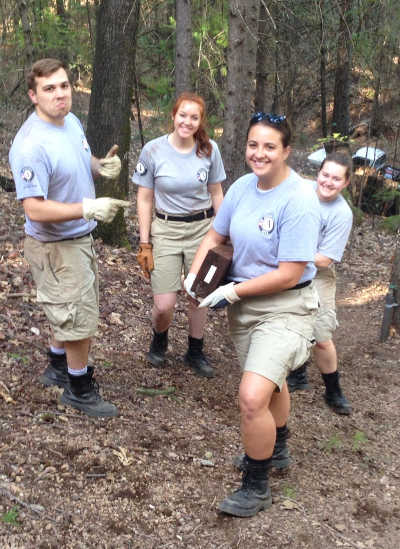
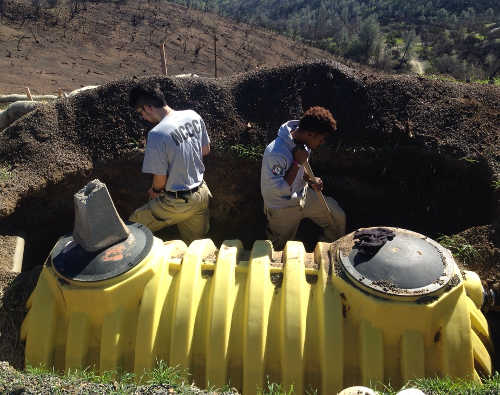
LAKE COUNTY, Calif. – With the welcome assistance of two groups of AmeriCorps volunteers, Habitat for Humanity Lake County has begun work on two homes for victims of the Lake County fires.
Once the weather improves and the winter rains are over, full-scale work will be under way to provide as many homes as possible for displaced families, the organization said.
To do this, Habitat for Humanity Lake County said it needs community support.
“By pulling together, we can make a difference to the community and the families affected by the fires,” the organization said in a statement.
If you, your organization, or business would like to participate in the rebuild process, monetary contributions are needed in addition to land, contractor labor and lunches for work crews.
Contact the Habitat for Humanity Lake County office at 707-994-1100 or come by the office at 16285A Main St. in Lower Lake to discuss how you can help.
California Gov. Edmund G. Brown Jr. has released annual applicant and appointee data for the administration's judicial appointments.
From 2011 through 2015, there were 1,817 applicants for judicial appointments and Gov. Brown appointed 311 judges, including 74 in 2015.
Approximately 35 percent of the applicant pool and 39 percent of Gov. Brown’s appointees identified themselves as American Indian or Alaska Native; Asian; Black or African-American; Hispanic; Native Hawaiian or Other Pacific Islander; or other/unknown.
From 2011 through 2015, Gov. Brown's judicial appointees included a number of notable firsts:
– Sonia Cortés, the first Latino judge ever appointed to the Yolo County Superior Court.
– Marsha G. Slough, the first openly gay justice in the history of the Fourth District Court of Appeal.
– Luis A. Lavin, the first openly gay justice to serve on the Second District Court of Appeal.
– Therese M. Stewart, the first openly lesbian justice to serve on the California Court of Appeal.
– Ferdinand P. Inumerable, the first Asian-American judge ever appointed to the Ventura County Superior Court.
– M. Bruce Smith, the first African-American judge to serve on the Fifth District Court of Appeal.
– Paul Lo, the first Hmong American judge ever appointed in the country;
– Sunshine Sykes, the first Native American judge ever appointed to the Riverside County Superior Court;
– Sunil Kulkarni, the first South Asian American judge ever appointed in Northern California;
– Rupa Goswami, the first South Asian American woman judge ever appointed in California.
– Halim Dhanidina, the first American-Muslim judge ever appointed in California.
– Jim Humes, the first openly gay justice ever appointed to the California Court of Appeal.
– Miguel Marquez, the first Latino justice ever appointed to the Sixth District Court of Appeal.
– Rosendo Peña, the first Latino justice ever appointed to the Fifth District Court of Appeal.
– Chris Doehle, the first female judge ever appointed to the Del Norte County Superior Court.
– Kimberly Colwell, the first openly lesbian judge ever appointed to the Alameda County Superior Court.
– Mark Andrew Talamantes, the first Latino judge ever appointed to the Marin County Superior Court.
– Kathleen O'Leary, the first female presiding justice ever appointed to the Fourth District Court of Appeal, Division Three.
– Raquel Marquez, the first Latina judge ever appointed to the Riverside County Superior Court.
Under SB 56 and SB 182, the governor is required to disclose aggregate statewide demographic data provided by all judicial applicants by March 1.
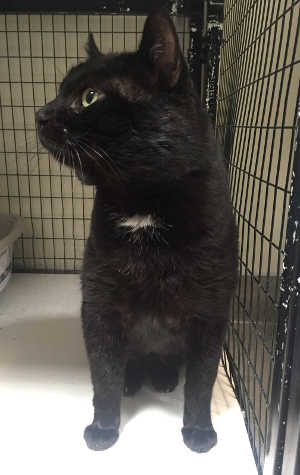
LAKE COUNTY, Calif. – There are black cats, and then there are big black cats.
This handsome fellow is a recent arrival at Lake County Animal Care and Control.
He's got a mostly black coat – with the exception of a little white spot on his chest. Sort of like a pocket square.
Black cats are incredibly cool, they have great attitudes and are fantastic pals.
Shelter staff said this guy likes attention, and he's also chatty.
Stop by to visit him and consider giving him a great new home.
He's in cat room kennel No. 35, ID No. 4325.
In addition to spaying or neutering, cats that are adopted from Lake County Animal Care and Control are microchipped before being released to their new owner. License fees do not apply to residents of the cities of Lakeport or Clearlake.
If you're looking for a new companion, visit the shelter. There are many great pets there, hoping you'll choose them.
All adoptable animals in Lake County can be seen here: http://bit.ly/Z6xHMb .
Adoptable cats also can be seen at http://www.co.lake.ca.us/Government/Directory/Animal_Care_And_Control/Adopt/Cats_and_Kittens.htm or at www.petfinder.com .
To fill out an adoption application online visit http://www.co.lake.ca.us/Government/Directory/Animal_Care_And_Control/Adopt/Dog___Cat_Adoption_Application.htm .
Lake County Animal Care and Control is located at 4949 Helbush in Lakeport, next to the Hill Road Correctional Facility.
Office hours are Monday through Friday, 11 a.m. to 5 p.m., and 11 a.m. to 3 p.m., Saturday. The shelter is open from 11 a.m. to 4 p.m. Monday through Friday and on Saturday from 11 a.m. to 3 p.m.
Visit the shelter online at http://www.co.lake.ca.us/Government/Directory/Animal_Care_And_Control.htm .
For more information call Lake County Animal Care and Control at 707-263-0278.
Email Elizabeth Larson at