 How to resolve AdBlock issue?
News
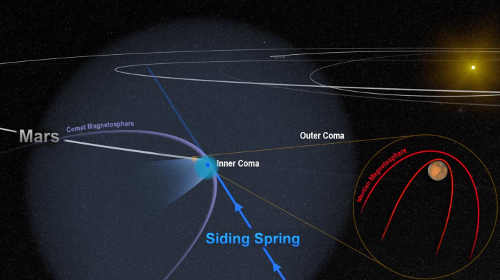
Just weeks before the historic encounter of comet C/2013 A1 (Siding Spring) with Mars in October 2014, NASA's Mars Atmosphere and Volatile Evolution (MAVEN) spacecraft entered orbit around the Red Planet.
To protect sensitive equipment aboard MAVEN from possible harm, some instruments were turned off during the flyby; the same was done for other Mars orbiters.
But a few instruments, including MAVEN's magnetometer, remained on, conducting observations from a front-row seat during the comet's remarkably close flyby.
The one-of-a-kind opportunity gave scientists an intimate view of the havoc that the comet's passing wreaked on the magnetic environment, or magnetosphere, around Mars. The effect was temporary but profound.
“Comet Siding Spring plunged the magnetic field around Mars into chaos,” said Jared Espley, a MAVEN science team member at NASA's Goddard Space Flight Center in Greenbelt, Maryland. “We think the encounter blew away part of Mars' upper atmosphere, much like a strong solar storm would.”
Unlike Earth, Mars isn't shielded by a strong magnetosphere generated within the planet.
The atmosphere of Mars offers some protection, however, by redirecting the solar wind around the planet, like a rock diverting the flow of water in a creek.
This happens because at very high altitudes Mars' atmosphere is made up of plasma – a layer of electrically charged particles and gas molecules. Charged particles in the solar wind interact with this plasma, and the mingling and moving around of all these charges produces currents.
Just like currents in simple electrical circuits, these moving charges induce a magnetic field, which, in Mars' case, is quite weak.
Comet Siding Spring is also surrounded by a magnetic field. This results from the solar wind interacting with the plasma generated in the coma – the envelope of gas flowing from a comet's nucleus as it is heated by the sun.
Comet Siding Spring's nucleus – a nugget of ice and rock measuring no more than about one-third of a mile – is small, but the coma is expansive, stretching out more than 600,000 miles in every direction.
The densest part of the coma – the inner region near the nucleus – is the part of a comet that's visible to telescopes and cameras as a big fuzzy ball.
When comet Siding Spring passed Mars, the two bodies came within about 87,000 miles of each other.
The comet's coma washed over the planet for several hours, with the dense inner coma reaching, or nearly reaching, the surface.
Mars was flooded with an invisible tide of charged particles from the coma, and the powerful magnetic field around the comet temporarily merged with – and overwhelmed – the planet's own weak one.
“The main action took place during the comet's closest approach,” said Espley, “but the planet's magnetosphere began to feel some effects as soon as it entered the outer edge of the comet's coma.”
At first, the changes were subtle. As Mars' magnetosphere, which is normally draped neatly over the planet, started to react to the comet's approach, some regions began to realign to point in different directions.
With the comet's advance, these effects built in intensity, almost making the planet's magnetic field flap like a curtain in the wind.
By the time of closest approach – when the plasma from the comet was densest – Mars' magnetic field was in complete chaos. Even hours after the comet's departure, some disruption continued to be measured.
Espley and colleagues think the effects of the plasma tide were similar to those of a strong but short-lived solar storm.
And like a solar storm, the comet's close passage likely fueled a temporary surge in the amount of gas escaping from Mars' upper atmosphere. Over time, those storms took their toll on the atmosphere.
“With MAVEN, we're trying to understand how the sun and solar wind interact with Mars,” said Bruce Jakosky, MAVEN's principal investigator from the University of Colorado's Laboratory for Atmospheric and Space Physics in Boulder. “By looking at how the magnetospheres of the comet and of Mars interact with each other, we're getting a better understanding of the detailed processes that control each one.”
This research was published in Geophysical Research Letters.
LAKEPORT, Calif. – The shape of the local races for three supervisorial seats in the June primary came one step closer to being finalized as one of the deadlines arrived, with another around the corner next week.
The supervisorial seats for Districts 1, 4 and 5 are up for election this year. The seats currently are represented by Jim Comstock, Anthony Farrington and Rob Brown, respectively.
On Friday the nomination period closed for any race in which the incumbent filed for reelection, according to Lake County Registrar of Voters Diane Fridley.
This year, the only race in which that is the case is District 5, Fridley said Friday evening.
Brown has filed to seek a fifth term, and he will be challenged this year by Philip Reimers of Cobb and John Wesley Stoddard of Kelseyville, Fridley said.
Because neither Comstock nor Farrington have filed to seek reelection, Fridley said the nomination period for their seats will be extended until 5 p.m. Wednesday, March 16.
In District 1, as of 5 p.m. Friday, the individuals who has filed all of the required paperwork and are officially candidates on the June 7 ballot were Voris Brumfield, Monica Rosenthal, Jim Ryan and Jose “Moke” Simon III, Fridley said.
In District 4, Fridley said that the candidates who have filed and will appear on the ballot as of Friday include Martin Scheel, Tina Scott and Ted Mandrones.
Until the end of day Wednesday, it's still possible that there could be changes in the composition of both of those races.
For more information about filing for elective office contact the Registrar of Voters office in person at the Lake County Courthouse, 255 N Forbes St, Room 209, Lakeport, or by phone at 707-263-2372.
Email Elizabeth Larson at
MIDDLETOWN, Calif. – Attendees at the Middletown Area Town Hall meeting on Thursday night received an update on a plan to build a roundabout north of town.
MATH Board Chair Fletcher Thornton added to the agenda the update from Jaime Matteoli, Caltrans' project manager on the roundabout, which is proposed to be built at the intersection of Highway 29 and Hartmann Road near Hidden Valley Lake.
Caltrans intends to hold a drop-in open house on the project from 6 to 8 p.m. Tuesday, March 22, at Middletown High School, 20932 Big Canyon Road.
The open house will give community members a chance to come in, see displays and a model of the roundabout, and talk to Caltrans staff, Matteoli said.
He said Caltrans wants to hear the community's concerns about the roundabout, which will be the third built by Caltrans in Lake County. Its first two roundabout projects, now completed, are located at the Nice-Lucerne Cutoff in Nice and at the intersection of Highway 20 and Highway 29 at Upper Lake.
Matteoli said the project is meant to reduce the number – and severity – of collisions at the intersection.
In 2011, Caltrans installed a three-way stop with signage and flashing lights at the intersection, which had a fatality and crash rate several times above the state average.
From Jan. 1, 2009, to Dec. 31, 2013, there were 13 collisions associated with the intersection, eight of them broadsides, according to data Matteoli shared with the group. That equated to a collision rate of 3.6 times the statewide average.
Matteoli said the stop signs – considered a temporary safety measure – eliminated injury collisions at the site but generated traffic impacts.
He said the roundabout's expected benefits include a 74-percent reduction in total collisions and 87-percent reduction in injury collisions.
“So you really have a safety benefit from the project,” he said.
During peak hours, the roundabout should reduce traffic delays from 44 seconds to 30 seconds, according to Matteoli.
In addition, he said the roundabout will be designed for industry standard trucks.
Matteoli said the project is on schedule for construction to begin in 2018. The current construction cost estimate is $6 million.
Asked about the design of the middle of the structure itself and how it might be decorated, Matteoli said Caltrans wants to work with the community on the look.
When asked if the design overall will change, he said no, but the open house will allow people to come and speak to the project team and get their concerns and questions addressed.
Caltrans' project page on the roundabout – www.dot.ca.gov/dist1/d1projects/hartmann – will feature the displays that will be used at the meeting for those who cannot attend.
Email Elizabeth Larson at
LAKE COUNTY, Calif. – Lake County is predicted to see still more rain as the weekend gets under way, according to forecasters.
The National Weather Service said a second weather system is set to arrive Saturday morning, followed by a third on Sunday, bringing with them rain and winds, and snow in higher elevations.
The agency's specific forecast for the county calls for heavy rains at times during the day on Saturday, with rain continuing into the night and through the day Sunday.
More winds – with gusts into the mid 20s – also are forecast on Saturday and Sunday, according to the forecast.
A flood watch the National Weather Service issued for all of Lake County remains in effect until 6 p.m. Sunday.
A 20-percent chance of rain is forecast on Monday, with conditions expected to be clear through Friday.
A cold front was responsible for generating the Friday rainfall, which according to National Weather Service 24-hour rainfall totals, as of 1 a.m. Saturday, were less than those reported for Thursday.
The totals in inches, are as follows: Boggs Mountain – 1.68; Cobb – 1.62; High Glade Lookout (above Upper Lake) – 1.10; Kelseyville – 0.81; Lakeport – 0.53; Lower Lake – 1.27; Middletown – 1.09; Upper Lake – 0.60; Whispering Pines – 1.48;
Clear Lake's level rose more on Friday thanks to the rainy conditions and fast-running creeks, reaching 6.79 feet Rumsey. It's expected to reach the full level of 7.56 feet Rumsey this weekend, officials said.
Email Elizabeth Larson at
LAKE COUNTY, Calif. – As the state’s annual Fire Prevention Fee bills begin to be mailed out, Cal Fire is working with counties to ensure homeowner’s whose homes were destroyed in last year’s wildfires receive an exemption from paying the fee.
Officials have endeavored to remove addresses of homes known to have been destroyed by natural disasters since July 1, 2015.
However, should homeowners still receive a bill; Cal Fire has a number of resources to assist them through the exemption process. The exemption form can be found at www.FirePreventionFee.org .
Cal Fire Staff Chief Dave Shew said 2015’s fire season was an extremely destructive year. “We know that for many the rebuilding process continues. That’s why we have worked hard to exempt those homeowners and have staff available to help homeowners should they receive a bill.”
The Fire Prevention Fee was signed into law in 2011 and established a fee for fire prevention services within the 31 million acres of State Responsibility Area (SRA).
Information about the fee as well as the exemption form for those whose homes were destroyed can be found at www.FirePreventionFee.org .
Additionally, a customer service call center is staffed Monday through Friday, 8 a.m. to 5 p.m. (except holidays) to further aid homeowners that have questions about the Fire Prevention Fee. The call center number is 1-888-310-6447.
The revenue generated from the fee pays for vital fire prevention services within the SRA. Fire prevention services funded by the fee include strategic fuel reduction activities, defensible space inspections, fire prevention engineering, emergency evacuation planning, fire prevention education, fire hazard severity mapping, implementation of the state’s and local fire plans, and fire related law enforcement activities such as fire cause determination and arson investigation.
Under the law, the Board of Equalization (BOE) is responsible for collecting the fee. The bills scheduled for mailing this summer are for fiscal year 2015/16, which includes July 1, 2015 through June 30, 2016.
The fee applies to the homeowner of record as of July 1, 2015, for all habitable structures within the SRA.
The BOE will begin mailing the bills alphabetically by county on March 5, 2016.
Many people in California are familiar with the revocable living trust. Revocable living trusts keep trust assets outside of a conservatorship, should the settlor become incapacitated, and also outside of a probate when the settlor dies.
Revocable trusts, however, offer no asset protection to the settlor personally, although they can be used to provide the death beneficiaries with asset protection if inheritances are held in further trust.
Few people, however, are familiar with irrevocable trusts, generally, or the irrevocable grantor trust, specifically.
Let us discuss revocable and irrevocable trusts and see how the irrevocable grantor trust can be particularly useful for persons who have or are receiving Medi-Cal.
Assets held in grantor trusts, including revocable living trusts, are treated as owned by the settlor for income tax purposes: All income generated by income producing assets owned by a grantor trust are taxed to the settler(s) personally.
Some irrevocable trusts also qualify as grantor trusts provided the settlor has retained certain special rights.
Grantor trust tax status is important because trusts, unlike natural persons, are subject to very compressed income tax tables: Trusts are taxed at the highest marginal income tax rate once their taxable income exceeds $12,300.
Revocable trusts become irrevocable non grantor trusts upon the death of the settlor(s); at which time the successor trustee obtains a taxpayer identification number.
Irrevocable trusts are so named because they cannot be amended or revoked at will by the settlor(s). They can sometimes be modified or terminated by court petition with the consent of all the beneficiaries and, when not all beneficiaries consent, with the additional the consent of the settlor.
Irrevocable trusts can also, if the trust expressly provides, be modified or terminated by a so-called “trust protector,” to the extent allowed in the trust instrument.
A trust protector is someone other than the settlor, the settlor's spouse, or a trust beneficiary; someone whom the settlor trusts, often a very close friend or relative.
Provided there is at least another beneficiary besides the settlor, an irrevocable trust, with limited exceptions, affords the settlor asset protection against claims by his or her future creditors. That is, claims by creditors where the underlying circumstances that give rise to the claim take place after the assets were transferred into the trust.
Subsequent asset transfers by the settlor into an irrevocable trust can be found to be so-called “fraudulent conveyances” and as such be reversed by a court to protect a creditor's legal rights.
Irrevocable trusts can provide the settlor with certain lifetime benefits, such as the right to live in any residence owned by the trust, so long as there are other beneficiaries in addition to the settlor.
As a grantor trust, any gain on the sale of a residence whose value has appreciated will be sheltered by the $250,000 exemption (or $500,000 exemption in the case of a married couple) on the sale of what was one's principal residence for two years out of the past five years ending with the sale of the residence.
An irrevocable grantor trust, therefore, can be used to remove a person's residence from his or her estate prior to death. Doing so is important to persons who have received Medi-Cal. Only assets still held in their estate at time of death are subject to Medi-Cal Estate Recovery claims.
Lastly, the settlor can also retain a limited power of appointment to appoint trust assets to anyone other than the settlor him or herself, the settlor's estate, the settlor's spouse and the creditors of the settlor's estate.
Thus, the settlor retains the power to decide which loved ones and/or charities receive his or her trust estate after his or her death.
Dennis A. Fordham, Attorney, is a State Bar-Certified Specialist in estate planning, probate and trust law. His office is at 870 S. Main St., Lakeport, Calif. He can be reached at