 How to resolve AdBlock issue?
News
LAKE COUNTY, Calif. – After a week of clear skies and sunshine, rain is once again in the forecast for this weekend.
The National Weather Service said the rain could begin as early as Saturday night, when there is a 20-percent chance after 11 p.m. Less than a 10th of an inch is forecast at that time.
Heavier rain is expected on Sunday, when the forecast calls for up to half an inch.
Rain also is forecast into Tuesday, when there will be a chance of thunderstorms, the National Weather Service said.
The weather is expected to clear beginning on Tuesday night, with sunny conditions through Friday.
The weekend forecast also calls for winds beginning on Saturday afternoon, reaching up to 10 miles per hour that night and 13 miles per hour on Sunday, with Sunday night gusts up to 20 miles per hour.
Temperatures this weekend and into the new week are forecast to be into the low 40s at night and mid 50s early in the week, with daytime highs into the mid 60s by week's end, forecasters said.
The recent storms have kept Clear Lake above its “full” level of 7.56 feet Rumsey. Early Saturday the lake was at 7.76 feet Rumsey, according to the US Geological Survey.
Email Elizabeth Larson at

Two comets that will safely fly past Earth later this month may have more in common than their intriguingly similar orbits. They may be twins of a sort.
Comet P/2016 BA14 was discovered on Jan. 22 by the University of Hawaii's PanSTARRS telescope on Haleakala, on the island of Maui.
It was initially thought to be an asteroid, but followup observations by a University of Maryland and Lowell Observatory team with the Discovery Channel Telescope showed a faint tail, revealing that the discovery was, in fact, a comet.
The orbit of this newly discovered comet, however, held yet another surprise.
Comet P/2016 BA14 follows an unusually similar orbit to that of comet 252P/LINEAR, which was discovered by the Massachusetts Institute of Technology's Lincoln Near Earth Asteroid Research (LINEAR) survey on April 7, 2000.
The apparent coincidence may be an indication of twin nature in that comet.
P/2016 BA14 is roughly half the size of comet 252P/LINEAR and might be a fragment that calved off sometime in the larger comet's past.
“Comet P/2016 BA14 is possibly a fragment of 252P/LINEAR. The two could be related because their orbits are so remarkably similar,” said Paul Chodas, manager of NASA's Center of NEO Studies (CNEOS) at the Jet Propulsion Laboratory in Pasadena. “We know comets are relatively fragile things, as in 1993 when comet Shoemaker-Levy 9 was discovered and its pieces linked to a flyby of Jupiter. Perhaps during a previous pass through the inner-solar system, or during a distant flyby of Jupiter, a chunk that we now know of as BA14 might have broken off of 252P.”
Observations made by the Hubble Space Telescope of comet 252P/LINEAR, and by NASA’s Infrared Telescope Facility of comet P/2016 BA14 will further investigate their possible twin nature.
Comet 252P/LINEAR, approximately 750 feet in size, will zip past Earth on Monday, March 21, at a range of about 3.3 million miles.
The following day, comet P/2016 BA14 will safely fly by our planet at a distance of about 2.2 million miles.
This will be the third closest flyby of a comet in recorded history next to comet D/1770 L1 (Lexell) in 1770 and comet C/1983 H1 (IRAS-Araki-Alcock) in 1983.
The time of closest approach for comet 252P/LINEAR on March 21 will be around 5:14 a.m. PDT.
The time of closest approach for P/2016 BA14 on March 22 will be around 7:30 a.m. PDT.
While both comets will safely fly past at relatively close distances, anyone hoping to see them will need powerful, professional-grade telescopes, due to their relatively small size.
The approaches of these two comets will be the closest they come to Earth for the foreseeable future.
“March 22 will be the closest comet P/2016 BA14 gets to us for at least the next 150 years,” said Chodas. “Comet P/2016 BA14 is not a threat. Instead, it is an excellent opportunity for scientific advancement on the study of comets.”
The CNEOS Web site has a complete list of recent and upcoming close approaches, as well as all other data on the orbits of known NEOs, so scientists and members of the media and public can track information on known objects.
For more information about NASA's Planetary Defense Coordination Office, visit http://www.nasa.gov/planetarydefense .
For asteroid news and updates, follow AsteroidWatch on Twitter at www.twitter.com/AsteroidWatch .
LAKEPORT, Calif. – In an effort to reduce the number of biting adult mosquitoes emerging this spring, the Lake County Vector Control District will be making an aerial treatment of the marshlands adjacent to the lake between the Clear Lake State Park and Lakeport, parts of Anderson Marsh State Park and a small section east of the Clearlake Keys.
The treatment is expected to begin at 10 a.m. Wednesday, March 23, but may be rescheduled if the weather prevents safe application.
If the application is canceled or rescheduled, that information will be posted on the district’s Web site, www.lcvcd.org .
The district’s winter mosquito surveillance program has detected large numbers of mosquito larvae in the marshlands along the perimeter of the lake that become flooded as the lake rises in winter.
These mosquito larvae are an early-season floodwater species (Aedes increpitus) that hatch from eggs laid in the mud in previous years as the lake receded.
When winter rains flooded the eggs, the larvae hatched and began developing in the still, shallow water.
As temperatures and day length increase in early spring, the Ae. increpitus mosquito larvae will pupate and then emerge as biting adults.
These mosquitoes are the aggressive biters experienced every spring by people living and recreating near this area.
The application will be made by a yellow, bi-winged crop duster flying at a low altitude over these marshy areas.
Some of the marshy areas are near homes, and people may experience a brief noise nuisance from the plane.
The product applied will be VectoBac GS, a biological larvicide used to control mosquito larvae in aquatic habitats.
VectoBac, manufactured by Valent BioSciences, is based on the naturally occurring soil bacterium, Bacillus thuringiensis israelensis (Bti). The district said it is a highly effective and economical microbial insecticide registered with the Environmental Protection Agency for the control of larval mosquitoes in nearly all aquatic habitats.
Bti is highly selective for the control of mosquito larvae in water and does not affect plants, animals or beneficial insects that live in or drink the water.
The formulation is a biodegradable solid corncob granule, similar to large sand particles, which are coated with the Bti, which breaks down rapidly in nature so there is no persistence of the active ingredient. The use of a solid formulation reduces the drift onto adjacent property.
The Lake County Vector Control District makes every effort to use the safest product available to minimize any health concerns the public may have.
The larvicide label and the safety data sheet are available from the Lake County Vector Control District’s Web site http://www.lcvcd.org/ or may be requested by calling 707-263-4770.
LAKE COUNTY, Calif. – The Lake County Sheriff’s Office is warning community members about multiple phone scams that are occurring in the county.
Lake County residents are receiving fictitious telephone calls from individuals identifying themselves as representatives of the Internal Revenue Service and demanding payment or a warrant will be issued for arrest, according to Lt. Steve Brooks.
Brooks said these telephone scams are occurring nationwide and are not isolated to Lake County.
Citizens should be suspicious of any caller who identifies themselves as a law enforcement official or government employee and then demands a “fine” be paid immediately over the telephone via credit/debit card or prepaid cards, he said.
The callers may become intimidating and threatening when demanding fines be paid immediately or if the resident questions the money owed or refuses to pay the money, according to Brooks.
Brooks said law enforcement and government officials do not call people and demand that fines be paid immediately over the telephone.
If you receive a telephone call from someone claiming to be from a law enforcement official or government agency, record the telephone number, ask the caller for their name, badge number, agency they are employed, their call back telephone number, and the court or case number they are calling about, he said.
Tell the caller you will call their office or agency and hang up. Do not provide the caller with any credit/debit card or prepaid debit card information to these callers, Brooks said.
Also, Brooks said not to provide any of your personal identity information.
Anyone with additional questions regarding protecting yourself or your family from telephone or email scams is urged to visit the following Web sites:
– www.irs.gov : More info on scams, click on “tax scams” under “news/events.”
– www.stopfraud.gov : Federal Government Financial Fraud Enforcement Task Force. This Web site will point you to what agency you need to report your fraud. They will have a link for tax fraud, insurance fraud, identity theft and many more. The Web site also contains information on how to avoid different scams.
– www.fraud.org : From the National Consumer League and is a Web site designated to provide you information on current fraud scams and how to obtain information.
– www.fbi.gov : The Federal Bureau of Investigations will investigate common fraud scams, investment related scams, Internet scams and senior citizen scams.
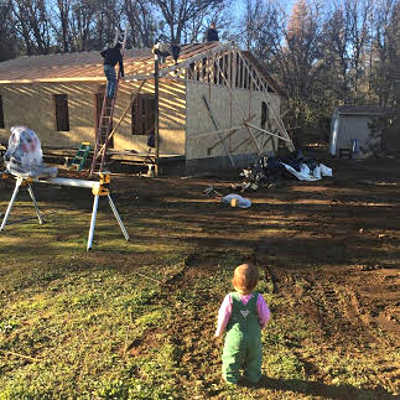
MIDDLETOWN, Calif. – Construction teams of volunteers have completed the first home rebuild for Valley fire survivors in Middletown.
The home build is a joint project of Team Lake County, the Middletown Rancheria of Pomo Indians of California and Hope City, a ministry of Hope Crisis Response Network Inc.
The three-bedroom family home was constructed on the Middletown Rancheria for homeowners Justin Lord and Courtney Van Leuven following a December ground-breaking.
The volunteer labor was coordinated by Hope City as the construction partner to Team Lake County, the long-term recovery group.
Team Lake County is working together to meet the unmet needs of the survivors of the 2015 wildfires in Lake County.
Reflecting on the progress made following the devastation of the Valley fire, Jose Simon, chairman for the Middletown Rancheria said, “We have experienced great adversity; and with the assistance of so many, a unified community has now made the first step in rebuilding what has been lost. We cannot express how grateful we are to everyone involved in giving Justin and Courtney a new beginning.”
Volunteers contributed more than 1,300 hours to complete this home.
The dedication is set for 1 p.m. Sunday at the home, located on Middletown Rancheria, 22223 Highway 29.
With March storms boosting reservoir levels, the California Department of Water Resources on Thursday increased its water delivery estimate – or allocation – for most recipients to 45 percent of requests for the calendar year.
DWR’s initial State Water Project (SWP) allocation of 10 percent of requests, announced in December, was increased to 15 percent on Jan. 26 and to 30 percent on Feb. 24 after January storms increased the Sierra snowpack and brought significant rainfall to the drought-parched state.
Although February was mostly dry, rain and snow returned this month to boost the state’s two largest reservoirs – Shasta Lake and Lake Oroville – to slightly above their historic levels for the date. Some key reservoirs, however, remain far below expected levels for this time of year.
The drought has not ended, officials said.
Although California is on track to end the winter season with near-average conditions, one such season does not compensate for four prior years of drought.
Accurately predicting whether water year 2017 will be wet, dry, or average is beyond the skill of climate forecasters, and officials said the state must be prepared for the possibility of a dry 2017. Even with reservoir levels rising, conservation is the surest and easiest way to stretch supplies.
“February reminded us how quickly California’s weather can turn from wet to dry,” said DWR Director Mark Cowin. “The lesson of this drought is that we all need to make daily conservation a way of life.”
Thanks to March storms, DWR will not need to install a drought barrier this year to help control salinity in the Sacramento-San Joaquin Delta.
A drought barrier that spanned West False River between Jersey and Bradford islands for six months in 2015 was removed in November. The barrier prevented saltwater from encroaching with the tides into the central Delta from San Francisco Bay. The rock barrier helped to maintain water quality for Delta residents and millions of other Californians dependent on Delta water.
The 29 public agencies that receive SWP water – State Water Project contractors – requested 4,172,786 acre-feet of water for 2016. With Thursday's allocation increase, they will receive 1,898,964 acre-feet.
Collectively, the SWP contractors serve approximately 25 million Californians and just under a million acres of irrigated farmland.
The SWP provides the same allocation percentages to cities and farms.
The U.S. Bureau of Reclamation, which operates California’s other major water project, the Central Valley Project (CVP), is expected to announce later this month its initial allocation to farms and cities.
The SWP and CVP have different legal and contractual obligations and operational capabilities, and the CVP uses a priority system to allocate water.
Both agriculture and many communities have felt the pain of low, drought-year allocations from the state and federal water projects, with vast tracts of farmland fallowed and drinking water systems failing in some communities.
It is important to note that nearly all areas served by the SWP also have other sources of water, among them streams, groundwater and local reservoirs.
Key reservoirs are rising from winter storms, but some remain below average for the date.
Lake Oroville in Butte County, the State Water Project’s principal reservoir, early this morning was holding 2,708,486 acre-feet, 77 percent of its 3.5 million acre-foot capacity and 105 percent of its historical average for the date.
Shasta Lake north of Redding, California’s and the CVP’s largest reservoir, was holding 3,850,207 acre-feet, 85 percent of its 4.5 million acre-foot capacity and 110 percent of its historical average.
But San Luis Reservoir, a critical south-of-Delta pool for both the SWP and CVP, was holding only 990,970 acre-feet, 49 percent of its 2 million acre-foot capacity and just 55 percent of average storage for the date.
Folsom Lake, a CVP reservoir near Sacramento, has risen to 70 percent of its 977,000 acre-foot capacity, 117 percent of historical average for the date, and has had to make flood control releases to retain space for heavy inflow.
Groundwater aquifers recharge much more slowly than surface reservoirs, with many in the Central Valley falling toward record levels.
Last year’s (2015) 20 percent SWP allocation was the second lowest since 1991, when agricultural customers of the SWP got a zero allocation and municipal customers received 30 percent of requests. In 2014, SWP deliveries were five percent of requested amounts for all customers.
The last 100 percent allocation was in 2006. Seven of the nine years since 2007 have been dry. SWP allocations in recent years:
– 2015: 20 percent;
– 2014: 5 percent;
– 2013: 35 percent;
– 2012: 65 percent;
– 2011: 80 percent;
– 2010: 50 percent;
– 2009: 40 percent;
– 2008: 35 percent;
– 2007: 60 percent;
– 2006: 100 percent.