 How to resolve AdBlock issue?
News
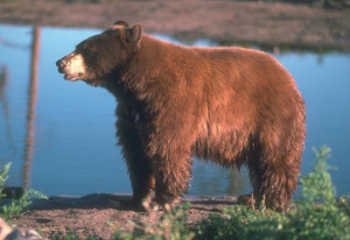
With an estimated 35,000 bears, California has a healthy and growing black bear population.
In spring hibernating bears emerge from their winter slumber and begin an almost perpetual search for food. It is not uncommon for a black bear to consume up to 20,000 calories a day.
Unfortunately, this search can sometimes lead bears into populated areas and conflicts with humans.
Recently, sightings of black bears have been reported in Lake County, in particular, the Glenhaven area and in the Lucerne Rivieras.
“A bear's nose is seven times better than a hound dog's, and it will lead a bear to anything that is edible or smelly,” said Marc Kenyon, the California Department of Fish and Wildlife's human-wildlife conflict expert. “Bears can smell meat drippings on your barbecue, dog food on your porch and candy in your sleeping bag. So if you live near or visit bear habitat, for your safety and the well-being of the bear, always keep your food and trash properly secured.”
Once a bear finds an easy food source, it will return again and again to the same location, and if that food source is a neighborhood or campground, the consequences are not going to be pleasant.
Not only can bears get sick from ingesting trash, they can also become dangerous as they begin to associate humans with food.
Bears that become habituated to human sources of food must be killed. Relocating habituated bears does not work.
The bears ultimately return to the same neighborhood or another populated area and continue their bad habits – scavenging through trash cans, breaking into homes and even attacking domestic animals.
Although there have been no documented human fatalities from black bears in the state's history, attacks have occurred. In order to keep bears in the wild and people safe, CDFW provides the following Bear Aware tips for people living in or visiting bear country:
For residents:
– Purchase and properly use a bear-proof garbage container.
– Wait to put trash out until the morning of collection day.
– Don't leave trash, groceries or animal feed in your car.
– Keep garbage cans clean and deodorize them with bleach or ammonia.
– Keep barbecue grills clean and stored in a garage or shed when not in use.
– Avoid using birdfeeders.
– Don't leave any scented products outside, including non-food items like suntan lotion and candles.
– Keep doors and windows closed and locked.
– Consider installing motion-detector alarms and/or electric fencing.
– Keep livestock in secure enclosures.
– Harvest fruit off trees as soon as it is ripe, and promptly collect fruit that falls.
– Securely block access to potential hibernation sites such as crawl spaces under decks and buildings.
For campers and hikers:
– Use bear-proof trash cans whenever possible or store your garbage in a secure location with your food.
– Store anything smelly including food, pet food and toiletries in bear-proof containers or in an airtight container in the trunk of your vehicle.
– Clean dishes and store food and garbage immediately after meals.
– Clean your barbecue grill after each use.
– Never keep food, toiletries or anything with a scent in your tent.
– Never intentionally feed bears in order to attract them for viewing.
– When hiking make noise to prevent surprising a bear. Clap, sing or talk loudly.
– Travel in a group if possible.
– Pay attention to the surroundings and watch for bear signs, such as tracks or claw or bite marks on trees.
– Keep dogs on a leash.
– If you see a bear, do not approach it. Make sure it has an escape route.
– If you encounter a bear in the wild, back away slowly. Do not run. Raise your arms to look larger and speak in a calm, loud voice. Do not turn your back.
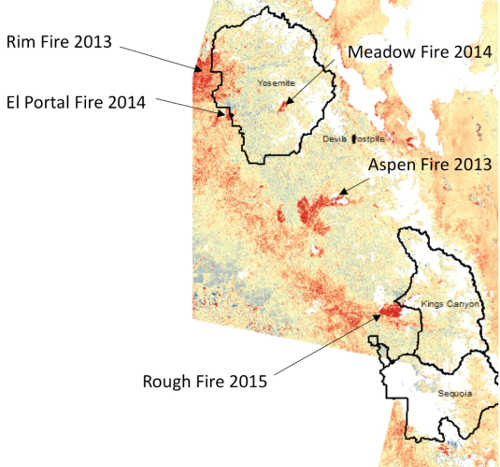
During the summer of 2015, survey flights conducted by the United States Forest Service (USFS) showed vast areas of dead and dying trees in the Sierra Nevada foothills and lower-elevation mountain areas of California.
Aircraft flew over four million acres of forested land and found that roughly 20 percent of stands had a distinct reddish-brownish coloration instead of a bright green, healthy leaf canopy. The toll was more than 10 million dead trees, region-wide.
To put this pattern of forest decline into historical perspective, investigators at NASA’s Ames Research Center in California’s Silicon Valley published a study in April 2016 in the Journal of Earth Science & Climatic Change.
The paper documented NASA's unique three-decade record of vegetation cover change from the Landsat satellite and analyzed a series of detailed yearly maps to compare previous controls on forest growth rates and effects of recent fluctuations in water availability since the mid-1980s.
Operating since the 1970s, the Landsat Earth-observing mission is operated jointly by NASA and the U.S. Geological Survey.
“NASA's satellite record offers abundant evidence that extensive tree die-back from the historically low water years of 2013 to 2015, combined with numerous large stand-replacing wildfires in the Sierra region, has essentially reversed the impressive accumulation of live tree density state-wide that we were tracking since the early 1980s,” said the study's lead author, Christopher Potter of Ames.
Three decades of forest growth was erased by the drought's impacts over much of the lower-elevation Sierra Nevada mountain region in the past couple years.
The U.S. Weather Service defines drought as a deficiency in precipitation over an extended period resulting in water shortages that cause adverse impacts on vegetation, animals and people.
The calendar year 2013 was the driest on record, with a total of just 30 percent of average statewide precipitation.
A record low snowpack level in 2015 in the Sierra Nevada Mountains was unprecedented in comparison to the past 500 years – typical snow water levels in 2015 were detected at just five percent of the historical average.
Ames scientists began by examining Landsat satellite imagery at nearly all of the high tree die-back sites in the southern Sierra region flown by the USFS. The first outcome confirmed that changes in drought-sensitive satellite indices from the years 2011 to 2015 closely matched patterns of tree die-back across the USFS aerial survey locations in the southern Sierra region.
But there was much more to learn; the satellite data record was analyzed further to put the 2013-2015 drought into historical context, particularly with respect to noticeable increases in forest canopy browning due to summer water limitations.
According to the satellite data, areas most severely impacted by constant water shortages were located just southwest of Yosemite, Kings Canyon, and Sequoia National Parks, and in the Sierra and Sequoia National Forests.
The Landsat satellite data values at dying tree locations nearly resembled those from charred forest stands burned in the 2013 Rim Fire near Yosemite and the 2015 Rough Fire near Kings Canyon National Park.
This won’t be the end of the analysis of these regions. Potter says that Landsat images are provided by NASA at no cost to researchers every two weeks.
“Our continued analysis of this unique, reliable satellite data over the next several years at these same Sierra aerial survey locations should help inform forest and park managers about the potential for further, delayed tree die-back,” Potter said. “It will also enable us to efficiently track subsequent recovery and regrowth rates of drought-affected forest stands during more favorable precipitation years.”
LAKE COUNTY, Calif. – An array of adorable felines of all ages are waiting for homes this week at Lake County Animal Care and Control.
Available this week are three kittens and three adult cats.
In addition to spaying or neutering, cats that are adopted from Lake County Animal Care and Control are microchipped before being released to their new owner. License fees do not apply to residents of the cities of Lakeport or Clearlake.
If you're looking for a new companion, visit the shelter. There are many great pets there, hoping you'll choose them.
In addition to the animals featured here, all adoptable animals in Lake County can be seen here: http://bit.ly/Z6xHMb .
The following cats at the Lake County Animal Care and Control shelter have been cleared for adoption (other cats pictured on the animal control Web site that are not listed here are still “on hold”).

Domestic short hair kitten
This female domestic short hair kitten has a brown and white coat.
She's in cat room kennel No. 53b, ID No. 4913.

Domestic short hair kitten
This female domestic short hair kitten has a white coat with blue eyes.
She's in cat room kennel No. 53c, ID No. 4914.

Domestic medium hair kitten
This male domestic medium hair kitten has a white coat and blue eyes.
He's in cat room kennel No. 70a, ID No. 4966.

Female domestic short hair
This female domestic short hair has a black coat with a white mark on her chest.
She's in cat room kennel No. 73, ID No. 4911.

'Mom'
“Mom” is a female domestic short hair mix with a gray tabby coat.
She's in cat room kennel No. 114, ID No. 4823.

Female domestic short hair
This female domestic short hair mix has a very colorful calico coat.
She's in cat room kennel No. 142, ID No. 4760.
Adoptable cats also can be seen at http://www.co.lake.ca.us/Government/Directory/Animal_Care_And_Control/Adopt/Cats_and_Kittens.htm or at www.petfinder.com .
To fill out an adoption application online visit http://www.co.lake.ca.us/Government/Directory/Animal_Care_And_Control/Adopt/Dog___Cat_Adoption_Application.htm .
Lake County Animal Care and Control is located at 4949 Helbush in Lakeport, next to the Hill Road Correctional Facility.
Office hours are Monday through Friday, 11 a.m. to 5 p.m., and 11 a.m. to 3 p.m., Saturday. The shelter is open from 11 a.m. to 4 p.m. Monday through Friday and on Saturday from 11 a.m. to 3 p.m.
Visit the shelter online at http://www.co.lake.ca.us/Government/Directory/Animal_Care_And_Control.htm .
For more information call Lake County Animal Care and Control at 707-263-0278.
Email Elizabeth Larson at

LOWER LAKE, Calif. – The Lower Lake Methodist Church has joined the Lake County Quilt Trail.
The 4-foot by 4-foot “Lower Lake Methodist Quilt Block” was installed at the church, located at 16255 Second St.
The beginning of the church's history is recorded in “Celebration of the First Hundred Years,” the diary of Thomas Fellows, builder of this church, and other church members.
The book recounts the following:
“On Monday, December 1, 1884, Mr. Fellows commenced building the new Methodist Church. The church was dedicated on August 2, 1885.
“A subscription and collection netted $425. When the church was completed the monies left the church free of debt. The one room church was heated by a big wood stove. The pews had reversible backs, similar to a train, so the children attending Sunday school could face each other.
“Members of the Lower Lake church continued to make improvements though the years, preserving, restoring and making additions for the modern usage of their charming, antique, 19th century church building. Their appreciation of the Methodist heritage in the Clear Lake region enriched church and community life.
“With the help of volunteer labor, proceeds from the Thrift Shop and memorials, this worship center has been enhanced down through the years, and they give thanks for this 'Little Church in the Vale'.”
The Lake County Quilt Trail is an agricultural and tourism project designed to promote community pride.
The quilt block was drawn and painted by the Lake County Quilt Trail team from the design suggestion given by Sandy Richards and the Lower Lake Methodist Community.
The Lake County Quilt Trail is a group of dedicated volunteer quilters, graphic artists, painters,
writers, carpenters and a videographer.
For more information about the Lake County Quilt Trail visit www.lakecountyquilttrail.com or visit the group on Facebook.

Faced by a loss, and perhaps by a loss of words, many of us find something to do with our hands.
Here's a poem about just that by Arden Levine, published in 2015 in an issue of Agni Magazine. Ms. Levine lives in New York.
Offering
She tells him she's leaving him and he
bakes a pie. His pies are exquisite,
their crusts like crinoline.
He doesn't change clothes, works
in slacks, shirtsleeves rolled.
Summer makes the kitchen unbearable
but he suffers beautifully, tenderly
cuts the strawberries, pours
into the deep curve of the bowl.
She hadn't missed his hands since
last they drew her to his body.
Now she watches them stroke the edges
of the dough, shape it like cooling glass.
When the oven opens, his brow drips,
he brings his hands to his face.
American Life in Poetry is made possible by The Poetry Foundation ( www.poetryfoundation.org ), publisher of Poetry magazine. It is also supported by the Department of English at the University of Nebraska-Lincoln. They do not accept unsolicited submissions. Poem copyright ©2015 by Arden Levine, “Offering,” (AGNI Magazine, 2015). Poem reprinted by permission of Arden Levine and the publisher. Introduction copyright © 2016 by The Poetry Foundation. The introduction's author, Ted Kooser, served as United States Poet Laureate Consultant in Poetry to the Library of Congress from 2004-2006.
Monica Rosenthal is most definitely my choice for District 1 supervisor.
I have found her to be a woman of her word, which is by no means a common character trait these days.
Monica's agenda as county supervisor will serve the needs and interests of the people here who have been through massive change and loss due to the south county fire.
She listens when you speak to her and always brings solutions to the subject or the willingness to find those solutions. The Economic Outlook Conference here in south county was a great example of her astute recognition of what the county needs and how to plan recovery.
I know that Monica was county planning commissioner and as such she recognized the need to regulate marijuana growing outdoors and keep it away from family communities.
She stood against the Dollar General store coming into downtown Middletown because they weren't willing to compromise the appearance of their store to suit the area.
Monica acts on the facts. She is hard working and genuine. She is the “informed choice.”
Dayle Marshall lives in Lower Lake, Calif.