How to resolve AdBlock issue?
News
Savings Bank customers switching to eStatements in support of Habitat for Humanity Fire Rebuild Fund
NORTH COAST, Calif. – Savings Bank is offering its customers an opportunity to help the rebuilding efforts in Lake County after the fires, simply by switching from paper statements to eStatements.
For every Savings Bank paper statement our customers switch to eStatements by July 30, 2016, the bank will donate $5 to the Lake County Habitat for Humanity Fire Rebuild Fund.
In recognition of accounts that have already gone paperless, Savings Bank is donating an additional $5,000.
Habitat for Humanity serves low income households who partner with the organization in the building process.
All homes are energy efficient, with green building practices and appropriate low energy appliances. Lake County Habitat for Humanity pledges that all funds received for the Fire Rebuild Fund will go 100 percent to the rebuilding of homes for qualified low-income Lake County families who were impacted by the fires.
“Assisting the rebuilding efforts after the Lake County fires is a priority for Savings Bank”, said Katie Kight, Savings Bank marketing officer. “Through this promotion, our customers can take pride in helping to make a difference for others while taking advantage of the benefits of eStatements; a free service that is more secure than paper statements and is the environmentally friendly thing to do.”
With eStatements, customers receive their account statements sooner because they no longer have to wait for delivery from the postal service.
The eStatements also reduce the risk of their confidential account information getting into the wrong hands through mail tampering.
For convenience, 24 months of eStatements history is stored in their Online Banking, allowing customers to print only what they need.
To switch from Savings Bank paper statements to eStatements, go to www.savingsbank.com and follow the steps provided on the eStatements promotion information page.
SACRAMENTO – The California Home Visiting Program (CHVP) celebrated a landmark 100,000th visit this week as part of the state’s hands-on efforts to provide assistance to new parents and improve the health and wellbeing of children across the state.
The California Department of Public Health (CDPH) preventive intervention program focuses on positive parenting and child development.
“Home visiting is an effective intervention for at-risk children and produces positive outcomes for babies, families and communities,” said CDPH Director and State Public Health Officer Dr. Karen Smith. “The California Home Visiting program provides low-income parents with the tools and skills they need to independently raise their children.”
Recent studies show that home visits by nurses or trained professionals during pregnancy and a child’s first years prevent child abuse and neglect, support positive parenting, improve maternal and child health, and promote child development and school readiness.
Home visitors teach parenting skills, provide guidance on everything from injury prevention to nutrition, and offer referrals to needed services for families struggling with substance abuse, violence and mental health concerns.
They also screen children for developmental milestones and promote early learning and a language-rich environment.
“Home visiting allows parents to build and develop trusting relationships with experts who can provide emotional and physical support for mom and baby during their critical first years,” said Dr. Connie Mitchell, Deputy Director of CDPH’s Center for Family Health, which oversees CHVP.
The state’s home visiting program began in 2012 and now includes 25 sites in 24 local health jurisdictions across the state.
“At the time I enrolled in home visiting, I was rebuilding my life and needed all the support I could get,” said Shannon, a Northern California mother who once struggled with addiction and is a survivor of domestic violence. “The relationship I developed with my home visitor has done wonders for repairing my confidence, getting me to a point where I believed in myself enough that I could return to college and get a degree.”
For additional information, visit CDPH’s California Home Visiting Program page, http://www.cdph.ca.gov/programs/mcah/Pages/HVP-HomePage.aspx .
Starting July 1, 2016, nonlead shot will be required when taking upland game birds with a shotgun in California, except for dove, quail, snipe, and any game birds taken at licensed game bird clubs.
In addition, nonlead shot will be required when using a shotgun to take resident small game mammals, furbearing mammals, nongame mammals, nongame birds and any wildlife for depredation purposes.
Existing restrictions on the use of lead ammunition in the California condor range, when taking Nelson bighorn sheep and when hunting on all California Department of Fish and Wildlife (CDFW) wildlife areas and ecological reserves remain in effect.
The next phase of the implementation goes into effect July 1, 2019, when hunters must use nonlead ammunition when taking any animal anywhere in the state for any purpose. There are no restrictions on the use of lead ammunition for target shooting purposes.
Nonlead ammunition for some firearm calibers may be in short supply so hunters should plan accordingly. Hunters are encouraged to practice shooting nonlead ammunition to make sure firearms are sighted-in properly and shoot accurately with nonlead ammunition.
In October 2013, Assembly Bill 711 was signed into law requiring the phase-out of lead ammunition for hunting anywhere in the state by July 1, 2019.
The law also required an implementation plan designed to impose the least burden on California’s hunters while adhering to the intent of the law.
In order to determine what was least disruptive to hunters, CDFW coordinated question and answer sessions at sportsmen’s shows, held meetings with hunting organizations, and hosted a series of eight public workshops throughout the state. Incorporating the public input from these workshops, CDFW then presented draft regulations to the Fish and Game Commission.
In April 2015, the Fish and Game Commission adopted CDFW’s proposed regulations and implementation plan.
More information on the phase-out of lead ammunition for hunting in California can be found at www.wildlife.ca.gov/hunting/nonlead-ammunition .
LOWER LAKE, Calif. – A Florida man who collided with a car Thursday evening while trying to cross Highway 29 on an all-terrain vehicle has died of his injuries.
The California Highway Patrol's Clear Lake Area office said the crash, involving a 2006 Yamaha ATV and a 2010 Mazda, occurred at 5 p.m. Thursday on Highway 29 south of A Street near Lower Lake.
The name of the 25-year-old man from Oakland Park, Fla., who died was not released by the CHP Thursday night, nor was the name of the 29-year-old Clearlake man driving the Mazda, who was accompanied by a 3-year-old boy and a 10-month-old baby boy.
The CHP said the ATV rider was stopped on the east shoulder of Highway 29, waiting to cross the roadway to enter a driveway just south of A Street.
The Mazda was heading northbound at approximately 55 miles per hour when, according to the CHP report, the ATV rider attempted to cross the highway before it was safe to do so, pulling directly into the path of the Mazda.
The report said the Mazda's driver attempted to apply the brakes but was unable to stop in time, with the front of the Mazda hitting the left side of the ATV.
The CHP said the ATV rider – who was not wearing a helmet – was ejected and sustained major injuries.
The injured ATV rider was flown by air ambulance to Santa Rosa Memorial Hospital, where he died of his injuries at 6:35 p.m., the CHP said.
The driver and the child passengers in the Mazda all were using their safety equipment and were uninjured, according to the report.
Reports from the scene said the highway was temporarily blocked while emergency responders worked in the area. The highway was reported to have reopened at around 6:30 p.m.
The crash is being investigated by CHP Officer Shawn Bertram.
Editor's note: The original report from the CHP misreported the ages of the two children as the result of a computer program error.
Email Elizabeth Larson at
SOUTH LAKE COUNTY, Calif. – On Friday, the Valley fire recovery process reached a milestone.
On that day, the last loads of Valley fire debris was removed by CalRecycle crews from a remote property at Ettawa Springs.
In the video above, Lake County Environmental Health Director Ray Ruminski discusses the cleanup at the last property and the process that the crews used to safely mitigate the waste left behind by the fire, which tore through the south county in September.
CalRecycle began the cleanup last fall, took a break during the wet winter months, and then resumed work in the spring, officials reported.
Ruminski estimated that CalRecycle has cleaned up 1,183 residential structures, with an estimated 25,000 tons of debris removed.
He said that amounted to more than 23,000 dump truck loads that, if lined up, would reach from Middletown to Monterey.
Still to be cleaned up is the Hoberg's Resort, which Ruminski said was determined ineligible for the state-funded cleanup.
Leading the CalRecycle effort was Todd Thalhamer, who was raised in Lake County. Thalhamer said his childhood home in Cobb was among the residences that burned.
Simultaneously, while working on the Valley fire cleanup, Ruminski said CalRecycle has been working on cleanup for the Butte fire, which burned in Amador and Calaveras counties last fall.
The video was shot and produced by John Jensen of Lake County News.
Email Elizabeth Larson at
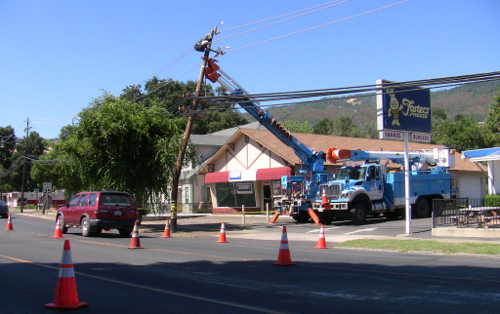
LUCERNE, Calif. – A vehicle crash on Wednesday on Highway 20 in Lucerne resulted in damage to power equipment and a park fence, and led to temporary traffic hangups.
The crash occurred on Wednesday morning, according to Paul Moreno of Pacific Gas and Electric Co.
He said a vehicle hit and damaged a utility pole, but power remained on except for a momentary outage at 11:14 a.m.
The pole was located between Ninth and 10th Avenue. Traffic control was in place in the area while the repairs took place.
Moreno said crews responded and finished pole replacements on Wednesday afternoon.
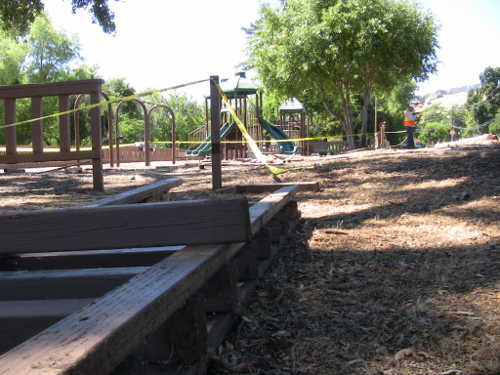
In addition to the damaged pole, the crash took out a large portion of the wooden fence surrounding the playground at Lucerne Harbor Park across the highway.
Public Services Director Lars Ewing said that the county will get the police report and driver's insurance information in order to get reimbursed for repairing the damage to the park fence, which he said is standard procedure when dealing with such accidents.
Email Elizabeth Larson at