 How to resolve AdBlock issue?
News
Signed by Governor Edmund G. Brown Jr. last October, a new law banning the sale of nearly all ivory in the state of California is effective as of July 1, 2016.
The ban, which can be found in California Fish and Game Code, section 2022, encompasses teeth and tusks of elephant, hippopotamus, mammoth, mastodon, walrus, warthog, whale and narwhal, as well as rhinoceros horn, regardless of whether it is raw, worked or powdered, or from a store or a private collection.
Under the law, advertising the sale of any items containing ivory is also strictly prohibited.
"The California Department of Fish and Wildlife (CDFW) continues its active role with our federal partners to end wildlife trafficking, which poses a critical threat to conservation throughout the world," said David Bess, Chief of CDFW's Law Enforcement Division. "This law provides another tool to aid in this effort."
Under the new law, raw ivory and most crafted items that include ivory may no longer be purchased, sold or possessed with the intent to sell, with limited exceptions, including the following:
– Ivory or rhino horn that is part of a bona fide antique (with historical documentation showing the antique is at least 100 years old) provided the item is less than 5 percent ivory or rhino horn by volume;
– Ivory or rhino horn that is part of a musical instrument (with documentation of pre-1975 construction) provided the instrument contains less than 20 percent ivory or rhino horn by volume; and
– Activities expressly authorized by federal law, or federal exemptions or permits.
California has a long history in the legal and illegal trafficking market of ivory within the United States.
Although the sale of ivory and elephant parts has been illegal in California since 1977 (and nationwide since 1990), the new law closed a loophole that allowed the continued sale of ivory that was imported into the state before 1977.
The sale of ivory, rhino horn or products that contain ivory will be a misdemeanor, punishable by fines up to $50,000 and one year of incarceration.
Gov. Jerry Brown has signed a 2016-17 state budget that provides $10 million to help launch a statewide earthquake early-warning system.
Although California passed a mandate in 2013 to create a statewide earthquake warning system, this is the first money appropriated by the state to make it a reality.
The federal government has already provided $13.2 million to improve and test a prototype West Coast early-warning system, but this is much less than the $38 million in buildout costs and $16 million per year in operating costs needed to establish a fully functioning system serving California, Oregon and Washington.
"This is a key step toward the goal of a public earthquake early-warning system for the entire state," said Richard Allen, director of the Berkeley Seismological Laboratory at UC Berkeley and one of the lead researchers on the project. "This funding will enable us to add more sensors to the seismic networks, making the warnings faster and enabling the system to reach more users."
“This is an excellent beginning,” said state Sen. Jerry Hill, San Mateo and Santa Clara counties, who introduced funding legislation for the warning system earlier this year with Assemblyman Adam Gray, Merced, and state Sen. Robert Hertzberg, Van Nuys. “While we still have work to do to secure public-private partnership money to complete the build-out, this $10 million is a big boost.”
The $10 million is seed money from the Governor’s Office of Emergency Services. The funds will enable scientists and emergency preparedness experts from UC Berkeley, the U.S. Geological Survey and the California Institute of Technology to expand an early-warning prototype called ShakeAlert, which would provide advance warning of seconds to a minute before ground-shaking from a nearby earthquake.
The funds will also be used for education, research, sustainable financing and other important project components.
Several pilot projects have been established around the state to beta-test ShakeAlert and the viability of the warning system, but ShakeAlert’s reach is limited by system distribution, strength and capabilities.
Including station additions in the past year, ShakeAlert has just 538 sensors around the state and is available only to partners in the prototype project, such as the Bay Area Rapid Transit system.
In contrast, the statewide earthquake early-warning system would need several thousand sensors throughout California to reliably notify the public.
“While the ShakeAlert project partners have been able to add some additional stations, this funding will enhance the buildout of the seismic networks to provide the best possible warnings for Californians,” said Allen, a professor of earth and planetary science.
Hill, Hertzberg and Gray took on the bipartisan effort after being approached by Allen and his team through UC Berkeley’s Office of Government and Community Relations, whose staff also briefed the governor’s staff about the need for a system to protect lives and property throughout the state.
The original mandate, SB 135, was authored by then-state Sen. Alex Padilla and signed into law in 2013.
Padilla’s intent was that the system would be funded by public-private partnerships, but it became apparent that public funding would be needed to supplement any such partnerships. Cal OES has since worked with partner organizations from the California Integrated Seismic Network, the private sector, utilities, the Legislature and all levels of government to implement the system.
California is second only to Alaska when it comes to earthquake activity in the country, according to the USGS. About $3.5 billion, or 66 percent, of the monetary losses suffered from earthquakes in the U.S. each year occur in California, the Federal Emergency Management Agency says.
Seismologists agree that California is due for another “Big One.” The Uniform California Earthquake Rupture Forecast in 2015 said there is a 99.7 percent likelihood that an earthquake with a magnitude 6.7 or greater will occur in California in the next 30 years – and a 93 percent chance that an earthquake with a 7.0 magnitude or greater will occur.
“Funding programs that keep our constituents safer should be a top priority for the Legislature and the administration,” said Gray. “The earthquake early-warning system will protect property, mitigate systemic damage and above all save lives in the event of an earthquake. The $10 million that we worked so hard to get approved in the budget will certainly provide a much-needed kick-start to the program, but there is still plenty of work to be done.”
“We know it is coming -- it’s just a matter of time – and the sooner we get the early-warning system up and running, the better,” said U.S. Rep. Adam Schiff, who represents Pasadena and Caltech and has led funding efforts for the warning system and earthquake preparedness at the federal level. “I hope today’s investment by California will encourage Oregon and Washington state to join the effort so we can build out the system along the entire West Coast.”
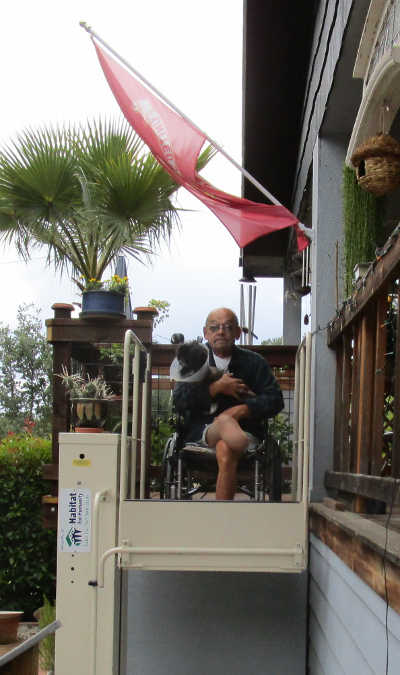
LAKE COUNTY, Calif. – Habitat for Humanity Lake County has once again been awarded grant funds from the Home Depot Veterans’ Repair program and is now accepting applications from local veterans.
This is the fourth year in a row that this opportunity is available to Lake County veterans thanks to the Home Depot grants.
In that time, Habitat for Humanity Lake County has received more than $500,000 from Home Depot for assisting veterans,.
Some of the kinds of repairs Habitat for Humanity carries out include new roofs, wheelchair ramps, bathroom upgrades, and replacement of heating and cooling systems.
The organization previously estimated that each project averages about $15,000.
If you are a low-income military veteran who has owned your home for at least five years, or if you are permanently reside in a home owned by other family members, you are encouraged to apply.
Funds are limited, so interested individuals are asked to submit applications and all accompanying paperwork as quickly as possible.
Applications can be found online at www.lakehabitat.org , at the organization's office at 16285 A Main St. in Lower Lake, or call the office at 707-994-1100 and provide your name and mailing address so that an application may be sent to you.
LAKEPORT, Calif. – The Lake County Fair is putting out the call for entries in thousands of competitions for the September event.
Just about anything you can make or grow at home is eligible for entry into competition at the annual Lake County Fair.
There are contests for the digital age artist, writers and singers, too. Want to see your art in the fair? How about entering in the new Fair Theme Poster Contest? With more than 3,000 competitions, there is something for everyone.
All entries into the Lake County Fair are made online at www.lakecountyfair.com .
If computers are a challenge, fair staff are happy to help you with your online entry at the Lake County Fair’s office at 401 Martin St.
They have designated computers that are open to the public for online entries during regular business hours until Friday, Aug. 5.
Internet access also can be found in a number of other public places, including libraries and at Umpqua Bank branches.
The 2016 Contest Handbook also is online at www.lakecountyfair.com and available in a variety of locations around Lake County, including the Lake County Chamber of Commerce, the 4-H Office, Kelseyville Pharmacy, Lakeshore Feed, Barreda’s Lower Lake Feed Store, all Hardester's Markets, Pet Acres, and the Redwood Empire Fair.
A complete list can be found on the fair’s Web site. Entry deadline is Friday, Aug. 5, by 6 p.m.
The Lake County Fair Board has chosen “Party with the Animals at the Lake County Fair” for the theme of the 2016 Fair.
The Lake County Fair traditionally occurs over Labor Day weekend each year at the fairgrounds in Lakeport.
The 2016 fair dates are Sept. 1 to 4.
The fair is one of Lake County’s favorite summertime events enjoyed by more than 37,000 people each year.
For more information, please call the fair office at 707-263-6181, or visit the fair’s Facebook page.
MENDOCINO NATIONAL FOREST, Calif. – Mendocino National Forest offices will be closed in observance of the Independence Day holiday on Monday, July 4.
Offices will resume regular business hours at 8 a.m. Tuesday, July 5.
For your safety, please plan ahead and be properly prepared for your trip to the Mendocino National Forest. Be aware that weather may change very quickly and plan accordingly. Tell someone where you are going and when you plan to return.
Remember that cell phones are unreliable in many parts of the forest. Carry emergency equipment in your vehicle. In the event of an emergency, please call 911.
“We invite you to get outdoors and enjoy all the Mendocino has to offer. While visiting the forest, we need your help to prevent wildfires; please be responsible and have a safe and enjoyable trip on the forest,” said Mendocino Forest Supervisor Ann Carlson.
With hot and dry conditions continuing, visitors are asked to be careful with fire on the Mendocino National Forest including campfires, gas stoves and lanterns. All fireworks, including sparklers, are prohibited on public lands. Remember, “One Less Spark – One Less Wildfire”.
While visiting the forest remember to always practice fire safety and follow these guidelines:
· Get your campfire permit http://www.preventwildfireca.org/Campfires/ .
· Have a responsible person in attendance at all times.
· Clear all flammable material away from the fire for a minimum of five feet in all directions.
· Make a fire only if you have a shovel and sufficient water to put it out.
· Never leave your campfire unattended.
· To make sure your campfire is out, drown with water and stir with dirt, making sure all burned materials are extinguished. Feel with your hand to make sure it’s out cold.
· Every campfire will be put DEAD OUT before leaving it.
For information on recreation opportunities see http://www.fs.usda.gov/recmain/mendocino/recreation .
U.S. Rep. Mike Thompson (CA-5) introduced the Earthquake Mitigation Tax Incentive Act (H.R. 5610) with Rep. Paul Cook (R-CA), bipartisan legislation to exclude earthquake mitigation incentives from being taxed at the federal level.
California has already made these incentives tax free at the state level.
The California Earthquake Authority (CEA) and the Governor’s Office of Emergency Services established the California Residential Mitigation Program (CRMP) to help Californians strengthen their homes against damage from earthquakes.
As the first program developed by CRMP, the Earthquake Brace + Bolt (EBB) Program provides grants of up to $3,000 to help homeowners pay for code-compliant retrofits, which cost an average of about $5,000.
A residential seismic retrofit strengthens an existing house, making it more resistant to earthquake activity by bolting the house to its foundation and adding bracing around the perimeter of the crawl space. In order to maximize the value of the incentive, H.R. 5610 would make the incentive tax free at the federal level.
“After the South-Napa earthquake damaged more than 1,500 homes in 2014, we need to do everything possible to ensure that our homes are better prepared to withstand the next earthquake,” said Rep. Thompson. “By ensuring that homeowners can take advantage of seismic retrofits without being taxed, this bipartisan legislation will help encourage more homeowners to take preventive measures to strengthen their homes against earthquake damage.”
“This bill will bring federal tax law into sync with California law to encourage residents in earthquake-prone regions to take preventative measures to safeguard their homes,” said Rep. Paul Cook. “Current federal law penalizes Californians with taxes, which leaves families and structures less safe. We have to change this, and these tax incentives are a step in the right direction.”
“We’ve designed this incentive program to help Californians make their homes safer,” said Glenn Pomeroy, CEO of the California Earthquake Authority. “That’s why this legislation is so important, because people who do the right thing by taking advantage of this program shouldn’t be penalized with a tax. California fixed the problem at the state level, and now it’s time for the federal government to do the same.”
On Aug. 24, 2014, a magnitude-6.0 earthquake struck the Napa, Solano and Sonoma County area at approximately 3:20 a.m.
According to the U.S. Geological Survey, the epicenter was three miles from American Canyon, six miles from Napa, and eight miles from Sonoma.
The earthquake was the largest to hit the Bay Area in 25 years. It earthquake damaged more than 1,500 homes and caused an estimated $362 million in damage to private homes and commercial properties, according to Napa County and the city of Napa.
Following the earthquake, Rep. Thompson helped secure Presidential approval of Federal Emergency Management Agency (FEMA) Individual Assistance (IA) disaster funds and Public Assistance (PA) disaster funds as well as Small Business Administration (SBA) loans.
Thompson represents California’s Fifth Congressional District, which includes all or part of Contra Costa, Lake, Napa, Solano and Sonoma Counties. He is a senior member of the House Ways and Means Committee. Rep. Thompson is also a member of the fiscally conservative Blue Dog Coalition and chairs the bipartisan, bicameral Congressional Wine Caucus.