 How to resolve AdBlock issue?
News
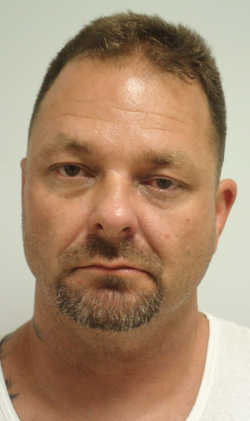
CLEARLAKE, Calif. – An early Saturday morning vehicle stop led to a Clearlake man's arrest for possession of a stolen firearm and heroin.
Micah Dane Faulkner, 42, was arrested during the stop, according to a report from Sgt. Rodd Joseph of the Clearlake Police Department.
Joseph said that at 1:15 a.m. Saturday Officer Matthew Huot conducted a traffic stop on a gold-colored Chevy Tahoe on Old Highway 53 near Ballpark Avenue. The vehicle was stopped because one of the vehicle’s headlights was not working.
The driver was identified as 32-year-old Heatherraynne Mellissa Scott of Modesto, who was found to have a suspended driver's license. Joseph said the front passenger was identified as Faulkner.
During an inventory search of the vehicle, Joseph said officers located a loaded and stolen .45-caliber Smith and Wesson semi-automatic handgun. The gun, reported stolen out of Yolo County, was located in the center console between the two front seats.
Additionally, a further search of the vehicle discovered a stun gun and an additional box of .45-caliber ammunition. Joseph said Scott and Faulkner are both convicted felons.
During questioning, Faulkner admitted to possessing the stolen handgun, claiming he had purchased the gun from a person off the street in Sacramento, Joseph said.
During a search incident to Faulkner's arrest, approximately 3.7 grams gross weight of suspected heroin was found in Faulkner’s pants pocket. Faulkner also claimed the heroin was his, according to Joseph.
Scott, who denied any knowledge of the gun or drugs, was charged with a misdemeanor violation of driving on a suspended license and released on a citation, Joseph said.
Joseph said Faulkner was charged with several felonies including being a felon in possession of a firearm, carrying a loaded firearm inside a vehicle, felon in possession of ammunition, felon in possession of a stun gun and possession of a stolen firearm. Faulkner also was charged with a misdemeanor violation of possession of a controlled substance.
Faulkner later was booked into the Lake County Jail, with bail was set at $15,000. Jail records indicated he later posted bail and was released.
The vehicle was impounded pursuant to state law, Joseph said.
Joseph said the case has been submitted to the Lake County District Attorney’s Office for charges.

“You don't have anything
if you don't have the stories.” – Leslie Marmon Silko, “Ceremony”
“But as long as you remember what you have seen, then nothing is gone. As long as you remember, it is part of this story we have together.” – Leslie Marmon Silko, “Ceremony”
LAKE COUNTY, Calif. – The story of California is still unfolding.
Historians, anthropologists and archaeologists are still “reading” the past, whether discoveries are unearthed in excavations, in the archives or via oral histories.
Many, many Indian tribes were annihilated, enslaved by Spanish missionaries, hunted down or decimated by disease brought over by the Europeans.
For thousands of years before the explorer Drake set foot on what is now California, there were more than 100 distinct tribes, or groups of Indians, with a population of about 750,000 people in California. By the 1900s only 15,000 Indians remained in California.
Luckily, those remaining are striving to keep their cultures alive – their beliefs, dances, food preparations and their unique stories.
For the most part Indians in California utilized an oral tradition, that is, stories were told, rather than written, to preserve them.
Children in these groups were told stories of creation, and also stories which gave explanations for the sacred lives of plants and animals all around them. The children passed the stories down to their children.
According to S.A. Barrett, in his book, “Pomo Myths,” “The six cardinal directions were inhabited by special supernatural beings. Toward the south lived Gu'ksu. Toward the east lived Ca'lnis. Toward the North lived Suu'padax (Whirl-wind). Toward the west lived Xa'matutsi ('water-occupation'). Above lived Kali'matutsi (”sky-occupation”). Below lived Ka'i matutsi ('earth-occupation').”
As detailed in the Pomo myth, “Coyote Creates the Sun, Moon and Stars and Peoples the Earth” detailed in Barrett's book, Coyote, who is a prominent character in many myths, used peeled pine sticks called “ciya'kale” and attached feathers of buzzard and eagle using a cord made of milkweed.
Next, Coyote sat in four special poses and tossed a small container of water to the skies above. This water began to form clouds and congregated in the vicinity of the east.
Then, Coyote, using his obsidian knife, cut an oak gall to form five edges. When he flung it up to the skies it became Sun.
After that, there was a conversation whereby Sun told the Moon that she would become the mother of Sun.
The story continued with the Sun and Moon conversing, and realizing that Coyote needed to take glowing coals from a burning fire and “... throw them up into the sky so that they will stick there. Those will be stars ...”
The story resumed with Moon explaining just how night would occur. It was to happen after a big fire was prepared and, using a willow club, strike at the fire to put it out.
This myth extends further into how earthquakes and other natural phenomena came about. This, and many other stories kept the rapt attention of the tribe.
Since most California Indians were of the oral tradition, then it serves to follow that not only is the true meaning obscured by writing it down, but it loses much in the language translation as well.
Kathleen Scavone, M.A., is a retired educator, potter, writer and author of “Anderson Marsh State Historic Park: A Walking History, Prehistory, Flora, and Fauna Tour of a California State Park” and “Native Americans of Lake County.” She also writes for NASA and JPL as one of their “Solar System Ambassadors.” She was selected “Lake County Teacher of the Year, 1998-99” by the Lake County Office of Education, and chosen as one of 10 state finalists the same year by the California Department of Education.
LAKE COUNTY, Calif. – Big dogs are waiting at Lake County Animal Care and Control's shelter to meet their new families.
This week's dogs include mixes of American Bulldog, American Staffordshire Terrier, Anatolian Shepherd, German Shepherd, Great Dane, hound, Labrador Retriever, pit bull, pug and shepherd.
Dogs that are adopted from Lake County Animal Care and Control are either neutered or spayed, microchipped and, if old enough, given a rabies shot and county license before being released to their new owner. License fees do not apply to residents of the cities of Lakeport or Clearlake.
If you're looking for a new companion, visit the shelter. There are many great pets hoping you'll choose them.
The following dogs at the Lake County Animal Care and Control shelter have been cleared for adoption (additional dogs on the animal control Web site not listed are still “on hold”).

'LJ'
“LJ” is a female pit bull terrier and pug mix with a short red and brown coat with white markings.
She's in kennel No. 3, ID No. 5561.

Pit bull terrier mix
This female pit bull terrier mix has a short black and white coat.
She's in kennel No. 5, ID No. 5378.
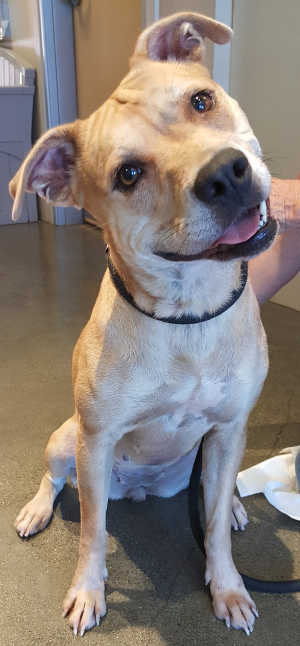
'Bingo'
“Bingo” is a female adult pit bull terrier mix.
She has a short buff coat and already is spayed, so her adoption fee will be lower.
She's in kennel No. 6, ID No. 5249.
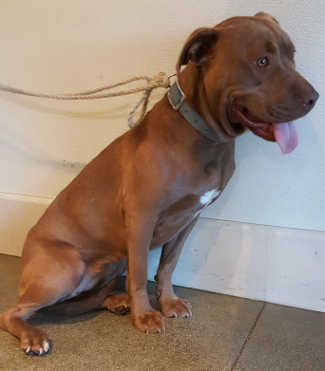
Female pit bull terrier
This female pit bull terrier mix has a short red coat.
She's in kennel No. 8, ID No. 5522.

'May'
“May” is a female American Bulldog mix.
She has a short black and white coat.
Shelter staff said she allows handling of her ears, mouth, paws, and tail with ease. She did fine in the cat room, and takes treats very gently.
She's in kennel No. 9, ID No. 5446.

'Hank'
“Hank” is a male hound with a short red coat.
He's in kennel No. 10, ID No. 5571.

'Max'
“Max” is a senior male Anatolian Shepherd and Labrador Retriever mix with a black, brown and white medium-length coat.
He's a sweet boy who shelter staff said needs a home with a secure yard.
He's in kennel No. 12, ID No. 5568.
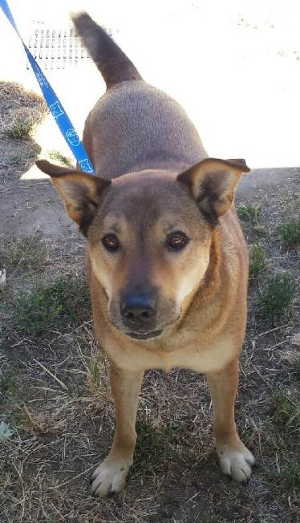
Shepherd mix
This male shepherd mix has a short tan and black coat. He already is altered.
He's in kennel No. 13, ID No. 5299.
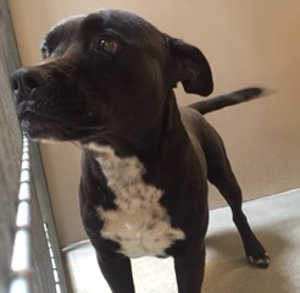
American Staffordshire Terrier
This male American Staffordshire Terrier has a short black and white coat and has already been neutered.
He's in kennel No. 14, ID No. 5194.

Pit bull terrier mix
This female pit bull terrier mix has a short blue and white coat.
Shelter staff said she is very sweet and just wants attention.
She's in kennel No. 15, ID No. 5456.

Male shepherd mix
This male German Shepherd mix has a short tan and black coat.
He's a pleasant fellow who is calm and friendly when greeting visitors.
He's in kennel No. 16, ID No. 5391.
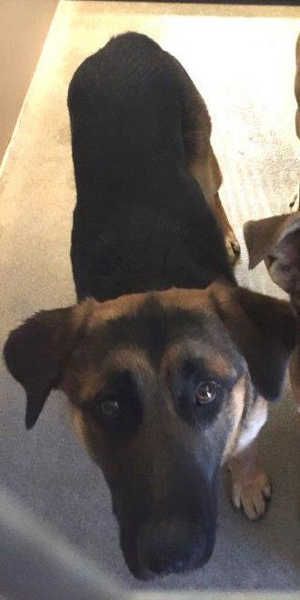
Male shepherd mix
This male German Shepherd mix has a short tan and black coat.
Like his kennel mate, he's friendly and calm.
He's in kennel No. 17, ID No. 5392.

'Storm'
“Storm” is a female pit bull terrier mix with a brown and white coat.
She's in kennel No. 24, ID No. 5363.
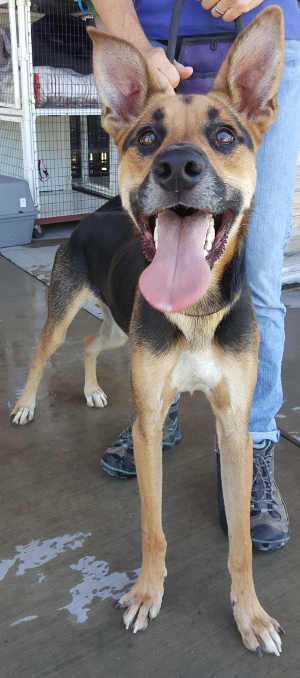
'Cooper'
“Cooper” is a sweet male shepherd mix with a black and tan coat and white markings.
Shelter staff said he already has been neutered, so his adoption fee will be lower.
He's in kennel No. 25, ID No. 5377.

'Roadie'
“Roadie” is a male pit bull terrier with a short black and white coat.
He's in kennel No. 26, ID No. 5558.
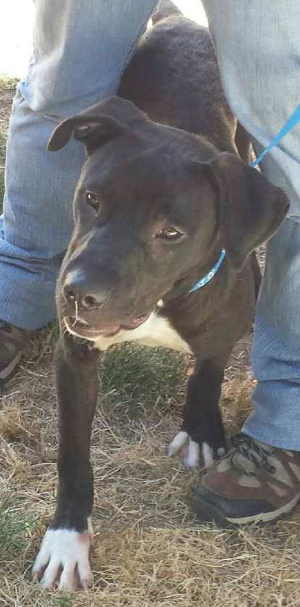
Great Dane-Labrador Retriever mix
This male Great Dane-Labrador Retriever mix has a short black coat with white markings.
He's in kennel No. 26, ID No. 5104.
To fill out an adoption application online visit http://www.co.lake.ca.us/Government/Directory/Animal_Care_And_Control/Adopt/Dog___Cat_Adoption_Application.htm .
Lake County Animal Care and Control is located at 4949 Helbush in Lakeport, next to the Hill Road Correctional Facility.
Office hours are Monday through Friday, 11 a.m. to 5 p.m., and 11 a.m. to 3 p.m., Saturday. The shelter is open from 11 a.m. to 4 p.m. Monday through Friday and on Saturday from 11 a.m. to 3 p.m.
Visit the shelter online at http://www.co.lake.ca.us/Government/Directory/Animal_Care_And_Control.htm .
For more information call Lake County Animal Care and Control at 707-263-0278.
Email Elizabeth Larson at

Looking for another Earth? An international team of researchers has pinpointed which of the more than 4,000 exoplanets discovered by NASA's Kepler mission are most likely to be similar to our rocky home.
The research, detailed in an article to be published in the Astrophysical Journal, outlines 216 Kepler planets located within the “habitable zone” – the area around a star in which a planet's surface could hold liquid water. Of those, they list 20 that are the best candidates to be habitable rocky planets like Earth.
“This is the complete catalog of all of the Kepler discoveries that are in the habitable zone of their host stars,” said Stephen Kane, an associate professor of physics and astronomy at San Francisco State University and lead author of the study. “That means we can focus in on the planets in this paper and perform follow-up studies to learn more about them, including if they are indeed habitable.”
The research also confirms that the distribution of Kepler planets within the habitable zone is the same as the distribution of those outside of it – additional evidence that the universe is teeming with planets and moons where life could potentially exist.
The boundaries of the habitable zone are critical. If a planet is too close to its star, it will experience a runaway greenhouse gas effect, like Venus.
But if it's too far, any water will freeze, as is seen on Mars. Kane and his colleagues sorted the planets by whether they were in a conservative or a more optimistic interpretation of the habitable zone. Then they further sorted them by planet size: smaller, rocky planets versus larger gas giants.
The four categories are aimed at helping astronomers focus their research. Those looking for moons that could potentially hold life can study exoplanets in the gas giant categories, for example.
The 20 planets in the most restrictive category – rocky surface and a conservative habitable zone – are the most likely to be similar to Earth. Kane has already begun gathering additional data on these planets, as well as those in the other categories.
Studying and cataloging the more than 4,000 exoplanets took more than three years and involved researchers at NASA, Arizona State University, Caltech, University of Hawaii-Manoa, the University of Bordeaux, Cornell University and the Harvard-Smithsonian Center for Astrophysics.
The team included Natalie Hinkel, a former SF State post-doctoral scholar now with Arizona State, and Michelle Hill, an undergraduate Australian student studying abroad at SF State.
“It's exciting to see the sheer amount of planets that are out there, which makes you think that there is zero chance of there not being another place where life could be found,” said Hill, who sought out Kane shortly after arriving on campus and soon got involved with the research.
Kane is one of the world's leading “planet-hunters,” having discovered several hundred exoplanets, including Kepler-186f, a rocky planet included in the new catalog.
He is contributing his scientific knowledge to two upcoming satellite missions – NASA's Transiting Exoplanet Survey Satellite (TESS) and the European Space Agency's Characterizing ExOPLanet Satellite (CHEOPS) – that will benefit from the information contained in his latest research.
“There are a lot of planetary candidates out there, and there is a limited amount of telescope time in which we can study them,” Kane said. “This study is a really big milestone toward answering the key questions of how common is life in the universe and how common are planets like the Earth.”
LAKEPORT, Calif. – It’s been many years since many older Lake County residents got their driver’s license.
Yet the driving experience is significantly different from even a decade ago with changing vehicles, changing technology, changing road rules and even changing roadways.
Residents can refresh their skills and have the opportunity to save money on their car insurance with the new, enhanced AARP Smart Driver Course being offered at the Lakeport Senior Activity Center, 527 Konocti Ave, telephone 707-263-4218.
The two-day course is being offered on Sept. 13 and Sept. 14, from 1 to 5 p.m. each day.
The volunteer instructor is Steve Hendricks, telephone 707-972-7884.
The cost of the course is $15 for AARP members and $20 for non-AARP members.
The new curriculum was developed following a two-year research study conducted by Eastern Virginia Medical School.
The course helps drivers 50 and older stay current with driving laws and new technologies inside and outside of vehicles.
Participants will also learn defensive driving skills, proven safety strategies and how to manage and accommodate common age-related changes in vision, hearing and reaction time.
“Since 1979, AARP Driver Safety has helped over 15 million drivers stay safe, educated and confident behind the wheel. Every driver can benefit from a refresher,” said Julie E. Lee, retired vice president and national director of AARP Driver Safety.
Many participants may be eligible for a multi-year insurance discount after taking the course.
Participants are encouraged to check with their insurance agent to see if they are eligible.
Attendance is required but there are no tests required to pass the course.
LOWER LAKE, Calif. – The Lake Community PRIDE Foundation will hold its annual meeting on Monday, Aug. 22.
The meeting will begin at 5:30 p.m. in the Konocti Unified School District’s Board Room, located at 9430 Lake St. in Lower Lake.
The foundation runs a safe house for homeless teenagers.