How to resolve AdBlock issue?
News
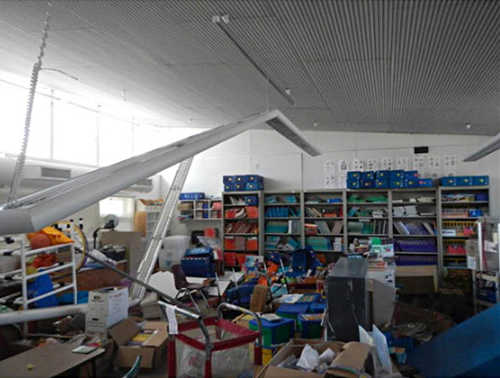
SACRAMENTO – A bill by Assemblyman Bill Dodd (D-Napa) to help safeguard students and teachers during earthquakes passed the Legislature this week with unanimous bipartisan support.
The legislation requires all school districts residing in seismically active areas to ensure that the contents of their classrooms, like heavy bookshelves or hanging light fixtures, comply with state earthquake safety guidelines.
In the event of an earthquake, unsecured contents put students and teachers at unnecessary risk of injury or death and can block emergency responders.
“The state has invested time and resources into developing guidelines to safeguard our kids from classroom contents during earthquakes, and it’s time we put those guidelines to good use. This legislation marks an important step in making sure California schools are safe, inside and out,” said Assemblyman Dodd. “I’m thankful for the bipartisan support of my colleagues in the legislature who‘ve shown their commitment to the safety of our children and teachers.”
The notion of securing classroom contents is not new to California.
Sixteen years ago, the legislature directed the Department of State Architects to develop guidelines that would outline the proper precautions needed to secure the contents of classrooms in the event of an earthquake.
However, there is no requirement in state law for school districts to adhere to those guidelines.
The successful passing of this legislation comes on the two-year anniversary of the 6.0 South Napa Earthquake, which devastated Dodd’s hometown of Napa on Aug. 24, 2014.
Inspections of Napa schools after the earthquake revealed significant damage inside of classrooms, totaling millions of dollars. The damage could have been life-threatening had the earthquake occurred during school hours.
These findings are not specific to Napa. Similar results have been identified following numerous earthquakes throughout the state, from Fresno to Los Angeles to Calexico.
“What we found after the Napa Earthquake was alarming…we found classrooms that we couldn’t even get inside because things had fallen in the doorway,” said Don Evans, member of the Napa Valley Unified School District, who testified in support of the Dodd bill earlier this year. “We believe the preventative approach is the way to go and we believe future damage is controllable.
Following the South Napa Earthquake, the Napa Valley Unified School District completed an inspection of its facilities and addressed the issues that were identified.
Dodd’s legislation will require all seismically active school districts in California proactively inspect school contents and equipment to ensure they are within state guidelines.
The bill now moves to the governor’s desk, where it will await his signature to become law.
Dodd represents the Fourth Assembly District, which includes all or portions of Napa, Yolo, Sonoma, Lake, Solano and Colusa counties. Visit his Web site at www.asm.ca.gov/dodd .
LAKEPORT, Calif. – The Lakeport Public Works Department said water line repair work on Thursday, Aug. 25, will necessitate a closure of a portion of Hillcrest Drive.
The agency said Hillcrest Drive between Loch Drive and Terrace Drive will be closed from 8 a.m. to 1 p.m., with only local traffic allowed in the area while the crew makes the repairs.
Drivers are asked to avoid the area, drive with caution and be aware of the crew.
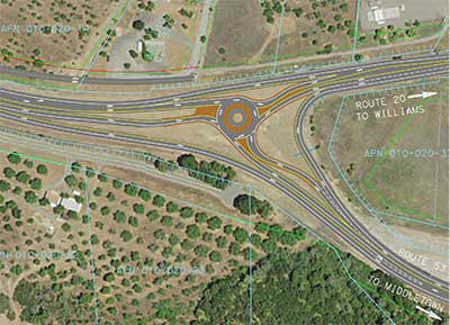
CLEARLAKE OAKS, Calif. – Caltrans will hold a public meeting this week to offer the community information on a proposed roundabout project at the intersection of Highway 20 and Highway 53 east of Clearlake Oaks.
The meeting will take place from 5 to 7 p.m. Thursday, Aug. 25, at the Clearlake Oaks Moose Lodge, 15900 E. Highway 20, which is located near the project site.
The drop-in style meeting will have displays of the proposed project, and Caltrans staff will be on hand to answer questions, according to Caltrans spokesman Phil Frisbie.
Frisbie said installing a roundabout at the Highway 20 and Highway 53 intersection is meant to improve the intersection's safety and operation.
The roundabout project currently is scheduled to go to construction in 2018. Frisbie said the current estimated total cost at completion is about $9.8 million.
This would be the fourth roundabout on the state highways in Lake County, and the fifth in the county overall, counting the first that was completed in Lakeport more than a decade ago at Lakeport Boulevard and Parallel Drive.
Previous roundabout projects overseen by Caltrans have been completed at the intersection of Highway 20 and the Nice-Lucerne Cutoff in Nice and the intersection of Highway 20 and Highway 29 in Upper Lake.
A third roundabout at Highway 29 and Hartmann Road in Middletown is just ahead of the Clearlake Oaks project. Frisbie said the Middletown roundabout is still on schedule for construction in 2018.
Email Elizabeth Larson at

KELSEYVILLE, Calif. – Historian Ruby Glebe will return to the Ely Stage Stop on Saturday, Aug. 27, to share more stories from the past during the museum’s Living History Day.
Glebe preserves and promotes Lake County’s historical resources.
On the fourth Saturday of each month local historians come to the Ely Stage Stop to visit with guests and answer questions regarding different aspects of Lake County history.
As these visits are recorded by Ely volunteers, the stories of Lake County's history are being preserved for future generations.
Glebe will be talking about the Pine Flat Community of 1870, once a quicksilver mining boomtown in the rugged Mayacamas Mountains that straddle Lake, Napa and Sonoma counties. Nothing remains of the once thriving community turned to bust due to the plummeting price of quicksilver and periodic wildfires that plague the area.
Her presentation will begin at noon. Admission is free with donations accepted.
The Lake County Historical Society’s Ely Stage Stop & Country Museum is located at 9921 State Highway 281 (Soda Bay Road) in Kelseyville, near Clear Lake Riviera, just north of Highway 29-Kit's Corner.
Current hours of operation are 11 a.m. to 3 p.m. each Saturday and Sunday. Living History events are held on the fourth Saturday of each month from noon until 2 p.m. Fiddlers’ Jams occur the first Sunday of every month from noon until 2 p.m. Private tours can be arranged by appointment.
Visit www.elystagestop.org or www.lakecountyhistory.org , check out the stage stop on Facebook at www.facebook.com/elystagestop or call the museum at 707-533-9990.
 NORTHERN CALIFORNIA – Two years ago, on Aug. 24, 2014, just south of Napa, a fault in the Earth suddenly slipped, violently shifting and splitting huge blocks of solid rock, 6 miles below the surface.
The underground upheaval generated severe shaking at the surface, lasting 10 to 20 seconds.
When the shaking subsided, the magnitude 6.0 earthquake – the largest in the San Francisco Bay Area since 1989 – left in its wake crumpled building facades, ruptured water mains, and fractured roadways.
But the earthquake wasn't quite done.
In a new report, scientists from the Massachusetts Institute of Technology and elsewhere detail how, even after the earthquake's main tremors and aftershocks died down, earth beneath the surface was still actively shifting and creeping – albeit much more slowly – for at least four weeks after the main event.
This postquake activity, which is known to geologists as “afterslip,” caused certain sections of the main fault to shift by as much as 40 centimeters in the month following the main earthquake.
This seismic creep, the scientists say, may have posed additional infrastructure hazards to the region and changed the seismic picture of surrounding faults, easing stress along some faults while increasing pressure along others.
The scientists, led by Michael Floyd, a research scientist in MIT's Department of Earth, Atmospheric and Planetary Sciences, found that sections of the main West Napa Fault continued to slip after the primary earthquake, depending on the lithology, or rock type, surrounding the fault.
The fault tended to only shift during the main earthquake in places where it ran through solid rock, such as mountains and hills; in places with looser sediments, like mud and sand, the fault continued to slowly creep, for at least four weeks, at a rate of a few centimeters per day.
“We found that after the earthquake, there was a lot of slip that happened at the surface,” Floyd said. “One of the most fascinating things about this phenomenon is it shows you how much hazard remains after the shaking has stopped. If you have infrastructure running across these faults – water pipelines, gas lines, roads, underground electric cables – and if there's this significant afterslip, those kinds of things could be damaged even after the shaking has stopped.”
Floyd and his colleagues, including researchers from the University of California at Riverside, the U.S. Geological Survey, the University of Leeds, Durham University, Oxford University, and elsewhere, have published their results in the journal Geophysical Research Letters.
Right time, right place
Floyd and co-author Gareth Funning, of UC Riverside, have been studying fault motions in Northern California for the past seven years.
When the earthquake struck, at about 3:20 a.m. local time, they just happened to be stationed 75 miles north of the epicenter.
“At the time, I did stir, thinking, 'C'mon, go back to sleep!'” Floyd said. “When we woke up, we turned on the news, figured out what happened, and immediately got back in our cars, picked up the instruments we had in the field, drove down the freeway to American Canyon, and started to put out instruments at sites we had measured just a few weeks before.”
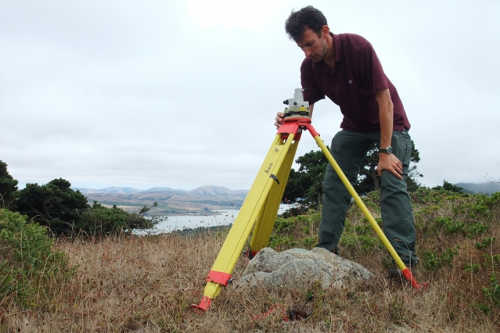
Those instruments made up a network of about a dozen GPS receivers, which the team placed on either side of the fault line, as close to the earthquake's epicenter as they could.
They left most of the instruments out in the field, where they recorded data every 30 seconds, continuously, for three weeks, to observe the distance the ground moved.
“The key difference between this study and other studies of this earthquake is that we had the additional GPS data very close to the epicenter, whereas other groups have only been able to access data from sites farther away,” Floyd said. “We even had one point that was 750 meters from the surface rupture.”
Creeping faults, silent shadows
The team combined its GPS data with satellite measurements of the region to reconstruct the ground movements along the fault and near the epicenter in the weeks following the main earthquake.
They found that the fault continued to slip – one side of the fault sliding past the other, like sandpaper across wood – at a steady rate of several centimeters per day, for at least four weeks.
“The widespread and rapid afterslip along the West Napa Fault posed an infrastructure hazard in its own right,” the authors wrote in the paper. “Repeated repairs of major roads crosscut by the rupture were required, and in some areas, water pipes that survived the [main earthquake] were subsequently broken by the afterslip.”
The earthquake and the afterslip took many scientists by surprise, as seismic data from the area showed no signs of movement along the fault prior to the main shock.
Regarding the afterslip's possible effects on surrounding faults, the researchers found that it likely redistributed the stresses in the region, lessening the pressure on some faults.
However, the researchers note that the afterslip may have put more stress on one particular region near the Rodgers Creek Fault, which runs through the city of Santa Rosa.
“Right now, we don't think there's any significantly heightened risk of quakes happening on other nearby faults, although the risk always exists,” Floyd said.
Curiously, the scientists identified a large region beneath the West Napa Fault, just northwest of Napa, which they've dubbed the “slip and aftershock shadow” – a zone that was strangely devoid of any motion during both the earthquake and afterslip. Floyd said this shadow may indicate a buildup in seismic pressure.
“The fact that nothing happened there is almost more cause for concern for us than where things actually happened,” Floyd said. “It would produce a fairly small quake if that area was to rupture, but there's just no knowing if it would continue on to start something more.”
Floyd said that in developing seismic hazard assessments, it's important to consider afterslip and slowly creeping faults, which occur often and over long periods of time following the more obvious earthquake.
“There are some earthquakes where we think we might be seeing some activity even 15 years after the main quake,” Floyd said. “So the more examples of an earthquake happening followed by afterslip that we can study, the better we can understand the entire process.”
Jennifer Chu writes for the MIT News Office.

MIDDLETOWN, Calif. – “Community Works,” an exhibition of art work inspired by the Valley fire and other wildfire experiences of 2015 and 2016, opens at the Middletown Art Center on Saturday, Aug. 27.
The opening will take place from 6 to 8 p.m.
The exhibit, which runs through Sept. 9, includes work by children and adults who used art as a means to give voice and expression to their experience, and as a way to find and make beauty despite chaos and devastation.
Musical guests will be Hearts and Bones. Big Valley and Beaver Creek wines will be available for purchase by the glass.
All proceeds will benefit MAC’s growing palette of programs and scholarship fund. MAC is a project of EcoArts of Lake County, a nonprofit 501c3.
The art center relies on tax-deductible donations, which are, and memberships to supplement income from classes and art sales.
Since the Valley fire, MAC has provided a strong sense of continuity, community and enrichment to recovering residents and the area.
MAC has become an increasingly critical component of life in the south Lake County area as residents continue to restore their lives and rebuild their homes.
The loss of friends and neighbors who have relocated elsewhere within Lake County or left the area entirely still pulsates painfully. Harbin Hot Springs too is sorely missed as both a place of work and a destination for visitors, providing a huge contribution to our local economy.
MAC recently offered two weeks of free healing art classes called “Community Works” to help ease and soothe anxiety and PTSD as the community approaches the Valley fire anniversary in high fire season. In the midst of classes the Clayton fire broke out. Several participants left suddenly to prepare for evacuation.
“A colleague was talking yesterday about how trauma shrinks the back part of our brain and it takes days/weeks to regroup back to ‘normal’,” said artist and teacher Sage Abella, one of several Clayton fire evacuees who sought MAC out as a place of refuge and solace daily. “I think that making art actually wiggles and enlivens that trauma shrink process. I bet making art helps our brain breathe in and out, expanding. At least that's what I feel while making my art inside this emotional time.”
Community Works is a collaboration of Middletown Art Center, local artists, musicians and dancers, and Tri Uplifting Lake County. It is made possible in part by Roby and Associates, a public insurance adjuster and by Lake County Rising Valley Fire Relief Fund.
For more information about Community Works and the schedule of classes offered, visit www.MiddletownArtCenter.org , or find them on Facebook.
MAC is located at 21456 Highway 175, at the junction of Highway 29 in Middletown.