 How to resolve AdBlock issue?
News
“You don’t take a photograph, you make it.” – Ansel Adams, 1902-1984
“Photography takes an instant out of time, altering life by holding it still.” – Dorothea Lange, 1895-1965
LAKE COUNTY, Calif. – How old do you have to be to recall using the venerable Brownie camera?
Like many folks, that was my first camera. Didn't you just love the explosion, then heat, then melt of a flash-bulb?
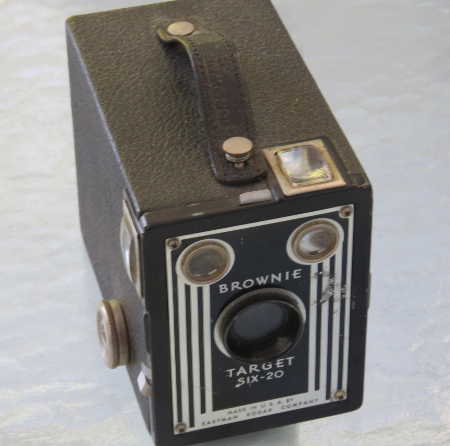
Brownie cameras were produced by Eastman Kodak, beginning in 1900. The Brownie was innovative in that it utilized the “snapshot” method of photography, and was low in cost, making photography enjoyable and affordable for the public.
The camera's moniker was derived from a popular cartoon by Palmer Cox, a Canadian whose protagonists were “brownies” or fairy-like creatures.
The wildly popular camera sold about 150,000 cameras in its first year.
The Brownie cameras were geared by public relations departments toward Boy Scouts and children in general, then for soldiers to take to war.
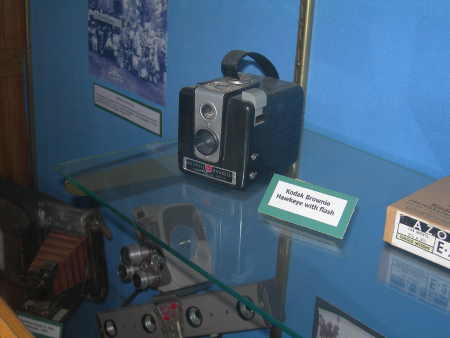
Many models of Brownie cameras were manufactured over the years.
The original model Brownie listed for sale at $1. In 1901 the aptly named No. 1 Brownie made its debut, and still cost consumers $1. In 1910 the No2A Folding Pocket Brownie retailed at $7.
Prices of the Brownie camera fluctuated with the times. In 1911 a Brownie No. 2A, a Box roll film camera cost the public $3.
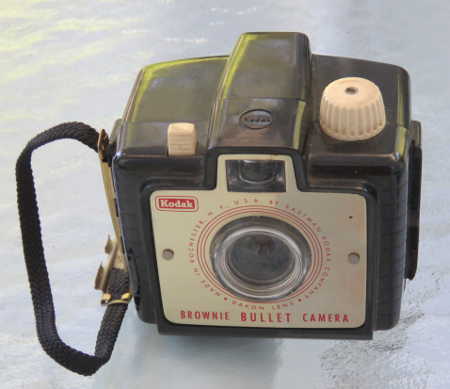
The line of Brownie Number 2s was produced by Eastman Kodak Co. from 1901 to 1935.
The Brownie Target Six-20 was introduced in 1941 and was manufactured until 1952. It used a roll film called 620, and produced an image 21/2 by 31/4 in size.
Brownie cameras took many forms and used different materials in the manufacture process. They started out using cardboard, and graduated on to being fabricated with aluminum.
With the camera's popular use in our culture came photography as a hobby, profession and tool.
The camera's creative uses, from aesthetically framed art photos, to selfies taken on a cell phones, to NASA's planetary shots – and beyond – are all techniques derived from the past's commonplace cameras, like the Brownie.
For a list of George Eastman Brownie cameras visit http://www.geh.org/fm/Brownie/htmlsrc/index.html .
Kathleen Scavone, M.A., is a retired educator, potter, writer and author of “Anderson Marsh State Historic Park: A Walking History, Prehistory, Flora, and Fauna Tour of a California State Park” and “Native Americans of Lake County.” She also writes for NASA and JPL as one of their “Solar System Ambassadors.” She was selected “Lake County Teacher of the Year, 1998-99” by the Lake County Office of Education, and chosen as one of 10 state finalists the same year by the California Department of Education.
LAKE COUNTY, Calif. – Lake County Animal Care and Control has several big dogs and a few smaller ones as well ready to go to new homes this week.
This week's dogs include mixes of Chihuahua, pit bull, shepherd and terrier.
There also are several strays picked up from the Clayton fire area that are being held for 30 days in order to reunite them with their families.
Dogs that are adopted from Lake County Animal Care and Control are either neutered or spayed, microchipped and, if old enough, given a rabies shot and county license before being released to their new owner. License fees do not apply to residents of the cities of Lakeport or Clearlake.
If you're looking for a new companion, visit the shelter. There are many great pets hoping you'll choose them.
The following dogs at the Lake County Animal Care and Control shelter have been cleared for adoption (additional dogs on the animal control Web site not listed are still “on hold”).
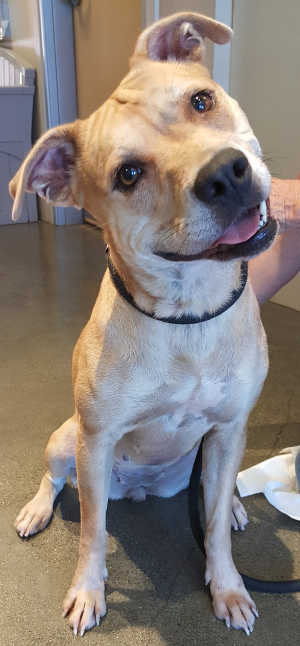
'Bingo'
“Bingo” is a female adult pit bull terrier mix.
She has a short buff coat and already is spayed, so her adoption fee will be lower.
She's in kennel No. 6, ID No. 5249.

'Conner'
“Conner” is a male terrier-Chihuahua mix.
He has a short brown and tan coat.
He's in kennel No. 9, ID No. 5888.
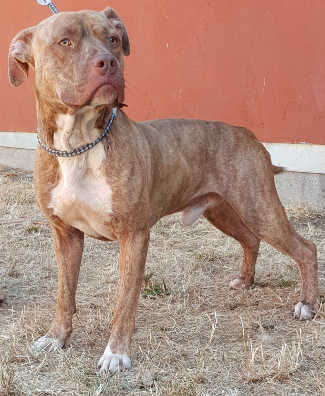
Male pit bull mix
This male pit bull terrier mix has a short brown brindle coat
He's in kennel No. 5642, ID No. 10.
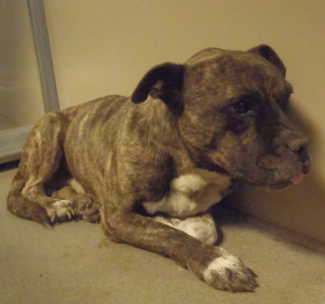
Male pit bull terrier
This male pit bull terrier has a short brown brindle coat.
He's in kennel No. 13, ID No. 5619.

Pit bull terrier mix
This female pit bull terrier mix has a short blue and white coat.
Shelter staff said she is very sweet and just wants attention.
She's in kennel No. 15, ID No. 5456.
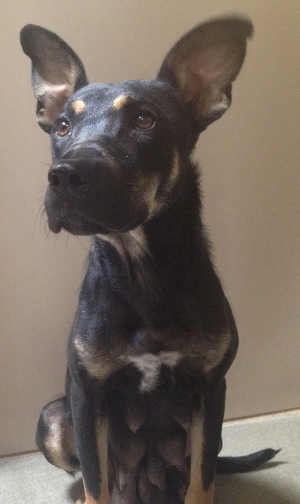
'Shelby'
“Shelby” is a female shepherd mix with a short black and tan coat.
She's in kennel No. 23, ID No. 5602.
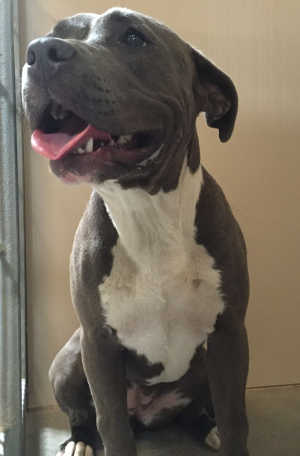
'Storm'
“Storm” is a female pit bull terrier mix with a brown and white coat.
She's in kennel No. 24, ID No. 5363.

'Roadie'
“Roadie” is a male pit bull terrier with a short black and white coat.
He's in kennel No. 26, ID No. 5558.
To fill out an adoption application online visit http://www.co.lake.ca.us/Government/Directory/Animal_Care_And_Control/Adopt/Dog___Cat_Adoption_Application.htm .
Lake County Animal Care and Control is located at 4949 Helbush in Lakeport, next to the Hill Road Correctional Facility.
Office hours are Monday through Friday, 11 a.m. to 5 p.m., and 11 a.m. to 3 p.m., Saturday. The shelter is open from 11 a.m. to 4 p.m. Monday through Friday and on Saturday from 11 a.m. to 3 p.m.
Visit the shelter online at http://www.co.lake.ca.us/Government/Directory/Animal_Care_And_Control.htm .
For more information call Lake County Animal Care and Control at 707-263-0278.
Email Elizabeth Larson at
CLEARLAKE, Calif. – A portion of 18th Avenue in Clearlake was closed for several hours on Sunday as authorities dealt with a suspicious device found near St. Helena Hospital Clear Lake.
Clearlake Police Sgt. Rodd Joseph said that at about 10 a.m. Sunday police officers responded to a request from Lake County Fire Protection District about a suspicious device found on St. Helena Hospital Clear Lake property that is adjacent to 18th Avenue.
Hospital staff had located the object in a wooded area north of the emergency room parking area and contacted Lake County Fire Protection District, which in turn contacted the Clearlake Police Department, Joseph said.
Joseph said 18th Avenue between Highway 53 and Eureka Avenue was closed for approximately six hours during the incident, however, the hospital remained open.
The Napa County Sheriff’s Office Hazardous Devices Team responded to the scene. Joseph said the team used its robot to move the device to a safer location – that was away from the hospital – on 18th Avenue.
It was there that Joseph said the device was rendered safe by use of a water cannon.
He said the device has been collected by the Clearlake Police Department for further analysis by state and federal agencies. The device’s exact design and purpose is not yet known.
The Clearlake Police Department thanked the Lake County Fire Protection District, Cal Fire, Napa County Sheriff’s Office and St. Helena Hospital Clear Lake's administration for their assistance during the incident.
Anyone with information on this incident is asked to contact Officer Jared Nixon at 707-994-8251, Extension 543. Callers may remain anonymous.
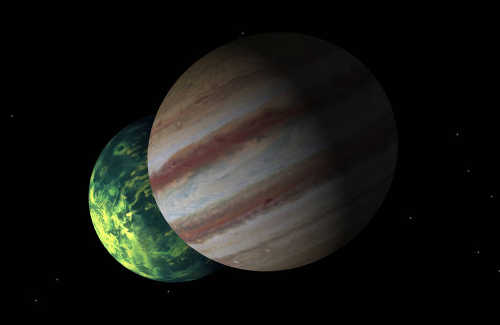
Our galaxy is home to a bewildering variety of Jupiter-like worlds: hot ones, cold ones, giant versions of our own giant, pint-sized pretenders only half as big around.
Astronomers say that in our galaxy alone, a billion or more such Jupiter-like worlds could be orbiting stars other than our sun. And we can use them to gain a better understanding of our solar system and our galactic environment, including the prospects for finding life.
It turns out the inverse is also true – we can turn our instruments and probes to our own backyard, and view Jupiter as if it were an exoplanet to learn more about those far-off worlds.
The best-ever chance to do this is now, with Juno, a NASA probe the size of a basketball court, which arrived at Jupiter in July to begin a series of long, looping orbits around our solar system's largest planet.
Juno is expected to capture the most detailed images of the gas giant ever seen. And with a suite of science instruments, Juno will plumb the secrets beneath Jupiter's roiling atmosphere.
It will be a very long time, if ever, before scientists who study exoplanets – planets orbiting other stars – get the chance to watch an interstellar probe coast into orbit around an exo-Jupiter, dozens or hundreds of light-years away. But if they ever do, it's a safe bet the scene will summon echoes of Juno.
“The only way we're going to ever be able to understand what we see in those extrasolar planets is by actually understanding our system, our Jupiter itself,” said David Ciardi, an astronomer with NASA's Exoplanet Science Institute (NexSci) at Caltech.
Not all Jupiters are created equal
Juno's detailed examination of Jupiter could provide insights into the history, and future, of our solar system. The tally of confirmed exoplanets so far includes hundreds in Jupiter's size-range, and many more that are larger or smaller.
The so-called hot Jupiters acquired their name for a reason: They are in tight orbits around their stars that make them sizzling-hot, completing a full revolution – the planet's entire year – in what would be a few days on Earth. And they're charbroiled along the way.
But why does our solar system lack a “hot Jupiter?” Or is this, perhaps, the fate awaiting our own Jupiter billions of years from now – could it gradually spiral toward the sun, or might the swollen future sun expand to engulf it?
Not likely, Ciardi says; such planetary migrations probably occur early in the life of a solar system.
“In order for migration to occur, there needs to be dusty material within the system,” he said. “Enough to produce drag. That phase of migration is long since over for our solar system.”
Jupiter itself might already have migrated from farther out in the solar system, although no one really knows, he said.
Looking back in time
If Juno's measurements can help settle the question, they could take us a long way toward understanding Jupiter's influence on the formation of Earth – and, by extension, the formation of other “Earths” that might be scattered among the stars.
“Juno is measuring water vapor in the Jovian atmosphere,” said Elisa Quintana, a research scientist at the NASA Ames Research Center in Moffett Field, California. “This allows the mission to measure the abundance of oxygen on Jupiter. Oxygen is thought to be correlated with the initial position from which Jupiter originated.”
If Jupiter's formation started with large chunks of ice in its present position, then it would have taken a lot of water ice to carry in the heavier elements which we find in Jupiter.
But a Jupiter that formed farther out in the solar system, then migrated inward, could have formed from much colder ice, which would carry in the observed heavier elements with a smaller amount of water.
If Jupiter formed more directly from the solar nebula, without ice chunks as a starter, then it should contain less water still. Measuring the water is a key step in understanding how and where Jupiter formed.
That's how Juno's microwave radiometer, which will measure water vapor, could reveal Jupiter's ancient history.
“If Juno detects a high abundance of oxygen, it could suggest that the planet formed farther out,” Quintana said.
A probe dropped into Jupiter by NASA’s Galileo spacecraft in 1995 found high winds and turbulence, but the expected water seemed to be absent. Scientists think Galileo's one-shot probe just happened to drop into a dry area of the atmosphere, but Juno will survey the entire planet from orbit.
The chaotic early years
Where Jupiter formed, and when, also could answer questions about the solar system's “giant impact phase,” a time of crashes and collisions among early planet-forming bodies that eventually led to the solar system we have today.
Our solar system was extremely accident-prone in its early history – perhaps not quite like billiard balls caroming around, but with plenty of pileups and fender-benders.
“It definitely was a violent time,” Quintana said. “There were collisions going on for tens of millions of years. For example, the idea of how the moon formed is that a proto-Earth and another body collided; the disk of debris from this collision formed the moon. And some people think Mercury, because it has such a huge iron core, was hit by something big that stripped off its mantle; it was left with a large core in proportion to its size.”
Part of Quintana's research involves computer modeling of the formation of planets and solar systems. Teasing out Jupiter's structure and composition could greatly enhance such models, she said. Quintana already has modeled our solar system's formation, with Jupiter and without, yielding some surprising findings.
“For a long time, people thought Jupiter was essential to habitability because it might have shielded Earth from the constant influx of impacts [during the solar system's early days] which could have been damaging to habitability,” she said. “What we've found in our simulations is that it's almost the opposite. When you add Jupiter, the accretion times are faster and the impacts onto Earth are far more energetic. Planets formed within about 100 million years; the solar system was done growing by that point,” Quintana said.
“If you take Jupiter out, you still form Earth, but on timescales of billions of years rather than hundreds of millions. Earth still receives giant impacts, but they're less frequent and have lower impact energies,” she said.
Getting to the core
Another critical Juno measurement that could shed new light on the dark history of planetary formation is the mission's gravity science experiment. Changes in the frequency of radio transmissions from Juno to NASA's Deep Space Network will help map the giant planet's gravitational field.
Knowing the nature of Jupiter's core could reveal how quickly the planet formed, with implications for how Jupiter might have affected Earth's formation.
And the spacecraft's magnetometers could yield more insight into the deep internal structure of Jupiter by measuring its magnetic field.
“We don't understand a lot about Jupiter's magnetic field,” Ciardi said. “We think it's produced by metallic hydrogen in the deep interior. Jupiter has an incredibly strong magnetic field, much stronger than Earth's.”
Mapping Jupiter's magnetic field also might help pin down the plausibility of proposed scenarios for alien life beyond our solar system.
Earth's magnetic field is thought to be important to life because it acts like a protective shield, channeling potentially harmful charged particles and cosmic rays away from the surface.
“If a Jupiter-like planet orbits its star at a distance where liquid water could exist, the Jupiter-like planet itself might not have life, but it might have moons which could potentially harbor life,” he said.
An exo-Jupiter’s intense magnetic field could protect such life forms, he said. That conjures visions of Pandora, the moon in the movie “Avatar” inhabited by 10-foot-tall humanoids who ride massive, flying predators through an exotic alien ecosystem.
Juno's findings will be important not only to understanding how exo-Jupiters might influence the formation of exo-Earths, or other kinds of habitable planets. They'll also be essential to the next generation of space telescopes that will hunt for alien worlds.
The Transiting Exoplanet Survey Satellite (TESS) will conduct a survey of nearby bright stars for exoplanets beginning in June 2018, or earlier. The James Webb Space Telescope, expected to launch in 2018, and WFIRST (Wide-Field Infrared Survey Telescope), with launch anticipated in the mid-2020s, will attempt to take direct images of giant planets orbiting other stars.
“We're going to be able to image planets and get spectra,” or light profiles from exoplanets that will reveal atmospheric gases, Ciardi said. Juno's revelations about Jupiter will help scientists to make sense of these data from distant worlds.
“Studying our solar system is about studying exoplanets,” he said. “And studying exoplanets is about studying our solar system. They go together.”
To learn more about a few of the known exo-Jupiters, visit https://exoplanets.nasa.gov/alien-worlds/strange-new-worlds .
Pat Brennan is part of NASA's Exoplanet Exploration Program.
Tracking wounded game with an electronic device?
Question: Archery season is starting and before we go out I would like to know if it’s legal to use an electronic tracking device that attaches to an arrow to help track our game.
The tracking device separates from the arrow as the arrow contacts the target animal and then enables the hunter to better follow the wounded animal.
Are these legal to use? Thanks for any help. (Jared T., Red Bluff)
Answer: No, unfortunately, they are not legal to use. The regulation below restricts the use of computerized or telemetry types of devices to track big game mammals. Because of this, the device you describe is not legal to use in California at this time.
“No person shall pursue, drive, herd, or take any bird or mammal from any type of motor-driven air or land vehicles, motorboat, airboat, sailboat, or snowmobile. Additionally, no person shall use any motorized, hot-air, or unpowered aircraft or other device capable of flight or any earth orbiting imaging device to locate or assist in locating big game mammals beginning 48 hours before and continuing until 48 hours after any big game hunting season in the same area. No person shall use at any time or place, without Department approval, any computer, telemetry device or other equipment to locate a big game mammal to which a tracking device is attached.” (California Code of Regulations Title 14, section 251).
Recorded abalone harvest data wrong on abalone report card
Question: After abalone diving in Mendocino last weekend, I didn’t realize until too late that when I tagged my abalone I mistakenly recorded my abalone catch incorrectly on my abalone report card.
I recorded them out of order in the wrong column and then used the corresponding wrong tags. This meant I skipped three of the lower numbered tags.
The tags are still on the report card and corresponding recording fields on the report card are still empty.
Can I go back and use those missed tags for my next trip? (Atsu I.)
Answer: No, the law requires that “Tags shall be used in sequential order, and shall not be removed from the report card until immediately prior to affixing to an abalone. Any tags detached from the report card and not affixed to an abalone shall be considered used and therefore invalid” (CCR Title 14, section 29.16(b)(4)).
You are also required to write “Void” on the Abalone Report Card in the spaces you skipped and then dispose of the three corresponding tags. This is because the law also says, “…(5) No person shall possess any used or otherwise invalid abalone tags not attached to an abalone shell.”
Permit required for fishing contests?
Question: Our club would like to hold a halibut derby in San Francisco Bay and we need information on permits. When and where are they needed and what are the requirements?
Do we need a permit for a halibut derby in the Bay or are permits only needed for bass fishing? (Mark S.)
Answer: Permits are not required for saltwater fishing contests.
Waters of the Pacific Ocean include all of San Francisco and San Pablo Bays west of the Carquinez Bridge (CCR Title 14, section 27.00).
As long as all fishing is done in waters west of the Carquinez Bridge, you will not need a fishing contest permit.
Fishing contest permits are required for various fishing contests in freshwater. For information on the requirements when holding fishing contests in inland waters, how to obtain fishing contest permits and for the actual permit application forms, please visit our Fishing Contests, Tournaments and Derbies Web site.
Do fishing boat passengers need fishing licenses if not fishing?
Question: As an avid fisherman on a private vessel at a slip, I often take friends out hoop netting or fishing. Often these friends are perfectly happy to operate my boat while I tend the fishing line(s) or hoop nets.
Do these companions need to have a fishing license as long as we follow the bag limits and limits on nets and lines in the water for a single fisherman?
It is often a spur of the moment decision to go out, and sending my guest off to get a license for one or two hours of fishing is inconvenient at best. (Jack Z.)
Answer: It is legal to take non-licensed passengers along to observe you while fishing or hoop netting as long they do not engage at all in any of the actual sport fishing activities.
It is only in the commercial fishing industry where those who assist with the boat handling and other tasks need to have their own commercial fishing license.
Carrie Wilson is a marine environmental scientist with the California Department of Fish and Wildlife. While she cannot personally answer everyone’s questions, she will select a few to answer each week in this column. Please contact her at
MECHANIC: RESURRECTION (Rated R)
The studio behind British action star Jason Statham’s “Mechanic: Resurrection,” tagged with an R rating for “violence throughout,” decided not to have an advance screening for critics.
This was probably a wise choice because the Statham action brand, evidently on full-throated display in the “Transporter” and “Crank” series, appeals to an audience indifferent, at best, to the opinions of professional couch potatoes.
I confess to enjoying the guilty pleasure of ludicrous action films that are the trademark of the charismatic Jason Statham. The absurdity of a one-man army run amok taking down henchmen and thugs of all stripes can be a lot of fun.
Give credit to the British thespian for actually starring in more creative films such as “Snatch” and “Lock, Stock and Two Smoking Barrels,” and that he displayed a knack for comedy in Melissa McCarthy’s “Spy.”
Even those predisposed to enjoy “Mechanic: Resurrection” must be reminded that Statham’s role of assassin-for-hire Arthur Bishop originated in a remake of the Charles Bronson “The Mechanic” just five years ago.
Admittedly, I remember Statham’s version of “The Mechanic” but not how it ended. The enjoyment of the sequel won’t suffer by failure to have seen the original, where Bishop faked his death to find a new life in Rio.
Indeed, this new “Mechanic” opens amidst the visually stunning beauty of Brazil’s most popular seaside city that even NBC’s Olympics coverage could not fully capture on such a grand scale.
Living off the grid, Bishop now goes by the name of Santos, living on a nice boat he’s only too willing to blow up if necessary to escape the clutches of nefarious actors seeking his services.
To be expected, trouble comes looking for him in the form of a femme fatale, dressed ominously in black, who interrupts his quiet meal at his favorite outdoor restaurant perched on a cliff high above Rio.
The mystery woman arrives with a proposition from an international arms dealer named Crain (Sam Hazeldine) that requires his services to eliminate three targets of dubious value to civil society.
To show his displeasure with an unwanted offer, Bishop is forced into the first of a series of hand-to-hand combats with a legion of henchmen that are easily dispatched while the restaurant suffers major damage.
Now that he is no safer than the average resident of a favela, Bishop relocates to a scenic, remote island in Thailand where the blue skies, clear water and sandy beaches prove most welcoming.
It is here that he reconnects with old colleague Mei (Michelle Yeoh) who now caters to the tourist trade.
Bishop soon becomes enamored with a pretty, mysterious young woman named Gina (Jessica Alba) who has escaped a bad relationship.
What Bishop doesn’t know is that Gina is an unwilling pawn in Crain’s sick game to get Bishop to commit to staging the deaths of three villainous people for reasons not immediately clear.
To raise the stakes, Crain has Gina kidnapped so that he can extort Bishop in carrying out the assassinations lest something terrible happen to the new love interest who only wants to get back to running an orphanage in Cambodia.
The first victim is an African warlord locked up in a prison more remote and inaccessible than Alcatraz. Bishop’s job is to infiltrate the prison, make the death look accidental and then manage an impossible escape.
At this point, “Mechanic” is being to look inspired by the old “Mission: Impossible” television series, where nifty gadgets, sleight-of-hand and a huge measure of cunning and guile are required to complete the objective.
What comes next is a visit to Sydney to orchestrate the accidental demise of a vile human trafficker surrounded as usual by an army of bodyguards and ensconced in an impenetrable fortress in a high-rise penthouse.
The film’s most unique ploy is how a cantilevered swimming pool protruding high above the city streets factors into an elaborate scheme of staging an amazing catastrophe.
The best victim is saved for last, this one being an arms dealer hiding out in Bulgaria in the type of villain’s lair one would expect to find in a James Bond film. Indeed, Tommy Lee Jones, looking an aging rocker, shows up as a better match for Bishop.
Despite the fact that he is, after all, a killer for hire, Bishop comes off the hero because he just happens to be eliminating some really, really bad people. And besides, he’s always the good guy, even if compromised.
“Mechanic: Resurrection,” though perhaps an imperfect vessel, is still fueled by the formula of high-octane action that makes just about any Jason Statham gritty action film something to be enjoyed on a B-movie level.
Tim Riley writes film and television reviews for Lake County News.