 How to resolve AdBlock issue?
News
LOWER LAKE, Calif. – A West Sacramento woman was arrested early Sunday morning following a crash that injured both her and her young son.
Yana Bednova, 25, was arrested on suspicion of driving under the influence of alcohol and child endangerment, according to a report from the California Highway Patrol's Clear Lake Area office.
The CHP said Bednova was involved in a single-vehicle crash that occurred on Highway 29 north of Diener Drive at 2:15 a.m. Sunday.
Bednova was driving a 2006 Mazda 6 northbound on Highway 29 at an undetermined speed, with a 4-year-old boy – her son, according to incident command – riding in the vehicle's rear seat, the CHP said.
For reasons that CHP's investigators have yet to determine, Bednova drove off the right side of the highway, overcorrected and lost control of the vehicle.
The CHP said Bednova's vehicle then went back across both lanes of traffic, with the right side of the Mazda hitting a tree on the west side of the highway.
Bednova was evaluated at the scene and arrested on the felony charges before she and her son were transported to UC Davis Medical Center in Sacramento, the CHP said.
Radio reports indicated that Bednova and her child were flown via separate REACH air ambulances. Incident command worked to ensure both were taken to the same medical facility, reporting that the child only spoke Russian.
Mother and son suffered moderate to major injuries, according to the CHP. Bednova had a head laceration and was complaining of pain, while her son had arm and head lacerations.
Bednova was wearing a seat belt, while the CHP said her son was restrained improperly in a child booster seat.
The CHP said the crash remains under investigation by Officer Alva.
Email Elizabeth Larson at
LOWER LAKE, Calif. – Firefighters continued mopping up and strengthening containment lines on the Clayton fire on Saturday, as local agencies began registering impacted community members for recovery services.
The 3,929-acre Clayton fire, burning since Aug. 13, was at 90-percent containment on Saturday night, and is expected to be fully contained on Sunday.
Cal Fire's Saturday night's report said resources assigned to the fire had been further rolled back to 1,216 firefighters, 69 fire engines, 35 fire crews, 17 water tenders, 12 dozers and six helicopters.
Firefighters concentrated on Saturday on fire suppression repair and assisting returning homeowners, Cal Fire reported.
Radio reports indicated fire crews responded to landowners' concerns about burned and damaged trees while continuing the mop up in the fire area.
Damage assessment teams also continued to work through the fire's footprint, but Cal Fire's estimate of 299 structures destroyed – including 189 homes – and 28 damaged didn't change on Saturday.
Cal Fire Incident Management Team 3 reported that it will transition command of the Clayton fire to the Cal Fire Sonoma Lake Napa Unit on Sunday.
With the last evacuation order for the fire area lifted on Friday afternoon, Saturday was a day of people working to put their lives back together.
Lake County Fire's Station 65 was open for community members to pick up face masks, gloves, trash bags and water, with Lake County Animal Care and Control and cooperating animal rescue groups using the location as a staging area to distribute pet food and supplies.
Also in Lower Lake, on Saturday the county opened a mini local assistance center at Adult Services, located at 16170 C Main St.
The center – which hosts a variety of state and local agencies – will be open at that location again on Sunday beginning at 10 a.m., the county reported.
On Monday, the local assistance center will open up for the week at the old Lower Lake Bank building, 16195 Main St., from 10 a.m. to 7 p.m., officials said.
The county said the center will be open through Friday, Aug. 26, and may be extended depending on need.
Community members are urged to stop by the center and register in order to find out about resources available to them.
Email Elizabeth Larson at

CLEARLAKE, Calif. – Authorities have arrested a Clearlake man who they say attempted to bribe a code enforcement officer conducting a compliance check on his marijuana grow.
Travis John White-Eagle, 33, was taken into custody on Saturday on a felony charge of giving or offering bribes to an executive officer, according to Sgt. Rodd Joseph of the Clearlake Police Department.
Joseph said an investigation in the case, led by Officer Mark Harden, began on Friday.
Clearlake Code Enforcement Officer Tina Viramontes reported to police that on Thursday morning she conducted a marijuana grow compliance check in the 15000 block of Stanyon Street, Joseph said.
At the marijuana grow site, Officer Viramontes contacted White-Eagle, who offered Viramontes a significant amount of money to ignore his marijuana grow, according to Joseph.
Officer Viramontes subsequently contacted a supervisor who told her to report the incident to the Clearlake Police Department, Joseph said.
Joseph said Harden contacted White-Eagle on Saturday and met with him at the police department.
During questioning, White-Eagle provided incriminating statements which led to his arrest for attempting to bribe an executive officer. Joseph said an executive officer by definition is any public employee charged with the responsibility of enforcing laws.
White-Eagle later was booked into the Lake County Jail, with bail set at $30,000, according to his booking sheet. Jail records indicated that he later posted bail and was released.
The case against White-Eagle will be submitted to the Lake County District Attorney’s Office for filing, Joseph said.
Joseph said the city of Clearlake will not tolerate the bribery or attempted bribery of any of its elected or executive officers, Joseph said.
LAKE COUNTY, Calif. – It's a selection of all big dogs at Lake County Animal Care and Control this week.
This dogs available for adoption include mixes of husky, pit bull, pug and shepherd.
Dogs that are adopted from Lake County Animal Care and Control are either neutered or spayed, microchipped and, if old enough, given a rabies shot and county license before being released to their new owner. License fees do not apply to residents of the cities of Lakeport or Clearlake.
If you're looking for a new companion, visit the shelter. There are many great pets hoping you'll choose them.
The following dogs at the Lake County Animal Care and Control shelter have been cleared for adoption (additional dogs on the animal control Web site not listed are still “on hold”).

'LJ'
“LJ” is a female pit bull terrier and pug mix with a short red and brown coat with white markings.
She's in kennel No. 3, ID No. 5561.

'Bingo'
“Bingo” is a female adult pit bull terrier mix.
She has a short buff coat and already is spayed, so her adoption fee will be lower.
She's in kennel No. 6, ID No. 5249.
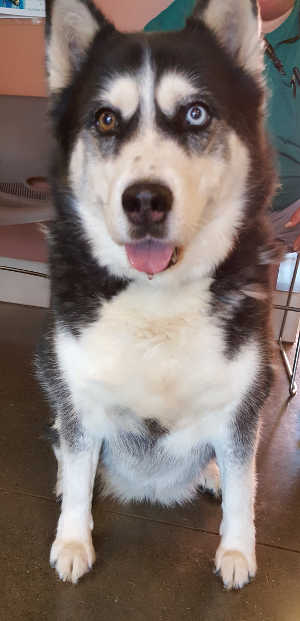
'Jasmine'
“Jasmine” is a female husky mix.
She has a medium-length black and white coat, and one blue eye and one brown eye.
Jasmine is in kennel No. 8, ID No. 5649.

Male pit bull mix
This male pit bull terrier mix has a short brown brindle coat and gold eyes.
He's in kennel No. 10, ID No. 5642.
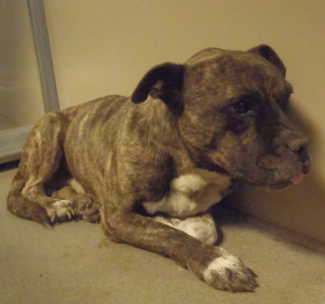
Male pit bull terrier
This male pit bull terrier has a short brown brindle coat.
He's in kennel No. 13, ID No. 5619.

Pit bull terrier mix
This female pit bull terrier mix has a short blue and white coat.
Shelter staff said she is very sweet and just wants attention.
She's in kennel No. 15, ID No. 5456.

Male pit bull terrier
This male pit bull terrier mix has a short brown coat.
He's in kennel No. 22, ID No. 5601.

'Shelby'
“Shelby” is a female shepherd mix with a short black and tan coat.
She's in kennel No. 23, ID No. 5602.

'Storm'
“Storm” is a female pit bull terrier mix with a brown and white coat.
She's in kennel No. 24, ID No. 5363.

'Roadie'
“Roadie” is a male pit bull terrier with a short black and white coat.
He's in kennel No. 26, ID No. 5558.
To fill out an adoption application online visit http://www.co.lake.ca.us/Government/Directory/Animal_Care_And_Control/Adopt/Dog___Cat_Adoption_Application.htm .
Lake County Animal Care and Control is located at 4949 Helbush in Lakeport, next to the Hill Road Correctional Facility.
Office hours are Monday through Friday, 11 a.m. to 5 p.m., and 11 a.m. to 3 p.m., Saturday. The shelter is open from 11 a.m. to 4 p.m. Monday through Friday and on Saturday from 11 a.m. to 3 p.m.
Visit the shelter online at http://www.co.lake.ca.us/Government/Directory/Animal_Care_And_Control.htm .
For more information call Lake County Animal Care and Control at 707-263-0278.
Email Elizabeth Larson at
Our planet is nestled in the center of two immense, concentric doughnuts of powerful radiation: the Van Allen radiation belts, which harbor swarms of charged particles that are trapped by Earth's magnetic field.
On March 17, 2015, an interplanetary shock – a shockwave created by the driving force of a coronal mass ejection, or CME, from the sun – struck Earth's magnetic field, called the magnetosphere, triggering the greatest geomagnetic storm of the preceding decade. And NASA's Van Allen Probes were there to watch the effects on the radiation belts.
One of the most common forms of space weather, a geomagnetic storm describes any event in which the magnetosphere is suddenly, temporarily disturbed.
Such an event can also lead to change in the radiation belts surrounding Earth, but researchers have seldom been able to observe what happens.
But on the day of the March 2015 geomagnetic storm, one of the Van Allen Probes was orbiting right through the belts, providing unprecedentedly high-resolution data from a rarely witnessed phenomenon.
A paper on these observations was published in the Journal of Geophysical Research on Aug. 15, 2016.
Researchers want to study the complex space environment around Earth because the radiation and energy there can impact our satellites in a wide variety of ways – from interrupting onboard electronics to increasing frictional drag to disrupting communications and navigation signals.
“We study radiation belts because they pose a hazard to spacecraft and astronauts,” said David Sibeck, the Van Allen Probes mission scientist at NASA's Goddard Space Flight Center in Greenbelt, Maryland, who was not involved with the paper. “If you knew how bad the radiation could get, you would build a better spacecraft to accommodate that.”
Studying the radiation belts is one part of our efforts to monitor, study and understand space weather. NASA launched the twin Van Allen Probes in 2012 to understand the fundamental physical processes that create this harsh environment so that scientists can develop better models of the radiation belts.
These spacecraft were specifically designed to withstand the constant bombardment of radiation in this area and to continue to collect data even under the most intense conditions.
A set of observations on how the radiation belts respond to a significant space weather storm, from this harsh space environment, is a goldmine.
The recent research describes what happened: The March 2015 storm was initiated by an interplanetary shock hurtling toward Earth – a giant shockwave in space set off by a CME, much like a tsunami is triggered by an earthquake.
Swelling and shrinking in response to such events and solar radiation, the Van Allen belts are highly dynamic structures within our planet's magnetosphere.
Sometimes, changing conditions in near-Earth space can energize electrons in these ever-changing regions. Scientists don't yet know whether energization events driven by interplanetary shocks are common.
Regardless, the effects of interplanetary shocks are highly localized events – meaning if a spacecraft is not precisely in the right place when a shock hits, it won't register the event at all.
In this case, only one of the Van Allen Probes was in the proper position, deep within the magnetosphere – but it was able to send back key information.
The spacecraft measured a sudden pulse of electrons energized to extreme speeds – nearly as fast as the speed of light – as the shock slammed the outer radiation belt.
This population of electrons was short-lived, and their energy dissipated within minutes. But five days later, long after other processes from the storm had died down, the Van Allen Probes detected an increased number of even higher energy electrons. Such an increase so much later is a testament to the unique energization processes following the storm.
“The shock injected – meaning it pushed – electrons from outer regions of the magnetosphere deep inside the belt, and in that process, the electrons gained energy,” said Shri Kanekal, the deputy mission scientist for the Van Allen Probes at Goddard and the leading author of a paper on these results.
Researchers can now incorporate this example into what they already know about how electrons behave in the belts, in order to try to understand what happened in this case – and better map out the space weather processes there.
There are multiple ways electrons in the radiation belts can be energized or accelerated: radially, locally or by way of a shock.
In radial acceleration, electrons are carried by low-frequency waves towards Earth. Local acceleration describes the process of electrons gaining energy from relatively higher frequency waves as the electrons orbit Earth.
And finally, during shock acceleration, a strong interplanetary shock compresses the magnetosphere suddenly, creating large electric fields that rapidly energize electrons.
Scientists study the different processes to understand what role each process plays in energizing particles in the magnetosphere. Perhaps these mechanisms occur in combination, or maybe just one at a time.
Answering this question remains a major goal in the study of radiation belts – a difficult task considering the serendipitous nature of the data collection, particularly in regard to shock acceleration.
Additionally, the degree of electron energization depends on the process that energizes them. One can liken the process of shock acceleration, as observed by the Van Allen Probe, to pushing a swing.
“Think of 'pushing' as the phenomenon that's increasing the energy,” Kanekal said. “The more you push a swing, the higher it goes.” And the faster electrons will move after a shock.
In this case, those extra pushes likely led to the second peak in high-energy electrons. While electromagnetic waves from the shock lingered in the magnetosphere, they continued to raise the electrons' energy. The stronger the storm, the longer such waves persist.
Following the March 2015 storm, resulting electromagnetic waves lasted several days. The result: a peak in electron energy measured by the Van Allen Probe five days later.
This March 2015 geomagnetic storm was one of the strongest yet of the decade, but it pales in comparison to some earlier storms.
A storm during March 1991 was so strong that it produced long-lived, energized electrons that remained within the radiation belts for multiple years.
With luck, the Van Allen Probes may be in the right position in their orbit to observe the radiation belt response to more geomagnetic storms in the future.
As scientists gather data from different events, they can compare and contrast them, ultimately helping to create robust models of the little-understood processes occurring in these giant belts.
The Johns Hopkins Applied Physics Laboratory in Laurel, Maryland, built and operates the Van Allen Probes for NASA's Heliophysics Division in the Science Mission Directorate.
The Van Allen Probes are the second mission in NASA's Living With a Star program, an initiative managed by Goddard and focused on aspects of the sun-Earth system that directly affect human lives and society.
LAKEPORT, Calif. – The Lakeport branch of Lake County Library will host a program on energy efficiency on Saturday, Aug. 27, from 2 to 4 p.m.
Austin McCaffrey, an energy efficiency specialist for Mendocino County’s Community Development Commission, or CDC, will present a PowerPoint slideshow about the Mendo-Lake Energy Watch program.
McCaffrey will have free giveaways for the audience members.
The CDC operates the Mendo-Lake Energy Watch (MLEW) as a partnership with PG&E under the auspices of the California Public Utilities Commission.
MLEW provides resources to the community, including local governments, small and medium sized businesses, school and nonprofit organizations.
It offers energy services and solutions through classes on a range of sustainability topics, an energy efficiency auditing and retrofitting program, benchmarking services for local governments and technical support services for programs like Proposition 39 for Schools.
Learn more about MLEW’s programs at the Web site www.mendoenergy.org .
The applications of the Energy Watch are supplemented by community outreach and networking through events such as this one at Lakeport Library.
The Lake County Library is on the internet at http://library.lakecountyca.gov and Facebook at www.facebook.com/LakeCountyLibrary .
The library is located at 1425 N. High St. in Lakeport. For more information call 707-263-8817.