 How to resolve AdBlock issue?
News
The recreational Dungeness crab season is scheduled to open statewide on Saturday, Nov. 5 – with a health warning in place for crabs caught north of Point Reyes (Marin County).
The California Department of Public Health (CDPH) has issued a warning to recreational anglers not to consume the viscera (internal organs) of Dungeness crab caught in coastal waters north of Point Reyes due to the sporadic detection of elevated levels of domoic acid in the viscera of Dungeness crabs caught off the Northern California coast.
The health warning is effective for recreationally caught Dungeness crabs taken from state waters north of Latitude 38° 00' N. (near Point Reyes). CDPH believes that Dungeness crab meat is safe to consume, however, as a precaution, consumers are advised not to eat the viscera (also known as "butter" or "guts") of crabs.
CDPH further recommends recreational anglers follow best preparation practices to ensure that they avoid any inadvertent exposure to domoic acid that might be sporadically found in some crab's viscera.
Domoic acid is a naturally occurring toxin related to a "bloom" of certain single-celled algae. Fish and shellfish are capable of accumulating elevated levels of domoic acid in their tissue, which can sicken people who eat them.
Last fall and winter, domoic acid along the West Coast interrupted Dungeness and rock crab fisheries from Santa Barbara to the Oregon state line.
This year, the California Department of Fish and Wildlife (CDFW) will continue to work with CDPH and the fishing community to collect crab samples from the northern California coast until the domoic acid levels have dissipated.
Consult the CDPH biotoxin information line at 800-553-4133 or CDPH's Domoic Acid Health Information webpage for more information.
CDFW reminds crabbers of new regulations that became effective on Aug. 1, 2016. For a complete description of the regulations, please go to www.wildlife.ca.gov and click on "New Recreational Dungeness Crab Fishery Regulations" in the Announcements box.
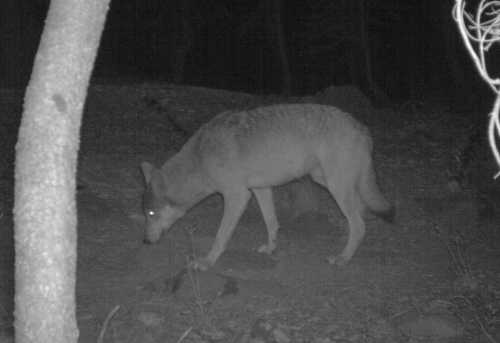
The California Department of Fish and Wildlife has confirmed the presence of two gray wolves in western Lassen County.
After a wolf-like canid was photographed by trail cameras in Lassen County in fall 2015 and spring 2016, CDFW began operating additional trail cameras in the area and regularly searching for wolf scat and tracks.
This summer, photographs, tracks and eyewitness sightings suggested the presence of two canids frequently traveling together.
Numerous scat samples were collected by CDFW scientists and submitted to the University of Idaho’s Laboratory for Ecological, Evolutionary and Conservation Genetics. Genetic analysis of the samples confirmed the presence of a male and a female gray wolf.
There is no current evidence – such as trail camera images, tracks, scat or reported observations – suggesting the wolves produced pups this year.
Analysis of scat indicates that the male wolf was born into the Rogue Pack in 2014, and most likely dispersed to Lassen County in late 2015 or 2016.
The founder of the Rogue Pack is the well-known gray wolf OR7 (collared in Oregon by the Oregon Department of Fish and Wildlife) who dispersed from northeast Oregon and traveled around northern California in 2011 and 2012 before eventually finding a mate and establishing a territory in southern Oregon in 2013.
The DNA of the female wolf does not match that of any known individual wolves from Oregon, and initial analyses indicates she is not a close relative of current Oregon wolves.
Dispersing wolves have commonly been documented to travel great distances, and it is possible that she dispersed from another western state, officials said. The collection of higher-quality genetic samples may eventually lead to a better understanding of her origin.
Gray wolves were eliminated from California more than 100 years ago, until the return of OR7 in 2011.
In May and July 2015, a trail camera in Siskiyou County captured images of a single adult, black wolf. Additional cameras were placed in the vicinity and in August 2015 images of two separate adult black wolves and five pups were captured. CDFW designated these animals the Shasta Pack.
Until confirmation of the pair of wolves in Lassen County, these were the only wolves known to occur in California.
According to strategies identified within CDFW’s draft Conservation Plan for Gray Wolves in California, CDFW will continue to assess and monitor gray wolves in California.
If the pair documented in Lassen County continues to stay in the region, monitoring may include capturing at least one of the two and fitting it with a satellite-based GPS transmitter.
“The purpose of collaring gray wolves is to understand some key biological parameters such as habitat use, prey preferences and reproduction, as well as to potentially minimize wolf-livestock conflicts” said Karen Kovacs, a CDFW Wildlife Program manager who has studied the wolves. “Due to concerns for the welfare of wolves, capturing them is generally not feasible in cold weather. Therefore, we would not attempt to capture and collar the wolves until late spring at the earliest.”
Gray wolves are currently listed as endangered both federally and within the state of California.
The U.S. Fish and Wildlife Service and CDFW have no plans to reintroduce gray wolves into California.
CDFW’s draft Conservation Plan for Gray Wolves is available at www.wildlife.ca.gov/conservation/mammals/gray-wolf .
As California continues to experience a rise in the number of motorcycle-involved collision deaths and injuries, the California Highway Patrol is increasing its focus to keep motorcyclists safe.
The number of victims from motorcycle-involved collisions in CHP jurisdiction has increased every year since 2013.
Without continued attention on motorcycle education and enforcement, these numbers will continue to rise as more Californians choose motorcycles for work, weekend getaways, and entertainment.
To address the problem, the CHP implemented the “Have A Good Ride III” (HAGR III) program to promote motorcycle safety and awareness.
From Oct. 1, 2016, through Sept. 30, 2017, the goal of the HAGR III grant is to reduce the number of motorcycle-involved fatal and injury collisions, and the number of victims of these collisions.
“With a combination of grant-funded education and enforcement efforts, we strive to raise awareness and reinforce the concept of sharing the road in order to save lives,” CHP Commissioner Joe Farrow said.
In regions with higher numbers of motorcycle incidents, CHP officers will increase motorcycle safety enforcement operations.
Motorcycle traffic safety education campaigns, including the “May is Motorcycle Safety Awareness Month” and a summer safety campaign by the National Highway Traffic Safety Administration, will be conducted at appropriate venues.
The campaigns will promote the use of properly approved helmets for all riders, raise motorists’ awareness of sharing the road with motorcyclists, and urge riders to refrain from actions most commonly identified in motorcycle-involved collisions, such as speeding, improper turning, and driving under the influence of alcohol and/or drugs.
Throughout the HAGR III campaign, the CHP will work with the California Department of Transportation to display “Share the Road – Look Twice for Motorcyclists” on changeable message signs on state highways.
Funding for this program was provided by a grant from the California Office of Traffic Safety, through the National Highway Traffic Safety Administration.

LAKE COUNTY, Calif. – Lake County Wine Studio is hosting a wine tasting event featuring wines from Gregory Graham, and artist reception with designer wall quilts made by Laraine Wade.
The event will be held on Friday, Nov. 4, from 5 to 8 p.m., and Saturday, Nov. 5, from 4 to 7 p.m.
The $15 ($12/per person for studio club members) wine sampler and appetizers by Fresh and Bangin’ Eatery will showcase the 2013 Chardonnay with a pork meatball garnished with mild curry and mango, 2012 Grenache with roasted root vegetables with a teriyaki glaze, black sesame and green onion, 2011 Cindercone with chicken egg roll, and the 2014 Moscato del Fresco with ginger ice cream and spiced cake topped with Mandarin orange.
In college, Wade majored in art and ceramics was her passion. She received her bachelor's degree and master's degree in art and then went to work teaching and raising two boys. She began quilting in her spare time.
After living in Lake County for 15 years, her family moved to Olympia, Wash., where she taught high school art. Since retiring from teaching, she quilts almost every day after working in her studio on paintings in a variety of mediums.
Wade’s first quilt was very traditional, but not interesting to her. She found that having to repeat a design was boring. She began to draw out her designs and never looked back. Asian fabrics caught her attention early on. She loved the elegance of the designs and the heavy gold accents, and mixes them with contemporary fabrics, sometimes adding Lamé and beads for glitz.
Wade’s creative process starts with sketches on copy paper and once she feels the design is right, she enlarges it on 1 inch graph paper drawing it to scale. Then, she uses tissue paper over the graph paper to make her patterns. Working on her family pool table she keeps the sizes manageable.
While considering color, texture and pattern, she pulls from two tables of fabrics and pieces the work together much like a puzzle. Then the shapes are cut out and the pattern pieces are replaced with fabric.
Wade enjoys the challenge of creating the design using many different patterns, colors and textures. She machine pieces and then quilts by hand. The surfaces are richly covered with quilting, following the fabric's pattern or creating her own. This finishing stage is when the quilts come to life for her.
While working as head winemaker at Rombauer Vineyard in Napa, Greg Graham envisioned producing wines under his own label. He began to do so in 1992 using fruit purchased in Napa, Carneros and Knights Valley.
In the year 2000, Graham seized the opportunity to grow his own wine grapes when he and his wife Marianne purchased a 13 acre Zinfandel vineyard in the Red Hills Appellation of Lake County.
In 2004, purchase of an adjacent property planted to Cabernet Sauvignon expanded the Graham's operations to 27 acres, and their winery was built at the base of the vineyard hills. The vineyard soils are red, rocky, well drained and ideally suited for the grape varietals that Graham grows.
Graham harvests his grapes at the peak of fruit flavor development. In the winery, he uses boutique wine making techniques to control the quality, to bring out superior characteristics from the fruit and early bottling to preserve the flavors. The result is wines with bright, fresh fruit aromas and flavors with intensity and softness.
Lake County Wine Studio is a gallery for display and sale of art and a tasting room, wine bar and retail shop for the fine wines of Lake County. Artists’ shows are held on a monthly basis with art and wine receptions held the first Friday and subsequent Saturday of each month.
The gallery is located at 9505 Main St. in Upper Lake. The hours of business September through May are Thursday through Monday from 1 to 7 p.m., and Friday from 1 to 8 p.m.
The Wade art exhibit will be on display for the full month of September.
For more information call Lake County Wine Studio at 707-275-8030 or 707-293-8752.
CLEARLAKE, Calif. – The next free household hazardous waste dropoff event will be held Friday, Nov. 18, and Saturday, Nov. 19, at Quackenbush Mountain Recovery & Compost Facility, 16520 Davis Street adjacent to the Landfill, Clearlake.
From Highway 53 turn on to 40th Avenue, take a left on Moss Avene, follow the signs to the landfill on Davis Avenue.
Hours will be from 9 a.m. until 1 p.m.
Households can bring up to 15 gallons of toxic items free of charge. Fees will be charged for amounts over 15 gallons.
Items that are accepted include paint, solvents, fuels, five-gallon propane tanks (empty), pool chemicals, pesticides, herbicides, batteries, fluorescent light tubes (up to 60 linear feet) and other toxic materials that cannot be put in the trash.
Items that cannot be accepted include televisions, computer monitors, ammunition, explosives, radioactive materials or infectious wastes.
To learn how and where to properly dispose these items, please visit www.recycling.co.lake.ca.us or contact the recycling hotline at 707-263-1980.
Household hazardous waste dropoff services are provided to Lake County residential households by the Integrated Waste Management Division of the Lake County Public Services Department and the Department of Resources Recycling and Recovery (CalRecycle).
Businesses also are welcome to use this convenient service to properly dispose of hazardous waste and protect our environment, however, businesses must pay for this county-funded service and first make an appointment. Business appointments can be made by calling Lake County Waste Solutions at 707-234-6400.
Beginning in June, ask about receiving a free puncture-proof sharps container at one of these events to use for free sharps disposal.
Free recycling options for residents and businesses:
· Recycled paint is available to both residents and businesses at Lake County Waste Solutions and South Lake Refuse and Recycling Center first-come, first-served basis in five gallon containers. Colors include tan, brown, gray and pink.
· Used motor oil and cooking oil can be dropped off by businesses and residents, at Lake County Waste Solutions, South Lake Refuse & Recycling Center, and the North Shore Fire Protection District station at 6257 Seventh Ave. in Lucerne. Visit www.recycling.co.lake.ca.us for more locations.
· Electronics (e-waste) can be dropped off at Lake County Waste Solutions and at South Lake Refuse & Recycling Center.
Lake County Waste Solutions
230 Soda Bay Road, Lakeport
888-718-4888 or 707-234-6400
Monday-Saturday, 7:30 a.m. - 4 p.m.
www.candswaste.com
South Lake Refuse & Recycling Center
16015 Davis St., Clearlake
Open daily, 7:30 a.m.-3 p.m.
707-994-8614
www.southlakerefuse.com
The free Household Hazardous Waste drop off program is subsidized by the Lake County Public Services Department, Integrated Waste Management Division and CalRecycle as a public service to Lake County households.
For more information about recycling, reusing and reducing, visit www.recycling.co.lake.ca.us , call the recycling hotline at 707-263-1980 or like Lake County Public Services on Facebook at https://www.facebook.com/LCPublicServices?fref=ts .
MENDOCINO NATIONAL FOREST, Calif. – The 70th annual Cowbell Enduro will start and end at the Middle Creek Campground staging area on the Upper Lake Ranger District Saturday, Nov. 5.
The event will begin at 8 a.m. and end around 7 p.m.
The Enduro is a time and distance off-road motorcycle event that will utilize 95 miles of designated OHV routes and roads.
This is an amateur motorcycle event where speed is not the determining factor. This is not a closed course which means that all roads and trails used during the Enduro are open to the public and are subject to two-way traffic.
For this reason forest officials encourage riders that are not part of the event use extreme caution when riding the routes that are being utilized by the event participants. These events are authorized under special use permits.
If you have questions, please contact Mike Burmann, OHV manager, Upper Lake Ranger District, at 707-275-1421.