 How to resolve AdBlock issue?
News
The California Department of Fish and Wildlife (CDFW) is holding a public meeting to solicit comments on proposed fishing closure alternatives for 5.5 miles of the Sacramento River above the Highway 44 Bridge in Redding to the Keswick Dam.
CDFW has determined a potential closure may be necessary to protect endangered winter-run Chinook salmon.
The meeting will be held Monday, Nov. 14, from 5 to 7 p.m. at the Redding Public Library, 1100 Parkview Ave.
CDFW is proposing a suite of closure alternatives in this critical holding and spawning area to ensure added protection for the federal and state endangered winter-run Chinook, which face high risk of extinction.
Given the gravity of the current situation, it is imperative that each and every adult fish be given maximum protection.
Current regulations do not allow fishing for Chinook, but incidental catch by anglers who are targeting trout could occur.
This reach is the principal spawning area for winter-run Chinook, with an estimated 98 percent of 2014 and 2015 in-river spawning occurring in the 5.5 mile stretch under consideration for closure.
This section represents only 10 percent of the waters currently open to fishing upstream of the Red Bluff Diversion Dam.
In 2014 and 2015, approximately 95 percent of eggs and young winter-run Chinook were lost due to elevated river temperatures.
CDFW works with the California Fish and Game Commission to determine whether fishing restrictions in certain areas are necessary.
Persons with disabilities needing reasonable accommodation to participate in public meetings or other CDFW activities are invited to contact CDFW’s Accessibility Coordinator Melissa Carlin at 916-651-1214 or
I am writing to convey my support for Monica Rosenthal as a candidate for District 1 supervisor.
For years, Monica has found ways to remain engaged in our community. During her time as planning commissioner, she asked hard questions and refused to cut corners. Monica spent countless hours researching zoning changes and proposed developments. She always came to the table educated about the topics being discussed.
During the aftermath of the devastating Valley fire, Monica once again showed her strength of character. She worked hard with local and state government to obtain resources and organize distribution to those in need. Monica was recognized as Lake County’s Woman of the Year for her involvement in the community before and following the fire.
Throughout the years, Monica has set an admirable standard of leadership that our community can respect. Hard work and determination is something that we can trust. Vote Monica for District 1 supervisor and the leadership we deserve.
Russell Rosenthal is the son of Monica and David Rosenthal. He lives in Santa Rosa, Calif.
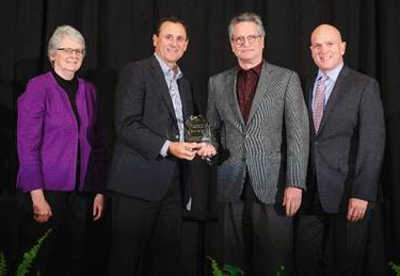
CLEARLAKE, Calif. – St. Helena Family Health Center-Clearlake family medicine physician John Weeks, MD, was recognized with a 2016 Physician of the Year Mission Award by Adventist Health.
Dr. Weeks is one of 19 physicians to be honored from Adventist Health locations throughout California, Hawaii, Oregon and Washington.
Dr. Weeks was nominated by St. Helena Hospital Clear Lake to receive the award because of his 37 years of dedication to a mission of providing exceptional care for five generations of Lake County residents.
When Dr. Weeks began practicing in Clearlake in 1979, the town was a physician shortage area. He was the only residency-trained family practice doctor in Lake County, the only physician providing obstetric care and one of only two physicians who provided pediatric or orthopedic services.
“John has served our community through thick and thin,” said Dr. Marc Shapiro, chief medical officer at St. Helena Hospital Clear Lake. “He has truly integrated with this community and always shown wisdom, grace and equanimity. Working with him is like working with family.”
Dr. Weeks is known for giving his full attention to each patient, learning about their lives and listening to their stories in the hope that taking time today will keep patients out of the hospital in the future.
“One of the principles of family practice is that the relationship is part of the treatment,” Weeks explains. “You may have the right treatment, but if you can’t explain things to your patients in a way they understand, you haven’t really done your job.”
Dr. Weeks has served as St. Helena Hospital Clear Lake’s chief of staff three times, providing an example of excellence in the art and science of medicine and service to others. He has also invested time in the next generation of physicians by training family practice residents.
“Dr. Weeks has been a change agent for our organization and is the consummate example of putting mission first,” said David Santos, president and chief executive officer of St. Helena Hospital Clear Lake. “He has a deep focus and vision for Lake County and is integral as we achieve goals within the Adventist Health mission.”
Weeks received the award at the Adventist Health Physician Leadership Symposium held in San Diego, Calif., Oct. 10 to 11.
Dr. Whie Oh, an interventional cardiologist, also received a Physician of the Year Mission Award at the symposium. Dr. Oh also sees patients at the St. Helena Family Health Center-Clearlake.
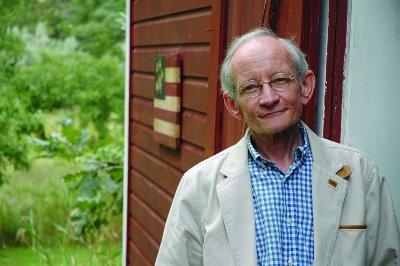
Emilie Buchwald was the co-publisher and founding editor of Milkweed Editions in Minneapolis going on forty years ago, and that press grew up to become one of the finest literary publishers in our country.
Today she edits children's books at Gryphon Press, which she also founded.
Here's a lovely remembrance from her new book, The Moment's Only Moment, from Nodin Press.
My Mother's Music
In the evenings of my childhood,
when I went to bed,
music washed into the cove of my room,
my door open to a slice of light.
I felt a melancholy I couldn't have named,
a longing for what I couldn't yet have said
or understood but still
knew was longing,
knew was sadness
untouched by time.
Sometimes
the music was a rippling stream
of clear water rushing
over a bed of river stones
caught in sunlight.
And many nights
I crept from bed
to watch her
swaying where she sat
overtaken by the tide,
her arms rowing the music
out of the piano.
American Life in Poetry does not accept unsolicited submissions. American Life in Poetry is made possible by The Poetry Foundation ( www.poetryfoundation.org ), publisher of Poetry magazine. It is also supported by the Department of English at the University of Nebraska-Lincoln. Poem copyright ©2016 by Emilie Buchwald, “My Mother's Music,” from The Moment's Only Moment, (Nodin Press, 2016). Poem reprinted by permission of Emilie Buchwald and the publisher. Introduction copyright © 2016 by The Poetry Foundation. The introduction's author, Ted Kooser, served as United States Poet Laureate Consultant in Poetry to the Library of Congress from 2004-2006.
"I do not understand how anyone can live without some small place of enchantment to turn to." – Marjorie Kinnan Rawlings
LAKE COUNTY, Calif. – If you like a good mystery, you need go no farther than your closest state park.
Take a hike along a shadowy trail and listen to the restrained murmurs amongst the billowing leaf-fall which is occurring.
After you shake off the reverie of your walk, look at the clusters of leaves, both on top, and beneath their elongated, variegated puzzle-pieces.
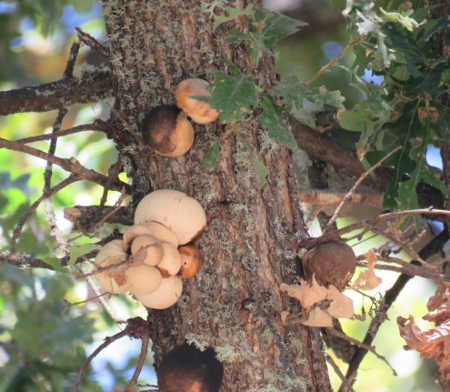
Also, observe the tree's trunk and limbs, and you see orbs, balls and bubbles of differing hues – off-white to black.
The oak gall comes in all shapes and sizes, and, at first sight, presents a mystery. What on earth is that tan sphere attached to the oak tree? What can the perfectly pink, tiny chocolate chip-shaped object possible be, affixed to an oak leaf like that?
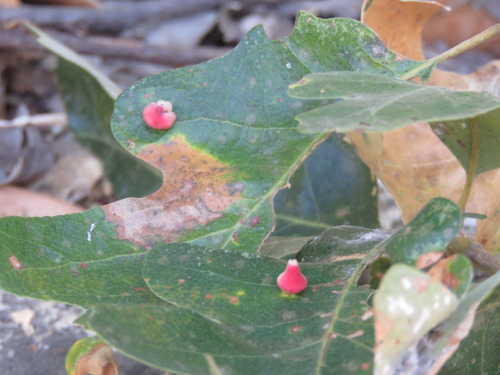
It appears that the Great Prankster has devised a myriad of ways to entertain and inform us. Nature, always ornate and exceedingly creative spares no effort in building tiny worlds for creatures to thrive.
Also known as oak apples, these are homes of tiny wasps, and are definitely not edible.
Galls are sometimes elusive, but through careful observation of oaks, and many other trees and plants, you will find all manner of shapes, sizes and kaleidoscopic colors beyond the aforementioned.
Galls can be found on alders, pines, manzanitas and more, in tints of yellow, red, green and even purple.
Through the science of cecidology, or galls and their producers, it has been found that trees may be home to not only one type of gall, but could be home-sweet-home to dozens.
According to Glenn Keator's book, “The Life of an Oak,” “The cynipid wasps are responsible for the majority of oak galls."
The tiny cynipid wasp is only millimeters in size, and has found oaks to be a favored place to survive and thrive in nature.
First, the wasp begins egg-laying in the trees' buds, leaves or, nearly any tree-tissue handy.
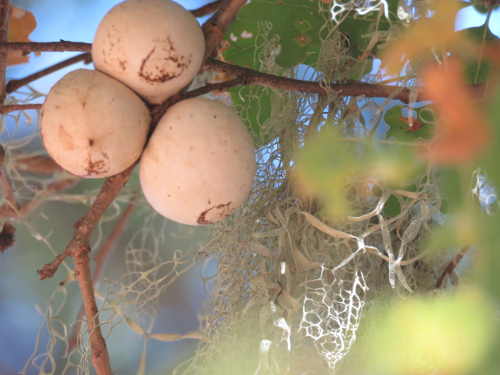
After the eggs hatch and change to larva, a chemical in the larva's saliva reacts with the cells, called meristematic that are in the oak tree's tissues, and voilà! A gall begins to form in which the wasp inhabits and metamorphoses – oh, and also feeds upon.
When the time comes to leave its gall, it tunnels out, leaving a miniscule opening in the formerly occupied home. Now the cycle begins once more- but, as they say, timing is everything. If the eggs are deposited too early or too late in the season, this entomologic ballet will not occur.
The swell of a gall's growth on a tree does not seem to do harm. Since galls are replete with tannic acid, they have been used historically for tanning, as dyes and in ointments.
In S. A. Barrett's book, entitled “Pomo Myths,” the story of Oak-ball who tricks Coyote is retold.
In the account an oak ball was seen drifting down as stream. Coyote was curious about why he could not float in water like the oak-ball. The oak-ball informs him that in order to float, you simply jump into the water, and after reaching the bottom you naturally float up.
After some trepidation Coyote got up his nerve and jumped in. He did not, however, bob up to the surface as Oak-ball had informed him, but was, instead, jettisoned roughly downstream, where he was drowning.
Oak-ball-people rescued Coyote, dragging him to the shore to rest, where Blue Jay came along to squawk and annoy him.
For more gall photos visit http://joycegross.com/galls_ca_oak.php .
Kathleen Scavone, M.A., is a retired educator, potter, writer and author of “Anderson Marsh State Historic Park: A Walking History, Prehistory, Flora, and Fauna Tour of a California State Park” and “Native Americans of Lake County.” She also writes for NASA and JPL as one of their “Solar System Ambassadors.” She was selected “Lake County Teacher of the Year, 1998-99” by the Lake County Office of Education, and chosen as one of 10 state finalists the same year by the California Department of Education.
A new look 100 miles beneath a massive tectonic plate as it dives under North America has helped clarify the subduction process that generates earthquakes, volcanoes and the rise of the Cascade Range in the Pacific Northwest.
The largest array of seismometers ever deployed on the seafloor, coupled with hundreds of others operating in the continental U.S., has enabled University of California, Berkeley, researchers to essentially create CT scans of the Juan de Fuca plate and part of the earth’s mantle directly below it.
The plate, about the size of the state of Michigan, is grinding under the continent along an 800-mile swath that runs from Northern California to Vancouver Island, known as the Cascadia subduction zone.
The 3-D imaging process, known as seismic tomography, has revealed with unprecedented clarity a huge, buoyant, sausage-shaped region of the upper mantle, or asthenosphere, pressing up on the oceanic plate.
The imaging casts new light on the competing hypotheses about the drivers of plate tectonics, a dynamic earth process that has been studied for more than 50 years but is still poorly understood.
Different evidence has led to three different plate movement scenarios: either the plates are pushed from mid-ocean ridges; or they are pulled from their subducting slabs; or their movement is driven by the drag of the viscous mantle material that lies directly below.
The new research suggests that the third scenario does not apply to the Cascadia subduction zone. Rather, it reveals that a distinct, thin – and difficult to observe – layer separates the plate from the mantle beneath, at least in the Cascadia subduction zone.
The layer acts as a kind of berm that the plate rolls over before descending beneath the continent, says UC Berkeley seismologist Richard Allen, leader of the research and co-author of a paper appearing in the Sept. 23 edition of the journal Science.
“What we observe is an accumulation of low-viscosity material between the plate and the mantle. Its composition acts as a lubricant, and decouples the plate's movement from the mantle below it,” Allen explains. The plates may move independently of the mantle below, he adds.
The finding, he says, will help refine models of plate tectonic dynamics, aiding the long-range effort to understand the connection between tectonics and earthquakes.
“It is the motion of the plates that causes earthquakes,” Allen says. “Models like this help us understand that linkage so we can be better informed of the coastal hazards.
“First though, we need to learn if what we find here is typical of subduction zones across the planet, or if it is unique for some reason.”
Japan has recently deployed a massive seafloor seismic network to study subduction and earthquakes. Allen hopes to next apply the tomography strategy there. Alaska also beckons.
Lead author on the Science paper is William Hawley, a graduate student in Allen’s lab.
“Plate tectonics is the most fundamental concept explaining the formation of features we see on the earth’s surface,” Hawley said, “but despite the fact that the concept is simple, we still do not know exactly why or how it operates.
“If the asthenosphere acts as a lubricant for tectonic plate movement throughout the planet, it will really change our long-term models of the process” – dynamic changes that occur over a 100 million years, Hawley said.
“Modelers will have to take this lubricating layer into account because it changes the way the mantle and the plates talk to each other,” according to Hawley.
Seismic tomography generates 3-D images of the earth’s interior by measuring how differences in shape, density, rock type and temperature affect the path, speed and amplitude of seismic waves traveling through the planet from an earthquake.
Much as in CT scans, computers process differences in energy measured at the receiving end to infer interior 3-D detail. CT scans use X-rays as the energy source, while seismic tomography measures energy from seismic waves.
A dense array of seismometers directly over the region of interest yields the best images and provides the highest resolution of the structures, which can then inform models of the process.
This study used the data from the largest scale ocean-floor deployment to complement the onshore data already available. Together, they generated the best images of the region to date.
The four-year seafloor research effort was made possible by the National Science Foundation’s ambitious $20 million Cascadia Initiative.
The NSF aimed to spur greater understanding of plate structure, subduction processes, earthquakes and volcanism by deploying seismometers at 120 sites on the ocean floor, arrayed throughout the 95,000-square-mile Juan de Fuca plate.
Over the four years, the offshore and onshore seismometer array measured thousands of earthquakes throughout the planet, ranging from magnitudes of 5 to about 9 on the Richter scale. The study examined a subset of 321 quakes with magnitudes between about 6 and 7.5.
Grad students and faculty scientists participated in 24 research cruises to deploy the instruments and move them between two swaths of the Juan de Fuca plate. Several of the seismic tomography cruises invited undergraduate students on the two-week trips.
On one Berkeley-led cruise aboard the R/V Thomas Thompson, the undergrads dubbed the trip the “Tom Cruise,” and sent daily video blogs ( https://www.youtube.com/playlist?list=PLaLpP50ifUEiz1cLei4aNZNfS4wtGihey ) .
Wallace Ravven writes for the UC Berkeley News Center.