 How to resolve AdBlock issue?
News
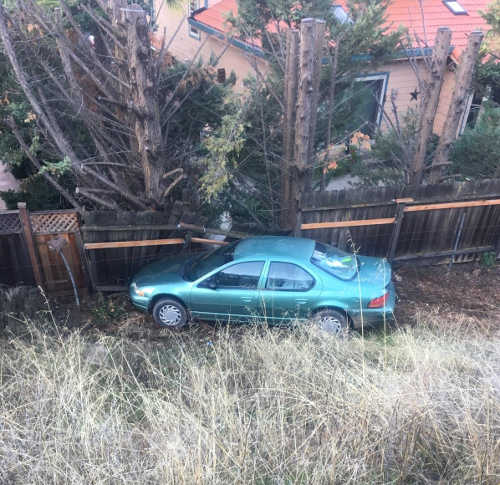 CLEARLAKE OAKS, Calif. – A Friday morning vehicle crash led to a propane leak, brief evacuations of some nearby homes and a closure of Highway 20.
The California Highway Patrol said the crash happened just before 8:30 a.m. on Highway 20 at Paradise Valley Boulevard.
A small green four-door sedan went off the highway and down an embankment next to the Paradise Cove subdivision, according to reports from the scene.
Northshore Fire Chief Jay Beristianos said the crash resulted in no injuries, but the vehicle hit a residential propane tank and knocked it over.
The result was that the overturned tank was leaking liquid propane in the backyard of the residence, Beristianos said.
Northshore and Cal Fire firefighters used water streams to disburse a propane gas cloud away from the home. Beristianos said a winch had to be used to upright the tank so the value could be turned off.
He said residents in nearby homes were asked to evacuate while the work at the scene involving the propane tank was taking place.
At the same time, Highway 20 was closed for about an hour to reduce the chance of igniting the propane cloud, Beristianos said.
Beristianos said Northshore Fire sent two engines, a heavy rescue and a medic unit, and Cal Fire sent two engines, with a total of 13 personnel on scene.
Email Elizabeth Larson at
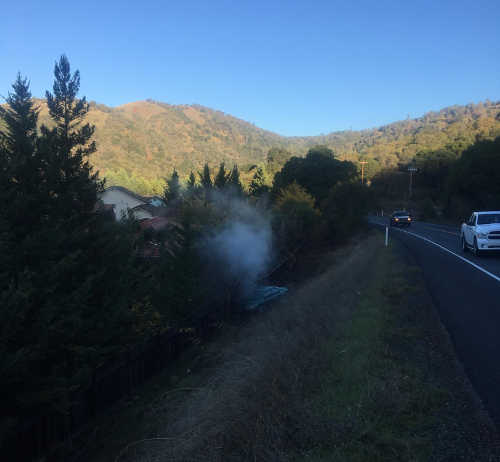
LAKE COUNTY, Calif. – After a break in the rain, forecasters are predicting some more precipitation on Saturday for Lake County.
The National Weather Service said there are chances of rain around Lake County during the day and night on Saturday.
Up to a tenth of an inch is expected during the daytime, with another quarter of an inch possible Saturday night, according to the forecast.
Light winds also are expected, with temperatures in the high 60s during the day and in the low 50s at night.
Conditions are expected to clear on Sunday and remain mostly clear through next weekend, the National Weather Service said.
Email Elizabeth Larson at
LAKE COUNTY, Calif. – Veterans with stories to share and volunteers to help collect personal accounts are being sought for the Veterans History Project.
The Veterans History Project is an ongoing effort of the American Folklife Center of the Library of Congress.
The project collects, preserves and makes accessible to the public the personal accounts of American war veterans.
The goal is that future generations may hear directly from veterans and better understand the realities of war.
This week it was announced that Karen D. Lloyd, a retired colonel and former US Army aviator, has been appointed as the new director of the Veterans History Project.
In her previous assignment in the Office of the Librarian of Congress, Lloyd worked to expand the Veterans History Project's outreach efforts and developed products to facilitate the implementation of a project volunteer corps.
Volunteers for the project are needed. Veterans are asked to share their stories, and interested individuals are needed to help record the veterans' accounts.
Students in the 10th grade and above also may participate and there are special resources for educators and students.
Help honor our veterans by making their stories known.
To participate, contact Congressman Mike Thompson's Napa District office at 707-226-9898 or email
For more information about the project, visit http://www.loc.gov/vets/ .
LAKE COUNTY, Calif. – Going to sleep “later” as a result of the upcoming Daylight Saving Time change on Sunday, Nov. 6, can disrupt sleep patterns and may result in sleep-deprived drivers struggling with performance and concentration behind the wheel.
The California Highway Patrol is joining with the National Sleep Foundation to promote Drowsy Driving Awareness Week, Nov. 6 to 13, and increase awareness of the dangers associated with the deadly driving behavior.
California has seen an increase in collisions involving sleepy or fatigued drivers over the last three years, the CHP said.
In 2013, there were 4,284 collisions involving sleepy or fatigued drivers. The number increased to 4,693 in 2014 and to 5,511 in 2015, according to the CHP.
Over the same time span, the CHP said those collisions resulted in the deaths of 28 people in 2013, 44 people in 2014 and 45 in 2015.
“Most people are aware of the dangers of driving while intoxicated, but many do not know that drowsiness also impairs judgment, performance, and reaction time just like alcohol and drugs,” CHP Commissioner Joe Farrow said. “Teens and young adults are at the highest risk of drowsy driving, due to their chronic sleepiness and overall lack of driving experience.”
According to the National Highway Traffic Safety Administration, there are an estimated 100,000 collisions annually in the United States that are a result of drowsy driving. These collisions result in more than 1,550 deaths, 71,000 injuries, and an estimated $12.5 billion in monetary losses.
Here are some tips to avoid drowsy driving:
· Get a good night’s sleep before a long drive.
· Get off the road if you notice any signs of fatigue.
· Take a nap. Exit the freeway, pull off the road and find a safe place to take a 15- to 20-minute nap.
· Consume caffeine. The equivalent of two cups of coffee can increase alertness for several hours, but do not rely on it for long periods.
· Drive with a friend. A passenger who remains awake can help watch for signs of fatigue in the driver and take a turn driving if necessary.
The mission of the CHP is to provide the highest level of safety, service and security to the people of California.
Humans sometimes struggle to adjust to Daylight Saving Time, but just measuring the exact length of a Saturn day is one of the big challenges for scientists on NASA's Cassini mission.
Over more than a decade in Saturn orbit, Cassini's instruments have wrestled with confusing measurements to determine the planet's precise rotation rate.
The mission's final year and unprecedented trajectory will carry Cassini to unexplored regions so near to Saturn that scientists might finally answer the question:
Just how long is a day on Saturn?
Michele Dougherty used to say that measuring the length of a Saturn day was like searching for a needle in a haystack. Now she thinks the old cliché falls short. "It's more like searching for several needles that change color and shape unpredictably," she said.
Based at Imperial College, London, Dougherty is principal investigator for the magnetometer instrument (MAG) on board Cassini, studying the planet more closely than any spacecraft before. Yet Cassini's instruments can't seem to nail down something fundamental about Saturn that, for Earth, is hard to miss: the length of a day. Part of the challenge stems from what a day truly is.
When a person says, "It's been cloudy for days," they're conveying how long (that is, for how much time) the sky's been cloudy. But a day is really a description of motion, not time. The sun doesn't rise or set. Instead, the sun's apparent motion is the result of Earth spinning on its axis. And an observer need not be on Earth to figure out the length of an Earth day.
Someone in space or on another planet in our solar system could choose a distinct surface feature on Earth, such as Madagascar, then note its position and click a stopwatch. When Madagascar returns to the position it was in when the stopwatch was started, the observer could note the elapsed time.
If they measured precisely enough, they would find that Earth rotates once per 23.934 hours. That's Earth's rotation rate – the very definition of a day.
Using the same principle, Earthlings have learned the rotation rates of other planets. A day on Mercury lasts about two Earth months. And a Mars day lasts 24.623 Earth hours, barely longer than Earth's. But watching surface features does not work equally well for all planets.
When the bulk of a planet swims beneath thousands of miles of atmosphere, the challenge of clocking its rotation rate is even tougher. The swirling cloud bands on a gas planet like Saturn and Jupiter move at different rates, making it impossible to use the clouds to measure the planet's rotation rate. But even then, scientists have a couple aces up their sleeve: the planet's magnetic field and radio wave emissions.
In a planet's interior, heat causes electrically conductive fluids to move, and those currents generate a magnetic field that can extend out into space many times the diameter of the planet.
On Earth and Jupiter, the magnetic north pole is tilted from each planet's rotation axis by about 10 degrees, meaning it's not aligned with the "true north" pole on either planet.
If you could see Jupiter's or Earth's magnetic field from space, and you sped up time, the magnetic field would appear to wobble like a hula hoop as the planet spins.
Since the magnetic field is generated in a planet's deep interior, for most planets, the field's rotation rate tells scientists the rotation rate of the planet itself. One full wobble equals one day.
We can't see magnetic fields, but instruments called magnetometers can, and radio antennas can detect radio emissions from a planet with patterns that repeat each time the planet rotates.
In fact, almost as soon as radio antennas were invented, scientists figured out that Jupiter has a nine-hour and 55-minute day, according to Bill Kurth, a University of Iowa physicist and leader of Cassini's Radio and Plasma Wave Science (RPWS) team.
"Jupiter is like a clock. It doesn't lose time. It doesn't gain time," he said.
But Saturn is like no other planet orbiting our sun. Its magnetic field seems to be offset from its rotation axis by very much less than a degree, so Saturn's magnetic field doesn't hula but instead appears to spin smoothly with no wobble. Scientists might then expect to observe a steady signal of magnetic strength and direction at Saturn, but they don't.
The Cassini MAG instrument has detected a signal in Saturn's magnetic field which looks like a wave in the data that repeats about every 10 hours and 47 minutes. Scientists call that regularly repeating signal a "periodicity."
But this periodicity has a different value whether you're observing Saturn's northern or southern hemisphere, and it also seems to change with the seasons.
The RPWS instrument has also detected periodicities, and another of Cassini's instruments, the Magnetospheric Imaging Instrument (MIMI) has observed energetic charged particles (protons, electrons, ions) being whipped around Saturn periodically by its magnetic field.
"The MIMI instrument sees these blobs that move about the planet," Kurth said. But observations of the blobs, the radio emissions, and the magnetic field don't agree enough for scientists to feel they're sure about Saturn's rotation rate.
Cassini scientists didn't think Saturn's rotation rate was a puzzle they'd have to solve. "We thought we already knew, because Voyager measured it," Kurth said. Voyager data had suggested a Saturn day was about 10.7 hours. But Cassini's magnetometer measures it as a bit longer, or a bit shorter, depending on whether the spacecraft is observing Saturn's northern or southern hemisphere.
"Saturn has stymied us," Dougherty said. "Its rotation rate is somewhere between 10.6 and 10.8 hours, probably, but the signal we're seeing, we're not sure it's linked to the interior at all. All we know is that, in our MAG data, we see oscillations that are different in the north or the south, and they change over time."
One possible cause is that something in Saturn's atmosphere is disrupting or canceling out the effects of the true planetary magnetic field, Dougherty said. If that's the case, getting closer to Saturn might help.
For the final phase of Cassini's mission, the spacecraft will perform 20 orbits just outside of Saturn's main rings starting in November 2016, followed by 22 orbits flying through the unexplored space between Saturn's upper atmosphere and its innermost ring starting in April 2017. There, Cassini should have a better shot at seeing Saturn's rotation rate more clearly and resolving the mystery of Saturn's day.
"By the end of May 2017," Dougherty said, "we should know whether we'll be able to solve it."
For more information on Cassini and its mission to Saturn, visit http://saturn.jpl.nasa.gov .
LAKEPORT, Calif. – The Lake County Law Library has new operating hours.
The library is now open from 9 a.m. to 1:30 p.m., Monday through Friday.
The law library will be closed Thanksgiving week, Nov. 21 to 25, and Christmas/New Year week, Dec. 26 to 30.
The Lake County Law Library is located at 175 Third St., across from the Lake County Courthouse.
Visit the library online for information and resources.