 How to resolve AdBlock issue?
News
LAKE COUNTY, Calif. — The Lake County Planning Commission will hold its first meeting of the year this week to discuss a cell tower project.
The meeting will begin at 9 a.m. Thursday, Jan. 23, in the board chambers on the first floor of the Lake County Courthouse, 255 N. Forbes St., Lakeport.
The agenda is here.
To participate in real-time, join the Zoom meeting by clicking this link.
The webinar ID is 994 1760 2765, the pass code is 155982.
Access the meeting via one tap mobile at +16699006833,,99417602765#,,,,*155982# or dial in at 669-900-6833.
The meeting also can be viewed on the county’s website or Facebook page.
The main item of business is the consideration of a wireless communication tower and equipment proposed by Carlsbad-based Public Safety Towers LLC at 3275 Hill Road in Lakeport.
The commission is being asked to approve a major use permit for the construction of an 80-foot-tall wireless communication facility that will provide AT&T customers with service. The monopine cell tower will be designed to look like a pine tree.
The staff report said the project will include 15 antennas, 15 radios, three surge suppressors and three antenna mounts, within a 35-foot by 35-foot lease compound area that will contain equipment needed to support the tower. There also will be a battery backup system providing approximately eight hours of power and a backup generator.
The project is expected to be constructed within 110 days.
Once completed, the tower will be unmanned, with the staff report noting that there will be between one and four annual maintenance trips required.
Email Elizabeth Larson atThis email address is being protected from spambots. You need JavaScript enabled to view it. . Follow her on Twitter, @ERLarson, and on Bluesky, @erlarson.bsky.social. Find Lake County News on the following platforms: Facebook, @LakeCoNews; X, @LakeCoNews; Threads, @lakeconews, and on Bluesky, @lakeconews.bsky.social.
The meeting will begin at 9 a.m. Thursday, Jan. 23, in the board chambers on the first floor of the Lake County Courthouse, 255 N. Forbes St., Lakeport.
The agenda is here.
To participate in real-time, join the Zoom meeting by clicking this link.
The webinar ID is 994 1760 2765, the pass code is 155982.
Access the meeting via one tap mobile at +16699006833,,99417602765#,,,,*155982# or dial in at 669-900-6833.
The meeting also can be viewed on the county’s website or Facebook page.
The main item of business is the consideration of a wireless communication tower and equipment proposed by Carlsbad-based Public Safety Towers LLC at 3275 Hill Road in Lakeport.
The commission is being asked to approve a major use permit for the construction of an 80-foot-tall wireless communication facility that will provide AT&T customers with service. The monopine cell tower will be designed to look like a pine tree.
The staff report said the project will include 15 antennas, 15 radios, three surge suppressors and three antenna mounts, within a 35-foot by 35-foot lease compound area that will contain equipment needed to support the tower. There also will be a battery backup system providing approximately eight hours of power and a backup generator.
The project is expected to be constructed within 110 days.
Once completed, the tower will be unmanned, with the staff report noting that there will be between one and four annual maintenance trips required.
Email Elizabeth Larson at
LAKE COUNTY, Calif. — Lake County Animal Care and Control has three adult cats waiting for new homes.
The cats at the shelter that are shown on this page have been cleared for adoption.
Call Lake County Animal Care and Control at 707-263-0278 or visit the shelter online for information on visiting or adopting.
The shelter is located at 4949 Helbush in Lakeport.
Email Elizabeth Larson atThis email address is being protected from spambots. You need JavaScript enabled to view it. . Follow her on Twitter, @ERLarson, and on Bluesky, @erlarson.bsky.social. Find Lake County News on the following platforms: Facebook, @LakeCoNews; X, @LakeCoNews; Threads, @lakeconews, and on Bluesky, @lakeconews.bsky.social.


The cats at the shelter that are shown on this page have been cleared for adoption.
Call Lake County Animal Care and Control at 707-263-0278 or visit the shelter online for information on visiting or adopting.
The shelter is located at 4949 Helbush in Lakeport.
Email Elizabeth Larson at
A#8
A#16
A#96

UKIAH, Calif. — The Bureau of Land Management has selected Neal Craig as the Ukiah field manager who will oversee management of more than 270,000 acres of public lands within Marin, Mendocino, Lake, Sonoma, Napa, Colusa, Glenn, Yolo and Solano counties.
The Ukiah Field Office also manages parts of the California Coastal National Monument in the Point Arena-Stornetta area and the Berryessa Snow Mountain National Monument, managed jointly with the Mendocino National Forest.
The field office also administers geothermal leasing at The Geysers, the world’s largest geothermal steam field and the Cow Mountain Recreation Area, which includes the first Congressionally designated OHV area.
“I’m very grateful for the opportunity to work collaboratively with our stakeholders and the public to manage the Ukiah Field Office,” Craig said. “I look forward to developing new and existing projects and programs that serve the surrounding communities, while balancing our multiple-use mission.”
Craig brings a broad background in natural resource management, sustainable agriculture, and organizational development in both the government and private sectors.
Most recently, he served as the assistant field manager in the BLM Bishop Field Office where he supervised the multi-resources staff and provided leadership in several program development areas.
He previously worked for the U.S. Geologic Survey, serving as a technical expert, project manager, and supervisor in water quality and water quantity projects in Colorado, Michigan, Kentucky, and other states.
Throughout his career, he has focused on employee training, mentoring, engagement and advancing organizational change. Craig has also owned and operated a sustainable farm that utilized livestock grazing systems, soil health improvement, and watershed restoration projects.
“We are fortunate to have Neal on our team,” said BLM Central California District Manager Gabe Garcia. “His experience and leadership in natural resource management combined with his knowledge of watershed restoration projects will be valuable additions to our Ukiah Field Office.”
Craig graduated from the University of Memphis with a Bachelor of Science in geography. When not in the office, Craig is an avid runner, small batch coffee roaster, and explorer of diverse social viewpoints.
He succeeds Nick Lavrov, who took a position with another government agency.
LAKEPORT, Calif. – The Lakeport City Council this week will discuss its meeting procedures, consider updates to the city’s public bathroom policies, get an update on crime status and consider new use policies for the Silveira Center.
The council will meet Tuesday, Jan. 21, at 6 p.m. in the council chambers at Lakeport City Hall, 225 Park St.
The agenda can be found here.
If you cannot attend in person, and would like to speak on an agenda item, you can access the Zoom meeting remotely at this link or join by phone by calling toll-free 669-900-9128 or 346-248-7799.
The webinar ID is 973 6820 1787, access code is 477973; the audio pin will be shown after joining the webinar. Those phoning in without using the web link will be in “listen mode” only and will not be able to participate or comment.
Comments can be submitted by email toThis email address is being protected from spambots. You need JavaScript enabled to view it. . To give the city clerk adequate time to print out comments for consideration at the meeting, please submit written comments before 3:30 p.m. on Tuesday, Jan. 21.
Under council business, Police Chief Dale Stoebe will present the annual crime statistics report and introduce an ordinance amending the city code regulating use of public bathrooms, which Stoebe’s written report says is in response to an increase in loitering in and around the city’s public bathrooms over the past 18 months.
In other business, Administrative Services Director/City Clerk Kelly Buendia will present an update on the Silveira Community Center and present an interim plan for operations of the building, gifted to the city in 2019 by Bank of America.
After a number of upgrades, the report explains, “The Silveira Community Center has served in a limited capacity as a valuable resource for local community activities, events, training, and meetings, as well as for emergency response purposes. However, the center's full potential has been hindered by infrastructure limitations, particularly with respect to plumbing and ADA compliance.”
Buendia’s report said that last year the city secured a Community Development Block Grant in the amount of $1,274,020 to address ADA compliance and plumbing upgrades, with a target completion date of January 2026.
“Despite increased interest from the public and progress to the facility, the Community Center faces significant hurdles in supporting full-scale operations,” Buendia wrote, noting that the building’s current usage policies are shaped by these limitations.
As such, staff is recommending that interim use be limited to business hours and events with fewer than 50 attendees; that the city secure ADA-compliant portable restroom facilities; and that a discretionary fee waiver program for City Council members that will support eligible non-profits and community groups while maintaining financial oversight be adopted.
In other business, the council will review its meeting procedures in order to conduct productive meetings, foster shared expectations and collaboration among council members, promote understanding and trust with the community, and enhance public engagement and participation in city decision-making.
Also on Tuesday the council will present a proclamation designating January 2025 as Human Trafficking Awareness Month, will hear from Sutter Health on the success of the 2024 Health & Wellness Expo that was held at Xabatin Community Park and consider the annual comprehensive financial report and a state housing legislation update.
On the consent agenda — items considered noncontroversial and usually accepted as a slate on one vote — are ordinances; minutes of the City Council’s regular meeting on Jan. 7; approval of the continuation of the proclamation declaring a local state of emergency due to severe weather conditions including heavy rain and extreme wind; approval of application 2025-003, with staff recommendations, for the Clear Lake Open Fishing Tournament; approval of application 2025-004, with staff recommendations, for the closure of Clear Lake Avenue. for the 2025 Splash-In event.
Email Elizabeth Larson atThis email address is being protected from spambots. You need JavaScript enabled to view it. . Follow her on Twitter, @ERLarson, and on Bluesky, @erlarson.bsky.social. Find Lake County News on the following platforms: Facebook, @LakeCoNews; X, @LakeCoNews; Threads, @lakeconews, and on Bluesky, @lakeconews.bsky.social.
The council will meet Tuesday, Jan. 21, at 6 p.m. in the council chambers at Lakeport City Hall, 225 Park St.
The agenda can be found here.
If you cannot attend in person, and would like to speak on an agenda item, you can access the Zoom meeting remotely at this link or join by phone by calling toll-free 669-900-9128 or 346-248-7799.
The webinar ID is 973 6820 1787, access code is 477973; the audio pin will be shown after joining the webinar. Those phoning in without using the web link will be in “listen mode” only and will not be able to participate or comment.
Comments can be submitted by email to
Under council business, Police Chief Dale Stoebe will present the annual crime statistics report and introduce an ordinance amending the city code regulating use of public bathrooms, which Stoebe’s written report says is in response to an increase in loitering in and around the city’s public bathrooms over the past 18 months.
In other business, Administrative Services Director/City Clerk Kelly Buendia will present an update on the Silveira Community Center and present an interim plan for operations of the building, gifted to the city in 2019 by Bank of America.
After a number of upgrades, the report explains, “The Silveira Community Center has served in a limited capacity as a valuable resource for local community activities, events, training, and meetings, as well as for emergency response purposes. However, the center's full potential has been hindered by infrastructure limitations, particularly with respect to plumbing and ADA compliance.”
Buendia’s report said that last year the city secured a Community Development Block Grant in the amount of $1,274,020 to address ADA compliance and plumbing upgrades, with a target completion date of January 2026.
“Despite increased interest from the public and progress to the facility, the Community Center faces significant hurdles in supporting full-scale operations,” Buendia wrote, noting that the building’s current usage policies are shaped by these limitations.
As such, staff is recommending that interim use be limited to business hours and events with fewer than 50 attendees; that the city secure ADA-compliant portable restroom facilities; and that a discretionary fee waiver program for City Council members that will support eligible non-profits and community groups while maintaining financial oversight be adopted.
In other business, the council will review its meeting procedures in order to conduct productive meetings, foster shared expectations and collaboration among council members, promote understanding and trust with the community, and enhance public engagement and participation in city decision-making.
Also on Tuesday the council will present a proclamation designating January 2025 as Human Trafficking Awareness Month, will hear from Sutter Health on the success of the 2024 Health & Wellness Expo that was held at Xabatin Community Park and consider the annual comprehensive financial report and a state housing legislation update.
On the consent agenda — items considered noncontroversial and usually accepted as a slate on one vote — are ordinances; minutes of the City Council’s regular meeting on Jan. 7; approval of the continuation of the proclamation declaring a local state of emergency due to severe weather conditions including heavy rain and extreme wind; approval of application 2025-003, with staff recommendations, for the Clear Lake Open Fishing Tournament; approval of application 2025-004, with staff recommendations, for the closure of Clear Lake Avenue. for the 2025 Splash-In event.
Email Elizabeth Larson at
LAKE COUNTY, Calif. — The National Weather Service has issued a wind advisory for Lake County on Monday as high northeast winds are expected throughout the day.
The advisory is in effect from 4 a.m. to 10 p.m.
The forecast calls for northeast winds of 20 to 30 miles per hour, with gusts of up to 50 miles per hour expected.
Martin Luther King Jr. Day is expected to have a high of 56 degrees during the day with a nighttime low of 37 degrees.
Daytime temperatures are forecast to rise to the high 60s mid-week before dropping back to the low 50s during the weekend.
Nighttime conditions will range from the low 40s midweek to the high 30s at the weekend.
Email Elizabeth Larson atThis email address is being protected from spambots. You need JavaScript enabled to view it. . Follow her on Twitter, @ERLarson, and on Bluesky, @erlarson.bsky.social. Find Lake County News on the following platforms: Facebook, @LakeCoNews; X, @LakeCoNews; Threads, @lakeconews, and on Bluesky, @lakeconews.bsky.social.
The advisory is in effect from 4 a.m. to 10 p.m.
The forecast calls for northeast winds of 20 to 30 miles per hour, with gusts of up to 50 miles per hour expected.
Martin Luther King Jr. Day is expected to have a high of 56 degrees during the day with a nighttime low of 37 degrees.
Daytime temperatures are forecast to rise to the high 60s mid-week before dropping back to the low 50s during the weekend.
Nighttime conditions will range from the low 40s midweek to the high 30s at the weekend.
Email Elizabeth Larson at
The share of the workforce working from home has declined in recent years but remains more than double what it was before COVID-19. New data reveal significant inequalities between remote workers and commuters: remote workers tend to be older, are more likely to be White and less likely to be in poverty.
These findings are consistent with earlier research that showed the generally higher earnings of home-based workers and the disproportionately White composition of remote workers.
In 2023, 13.8% of U.S. workers usually worked from home — more than twice the 5.7% that did so in 2019, despite a decrease from 17.9% in 2021 and 15.2% in 2022.
In 2019, around 9 million people worked from home in the United States. By 2023, that number had soared to more than 22 million.
New data on remote workforce
Because of the increased prominence of home-based workers within the U.S. workforce, American Community Survey (ACS) tables have been updated beginning in 2023 to include their key sociodemographic characteristics.
Previously, the ACS subject tables describing worker characteristics according to their means of transportation to work (Tables S0802 and S0804, corresponding to workers’ residence and workplace geographies, respectively) only accounted for workers who commuted by driving alone, carpooling, or public transportation — generally the most common commuting modes prior to the COVID-19 pandemic.
A “worked from home” category was added to both tables. Users can now explore the characteristics of home-based workers relative to other workers.
For example, the workers’ residence geography table (S0802) shows these characteristics of U.S. home-based workers in 2023:
• Their median age was about 43.5, almost two years older than the median age of the total workforce (41.7).
• Roughly two-thirds were White, compared to about one-half of workers who carpooled.
• Around 3.6% were below the poverty level in 2023, compared to 9.3% of workers who commuted by public transportation.
These residence and workplace geography tables (S0802 and S0804) are also available for more detailed geographies like states, metro areas and counties. Examples of the comparisons possible using these publicly available tables include:
• In North Carolina, the median earnings of home-based workers ($65,652) were roughly twice that of public transportation commuters ($30,664).
• In the Denver, Colorado, metropolitan area, 11.8% of home-based workers spoke a language other than English at home in 2023, compared to 20.5% of workers who commuted by driving alone.
• In New York’s Bronx County, 39.3% of home-based workers worked in the management, business, science and arts occupations, compared to 27.6% of all workers.
Other characteristics, such as industry, housing tenure and vehicle availability are also available in these tables, giving data users new insight into the make-up of different groups of commuters.
Because residence and workplace geographies are identical for home-based workers, statistics for this group are also identical in the two tables (S0802 and S0804).
Highlighting inequality
Earnings and poverty status are common measures to describe inequality within a population.
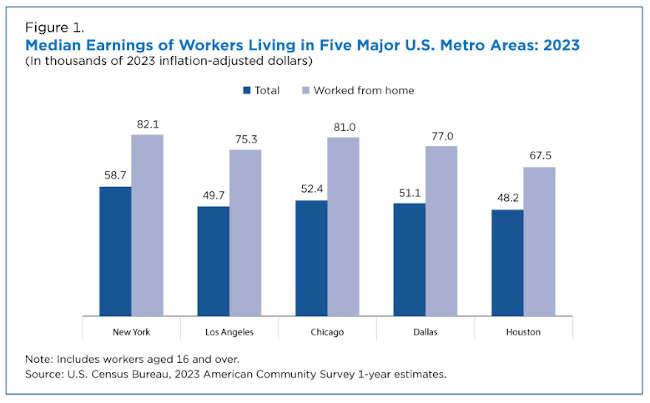
In five of the most populous metropolitan areas in the United States, home-based workers consistently showed higher median earnings than all workers in 2023 (Figure 1).
Among home-based workers in these five metro areas, median earnings were highest in the New York and Chicago metros (over $80,000), and lowest in the Houston metro (under $70,000).
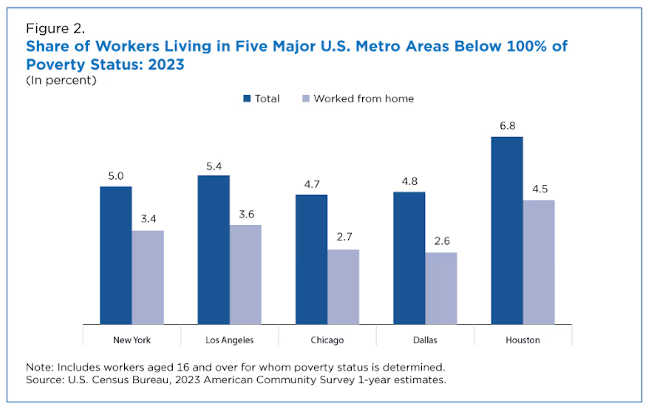
Figure 2 displays the percentage of workers living below the poverty level in five of the most populous metro areas.
In line with their generally higher earnings, a smaller share of home-based workers lived below 100% of the poverty level in 2023 than all workers in each metro area included in this analysis.
Among all workers in these metro areas, the Houston metro had the highest percentage (6.8%) of all workers living below the poverty level.
The dynamic relationship between people and their jobs provides valuable context for understanding numerous dimensions of individual wellbeing. The ACS will continue to collect data that help describe changing commuting and employment trends in the United States.
Michael Burrows, Charlynn Burd and Mehreen S. Ismail are survey statisticians in the Census Bureau’s Social, Economic, and Housing Statistics Division.
These findings are consistent with earlier research that showed the generally higher earnings of home-based workers and the disproportionately White composition of remote workers.
In 2023, 13.8% of U.S. workers usually worked from home — more than twice the 5.7% that did so in 2019, despite a decrease from 17.9% in 2021 and 15.2% in 2022.
In 2019, around 9 million people worked from home in the United States. By 2023, that number had soared to more than 22 million.
New data on remote workforce
Because of the increased prominence of home-based workers within the U.S. workforce, American Community Survey (ACS) tables have been updated beginning in 2023 to include their key sociodemographic characteristics.
Previously, the ACS subject tables describing worker characteristics according to their means of transportation to work (Tables S0802 and S0804, corresponding to workers’ residence and workplace geographies, respectively) only accounted for workers who commuted by driving alone, carpooling, or public transportation — generally the most common commuting modes prior to the COVID-19 pandemic.
A “worked from home” category was added to both tables. Users can now explore the characteristics of home-based workers relative to other workers.
For example, the workers’ residence geography table (S0802) shows these characteristics of U.S. home-based workers in 2023:
• Their median age was about 43.5, almost two years older than the median age of the total workforce (41.7).
• Roughly two-thirds were White, compared to about one-half of workers who carpooled.
• Around 3.6% were below the poverty level in 2023, compared to 9.3% of workers who commuted by public transportation.
These residence and workplace geography tables (S0802 and S0804) are also available for more detailed geographies like states, metro areas and counties. Examples of the comparisons possible using these publicly available tables include:
• In North Carolina, the median earnings of home-based workers ($65,652) were roughly twice that of public transportation commuters ($30,664).
• In the Denver, Colorado, metropolitan area, 11.8% of home-based workers spoke a language other than English at home in 2023, compared to 20.5% of workers who commuted by driving alone.
• In New York’s Bronx County, 39.3% of home-based workers worked in the management, business, science and arts occupations, compared to 27.6% of all workers.
Other characteristics, such as industry, housing tenure and vehicle availability are also available in these tables, giving data users new insight into the make-up of different groups of commuters.
Because residence and workplace geographies are identical for home-based workers, statistics for this group are also identical in the two tables (S0802 and S0804).
Highlighting inequality
Earnings and poverty status are common measures to describe inequality within a population.
In five of the most populous metropolitan areas in the United States, home-based workers consistently showed higher median earnings than all workers in 2023 (Figure 1).
Among home-based workers in these five metro areas, median earnings were highest in the New York and Chicago metros (over $80,000), and lowest in the Houston metro (under $70,000).
Figure 2 displays the percentage of workers living below the poverty level in five of the most populous metro areas.
In line with their generally higher earnings, a smaller share of home-based workers lived below 100% of the poverty level in 2023 than all workers in each metro area included in this analysis.
Among all workers in these metro areas, the Houston metro had the highest percentage (6.8%) of all workers living below the poverty level.
The dynamic relationship between people and their jobs provides valuable context for understanding numerous dimensions of individual wellbeing. The ACS will continue to collect data that help describe changing commuting and employment trends in the United States.
Michael Burrows, Charlynn Burd and Mehreen S. Ismail are survey statisticians in the Census Bureau’s Social, Economic, and Housing Statistics Division.