 How to resolve AdBlock issue?
News

"Feathers predate birds." – Robert T. Bakker
LAKE COUNTY, Calif. – The landscape in Lake County beckons birds of all species to feed or reside here, including bald eagles, osprey herons and grebes.
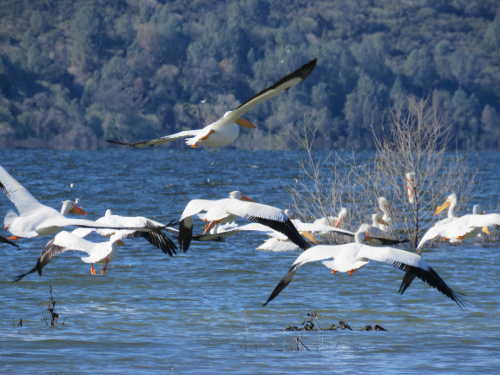
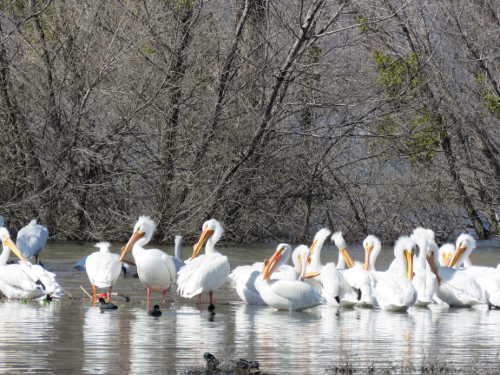
At least a hundred American white pelicans were on patrol recently, which could be viewed from the shores of Clear Lake at Austin Park.
Clear Lake, with its 110-mile-long shoreline, is a magnet, attracting birds of all sizes to its 44,000 acres.
Birds possess a wondrous functional beauty whether floating, flying, walking or perching.
Soaring high in the thermals above the lake, the American white pelicans, like rumors, were difficult to sight. Soon, the black bars of their massive wings came into view and the pelicans looked like rickrack on a blue silken sky.
They landed gracefully in the lake to join their growing squadron, as a flock of pelicans is called, of about 100 birds.
These remarkable birds are among the largest birds on our continent. With their huge heads and black-and-white wings outstretched they bring to mind prehistoric pterodactyls, since modern theories such as those of paleontologist Robert T. Bakker and others, believe that birds evolved from dinosaurs.
Pelicans sometimes fish together in their squadrons, cooperatively rounding up schools of fish like bathing cowboys.
Once they corral their prey, they dunk their pouched beaks into the lake to scoop up and devour their banquet.
American white pelicans do not fly with full pouches; instead, they consume the catch-of-the day before taking flight. They do not dive-bomb for prey as their cousins, the Brown pelicans do.
American white pelicans prefer small fish, and forage on wetlands and the shallow edges of the lake.
These birds are migratory, usually wintering from the American South all of the way to Central or South America.
Talented architects, pelicans construct nests of tule reeds and other sticks in shallow pits to lay two or three eggs, usually within colonies.
During breeding season the pelican's bill, along with its feet, sport a sherbet-orange coloring, as well as a “horn” or bump on its upper bill.
Of all of the eight species of pelicans, the American white pelican is the single bird type to possess a “bill horn.” When mating and egg-laying is complete the pelicans shed their horns. Then their bills and feet revert to a dull coloration once again.
Pelicans' wingspan ranges in width from 95 to 120 inches, making it the second largest wingspan of any North American birds. The California Condor wins first prize in average width of wingspan of a North American bird species.
Pelicans can reach a length, from bill to tail feathers, to about 50 to 70 inches.
The American white pelican is designated as a species of special concern and they enjoy protection by the Migratory Bird Treaty Act of 1918, as well as protection from the California Department of Fish and Wildlife.
Kathleen Scavone, M.A., is a retired educator, potter, writer and author of “Anderson Marsh State Historic Park: A Walking History, Prehistory, Flora, and Fauna Tour of a California State Park” and “Native Americans of Lake County.” She also writes for NASA and JPL as one of their “Solar System Ambassadors.” She was selected “Lake County Teacher of the Year, 1998-99” by the Lake County Office of Education, and chosen as one of 10 state finalists the same year by the California Department of Education.
LUCERNE, Calif. – On Saturday California Water Service and the State Water Resources Control Board’s Division of Drinking Water canceled a precautionary boil water advisory for a portion of the water system in the town of Lucerne.
The advisory had first been issued on Thursday for the 140 customers residing in the area bordered by Fifth Avenue on the north, Country Club Drive on the east, 11th Avenue on the south and the frontage road on the west, as Lake County News has reported.
Customers in that area of Lucerne had been advised to boil water or use bottled water for cooking, drinking and brushing teeth due to a temporary service interruption and main repair.
Local Manager Darin McCosker told Lake County News that the issue that precipitated issuance of the notice began on Wednesday afternoon, when Cal Water staff found a leak in a water main in an easement in the area of Sixth and Seventh avenues.
When they started to shut the main down to repair the leak, a valve broke. McCosker said that meant they couldn’t isolate the leak, and had to widen the perimeter for the impacted area.
By 8 p.m. Wednesday, the crews buttoned up the leak and dropped in another valve. “We improved our infrastructure in the process. That’s what we always try to do,” McCosker said.
McCosker said Cal Water had to conduct two bacteriological samples of the water to confirm that it met all quality standards.
By Friday they had taken the first sample and confirmed it was OK, he said. That led on Saturday to Cal Water being able to lift the boil water advisory for the impacted portion of the system after the second test came through clear.
“We had advised customers to take this precautionary measure because protecting their health and safety is our highest priority,” said McCosker. “We apologize for this inconvenience and thank them for their patience during the advisory.”
McCosker said there is still a problem with a small section of the water main in the middle of the easement that was the source of the original leak.
He said it will require another isolated shutdown of the water system in that area, which McCosker said they want to do sometime in the next two weeks. Customers will be notified ahead of time.
Customers who purchased bottled water during the advisory can bring their receipts to the Cal Water Customer Center in Lucerne, located at 6125 East Highway 20, for reimbursement. Or, they may mail them to P.O. Box 1133, Lucerne, CA 95458 to the attention of Darin McCosker.
Email Elizabeth Larson at
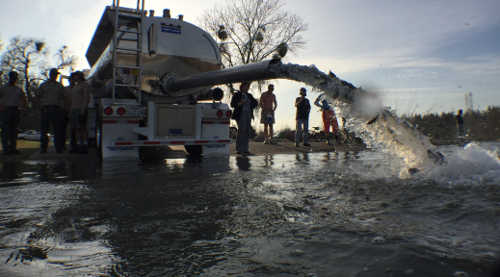
NORTHERN CALIFORNIA – Nearly a half million young steelhead recently started their journey to the ocean, thanks to the California Department of Fish and Wildlife, or CDFW.
Staff at Nimbus Fish Hatchery nursed the young steelhead through several potentially devastating conditions, including drought-induced high water temperatures in the hatchery last summer and winter flood conditions that nearly cut off usable water supplies and carried dangerous levels of silt into the hatchery’s normally clean water distribution system.
“The fish we released will be returning to the American River over the next two to four years, and we are proud and relieved to have brought them this far,” said Gary Novak, the Nimbus Hatchery manager. “Steelhead are hardy, but considering their size and the number of environmental obstacles cropping up in rapid succession, they still needed human intervention in the hatchery to ensure a better chance of survival in the wild.”
All 420,000 young steelhead were released into the American River just upstream of the I Street Bridge in Sacramento.
Due to the high water conditions, the juvenile fish are expected to make excellent time traveling down the Sacramento River to the Bay and eventually on to the Pacific Ocean. Losses to predators are believed to be lower during turbid water and high flow conditions.
During January and February 2017, water releases from Nimbus Dam reached 80,000 cubic feet per second, or cfs, which is well above the normal 6,000 to 10,000 cfs.
The high flows created conditions that dislodged exceptional amounts of debris, clogging the intake structure at Nimbus Fish Hatchery and creating near-lethal levels of nitrogen in the water.
Hatchery staff worked around the clock over a month-long period to keep the water intake open, clear water distribution points, tanks and raceways of silt, and install aerators to lower nitrogen levels.
Fish health assessments by CDFW pathologists found the steelhead to be in satisfactory condition and near the average weight for fish their age prior to release.
It remains to be seen how the stressors of living in turbid water and enduring some periods of high nitrogen levels will affect the fish. Annual returns of mature steelhead to Nimbus Hatchery have varied widely in recent years, from a high of 3,409 in 2013 to a low of just 150 the following year.
All the fish in this release were marked with an adipose fin clip.
COLLIDE (Rated PG-13)
Besides death and taxes, one thing is certain in life: A Jason Statham action film is not going to get nominated for a Best Picture Academy Award. But action fans, for the most part, love his high-energy cinematic adventures regardless.
This won’t be true for every film that seeks to emulate the Statham style of high-octane car chase scenes. “Collide” makes an effort but falls short in this regard with high-speed pursuits on Germany’s famed Autobahn.
Despite a talented cast that is unable to save a film from its own self-destructive manner, “Collide” has the unfortunate feel of an inferior exercise to duplicate Statham’s success in the “Transporter” franchise.
Nicholas Hoult’s Casey is an American ex-pat working in Cologne for flashy mobster Geran (Ben Kingsley), who speaks with a terrible Turkish accent that he inexplicably loses during the unfolding action while living it up with hookers and cocaine.
When Casey meets pretty fellow American Juliette (Felicity Jones) in a nightclub, he decides to turn legitimate at menial jobs just so they can have a happy, normal life even if they have to struggle financially.
But when Juliette discovers that she needs an expensive kidney transplant, Casey returns to Geran for a major heist job to score the money needed for medical treatments.
Geran has in mind the daring theft of his chief rival’s shipment of cocaine hidden in golf balls. The contraband load belongs to industrialist Hagen Kahl (Anthony Hopkins), who is equally adept as Kingsley in delivering high-camp theatrics.
The idea of robbing Kahl only comes to surface after Geran’s plea for a partnership has been rudely dismissed by his rival’s haughty sense of superiority. The volatile Geran decides that the best revenge is to hit Kahl in the pocketbook.
What happens for the next hour is that Casey and his sidekick Matthias (Marwan Kenzari) hijack a truck in an elaborate scheme, soon followed by Kahl’s heavily-armed goons descending on Casey’s trail in a furious chase.
The stakes are raised considerably when Kahl kidnaps Juliette, resulting in Casey having to use more smarts than he appears to possess to maneuver his adversaries into a more tenuous position.
Aside from Kahl and Geran facing off in a comical showdown in a tavern, the hour-long climactic action of “Collide” is all about the chase scenes with expensive and exotic German cars involved in demolition derby-style destruction.
TV Corner: ‘Feud: Bette and Joan’ on FX Network
A glimpse into the waning days of Old Hollywood, where female movie stars exuded real glamour even if they had no power to exert control of their professional destinies, seems about right as the backdrop for the FX Network’s anthology series “Feud: Bette and Joan.”
In the early 1960s, a ruthless studio head like Jack Warner (Stanley Tucci) could rule Warner Brothers with an iron-fist, giving the green light to movie productions without consulting a slew of executives.
When approached by second-rate director Bob Aldrich (Alfred Molina) for a project teaming up bitter rivals Joan Crawford and Bette Davis, at a time the two actresses had long passed their sell-by dates, Warner was rudely profane in his initial reaction to the pitch.
The thing to keep in mind about the aptly named “Feud” is that Joan Crawford (Jessica Lange) and Bette Davis (Susan Sarandon) absolutely detested each other and any definition of “cat fight” should include a picture of them at each other’s throats.
What would bring two enemies together was the shared realization that Hollywood, then and even now, subjected aging female stars to enduring a measure of ageism, sexism and misogyny during the twilight of their careers.
As “Feud: Bette and Joan” opens circa 1962, Crawford, having lost her beloved husband Albert Steele, the chairman of Pepsi-Cola, was coping with financial troubles amidst the inability to secure any film roles.
Unable to convince various studio titans to give her a chance, Crawford found a film vehicle in the novel “What Ever Happened to Baby Jane?” and pitched it to Bob Aldrich for a comeback attempt.
Putting aside petty grievances, Crawford suggests to Davis, then relegated to stage productions, that “Baby Jane,” a gothic horror story of two aging, reclusive sisters, would put them both back in the limelight.
For her part, Davis believes that while Crawford may have the looks she has talent that her inferior rival would never have. The pairing of the two became either a union of convenience or the setup for a raging battle of snide remarks and furious gossip. Here, it looks like both.
The best thing going for “Feud” is the excellent casting of not just the leading ladies but the supporting members, from Judy Davis’ turn as gossip columnist Hedda Hopper to Jackie Hoffman’s loyal if put-upon housekeeper for the temperamental Crawford.
At one point, Crawford says about her adversary: “I will have her respect even if I have to kill both of us to get it.”
As fate would have it, “Baby Jane” turned into a huge commercial success for which Davis would win the Academy Award.
Tim Riley writes film and television reviews for Lake County News.
LAKEPORT, Calif. – Curtis Fair and Barbara White, US Forest Service archaeologists for the National Forest Service, will talk about native technologies at the Lakeport Library on Saturday, March 18.
This free program is part the Lake County Library’s “Know Lake County” series.
The program will be held at the Lakeport branch of Lake County Library at 1425 N. High St. from 2 to 4 p.m.
The program will include displays and a demonstration of the lithic-knapping to make stone tools.
The Know Lake County lectures feature speakers from a wide array of organizations and disciplines, each representing some aspect of Lake County.
For more information call the library at 707-263-8817.
The Lake County Library is on the Internet at http://library.lakecountyca.gov and Facebook at www.Facebook.com/LakeCountyLibrary .
NORTH COAST, Calif. – Caltrans reports that the following road projects will be taking place around Lake County and the North Coast during the coming week.
Included are Mendocino County projects that may impact Lake County commuters.
LAKE COUNTY
Highway 20
– Emergency highway repairs east of the Bachelor Creek Bridge will continue. One-way traffic control will be in effect from 7 a.m. to 6 p.m. weekdays. Motorists should anticipate 15-minute delays.
– Curb and sidewalk repairs from Sayre Avenue to Howard Street will begin Monday, March 13. One-way traffic control will be in effect from 7 a.m. to 5 p.m. weekdays. Motorists should anticipate 15-minute delays.
– Emergency highway repairs from Foothill Drive to Bruner Drive will continue. One-way traffic control will be in effect from 7 a.m. to 6 p.m. weekdays. Motorists should anticipate 10-minute delays.
– PG&E has been granted a Caltrans Encroachment Permit for utility repairs from Grove Street to Second Street on Thursday, March 16. One-way traffic control will be in effect from 8 a.m. to 4 p.m. Motorists should anticipate five-minute delays.
Highway 29
– Emergency culvert repairs from Spruce Grove Road to Hofacker Lane will continue. One-way traffic control will be in effect from 7 a.m. to 6 p.m. weekdays. Motorists should anticipate five-minute delays.
Highway 175
– Emergency highway repairs from Grouss Springs Road to Emerford Road will continue. One-way traffic control will be in effect 24 hours per day, seven days per week. Motorists should anticipate five-minute delays.
– Emergency highway repairs from east of Arroyo Vista Road will continue. One-way traffic control will be in effect 24 hours per day, 7 days per week. Motorists should anticipate five-minute delays.
MENDOCINO COUNTY
Highway 1
– PG&E has been granted a Caltrans Encroachment Permit for utility repairs near Pearl Drive on Wednesday, March 15. One-way traffic control will be in effect from 9 a.m. to 3 p.m. Motorists should anticipate five-minute delays.
– Emergency slide removal near Leggett will continue. A full road closure is in effect 24 hours per day, seven days per week. Motorists should seek an alternate route.
Highway 101
– Routine maintenance near Frog Woman Rock will continue. Northbound traffic will be restricted to one lane 24 hours per day, seven days per week. Motorists should anticipate minor traffic slowdowns.
– PG&E has been granted a Caltrans Encroachment Permit for utility repairs near Henry Station Road on Thursday, March 16. One-way traffic control will be in effect from 9 a.m. to 3 p.m. Motorists should anticipate five-minute delays.
– Emergency slide repairs on the westbound Route 20 to southbound Route 101 connector ramp will continue. Intermittent ramp closures will be in effect from 7 a.m. to 7 p.m. Motorists should anticipate 10-minute delays.
– Emergency slide removal near Piercy will continue. Traffic will be reduced to one lane in both directions 24 hours per day, seven days per week. Motorists should anticipate minor traffic slowdowns.
Highway 162
– Emergency storm damage repairs from the junction of Routes 101/162 to 1.8 miles west of Pookiny will continue. One-way traffic control will be in effect from 6:30 a.m. to 7 p.m. weekdays. Motorists should anticipate 10-minute delays.
– Emergency storm damage repairs near The Middle Way will continue. One-way traffic control with temporary stop signs will be in effect 24 hours per day, seven days per week. Motorists should anticipate five-minute delays.
The Caltrans Traffic Operations Office has reviewed each project and determined that individual project delays are expected to be less than the statewide policy maximum of 30 minutes, unless noted otherwise above.
For information pertaining to emergency roadwork or for updates to scheduled roadwork, please contact the California Highway Information Network (CHIN) at 1-800-GAS-ROAD (1-800-427-7623).