 How to resolve AdBlock issue?
News

Nearly all of us have a story about once brushing up against somebody famous.
On their honeymoon my father and mother went to New York City where they rode up in a hotel elevator with the famous striptease artist Gypsy Rose Lee. My father talked about those heady few moments for the rest of his life.
Here's Carol V. Davis of Los Angeles, pitching horseshoes with an admiral.
This poem is from her most recent book, “Because I Cannot Leave This Body,” from Truman State University Press.
Admiral Nimitz
Every day in summer I'd cross the border;
he'd nod, pick up the horseshoes,
hand me one, triple the size
of my palm, and say, You first. We'd play
away the afternoon. Few words
punctuated the clank of horseshoe
against stake, until the fog rolled in
and I'd retrace my steps home.
I was five or six; he, white haired,
however old that meant.
One evening my father sat me down,
spoke in the exaggerated tone
adults adapt for children, asked
if I knew who he was.
Admiral Nimitz, of course, though
I knew nothing of his command
of the Pacific Fleet and was less impressed
than if he'd landed a horseshoe.
He was a calm man, a useful attribute
for sending young men to their deaths.
The only time I saw him upset,
raccoons had invaded from their hideouts
in the hills, attacked the goldfish in his pond,
leaving muddy footprints as they escaped.
As far as I knew, this was his only defeat.
American Life in Poetry does not accept unsolicited submissions. It is made possible by The Poetry Foundation ( www.poetryfoundation.org ), publisher of Poetry magazine. It is also supported by the Department of English at the University of Nebraska-Lincoln. Poem copyright ©2016 by Carol V. Davis, “Admiral Nimitz,” from Because I Cannot Leave This Body, (Truman State University Press, 2017). Poem reprinted by permission of Carol V. Davis and the publisher. Poem first appeared in Atlanta Review, (Vol. XXII, no.2, Spring/Summer 2016). Introduction copyright © 2017 by The Poetry Foundation. The introduction's author, Ted Kooser, served as United States Poet Laureate Consultant in Poetry to the Library of Congress from 2004-2006.
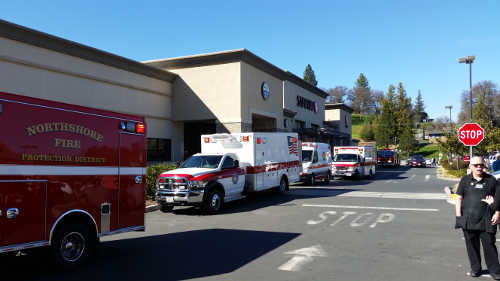
LAKEPORT, Calif. – The Lakeport Safeway store was evacuated Sunday afternoon due to what officials believe may have been a release of pepper spray in the building.
Shortly before 3:30 p.m. fire and police units were dispatched to the store on 11th Street on the report of numerous people having trouble breathing.
Initial reports indicated that an unknown individual, or individuals, may have set off some kind of aerosol in the checkstand area.
Shortly after those first calls, radio reports indicated the store manager evacuated the building.
Lakeport Fire units requested mutual aid from Kelseyville Fire and Northshore Fire, and shortly afterward ordered a countywide strike team of ambulances due to concerns that they may have more than 20 patients.
Cal Fire was reported to be sending resources to assist with decontamination, with Lakeport Fire’s decontamination unit also on scene, according to reports over the air from Lakeport Fire Chief Doug Hutchison.
In addition to fire units, Lakeport Police Chief Brad Rasmussen and his officers responded to the incident and are conducting an investigation.
Just what had happened remained unclear at that that point, Rasmussen said.
“The initial information indicates a possible release of pepper spray,” he said.
Several people were affected, but he said most had denied any further medical care after getting some fresh air once outside of the store.
Brittany Faustino, a courtesy clerk at the store, was one of those who reported experiencing respiratory issues during the incident.
She said people were shopping and checking out, and then a couple of the store’s customers started coughing. “All of a sudden, out of nowhere, everybody just started choking.”
Faustino said nobody could breathe, and there was no real smell to whatever the substance was.
“I couldn't breathe. I was choking and coughing,” she said.
Faustino said nobody saw a can of any type.
Updated estimates from the scene stated that there were about eight people who firefighters had evaluated for respiratory issues.
Rasmussen said shortly before 4 p.m. that the store remained evacuated while the fire department tried to clear out the air in the building using fans.
He said at that time that the store would remain closed until further notice. The closure was expected to continue for at least another hour, with the vehicle entrance nearest the store from 11th Street blocked off.
Rasmussen asked people to please avoid the area while the emergency response was under way.
Additional update will be posted as information becomes available.
Email Elizabeth Larson at

LAKEPORT, Calif. – Five young Lake County gymnasts have qualified to compete in upcoming state-level gymnastics competitions.
Skycatch Gymnastics’ entire boys competitive team rose to the occasion this season, making the cut to advance to the state level events.
The team members include Philip Sparkes, age 10, level four; Alex Fordham and Trey Broyles, both age 10, level five; and Catch Devore, 14, and Tanner Broyles, 13, level six.
“Their season was so fun,” said Annette Broyles, mother of Tanner and Trey.
New to the sport is Philip, who has decided not to compete in the state meet. However, young Alex Fordham and Trey Broyles will go to Emeryville to compete on Sunday.
Then, next weekend, it’s the senior members of the team, Catch and Tanner, who will travel to their competition in Oroville.
Catch is the son of Roger and Jerae Devore, owners of Skycatch Gymnastics and themselves former competitive gymnasts. Both he and Tanner went to the state and regional competition last year, as Lake County News has reported.
In just a year, both Catch and Tanner have gotten taller, stronger and more confident in their skills.
They have to be at the top of their form. Roger Devore said Region 1 is the best place on Earth to be a gymnast, which also means it’s among the most competitive places for the sport.
And after this season, Devore said they will be moving to level eight competition. Level 10 is Olympic level.
Both boys attended a gymnastics camp at Stanford University last summer, and will attend again this year, said Annette Broyles.

Tanner and Catch are “all-around” gymnasts, and don’t just specialize in a few skills, Devore said.
When the boys gathered for a team picture with the many medals they’ve racked up this season, one little girl in the gym remarked, “That’s a lot of medals.”
In addition to the team, there are other young gymnasts who are entering the sport at Skycatch.
They include Eli Carlson, 7, whose dad sat and looked on proudly as his young son took to the floor to practice his new skills. He even took a turn on the high bar.
Eli, who is poised and well-spoken for one so young, said he’s been doing gymnastics not yet a year, and his dad confirmed his son’s enthusiasm for the sport.
He started doing gymnastics two to three days a week because he likes it. “It also looked really cool,” Eli said.
Skycatch Gymnastics is located at 888 Lakeport Blvd. in Lakeport.
Email Elizabeth Larson at

LAKE COUNTY, Calif. – A new group of puppies, adult and senior dogs is waiting for new homes this week at Lake County Animal Care and Control.
The dogs available this week include mixes of American Eskimo Dog, border collie, beagle, boxer, Catahoula Leopard Dog, cattle dog, German Shorthaired Pointer, Labrador Retriever, pit bull, shepherd, Shih Tzu and wirehaired terrier mix.
Dogs that are adopted from Lake County Animal Care and Control are either neutered or spayed, microchipped and, if old enough, given a rabies shot and county license before being released to their new owner. License fees do not apply to residents of the cities of Lakeport or Clearlake.
If you're looking for a new companion, visit the shelter. There are many great pets hoping you'll choose them.
The following dogs at the Lake County Animal Care and Control shelter have been cleared for adoption (additional dogs on the animal control Web site not listed are still “on hold”).
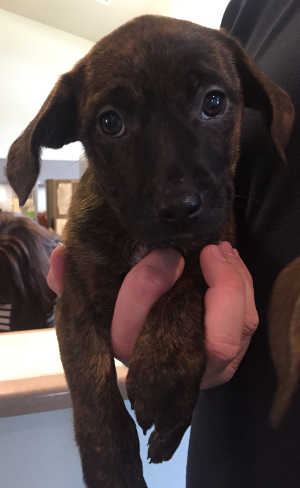
Boxer-shepherd puppy
This female boxer-shepherd mix puppy has a short brown brindle coat.
She’s in kennel No. 2a, ID no. 7100.
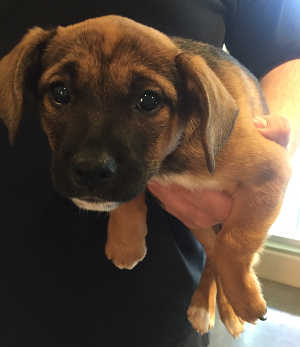
Boxer-shepherd puppy
This female boxer-shepherd mix puppy has a short tan coat.
She’s in kennel No. 2b, ID no. 7101.

Boxer-shepherd puppy
This female boxer-shepherd mix puppy has a short brown coat.
She’s in kennel No. 2c, ID no. 7102.
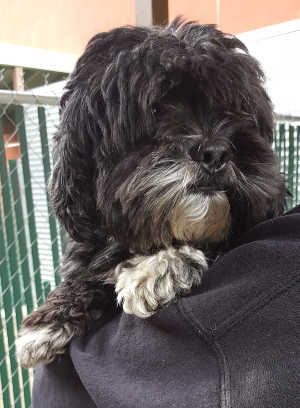
Shih Tzu
This male Shih Tzu has a curly black coat with white markings.
He’s in kennel No. 3, ID No. 7072.
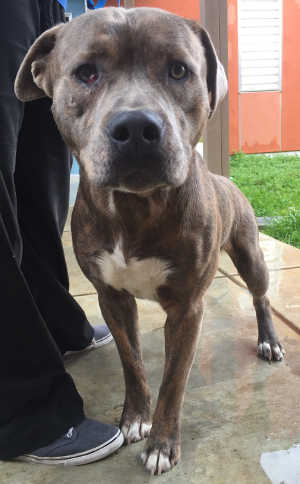
'Miles'
“Miles” is a young male pit bull terrier mix with a short brindle coat and gold eyes, and he’s a shelter favorite.
Shelter staff said he is great with other dogs and a little shy of people, but show him some kindness and he will learn to trust you. He would do great in a home with children ages 10 years old and up. He’s also OK with cats, based on an introduction with shelter kitties. He’s looking for a calm, quiet home.
She's in kennel No. 6, ID No. 6875.
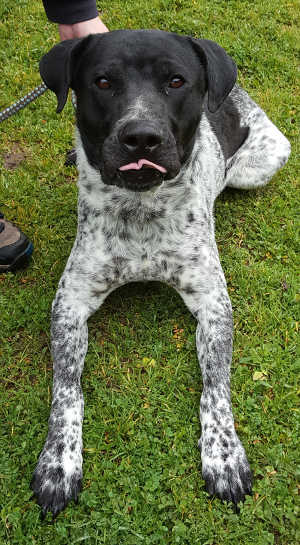
‘Love’
“Love” is a male German Shorthaired Pointer mix with a short black and white coat.
Shelter staff said he is a big, young, happy, bouncy boy would will be a lot of fun for an active family that is willing to include him in their activities. He would benefit from training classes for basic manors. He does well with other dogs that tolerate his level of play, but would do best in a home with no small dogs or cats due to his size and energy level.
He’s in kennel No. 7, ID No. 7057.
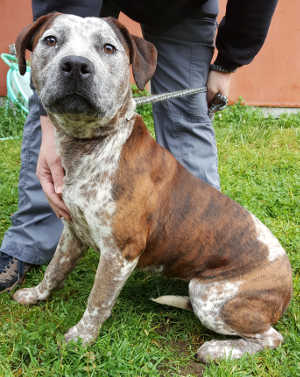
Catahoula Leopard Dog
This female Catahoula Leopard Dog has a short red merle/brindle coat.
Shelter staff said she is a very sweet girl, and is very submissive with people and other dogs. She will be a great dog with a little work and someone to build her confidence. She needs an experienced dog owner or someone willing to go to training with her.
She’s in kennel No. 8, ID No. 7058.
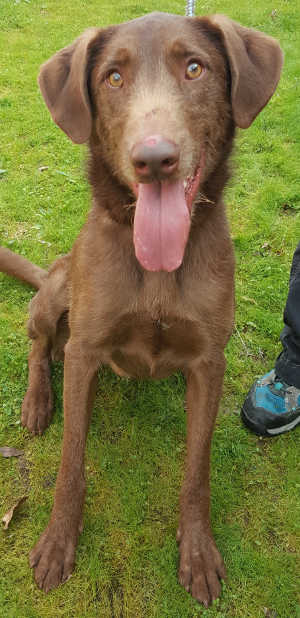
‘Ralph’
“Ralph” is a Labrador Retriever-wirehaired terrier mix with a medium-length brown coat.
He already has been neutered, and is being offered for a low adoption fee.
Shelter staff said he is good with other dogs that respect his space, and would do best with a family that is home often or willing to take him with them. He doesn't like to be left alone, and needs to be contained in a metal kennel if he’s by himself. They said Ralph would do great in a home with an active family willing to include him in their adventures.
He’s in kennel No. 14, ID No. 6787.
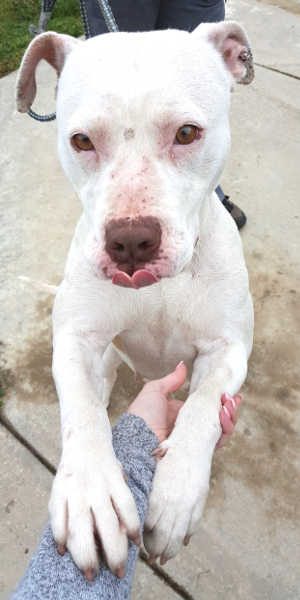
‘Shygirl’
“Shygirl” is a female pit bull terrier mix.
She has a short coat coat with tan markings.
She’s in kennel No. 16, ID No. 7059.
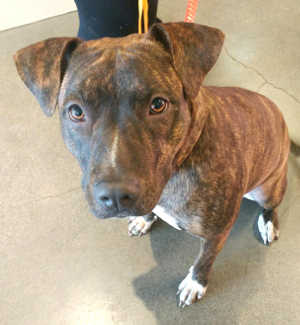
‘Asha’
“Asha” is a female box-pit bull terrier mix.
She has a short brown brindle coat with white markings.
She’s in kennel No. 10, ID No. 7079.
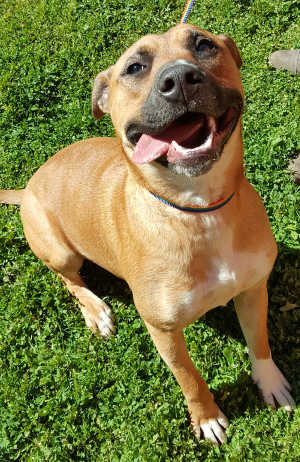
‘Trixie’
“Trixie” is a female boxer-Labrador Retriever mix.
She has a short tan coat with white markings, and has already been spayed.
Shelter staff said she is very bouncy and playful needs an energetic family that will give her lots of exercise and guidance. Trixie does well with other dogs her size that will tolerate her playfulness. She would do best in a home with no small dogs, cats or livestock,and has great manners.
She’s in kennel No. 23, ID No. 7036.
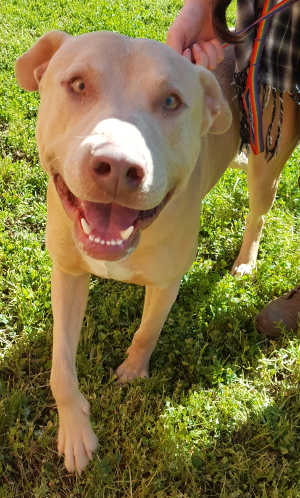
Male pit bull terrier
This male pit bull terrier mix has a short cream-colored coat.
Shelter staff said he is an overgrown puppy that loves to play and jump around. He needs a home with a family willing to start from the beginning and teach him manners and boundaries with other dogs, sometimes he is too playful. He would do best in a home with children ages 12 and above and an experienced dog owner or someone willing to go to training with him.
He’s in kennel No. 28, ID No. 7032.
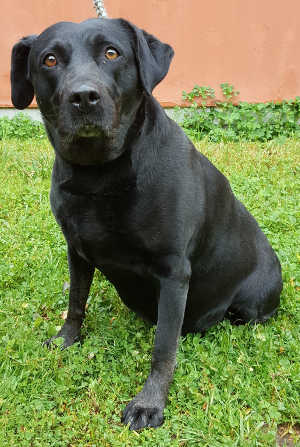
‘Pixie’
“Pixie” is a female Labrador Retriever-beagle with a short black coat.
She’s in kennel No. 29, ID No. 7064.
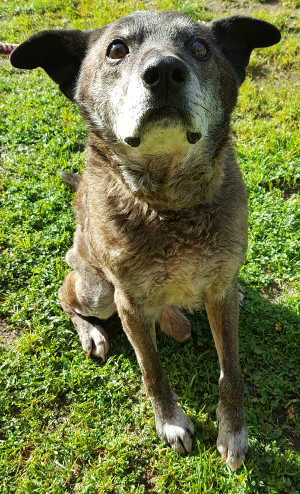
Cattle dog
This senior male cattle dog has a short brown coat.
Shelter staff said he’s good with other dogs, and has a low energy level. They said he is a “very sweet boy” who needs a family to just love him for however many years he has left. Low energy level but always eager to see people. He was found in a flood area of Lakeport as a stray.
He’s in kennel No. 31, ID No. 7000.
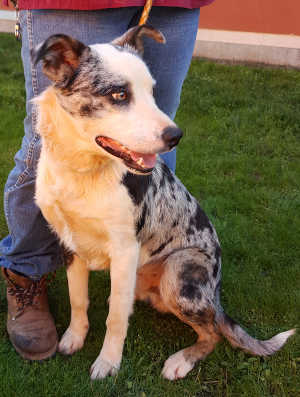
‘Theo’
“Theo” is a male border collie mix.
He has a long blue merle coat and gold eyes.
Shelter staff said Theo is a very energetic, playful boy who needs something to do each day; if you are looking for a couch potato he is not going to fit that description. He does well with other dogs; he can be a little dominant with other males at times until he is distracted or corrected. He has never lived with other animals including other dogs, however he is doing well with other dogs. Theo has been an outside only dog so he needs to be house-trained.
He’s in kennel No. 33, ID No. 7040.
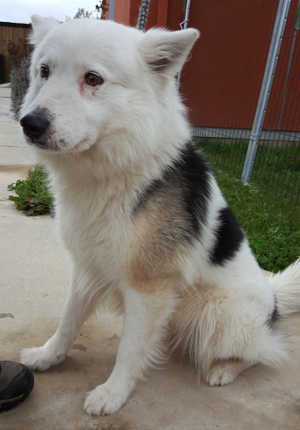
American Eskimo Dog-border collie mix
This male American Eskimo Dog-border collie mix has a medium-length white coat with black markings.
He already has been neutered.
He’s in kennel No. 34, ID No. 7065.
To fill out an adoption application online visit http://www.co.lake.ca.us/Government/Directory/Animal_Care_And_Control/Adopt/Dog___Cat_Adoption_Application.htm .
Lake County Animal Care and Control is located at 4949 Helbush in Lakeport, next to the Hill Road Correctional Facility.
Office hours are Monday through Friday, 11 a.m. to 5 p.m., and 11 a.m. to 3 p.m., Saturday. The shelter is open from 11 a.m. to 4 p.m. Monday through Friday and on Saturday from 11 a.m. to 3 p.m.
Visit the shelter online at http://www.co.lake.ca.us/Government/Directory/Animal_Care_And_Control.htm .
For more information call Lake County Animal Care and Control at 707-263-0278.
Email Elizabeth Larson at

This week in history features the establishment of America’s two favorite pastimes: baseball and shopping.
March 12, 1877
The decades following the Civil War saw America emerge as a growing industrial power on the world stage.
By the close of the century, we had joined the imperialist powers of Europe, controlling colonies in the Pacific and Caribbean.
At the same time, some of the world’s richest men hailed not from London or Paris, but New York City and a new force began exerting itself on the nation’s economy: the consumer.
America was not alone in the emergence of conspicuous consumers by the mid-19th century – in fact, it was a bit late to the party.
The rise of the middle class in France and England by the early 1800s had already created an industry that served this clientèle before America even knew what was happening.
With the sudden appearance of a whole new group of people, and potential customers, businesses began to expand their production and rethink how they made and marketed their goods.
Common stores in cities at this time were haberdasheries, milliners, tailors and shoemakers. That virtually none of those stores exists on a large-scale to this day speaks volumes to the changes that were wrought during this time.
Gradually, some stores began to stock a variety of items on their shelves, expanding beyond their usual areas of expertise. You might find the occasional vest or suit sold at your local milliners (hat maker) shop, perhaps in a style that went well with the latest hat produced.
In the beginning, stores that made these concessions were often labeled as “novelty shops,” places where a customer could buy buttons, fabric and hats as well as clothes and shoes. In time, these stores began stocking their items by type, or department. So was born the department store.
Determining who can claim the title of first department store is next to impossible. Some would say that Harding, Howell & Co. in London, established in 1796, deserves that honor. Others would argue against that and claim instead that Bennett’s established in Derby in 1734 was the first.
In the United States, the debate for first American department store is more straightforward. It is likely that the first one was Arnold, Constable, which was founded in 1825 New York City.
Although not the first ever – either in the world or even the United States – Wanamakers in Philadelphia is often cited as America’s first modern department store.
Founded in time for the American Centennial Exposition of 1876 by Philadelphia’s by John Wanamaker, Wanamakers was completely refurbished a year later and reopened on this day in 1877. The new, expanded store included not only men’s clothing but also women’s clothing and dry goods.
In the next few years Wanamakers would roll out innovative solutions to the growing demand placed on stores by America’s consumers. These innovations included offering fixed prices marked on every article (the first ever price tags) and cash refunds for return purchases.
They were also the first to offer electrical illumination and a telephone for the benefit of the customers who visited their large building (formerly the Pennsylvania Railroad freight terminal in the city).
Perhaps thinking ahead to the popularity of malls and their food courts, Wanamakers was also the first department store to offer a restaurant in its building, truly making it a one-stop shop for middle class Philadelphians of the Victorian era.
Like their competitors, the early 20th century saw Wanamakers greatly expand. Their mail order business, especially, took off as more and more American’s from outside the major urban centers sought the same conveniences as their city-dwelling counterparts.
Although never as popular – or profitable – as the larger stores like Macy’s, Wanamakers remained in business for more than a century.
Presaging the troubles that would face all department stores two decades later, the struggling Wanamakers sold out to its competitors in 1978.
After being sold from one company to another, the Wanamakers stores finally went bankrupt when its then-parent company of Woodward & Lothrop filed its papers. The stores were formally dissolved a year later.
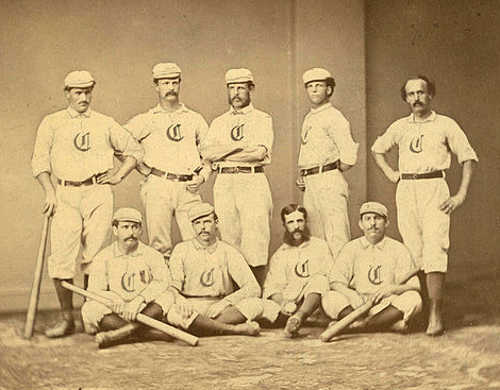
March 15, 1869
Baseball has long been America’s national pastime, capturing the imagination of children and adults alike.
For hundreds of thousands of Americans, going to a baseball game each year is akin to a religious pilgrimage. The sights, sounds and smells experienced and the memories made during a hot day of baseball is something shared from one generation to the next.
Over the decades the likes of Babe Ruth, Willie Mays and Lou Gehrig stand tall in American memory as colossuses without equals. For all they do to entertain us today, professional baseball players are well compensated.
In 2015, the average MLB player made more than $4 million, over $1 more than just five years earlier, according to USA Today.
Of course, they ought to be given something, given that the top baseball teams in America are worth over $3 billion.
Leveraging the game and their players, a 2015 USA Today report said these big-money teams make extra profit directly through television deals and indirectly through real estate ventures near their stadiums. Baseball in America is big business.
Although it might be difficult to comprehend now, there was once a time when America’s greatest athletes weren’t paid a nickel to play the game they loved. In fact, for years baseball in America consisted of city clubs of amateur players who, although no doubt talented, were not expected to be paid for playing the sport.
That all changed on this day in 1869 when the Cincinnati Red Stockings Baseball Club became the first openly professional club in America.
Certainly, by 1869 baseball players had experienced a form of compensation, but it was all under the table. That is, until the Red Stockings came out in the open and won every single game they played that season.
Nothing quite convinced the rest of the industry of the need to pay its players than a paid team going undefeated right out of the gate. Baseball hasn’t looked back since.
Antone Pierucci is the former curator of the Lake County Museum and a freelance writer whose work has been featured in such magazines as Archaeology and Wild West as well as regional California newspapers.
About 30 years ago, researchers announced that ozone concentrations high in the atmosphere over the South Pole had hit an all-time low.
This critical layer of the atmosphere that shields us from the Sun’s harmful UV rays had a “hole” in it. And that hole was rapidly expanding.
This discovery led to the Montreal Protocol, an international treaty that regulates production of ozone-destroying chemicals like chlorofluorocarbons, or CFCs. As a result, the ozone layer is now on the mend.
To study this layer of the atmosphere further, NASA has launched an ozone sensor to help monitor the long-term change in the ozone layer.
Called SAGE III, short for Stratospheric Aerosol and Gas Experiment III, it will be installed on the International Space Station in 2017.
SAGE III represents the fourth of a series of instruments that have used similar techniques to measure atmospheric ozone and aerosols, going back to 1979, with more than 25 years of on-orbit heritage.
The space station’s orbit, different from that of most Earth observing satellites, makes the station a unique vantage point for collecting valuable data about our planet’s health and status. The orbit brings it closer to Earth and allows instruments onboard to see our planet at different times of day under varying illumination conditions.
NASA is adding to the station’s Earth observing capabilities with instruments like SAGE III. This instrument will monitor ozone all around the Earth at various times of day and and night, around the globe and during all seasons of the year, using light from the sun and moon passing through the atmosphere.
“Particles (aerosols) and gases in the atmosphere absorb and scatter light to various degrees depending on their properties,” explained SAGE III principal investigator Pat McCormick. “By measuring the attenuation of light from the sun as it passes through a section of Earth’s atmosphere at spacecraft sunrise or sunset, we can determine the quantity and location of these aerosols and gases. Attenuation of sunlight reflected from the moon will be used in similar fashion for additional data collection.”
SAGE III will also measure ozone in multiple levels of the atmosphere, reaching all the way down into the upper troposphere and stratosphere. It will provide a nearly global picture of the tropospheric ozone, and features improved vertical resolution over most ozone instruments.
McCormick said, “All of this means that SAGE III will provide a very robust and precise characterization of the ozone layer.”
Another state-of-the-art instrument – the Lightning Imaging Sensor, or LIS – will be installed on station in 2017.
LIS will capture real-time total lightning data over much of the globe – even over data-sparse regions such as the oceans – to support weather forecasting and warnings.
The LIS instrument for ISS is a duplicate of the LIS that operated as part of NASA’s Tropical Rainfall Measuring Mission, or TRMM, which completed operations in 2015.
From the station, this new LIS instrument will be able to ‘look’ much farther toward Earth’s poles than it did on TRMM, taking advantage of the station’s higher inclination.
Three more instruments are expected to be operating on the station by 2019: the Global Ecosystem Dynamics Investigation, or GEDI; the ECOsystem Space-borne Thermal Radiometer Experiment on Space Station, ECOSTRESS; and The Orbiting Carbon Observatory-3, OCO-3.
GEDI will revolutionize the way tropical forests are monitored, shooting laser beams into tree canopies of the world’s forests to take fine-scale measurements of their height and internal structure.
ECOSTRESS will study water use and water stress in vegetation. The station’s orbit will allow ECOSTRESS to take observations at different times of day across the seasons. OCO-3 will collect space-based measurements of atmospheric carbon dioxide, to help assess its distribution and variability.
The ISS is a busy place, studying effects beyond Earth and also Earth itself.
For more news from the International Space Station, visit www.nasa.gov/station .