 How to resolve AdBlock issue?
News
LAKEPORT, Calif. – Kevin Lee Dameron died peacefully on March 13, 2017, in Lakeport at the age of 58.
Kevin is survived by his sister, Jackie Courtney (Glenn Courtney) of Lakeport, who raised him from the time he was 15 years old; sisters, Susan Shryock (Steve Shryock) of Pocatello, Idaho, and Sharon Dickens (Kenny Dickens) of Yucca Valley; and brother, James Smith of Long Beach.
He is preceded in death by his mother, Geraldine Jepson (George Jepson); father, John Dameron; and sister, Gerilyn Breeze.
Kevin was born on Oct. 6, 1958, in Huntington Park, Los Angeles. He moved to Lake County in 1979 and started working with People Services. It was there that he met his first girlfriend, Millie Hill.
Kevin enjoyed music, dancing, football and racing.
A memorial service will be held at Chapel of the Lakes Mortuary in Lakeport on Friday, March 17, at 2:30 p.m.
For more information please contact Chapel of the Lakes Mortuary at 707-263-0357 or 707-994-5611, or visit www.chapelofthelakes.com .
In a report released Feb. 23, the American Association of Orthodontists, or AAO, revealed that nearly 13 percent of its member orthodontists are seeing patients who have tried do-it-yourself teeth straightening.
The reported ages of people attempting to straighten their own teeth ranges from 8 to over 60 years old.
The AAO survey conducted among its members indicates some of these DIY teeth straightening attempts have caused severe damage including tooth loss and leading to costly repairs.
“The cost of dealing with replacing a lost tooth can easily exceed $20,000 over a lifetime,” said DeWayne B. McCamish, DDS, MS, AAO president.
The AAO reports the most common materials used to attempt do-it-yourself teeth straightening include rubber bands, dental floss, fishing line and paper clips – as well as DIY method such as biting on pencils, creating fake retainers and using rubber band to push teeth together.
“Attempting any self-directed, DIY teeth straightening puts your teeth, gums and overall dental health at risk. Patients may think they are saving time and money by trying to straighten their teeth at home, but the damage caused by unsupervised treatment may ultimately cost the patient more than if they saw an orthodontic specialist from the very beginning,” said Dr. Andrew Harner, California Association of Orthodontists president.
The AAO attributes the trend of DIY teeth straightening to social media video content, such as YouTube video tutorials. “I’ve seen horrific results of patients that have tried mimicking online methods in an attempt to straighten their own teeth. It’s a worrying trend,” said Harner.
Harner added, “Children should visit an orthodontist for the first time at age 7, who will then determine whether they need orthodontic treatment and will map out a safe and effective treatment plan. Seeing an orthodontic specialist for treatment is the only way orthodontic treatment should be undertaken and under no circumstances should anyone attempt DIY, at-home or self-directed orthodontics.”
U.S. Air Force Airman Noah T. Williams graduated from basic military training at Joint Base San Antonio-Lackland, San Antonio, Texas.
The airman completed an intensive, eight-week program that included training in military discipline and studies, Air Force core values, physical fitness, and basic warfare principles and skills.
Airmen who complete basic training also earn four credits toward an associate in applied science degree through the Community College of the Air Force.
Williams is the son of Jessica H. Killops of Hidden Valley Lake, Calif.
He is a 2016 graduate of Middletown High School, Middletown, Calif.
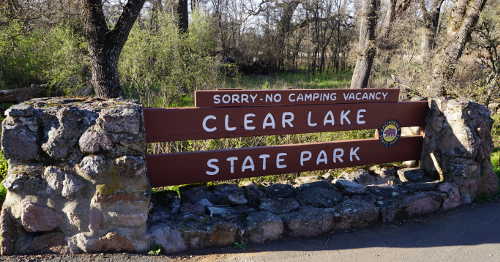
KELSEYVILLE, Calif. – After being closed for more than a month, Clear Lake State Park is reopening to day use and boating on Wednesday, but the recent flooding has necessitated repairs to campgrounds that could take months, with some facilities not expected to open until next spring.
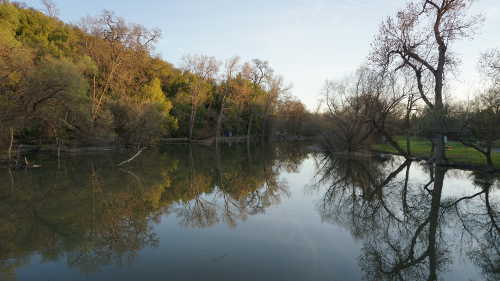
On Feb. 9 the park was closed due to flooding of main park roads, campgrounds, cabins, boat launch, day use and restroom facilities, as Lake County News has reported.
With the waters now receding, Park Superintendent Bill Salata said the park will reopen for day use starting on Wednesday, with day use hours from sunrise to sunset.
However, Salata said campgrounds and cabins remain closed due to flooding and storm damage.
Clear Lake’s level continues to steadily recede. Early Wednesday, it was just under 8.4 feet Rumsey. Flood stage is 9 feet Rumsey.
Salata said the reopening of the campgrounds is still undetermined. That’s because park staffers haven’t been able to fully evaluate the erosion and facilities damage from the flooding due to some areas still being underwater.
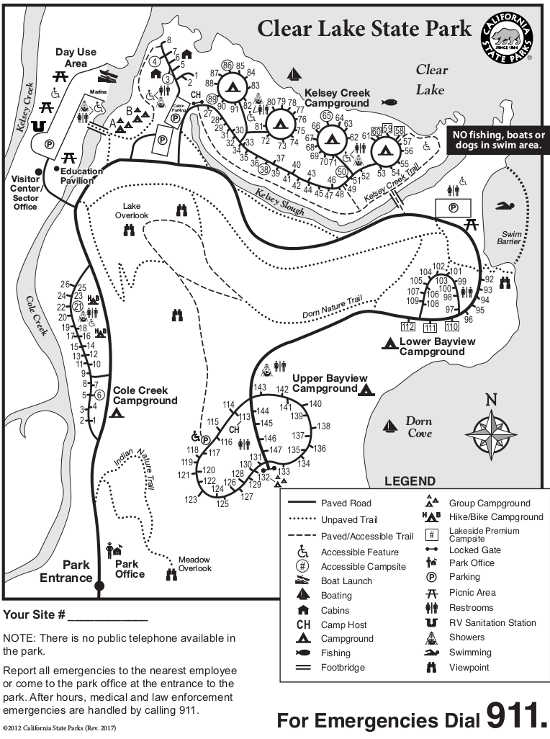
He said the Cole Creek campground, which still has some standing water, along with Upper Bayview campground and Lower Bayview Campground are closed until June 1, due to needing to do repair work that requires digging up the roadway. Once the main park road is evaluated, those campgrounds can be reopened.
Kelsey Creek campground, which is still partially underwater, is expected to be closed until March 2018, he said, noting closures may be extended if additional damage is identified.
“We still have picnic tables floating, and we have about 50 trees down,” he said.
Those picnic tables, which range in weight from 500 to 800 pounds, are at the water’s edge in the Kelsey Slough. Salata said it is expected to take until the end of the summer to retrieve all of those picnic tables.
There also are crushed tables and lifted blacktop, and the need to assess the condition of the park’s sewer and fresh water system. He said that will require digging up parts of the roadway in order to access fresh water lateral lines.
There are concerns that driving through the park could further damage roads and infrastructure, he said.
Salata put the damage estimate to the park’s facilities in excess of $100,000. “I imagine that number is going to double.”
 \
\
He said park staff is now cutting down trees, trying to clean the roads and cleaning facilities for day use, which is a priority.
“The amount of work right now is overwhelming,” he said.
In order to complete repairs, Salata said State Parks has an interagency agreement with the California Conservation Corp which starts at the end of the month, and they’re working on an amendment with Cal Fire for use of its inmate crews to begin this month.
Salata, who has been at Clear Lake State Park for the last eight years, hasn’t seen this kind of damage previously during his tenure.
However, he said the facility was seriously damaged in the 1998 flood, when Clear Lake’s elevation topped 11.4 feet on the Rumsey gauge, nearly a food higher than its peak level in February. At that time, the park didn’t have gates to close and some of the other infrastructure it now has.
He said he’s added gates to keep the public safe and to allow for making closure when necessary.
Salata said Clear Lake State Park has about 200,000 visitors a year between Memorial Day and Labor Day. During the “shoulder season” last spring, they had 300 to 500 people people a day using the park thanks to the crappie fishing.
“Our numbers are higher than they have ever been in history, up until this winter,” Salata said.
Email Elizabeth Larson at
LAKEPORT, Calif. – The Lakeport Planning Commission will hold a special meeting on Wednesday to discuss plans for a new commercial building and review conditions for an existing business.
The commission will meet beginning at 5 p.m. Wednesday, March 15, in the council chambers at Lakeport City Hall, 225 Park St.
On the agenda is an application for an architectural and design review for construction of an 11,026-square-foot commercial building on a vacant half-acre parcel located at 244 Peckham Court.
The one-story building, proposed by Market Street Development LLC of Roseville, would be a medical clinic consisting of a kidney dialysis center.
The commission also will review conditions of approval – specifically, removal of a cargo container – for the architectural and design review for Lakeport Napa Auto Parts.
In other business, the commission will get a list of current Planning Department pending approval as of March 9.
Email Elizabeth Larson at
LAKEPORT, Calif. – In an effort to reduce the number of biting adult mosquitoes emerging this spring, the Lake County Vector Control District will be making an aerial treatment to the marshlands adjacent to the lake between Clear Lake State Park and Lakeport, parts of Anderson Marsh State Park, and a small section east of the Clear Lake Keys.
The treatment is expected to begin at 10 a.m. Friday, March 17, but may be rescheduled for Monday, March 20, if the weather prevents safe application.
If the application is canceled or rescheduled, that information will be posted on the district’s Web site, www.lcvcd.org .
The district’s winter mosquito surveillance program has detected large numbers of mosquito larvae in the marshlands along the perimeter of the lake that flooded as the lake rose due to the abundant rain this winter.
These mosquito larvae are an early-season floodwater species (Aedes increpitus) that hatch from eggs laid in the mud in previous years as the lake receded.
When winter rains flooded the eggs, the larvae hatched and began developing in the still, shallow water. As temperatures and day length increase in early spring, the Ae. increpitus mosquito larvae will pupate and then emerge as biting adults.
These mosquitoes are the aggressive biters experienced every spring by people living and recreating near this area.
The application will be made by a yellow, bi-winged crop duster flying at a low altitude over these marshy areas. Some of the marshy areas are near homes, and people may experience a brief noise nuisance from the plane.
The product applied will be VectoBac G, a biological larvicide used to control mosquito larvae in aquatic habitats.
VectoBac is manufactured by Valent BioSciences, and is based on the naturally occurring soil bacterium, Bacillus thuringiensis israelensis (Bti).
This highly effective and economical microbial insecticide is registered with the Environmental Protection Agency for the control of larval mosquitoes in nearly all aquatic habitats.
Bti is highly selective for the control of mosquito larvae in water and does not affect plants, animals, or beneficial insects that live in or drink the water.
The formulation is a biodegradable solid corncob granule coated with Bti. The Bti breaks down rapidly in nature so there is no persistence of the active ingredient. The use of a solid formulation reduces the possibility of drift onto adjacent property.
The Lake County Vector Control District makes every effort to use the safest product available to minimize any health concerns the public may have.
The VectoBac G label and the safety data sheet are available from the Lake County Vector Control District’s Web site or may be requested by calling 707-263-4770.