 How to resolve AdBlock issue?
News
LAKE COUNTY, Calif. – Lake County Animal Care and Control has a selection of dogs from working and hunting breeds this week.
The dogs available this week include mixes of border collie, Catahoula Leopard Dog, Chihuahua, German Shorthaired Pointer, hound, Labrador Retriever and pit bull.
Dogs that are adopted from Lake County Animal Care and Control are either neutered or spayed, microchipped and, if old enough, given a rabies shot and county license before being released to their new owner. License fees do not apply to residents of the cities of Lakeport or Clearlake.
If you're looking for a new companion, visit the shelter. There are many great pets hoping you'll choose them.
The following dogs at the Lake County Animal Care and Control shelter have been cleared for adoption (additional dogs on the animal control Web site not listed are still “on hold”).

Chihuahua mix
This male Chihuahua mix has a short brown and tan coat.
He’s in kennel No. 2, ID No. 7169.
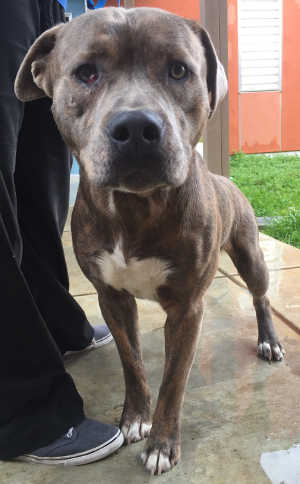
'Miles'
“Miles” is a young male pit bull terrier mix with a short brindle coat and gold eyes, and he’s a shelter favorite.
Shelter staff said he has lived with multiple other dogs and has done great with those he’s encountered at the shelter. He has also lived with cats and small children. He needs a family to teach him confidence in himself and he will make a great friend.
He's in kennel No. 6, ID No. 6875.
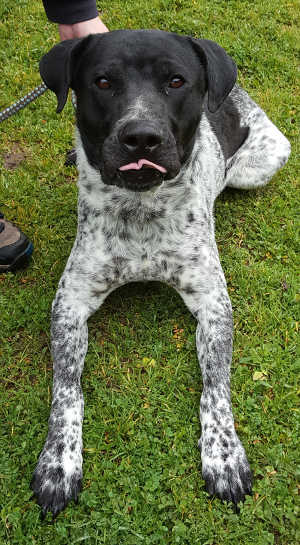
‘Love’
“Love” is a male German Shorthaired Pointer mix with a short black and white coat.
Shelter staff said he is a big, young, happy, bouncy boy would will be a lot of fun for an active family that is willing to include him in their activities. He would benefit from training classes for basic manners. He does well with other dogs that tolerate his level of play, but would do best in a home with no small dogs or cats due to his size and energy level.
He’s in kennel No. 7, ID No. 7057.
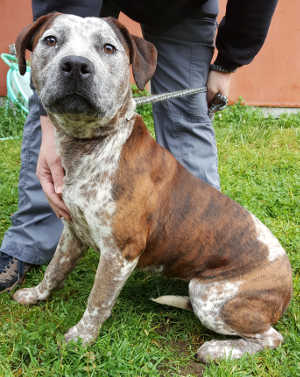
Catahoula Leopard Dog
This female Catahoula Leopard Dog has a short red merle/brindle coat.
Shelter staff said she is a very sweet girl, and is very submissive with people and other dogs. She will be a great dog with a little work and someone to build her confidence. She needs an experienced dog owner or someone willing to go to training with her.
She’s in kennel No. 8, ID No. 7058.
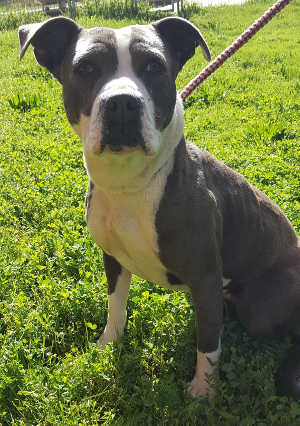
Female pit bull mix
This female pit bull mix has a short blue and white coat.
She’s in kennel No. 9, ID No. 7184.
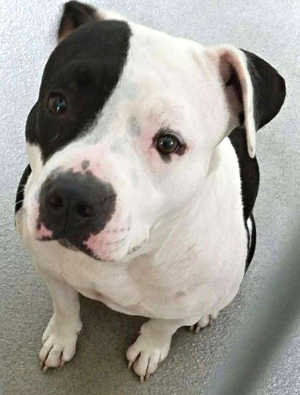
Female pit bull terrier mix
This female pit bull terrier mix has a short white coat with black markings.
She’s in kennel No. 12, ID No. 7156.
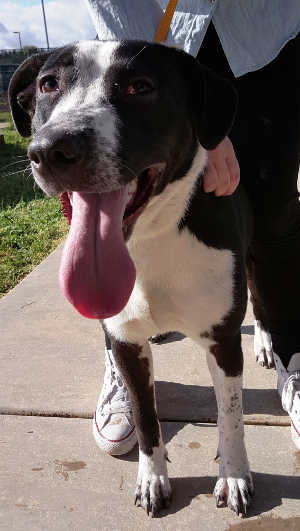
Border collie-pit bull mix
This female border collie-pit bull mix has a black and white coat.
She already has been altered.
Shelter staff said she loves to play and is great with other dogs. She has a higher energy level and needs a family that will exercise her regularly. She appears to be afraid of cats.
She’s in kennel No. 16, ID No. 7164.
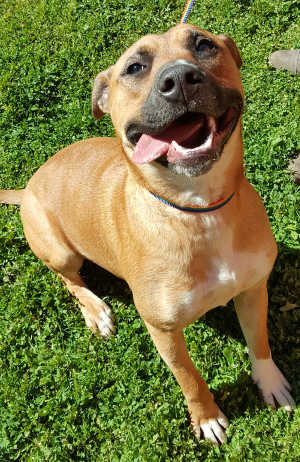
‘Trixie’
“Trixie” is a female boxer-Labrador Retriever mix.
She has a short tan coat with white markings, and has already been spayed.
Shelter staff said she is very bouncy and playful needs an energetic family that will give her lots of exercise and guidance. Trixie does well with other dogs her size that will tolerate her playfulness. She would do best in a home with no small dogs, cats or livestock,and has great manners.
She’s in kennel No. 17, ID No. 7036.
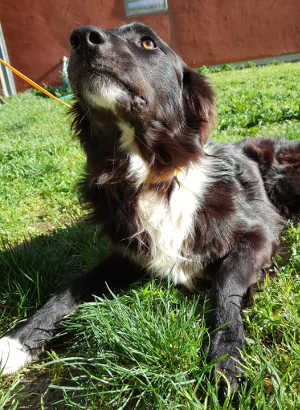
Male border collie
This male border collie has a medium-length black coat with white markings.
He’s in kennel No. 18, ID No. 7179.
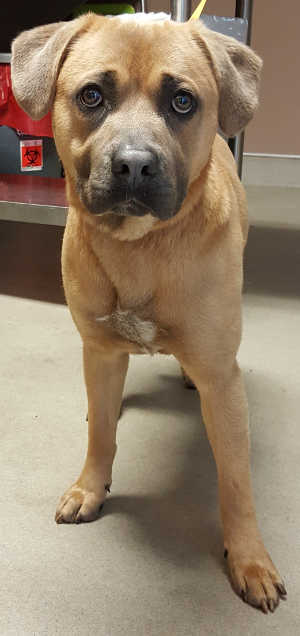
‘Archi’
“Archi” is a young male hound mix with a short tan coat.
He’s in kennel No. 21, ID No. 7183.
To fill out an adoption application online visit http://www.co.lake.ca.us/Government/Directory/Animal_Care_And_Control/Adopt/Dog___Cat_Adoption_Application.htm .
Lake County Animal Care and Control is located at 4949 Helbush in Lakeport, next to the Hill Road Correctional Facility.
Office hours are Monday through Friday, 11 a.m. to 5 p.m., and 11 a.m. to 3 p.m., Saturday. The shelter is open from 11 a.m. to 4 p.m. Monday through Friday and on Saturday from 11 a.m. to 3 p.m.
Visit the shelter online at http://www.co.lake.ca.us/Government/Directory/Animal_Care_And_Control.htm .
For more information call Lake County Animal Care and Control at 707-263-0278.
Email Elizabeth Larson at
The earliest satellites of the Space Age were small. Sputnik, for instance, weighed just 184.3 pounds. America’s first satellite, Explorer 1, was even smaller at only about 30 pounds.
Over time, satellites grew to accommodate more sensors with greater capabilities, but thanks to miniaturization and new technology capabilities, small is back in vogue.
NASA is one of many government agencies, universities, and commercial organizations embracing small satellite designs, from tiny CubeSats to micro-satellites. A basic CubeSat has 4 inch sides and weighs just a few pounds!
A CubeSat can be put into place a number of different ways. It can be a hitchhiker, flying to space onboard a rocket whose main purpose is to launch a full-sized satellite.
Or it can be put into orbit from the International Space Station. Astronauts recently used this technique when they deployed the Miniature X-Ray Solar Spectrometer, or MinXSS, a CubeSat that studies solar flares.
In 2018, NASA plans to launch the CubeSat to study Solar Particles, or CuSP. It will hitch a ride out of Earth orbit during an uncrewed test flight of NASA's Space Launch System.
CuSP could serve as a small “space weather buoy.”
"Right now, with our current fleet of large satellites, it's like we're trying to understand weather for the entire Pacific Ocean with just a handful of weather stations,” said Eric Christian, CuSP’s lead scientist at NASA’s Goddard Space Flight Center in Greenbelt, Maryland. “We need to collect data from more locations."
For certain areas of science, having a larger number of less expensive missions will provide a powerful opportunity to really understand a given environment.
“If you had, say, 20 CubeSats in different orbits, you could really start to understand the space environment in three dimensions,” Christian said.
NASA scientists are taking this approach of using a constellation of sensors to probe the details of a large area with a number of recently launched and upcoming missions.
The Cyclone Global Navigation Satallite System, or CYGNSS, launched in December 2016.
CYGNSS uses eight micro-satellites to measure ocean surface winds in and near the eyes of tropical cyclones, typhoons, and hurricanes to learn about their rapid intensification.
These micro-satellites each weigh about 65 pounds, larger than a CubeSat but still very small compared to traditional satellite designs.
Additionally, the first four selections from the In-Space Validation of Earth Science Technologies, or InVEST, program recently began launching. The goal of the InVEST program is to validate new technologies in space prior to use in a science mission.
RAVAN, the first of the InVEST CubeSats, was launched in November 2016 to demonstrate a new way to measure radiation reflected by Earth.
The next three InVEST missions to launch, HARP, IceCube, and MiRaTA, will demonstrate technologies that may pave the way for future satellites to measure clouds and aerosols suspended in Earth’s atmosphere, probe the role of icy clouds in climate change, and collect atmospheric temperature, water vapor, and cloud ice data through remote sensing, respectively.
NASA’s Science Mission Directorate is looking to develop scientific CubeSats that cut across all NASA Science through the SMD CubeSat Initiative Program.
Andrea Martin, communications specialist for NASA’s Earth Science Technology Office, believes this is just the beginning.
“CubeSats could be flown in formation, known as constellations, with quick revisit times to better capture the dynamic processes of Earth,” Martin said. “Multiple CubeSats can also take complementary measurements unachievable by a single larger mission.”
Martin envisions big things ahead for these little satellites.
For more news about CubeSats and other cutting edge technologies both big and small, stay tuned to http://science.nasa.gov .
“The goal of life is to make your heartbeat match the beat of the universe, to match your nature with Nature.” – Joseph Campbell
LAKE COUNTY, Calif. – Take a walk on the wild side, near any marsh, pond, creek or lake and it won't be long before you spy a dragonfly.
As you wander these special places after a dashing spring rain or two, you are apt to sink into the soft, mushy earth with only matted vegetation beneath, to hold you up.
The wetlands and wet ponds are alive with a myriad of life, shining and sparkling to beckon you further.
Don't get distracted by the bird songs that pulse and invite your inspection now – you are here to view the ancient order of Odonata, or dragonflies and damselflies today.
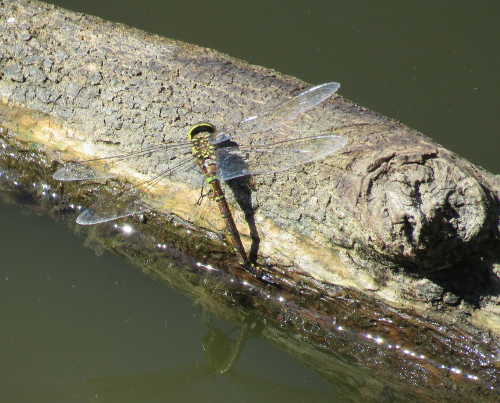
To determine the difference between a dragonfly and damselfly, note the wings. The wings of a dragonfly are straight when resting, like airplane wings, while damselflies tuck in their wings to hold them against their bodies.
Dragonflies possess four separate wings. Like modern drones, dragonflies do not flap their wings, but, instead, hover with wings out, flying forward or backward. Dragonflies use their flight muscles, which are connected at the base of their wings, to fly at speeds up to 60 miles per hour!
As dragonflies hover, then land at an impossible spot at the tip of a reed, you can see just how they have kept their prehistoric demeanor.
Scientists have found insect fossils resembling dragonflies which were determined to be aged at over 300 million years before the present.
If you think today's dragonflies are large for an insect, hold onto your binoculars, because some dragonflies who droned about prior to the time of dinosaurs held a nearly two-and-a-half foot wingspan!
There are more than 60 kinds of these iridescent insects in California. Some are quite brilliant in color, with their dazzling reds, blues and yellow shades, while others are a more sedate brown or black in pigment.
Dragonflies enjoy warm weather, requiring a 63-degree day, or warmer to allow it to start moving.
These insects use their powerful, multifaceted eyesight when hunting their prey, and these incredible insects are carnivorous, consuming other insects, like mosquitoes.
Scientists have found that dragonflies can devour one-fifth their body weight in prey. They, in turn are prey to frogs, water striders and water fowl. Falcons, swallows and flycatchers also consume dragonflies. At certain times of the year dragonflies have been known to swarm.
Some folks have been privy to spy thousands of dragonflies swarming the skies. It is believed that they sometimes hunt in swarms. They can be quite territorial critters, and zoom in on intruders to maintain ownership of their lands.
To various cultures the dramatic dragonfly holds special significance. For example, the Navajo Indians use the symbol of the dragonfly to denote fresh water, and the Zuni portray dragonflies on special pottery.
In some Asian cultures certain dragonfly species have been used in medicines and foods. The Art Nouveau style of art favored by Tiffany Studios in New York featured dragonflies in their glass creations.
The darting dragonfly is an interesting creature to observe.
Kathleen Scavone, M.A., is a retired educator, potter, writer and author of “Anderson Marsh State Historic Park: A Walking History, Prehistory, Flora, and Fauna Tour of a California State Park” and “Native Americans of Lake County.” She also writes for NASA and JPL as one of their “Solar System Ambassadors.” She was selected “Lake County Teacher of the Year, 1998-99” by the Lake County Office of Education, and chosen as one of 10 state finalists the same year by the California Department of Education.

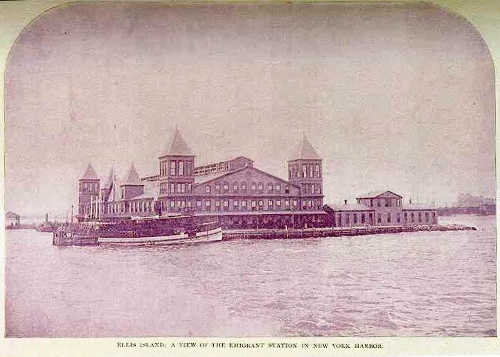
This week’s historical highlight marks the first step in setting rules for immigration to the United States of America.
March 26, 1790
For better or worse, the history of laws concerning immigration and citizenship in the United States is one of exclusion.
That America has become a melting pot of different cultures and races is, in many ways, despite these laws, rather than because of them. On the books, we’ve done our best to be monocultural, but humans are often less manageable in reality than they are on paper.
In the 21st century, the United States Citizenship and Immigration Services control both immigration and the process of becoming a citizen.
Today, someone can become an American citizen either at birth (by being born in the country or certain territories) or after birth (primarily through naturalization). In both cases, the requirements for immigration and citizenship have developed over the course of decades and represent the culmination of a contentious history.
Immigration and citizenship have always been wrapped up in our national identity, as we as a people grapple with the question of what it means to be an American and the types of people who fit that archetype. At the heart of laws governing citizenship in any country is the unspoken understanding that some people aren’t fit to become one. There is a filtering process.
On this day in 1790, the United States government took the first step towards defining the parameters of our own filter.
The Naturalization Act of 1790 established the first criteria for the process of becoming a naturalized American citizen.
The law itself required an immigrant to have lived within the United States for at least two years and to be a free, white person of good standing. The individual’s citizenship was extended to any children under the age of 21, regardless of their birthplace.
By the wording of this law, the very first of its kind in America, a large swathe of the world was excluded from the possibility of gaining citizenship (Asian, Middle Eastern, Native American, African etc.).
Five years later, the 1790 law was replaced with a new one, which put even stricter constraints on naturalization by extending the minimum number of years in residence from two to five. A few years later, that was extended to 14, only to be reduced once more to five in 1802.
It would only be grudgingly that America expanded the circle of acceptable, potential citizens. The Fourteenth Amendment in 1868 granted citizenship to people born within the United States and subject to its jurisdiction (including former slaves).
The Naturalization Act of 1870, five years following the end of the Civil War, even extended the naturalization laws to “aliens of African nativity and to persons of African descent.”
However, as if to backtrack from the slight expansion created in the 1860s, the next several decades were spent excluding people of Asian descent, with the passing of the Chinese Exclusion Act of 1882.
This act itself was the culmination of a decades-long battle over the issue of Chinese immigration and labor in the western United States, a history that played out in bloody riots across the region (hyperlink to former article on Chinese riots).
Even the children of these Chinese aliens were unable to claim American citizenship, until the ruling of a court in the 1890s changed that restriction. The final restrictions on people of Asian descent becoming citizens were finally lifted following the Second World War.
If Africans and Asian immigrants had trouble becoming American citizens, it was downright impossible for Native Americans.
It is somewhat ironic that the one group of people who faced the fiercest battle for citizenship were those whose ancestors have called this land home for millennia – but history is full of such sad ironies.
Throughout most of the 19th century, American Indians were forbidden citizenship, a status that gradually began to break down as the 20th century dawned.
In California, most American Indians were granted citizenship following the 1916 state Supreme Court case involving a Lake County Pomo, Ethan Anderson, and the county recorder, Shaffer Matthews. All American Indians were finally granted full citizenship in 1924.
After hard-won victories, different races were eventually able to carve out their place at the American table, but only after decades of prejudice and countless court cases.
In one form or another, the laws governing the granting of citizenship to immigrants remained prejudicial until the middle of the 20th century.
Finally, in 1952 Congress passed the Immigration and Nationality Act, which forbade discrimination during the citizenship process based on race and gender.
As you can see from this litany of laws, acts and amendments, America has always been rather specific in the types of people it has wanted as citizens.
Historically, Lady Liberty’s illuminating lamp was more often used to get a closer look at those huddled masses than as a beacon of welcome to all.
The laws that are created in the coming years will determine if we can break from our history or are irrevocably chained to it.
Antone Pierucci is the former curator of the Lake County Museum and a freelance writer whose work has been featured in such magazines as Archaeology and Wild West as well as regional California newspapers.
LAKE COUNTY, Calif. – Johanna Francina Dent passed away March 9, 2017. She was 105 years old.
Born in the Netherlands, Joep married Johannes Zwager in 1935. Her daughter Joyce was born in 1942.
Widowed in 1969, she moved to California in 1970 with Stanley Dent her second husband.
Joep's life's celebration will follow.
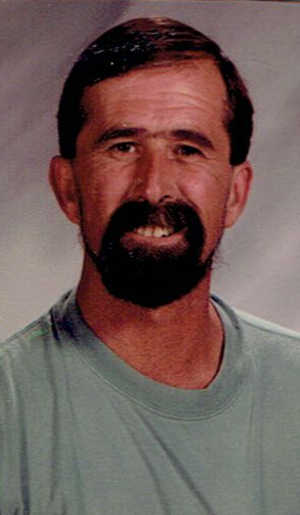
Donald Russell Howard
Dec. 28, 1952 - March 4, 2017
“My best friend, loving husband, you will be with me always,” your wife Sheila.
Don enjoyed designing and creating unique wood working projects.
He is also survived by his son, Justyn and sister Linda Wearne.
A celebration of life will be held on Saturday, April 29, from 3 to 6 p.m. at the Riviera Hills Lounge, Clearlake Riviera, Kelseyville, Calif.
Arrangements by Chapel of the Lakes Mortuary at 707-263-0357 or 707-994-5611, or visit www.chapelofthelakes.com .