 How to resolve AdBlock issue?
News
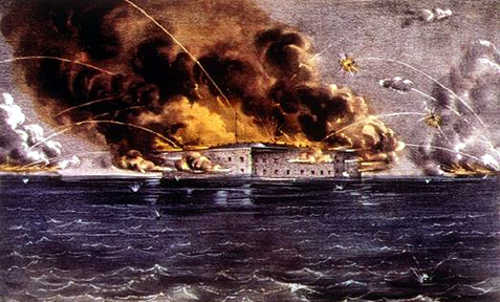
This week’s historical highlights mark two important tragedies in modern history: the start of a war and the sinking of a ship.
April 12, 1861
In hindsight it was hardly the first hostilities in what would become America’s Civil War.
Dozens, possibly hundreds, of people had already died, homes burned and soldiers recruited years before Confederate forces fired on Fort Sumter in the harbor of Charleston, South Carolina.
Most of these early hostilities centered on the Missouri and Kansas border, however, and like the rest of the war and how it has since been remembered, the western front remained on the periphery of national interest.
It is easy to forget that when Fort Sumter was attacked in April of 1861, the state of South Carolina had already been seceded from the nation a full four months.
To the South Carolina secessionist government, United States Major Robert Anderson and his force of 85 men were foreign invaders on sovereign Carolinian territory.
Knowing full well the precariousness of his position, Major Anderson had already moved his force from Fort Moultrie at the mouth of the harbor to the water-bound Fort Sumter situated in the harbor itself.
This move, done just six days following the state’s secession in December of 1860, was widely criticized at the time as an overreaction to what many thought was an empty move on the part of the Carolinian government. After all, who would ever actually secede from America?
Anderson’s caution was born out when, on April 11, a representative of Confederate General P.T. Beauregard demanded the fort’s surrender.
Early the following morning, Major Anderson and his men were awoken to the sharp retort of cannon fire and the shuddering impact of shot on stone walls. They were being attacked. There was no turning back for South Carolina.
For the first few hours of the bombardment, Fort Sumter did not return the enemy’s fire.
For the last few months of their time in the fort, supplies had begun to dwindle and relief was nowhere in sight. The only ammunition the fort had to return fire was solid shot, since they had no fuses for their explosive rounds.
They therefore bided their time until the light of day could more completely illuminate their enemy’s location.
For the next 30 hours or so the battle raged on, with shells raining down on the defenders and shot searing outward towards the attackers.
The following day, April 13, Major Anderson was forced to accept the terms of surrender, which allowed him and his men the honor of firing a 100 gun salute on their way out of the fort and back to the north to safety.
Remarkably, no men were injured in the fort during the actual assault, although one was killed and another mortally wounded when a cannon misfired during the honorary salute at the end of the fighting.
On the Confederate side, one soldier had been injured during the fighting but also from a misfired canon, rather than enemy fire.
Unfortunately, the near bloodless battle, which ended in honor to both sides, would not set the tone for the war.
As the war dragged on beyond the first and second battle, each side became entrenched in their passionate dislike of the other. War breeds animosity, it does not solve it.
The nation that emerged four bloody years later was a stranger to the one that awoke, bleary-eyed, the early morning of April 12, 1861.

April 14 to 15, 1912
Thanks to the 1997 blockbuster, just about the only question we have regarding the sinking of the RMS Titanic today is why Rose couldn’t move over on that wood board and give Jack room. Seriously, there was plenty of space for two people to cling onto.
That plot hole aside, there do actually remain plenty of unanswered questions about the sinking of the Titanic, a luxury cruise liner that was supposed to be unsinkable.
The general timeline of events is clear: the Titanic set off from Southampton, England on April 10 for her maiden voyage to New York; the ship received several warnings of icebergs in the immediate area from other ships as she approached the southern tip of Newfoundland, nearing her journey’s end; around 11:40 p.m. on April 14 she collided with an iceberg; over two hours later she sank and over nine hours after the collision, help finally arrived to save those few passengers who had made it to the lifeboats in time.
Equally irrefutable are the numbers: 705 passengers and crewmen survived, while more than 1,500 perished.
There exist plenty of theories as to why the ship sank. Chief among them is that by attempting to turn aside from the iceberg and exposing her side, the Titanic had caused more damage to the most vulnerable part of the ship than had she chosen to simply hit the iceberg full on.
The discovery of the actual wreckage of the ship in 1985 and subsequent study of the remains have put to rest some of the wilder ideas.
During the inquiry into the wreck shortly after it occurred, testimony by eyewitnesses and architects and engineers estimated that the iceberg had caused a significant breach of the hull.
Some commentators claimed the hole to have been several hundred feet in length and a dozen feet wide in places. Even the most conservative estimate of the damage at the time was far from the truth.
In reality, the damage to the hull was far less dramatic, with six relatively small areas of damage located along the hull where the iceberg had caused the iron rivets connecting two plates together to break apart.
The iron rivets, when analyzed, were found to have contained a high level of slag, or contaminants, built into them – the result of shoddy forging.
When exposed to cold temperatures, iron rivets with high slag content are prone to snapping, just as they did on April 14, 1912.
The rivets, however, are not the sole culprits for the sinking of the ship, since the Titanic’s sister ship, the Olympic, served without incident for 25 years despite being riveted with the same iron rivets as her ill-fated sibling.
Regardless of why the ship’s hull suffered so much damage from a mere glancing blow, within 40 minutes of contact more than 35,000 tons of water had filled the Titanic, far too much for the ship’s pumps to handle.
Like a giant hand pushing the bow of the ship farther into the water, the Titanic’s stern rose into the air until the strain was too much and the ship snapped in half.
Outfitted with too few lifeboats and far away from help, most of the passengers on board were doomed the moment the ship collided with the iceberg; it just took them two hours to realize their fate.
Antone Pierucci is the former curator of the Lake County Museum and a freelance writer whose work has been featured in such magazines as Archaeology and Wild West as well as regional California newspapers.
LAKE COUNTY, Calif. – Lake County Animal Care and Control has another varied selection of dogs of many breeds and sizes available for adoption this week.
This week’s available dogs include mixes of American Eskimo Dog, American Staffordshire Terrier, Australian Kelpie, beagle, border collie, boxer, Chihuahua, collie, German Shepherd, German Shorthaired Pointer, Labrador Retriever, mastiff, pit bull, shepherd and wirehair terrier.
Dogs that are adopted from Lake County Animal Care and Control are either neutered or spayed, microchipped and, if old enough, given a rabies shot and county license before being released to their new owner. License fees do not apply to residents of the cities of Lakeport or Clearlake.
If you're looking for a new companion, visit the shelter. There are many great pets hoping you'll choose them.
The following dogs at the Lake County Animal Care and Control shelter have been cleared for adoption (additional dogs on the animal control Web site not listed are still “on hold”).

Chihuahua mix
This young female Chihuahua mix has a short tricolor coat.
She’s in kennel No. 2, ID No. 7243.

Chihuahua mix
This male Chihuahua mix mix has a short black and tan coat.
Shelter staff said he gets along fine with other dogs, is not food aggressive and when introduced to a cat, he allowed the cat to rub all over him.
He’s in kennel No. 3, ID No. 7229.

Wirehaired terrier mix puppy
This male wirehaired terrier mix puppy has a medium-length black coat.
He’s in kennel No. 4, ID No. 7244.

‘Luke’
“Luke” is a male German Shorthaired Pointer mix with a short black and white coat.
Shelter staff said he is a big, young, happy, bouncy boy would will be a lot of fun for an active family that is willing to include him in their activities. He would benefit from training classes for basic manners. He does well with other dogs that tolerate his level of play, but would do best in a home with no small dogs or cats due to his size and energy level.
He’s in kennel No. 5, ID No. 7057.

‘Oreo’
“Oreo” is a female Chihuahua mix with a short black and white coat.
She’s in kennel No. 6, ID No. 7262.

‘Midnight’
“Midnight” is a young male Labrador Retriever mix with a short black coat with tan markings.
He’s in kennel No. 7, ID No. 7239.

Australian Kelpie-fox terrier
This female Australian Kelpie-fox terrier has a medium-length black and white coat.
She’s not food aggressive, and when introduced to a spayed female dog she was shy at first but warmed up quickly and eventually wanted to play. She would be OK with children ages 9 and up. She was introduced to cats and had interest in them but was easily called off.
She’s in kennel No. 8, ID No. 7213.

‘Roxanne’
“Roxanne” is a female pit bull terrier mix with a short white coat.
She’s in kennel No. 9, ID No. 7200.

‘Rosco’
“Rosco” is a male pit bull terrier mix with a short tan and white coat.
He already has been neutered.
He’s in kennel No. 10, ID No. 6752.

American Staffordshire Terrier-mastiff
This male American Staffordshire Terrier-mastiff has a short black and brown coat.
He’s in kennel No. 11, ID No. 7225.

Border collie
This female border collie has a medium-length black and white coat and has been spayed.
Shelter staff said she has a high energy level. When introduced to another dog and a cat, she play bowed and was friendly. They suggest she would do well in a high energy home with older children because of her size. She also knows how to sit on command.
She already has been spayed.
She’s in kennel No. 14, ID No. 7227.

‘Lucy’
“Lucy” is a beagle with a short red and white coat.
She already has been spayed.
She’s in kennel No. 18, ID No. 4743.

‘Lexi’
“Lexi” is a female American Eskimo Dog.
She has a long, white and fluffy coat.
She’s in kennel No. 20, ID No. 7247.

German Shepherd
This female German Shepherd has a medium-length brown and black coat.
She’s in kennel No. 24, ID No. 7253.

German Shepherd
This male German Shepherd has a medium-length white coat.
He’s in kennel No. 25, ID No. 7254.

Collie-shepherd mix
This female collie-shepherd mix has a short brown, tan and white coat.
She’s in kennel No. 26, ID No. 7260.
To fill out an adoption application online visit http://www.co.lake.ca.us/Government/Directory/Animal_Care_And_Control/Adopt/Dog___Cat_Adoption_Application.htm .
Lake County Animal Care and Control is located at 4949 Helbush in Lakeport, next to the Hill Road Correctional Facility.
Office hours are Monday through Friday, 11 a.m. to 5 p.m., and 11 a.m. to 3 p.m., Saturday. The shelter is open from 11 a.m. to 4 p.m. Monday through Friday and on Saturday from 11 a.m. to 3 p.m.
Visit the shelter online at http://www.co.lake.ca.us/Government/Directory/Animal_Care_And_Control.htm .
For more information call Lake County Animal Care and Control at 707-263-0278.
Email Elizabeth Larson at
A relatively large near-Earth asteroid discovered nearly three years ago will fly safely past Earth on April 19 at a distance of about 1.1 million miles, or about 4.6 times the distance from Earth to the moon.
Although there is no possibility for the asteroid to collide with our planet, this will be a very close approach for an asteroid of this size.
The asteroid, known as 2014 JO25, was discovered in May 2014 by astronomers at the Catalina Sky Survey near Tucson, Arizona – a project of NASA's Near Earth Object Observations Program in collaboration with the University of Arizona.
Contemporary measurements by NASA's NEOWISE mission indicate that the asteroid is roughly 2,000 feet in size, and that its surface is about twice as reflective as that of the moon.
At this time very little else is known about the object’s physical properties, even though its trajectory is well known.
The asteroid will approach Earth from the direction of the sun and will become visible in the night sky after April 19.
It is predicted to brighten to about magnitude 11, when it could be visible in small optical telescopes for one or two nights before it fades as the distance from Earth rapidly increases.
Small asteroids pass within this distance of Earth several times each week, but this upcoming close approach is the closest by any known asteroid of this size, or larger, since asteroid Toutatis, a 3.1-mile asteroid, which approached within about four lunar distances in September 2004.
The next known encounter of an asteroid of comparable size will occur in 2027 when the half-mile-wide asteroid 1999 AN10 will fly by at one lunar distance, about 236,000 miles.
The April 19 encounter provides an outstanding opportunity to study this asteroid, and astronomers plan to observe it with telescopes around the world to learn as much about it as possible.
Radar observations are planned at NASA's Goldstone Solar System Radar in California and the National Science Foundation’s Arecibo Observatory in Puerto Rico, and the resulting radar images could reveal surface details as small as a few meters.
The encounter on April 19 is the closest this asteroid has come to Earth for at least the last 400 years and will be its closest approach for at least the next 500 years.
Also on April 19, the comet PanSTARRS (C/2015 ER61) will make its closest approach to Earth, at a very safe distance of 109 million miles.
A faint fuzzball in the sky when it was discovered in 2015 by the Pan-STARRS NEO survey team using a telescope on the summit of Haleakala, Hawaii, the comet has brightened considerably due to a recent outburst and is now visible in the dawn sky with binoculars or a small telescope.
JPL manages and operates NASA's Deep Space Network, including the Goldstone Solar System Radar, and hosts the Center for Near-Earth Object Studies for NASA's Near-Earth Object Observations Program, an element of the Planetary Defense Coordination Office within the agency's Science Mission Directorate.
More information about asteroids and near-Earth objects can be found at http://cneos.jpl.nasa.gov and http://www.jpl.nasa.gov/asteroidwatch .
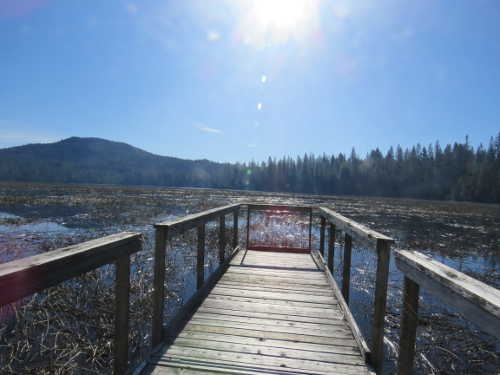
"Tread lightly as you explore Boggs Lake Preserve. This is the fragile home of plants and animals that are rarely seen anywhere else. With your help this beautiful and important preserve will continue to provide the needed protection for their survival." – From the interpretive sign at Boggs Lake
COBB, Calif. – Lake County contains a myriad of sequestered spots that gleam like gold for the beauty they contain.
Boggs Lake Ecological Preserve is one of those special places.
Located off Highway 175 to Bottle Rock Road, then 4.7 miles to Harrington Flat Road, it contains a small parking area with educational interpretive signs and a self-guided tour around the lake.
According to the California Department of Fish and Wildlife's Web page, "Boggs Lake Ecological Reserve is a 46 acre property co-owned and managed with The Nature Conservancy. It was designated as an ecological reserve by the Fish and Game Commission in 1998. Boggs Lake is an unusual example of an upland vernal pool that occurs on volcanic substrate. This Volcanic Ash Flow Vernal Pool is known from only a few localities in Lake County. The lake is not fed by streams or springs, but rather acts as a catch basin for rainfall during the wet season, then gradually dries through the summer. This natural community supports unusual plant species adapted to this unique environment. The lake also provides habitat for a variety of waterfowl and marsh birds."
This extraordinary lake was saved from a housing tract by many concerned Lake County citizens and groups.
Another threat was logging nearby, that brought a concern for the safety of this fragile area to members of the California Native Plant Society, local residents and botanists from the University of California.
With combined efforts this area has been mapped and studied. It wasn't long before The Nature Conservancy and the Lake County Land Trust partnered to manage this preserve and educate the public about the biological significance and diversity of Boggs Lake.
Sonoma State University has studied the Western pond turtles here, trying to determine the correlation between the turtle's temperature regulation and the animal's specific needs for survival, since the reptiles are listed as a species of concern by the California Department of Fish and Wildlife.
The area around the lake contains downed trees which have been ravaged by drought and insects. The trees now attract fungi, termites and scorpions, as well as salamanders and newts.
The ponderosa pine, madrone, various oaks, manzanita, ferns, poison oak and Douglas-fir that dwell there now create a unique understory for wild mustard, rose, shooting star flowers and more, to grow and thrive.
Wildlife abound in this environment, and include coyote, deer, chipmunk, skunk, bobcat and more. The vernal pool provides a rest stop for migrating birds. Over 139 species have been spotted here, including pileated woodpecker, purple martin, red-winged blackbird, mallard, California quail and more.

The exceptional characteristics of the vernal pool include endangered plants like the hedge-hyssop that was found to grow here, back in 1923.
Vernal pools once proliferated all across California, before our state became intensely populated. Vernal pools are considered as a special type of wetland, and it is in vernal pools where special, ecologically significant flora and fauna can be found.
Vernal pools are located in the climate we have here in Lake County, which is considered a Mediterranean climate.
The pools form due to a rigid underground layer which keeps the seasonal rains from draining. When the water fills the depressions, then, gradually evaporates, unusual plants thrive only here.
In some vernal pools the unique ecosystems create homes for plants, animals and waterfowl that can't thrive elsewhere.
"The Lake County Land Trust protects land and water resources of important value on behalf of present and future generations. We work to sustain our county's cultural, historical, scenic and environmental integrity,” according to the interpretive sign at Boggs Lake.
For more information on the unique gems that are vernal pools, log onto the California Department of Fish and Wildlife's Web site at https://www.wildlife.ca.gov/Conservation/Plants/Vernal-Pools .
Kathleen Scavone, M.A., is a retired educator, potter, writer and author of “Anderson Marsh State Historic Park: A Walking History, Prehistory, Flora, and Fauna Tour of a California State Park” and “Native Americans of Lake County.” She also writes for NASA and JPL as one of their “Solar System Ambassadors.” She was selected “Lake County Teacher of the Year, 1998-99” by the Lake County Office of Education, and chosen as one of 10 state finalists the same year by the California Department of Education.
Suicide prevention is one of the Department of Veterans Affairs’ (VA) highest priorities.
As part of VA’s commitment to put resources, services and all technology available to reduce veteran suicide, VA has launched an innovative program called Recovery Engagement and Coordination for Health – Veterans Enhanced Treatment (REACH VET).
Recent research suggests that 20 veterans die by suicide each day, putting veterans at even greater risk than the general public.
Using a new predictive model, REACH VET analyzes existing data from Veterans’ health records to identify those at a statistically elevated risk for suicide, hospitalization, illness or other adverse outcomes.
This allows VA to provide preemptive care and support for veterans, in some cases before a veteran even has suicidal thoughts.
“One veteran suicide is one too many,” said Secretary of Veterans Affairs David J. Shulkin. “This cutting-edge program is saving lives by identifying at-risk veterans and connecting them with the specialized care and support they need.”
Once a veteran is identified, his or her VA mental health or primary care provider reaches out to check on the veteran’s well-being, review their condition(s) and treatment plans to determine if enhanced care is needed. The program began as a pilot in October and is now fully implemented across VA.
“REACH VET is a game changer in our effort to reduce veteran suicide,” said Dr. Caitlin Thompson, National Director of VA’s Office for Suicide Prevention. “Early intervention can lead to better recovery outcomes, lessen the likelihood of challenges becoming crises and reduce the stress that veterans and their loved ones face.”
VA’s suicide prevention resources include the Veterans Crisis Line, which provides confidential support from specially trained and experienced responders to veterans, even if they are not enrolled in VA health care.
Veterans and their families and friends may call 800-273-8255 and press 1; chat online at www.VeteransCrisisLine.net/Chat or text to 838255.
For more information about VA’s suicide prevention efforts, visit these resources:
– Veterans Crisis Line website: www.VeteransCrisisLine.net/BeThere ;
– Suicide prevention outreach toolkit: www.VeteransCrisisLine.net/SpreadTheWord ;
– “Be There” public service announcement: http://bit.ly/BeTherePSA ;
– Suicide prevention fact sheet: http://bit.ly/2axW88D ;
– Make the Connection Web site: http://MakeTheConnection.net ;
– VA Mental Health Web site: http://www.mentalhealth.va.gov .
CLEARLAKE, Calif. – Lake County Republican Women, Federated will hold a monthly luncheon meeting on Wednesday, April 12.
The group will meet at 11:30 a.m. at Howard's Grotto, 14732 Lakeshore Drive in Clearlake.
Featured speaker will be Randy Sutton, co-chairperson of the Lake County Committee for the State of Jefferson Declaration.
Sutton will discuss developments in the efforts to form a new state in rural northern California and why political events are coming together in significant new ways to build the foundation for creating a new state. He will be prepared to answer the many questions that will be asked.
Sutton has an interesting background that prepares him for the work to which he is now dedicated. He is a life associate member of Vietnam Veterans of America.
He relates to recent military action through his son Corporal David Sutton of the United States Marine Corps, who served four tours in Iraq. Then, after a year at Tule Air Force Base in northern Greenland, he served a year in Afghanistan.
Sutton is a life endowment member of the NRA, life member of the California Rifle & Pistol Association and a life member of the Konocti Rod and Gun Club.
For more than 30 years he worked in the financial services profession as the registered principal of Sutton Associates, an independent financial planning, investment advisory firm in Lakeport.
His principled background also shows in another way as he is a lay-preacher and assistant to the pastor at the mission church of Clearlake Ministries.
Also, included on the agenda are items concerning local, state and national issues.
Lake County Republican Women, Federated meets the second Wednesday each month February through November.
For information on membership, menu selections and reservations, please phone 707-994-3543.